Waymo operates the largest commercial robotaxi fleet in the United States, completing over 10 million paid trips by early 2026. But behind every driverless ride is an electric vehicle that needs electrons — and managing the charging logistics of thousands of autonomous Jaguar I-PACE SUVs across multiple metro areas is one of the most complex fleet-energy operations in the world.
If you've searched "how do Waymo cars charge" and expected a simple answer, the reality is far more interesting. Waymo doesn't rely on public charging networks or plug-in-and-wait routines. Instead, the company has built a proprietary depot-charging infrastructure that keeps its Level 4 fleet running nearly around the clock. Here's exactly how it works, alongside a full breakdown of Waymo's service footprint, safety record, pricing, and technology.
The Waymo Fleet: Jaguar I-PACE EV Specs and Battery Basics
Waymo's current robotaxi fleet is built on the Jaguar I-PACE, a luxury electric SUV that was selected for its spacious interior, solid range, and compatibility with Waymo's sensor suite. Before we get into charging logistics, here are the key EV specifications that define how the fleet operates:
| Specification | Value |
|---|---|
| Battery Capacity | 90 kWh (usable ~84 kWh), NMC chemistry |
| EPA Range (stock) | 246 miles (fueleconomy.gov) |
| Real-World Range (robotaxi ops) | ~160–200 miles per charge cycle |
| Max DC Fast Charge Rate | 100 kW peak (CCS1 connector) |
| 10–80% DC Charge Time | ~45 minutes (at sustained 100 kW) |
| Level 2 AC Charging | 11 kW onboard charger |
| Drivetrain | Dual-motor AWD, 394 hp, 512 lb-ft |
| 0–60 mph | 4.5 seconds |
How Waymo Cars Actually Charge: Depot-Based DC Fast Charging
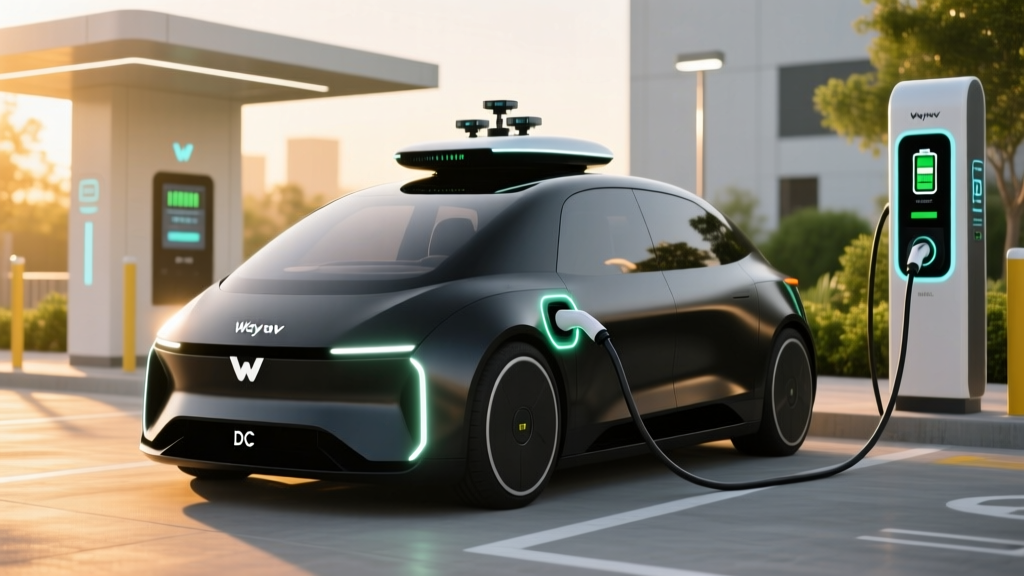
Waymo does not use public charging stations like Electrify America or EVgo for its daily fleet operations. Instead, the company operates dedicated charging depots in each service city. Here's how the system works in practice:
- Vehicle returns to depot: When an I-PACE's battery reaches a predetermined state-of-charge threshold (typically around 20–25% SoC), the autonomous system routes the vehicle back to the nearest Waymo charging facility — no driver needed.
- Automated or attendant-assisted plug-in: At the depot, fleet attendants plug vehicles into DC fast chargers using the CCS1 connector. Waymo has tested automated plug-in systems but currently relies on human attendants for reliability.
- DC fast charging at ~100 kW: The I-PACE charges at up to 100 kW on DC, taking roughly 45 minutes to go from 20% to 80% SoC. Waymo manages charge curves to balance speed with long-term battery health.
- Fleet scheduling optimization: Charging is staggered across the fleet so that vehicles are available during peak demand hours (morning and evening commutes, weekend nights). Most charging happens during off-peak hours — late night and midday lulls.
This depot model gives Waymo control over electricity costs (negotiating commercial utility rates), charger uptime (no broken public stalls), and charge scheduling (matching supply to predicted ride demand). It also means Waymo vehicles are almost never seen at public charging stations.
Why Not Public Charging?
Public DC fast chargers present reliability challenges that are unacceptable for a commercial fleet. Broken connectors, occupied stalls, inconsistent power delivery, and payment-system failures would create unacceptable downtime. By building dedicated depots, Waymo ensures >95% charger uptime and can manage electricity demand charges from utilities — a major cost factor for commercial EV operations.
Where Can You Use Waymo Right Now? Service Cities in 2026
Waymo's commercial robotaxi service, branded as Waymo One, operates in several major U.S. metro areas. Availability has expanded steadily since the service launched in Phoenix in 2020.
| City | Status | Service Area Notes |
|---|---|---|
| Phoenix, AZ | Fully operational | Largest service area; covers Phoenix, Scottsdale, Tempe, Mesa, Chandler — over 300 sq mi |
| San Francisco, CA | Fully operational | City-wide coverage including downtown, SOMA, Mission, Sunset districts |
| Los Angeles, CA | Fully operational | Santa Monica, Hollywood, Beverly Hills, downtown LA, LAX service |
| Austin, TX | Operational (expanding) | Central Austin, downtown, South Austin; active expansion into suburbs |
| Mountain View, CA | Operational | Waymo HQ city; limited but growing service zone |
Service areas are geofenced — Waymo vehicles will only operate within mapped and approved zones. If a ride request originates outside the geofence, the app will not allow the booking. Expansion into additional cities (including potential East Coast markets) has been announced but is not yet live as of mid-2026.
Is Waymo Truly Self-Driving? SAE Automation Levels Explained
| Level | Name | Driver Role | Example |
|---|---|---|---|
| Level 0 | No Automation | Full control | Traditional gas car |
| Level 1 | Driver Assistance | Hands on wheel, eyes on road | Adaptive cruise control |
| Level 2 | Partial Automation | Must supervise at all times | Tesla Autopilot, BlueCruise, Super Cruise |
| Level 3 | Conditional Automation | Can disengage in specific conditions | Mercedes Drive Pilot (limited markets) |
| Level 4 | High Automation | No driver needed in geofenced area | Waymo One, Zoox |
| Level 5 | Full Automation | No driver needed anywhere, ever | Does not yet exist commercially |
The distinction matters enormously. When you ride in a Waymo, the vehicle is making every driving decision — lane changes, unprotected left turns, pedestrian detection, construction-zone navigation — entirely on its own. If the system encounters a scenario it cannot handle, it executes a minimal risk condition (pulling over safely) rather than handing control to a human.
Waymo's Technology Stack: Lidar, Cameras, and Radar
Waymo's autonomous driving system — called the Waymo Driver — uses a multi-sensor approach that differs sharply from camera-only systems like Tesla's FSD.
Waymo Driver Sensor Suite (6th Generation)
- Lidar: Multiple roof-mounted and body-mounted lidar units provide a 360° real-time 3D point cloud of the vehicle's surroundings, accurate to ~200+ meters. Lidar works in darkness and is not dependent on ambient light.
- Cameras: High-resolution cameras (visible spectrum) handle lane-line detection, traffic-light state recognition, sign reading, and object classification.
- Radar: Imaging radar units complement lidar for velocity detection of moving objects (other vehicles, cyclists) and perform reliably in rain and fog where lidar performance can degrade.
- Audio sensors: External microphones detect emergency-vehicle sirens and trigger appropriate pull-over behavior.
- HD Maps: Waymo pre-maps every inch of its geofenced service areas at centimeter-level precision. The vehicle cross-references its live sensor data against these maps for localization.
This sensor redundancy is a key reason Waymo has been able to achieve Level 4 operations. If one sensor modality is degraded (e.g., heavy rain reducing lidar range), the others compensate. The trade-off is cost: each Waymo-equipped I-PACE carries well over $100,000 in sensor and computing hardware on top of the vehicle's base price.
How Much Does Waymo Cost? Pricing vs. Uber and Lyft
Waymo One pricing is designed to be competitive with traditional rideshare, though it varies by city, time of day, and distance. Here's a general comparison based on typical rides in 2026:
| Ride Type | Waymo One | UberX | Lyft Standard |
|---|---|---|---|
| Short ride (~3 miles, city) | $8–$12 | $9–$14 | $8–$13 |
| Medium ride (~7 miles) | $15–$22 | $16–$25 | $15–$24 |
| Airport trip (~15 miles) | $28–$40 | $30–$45 | $28–$42 |
| Surge pricing | Less aggressive surging | Can 2–3x during peaks | Can 2–3x during peaks |
| Tipping | Not expected (no driver) | Expected ($2–$5+) | Expected ($2–$5+) |
Key difference: With no driver to tip, the effective cost of a Waymo ride is often lower than an equivalent Uber or Lyft trip once you factor in the tip you'd normally add. Waymo also tends to have less aggressive surge pricing during high-demand periods, since its fleet supply is algorithmically managed rather than dependent on gig-worker availability.
To use Waymo One, download the Waymo One app (available on iOS and Android), create an account, and request a ride within a supported service area. The app shows the vehicle's location, license plate, and exact pickup point. When the car arrives, you tap a button on the rear door handle or inside the vehicle to unlock it, and the ride begins.
Waymo Safety Record: What the Data Shows
- Over 50 million fully autonomous miles driven across all service cities
- Over 10 million paid rider trips completed
- Waymo's serious-injury crash rate is approximately 85% lower than human benchmarks in comparable urban environments, according to the company's published safety analysis and NHTSA data comparisons
- Contactless minor incidents (e.g., low-speed sideswipes by other vehicles at stop signs) do occur but are overwhelmingly caused by other road users
- Zero passenger fatalities in Waymo One commercial operations
Waymo publishes periodic safety reports and submits incident data to NHTSA as required for autonomous vehicle operators. The company's safety case rests on the fact that its vehicles don't get distracted, don't drive impaired, don't text, and maintain 360° sensor awareness at all times. However, the fleet has faced scrutiny over edge-case behaviors — such as how vehicles respond to temporary construction zones, unusual road configurations, or erratic human drivers.
For comparison, human drivers in the U.S. experience roughly 1.35 fatalities per 100 million vehicle miles (NHTSA FARS data). Waymo's serious-injury rate per million miles is substantially below this benchmark, though direct comparison is complicated by the fact that Waymo operates in geofenced urban environments at moderate speeds, not on rural highways.
Current Limitations: Where Waymo Can't Go (Yet)
Level 4 autonomy is powerful, but it comes with defined constraints. Here's what Waymo One cannot do in 2026:
- Geofence boundaries: Waymo vehicles will not travel outside their mapped service areas. If you need a ride from downtown Phoenix to Flagstaff (140 miles), Waymo cannot take you.
- Severe weather: Heavy rain, dense fog, and dust storms can degrade lidar and camera performance. Waymo will suspend service or restrict operations during severe weather events. Phoenix's monsoon season and San Francisco's dense fog are real operational challenges.
- Highway speeds above ~65 mph: While Waymo vehicles can handle highways, their operational design domain prioritizes urban and suburban roads. Long highway segments at 75+ mph are generally outside the current service profile.
- Unmapped construction zones: If a road is significantly reconfigured by construction and the HD maps haven't been updated, Waymo may reroute or decline the trip.
- Multi-stop or complex errands: Waymo One is a point-A-to-point-B service. You cannot ask the car to wait while you run into a store, or make multiple stops on a single ride.
- Accessibility limitations: While Waymo offers wheelchair-accessible vehicles in some markets, availability is limited compared to standard I-PACE SUVs.
Regulatory Landscape: Who Approves Robotaxi Operations?
Robotaxi operations in the U.S. are regulated at both the state and local levels. There is no single federal "robotaxi license." Here's how the regulatory framework works:
- State-level approval: Each state sets its own rules for autonomous vehicle testing and commercial deployment. In California, the California DMV and the California Public Utilities Commission (CPUC) both play roles — the DMV issues testing and deployment permits, while the CPUC regulates commercial passenger service. Arizona takes a lighter-touch approach, with executive orders enabling autonomous vehicle operations with fewer permit requirements.
- Federal oversight: NHTSA regulates vehicle safety standards and investigates incidents involving autonomous systems. The agency requires AV operators to submit crash reports and can issue recalls or standing general orders for safety concerns.
- Local coordination: Cities negotiate with Waymo on issues like curb access, pickup/dropoff zones, and integration with public transit. San Francisco, for instance, had significant public debate about robotaxi operations blocking bus lanes and emergency vehicles before reaching operational agreements.
Waymo has invested heavily in regulatory relationships and has generally pursued a cautious, city-by-city expansion strategy rather than pushing into markets without approval. This stands in contrast to some competitors who have faced regulatory backlash for operating without clear authorization.
Frequently Asked Questions
How long does it take to charge a Waymo car?
At Waymo's depot DC fast chargers, a Jaguar I-PACE takes approximately 45 minutes to charge from 20% to 80% SoC at the vehicle's peak rate of 100 kW. The full charge cycle (to ~90–95%) may take closer to 70–80 minutes due to charge-curve tapering above 80%. Waymo typically charges vehicles to 90%+ during longer off-peak windows to maximize operational range.
Does Waymo use Tesla vehicles?
No. Waymo's fleet is exclusively built on the Jaguar I-PACE. The company previously used Chrysler Pacifica Hybrid minivans (which were plug-in hybrids, not fully electric) in its early Phoenix operations but has transitioned to the all-electric I-PACE. Waymo has also announced a partnership with Geely's Zeekr brand for a purpose-built robotaxi vehicle, but that model is not yet in commercial service.
Can I hail a Waymo like an Uber?
Yes, but through Waymo's own app — not through Uber or Lyft. Download the Waymo One app, enter your pickup and destination, and the nearest available vehicle will be dispatched to you. The experience is similar to rideshare: you see the car approaching on a map, get a license plate number, and unlock the door when it arrives.
What happens if a Waymo car gets into an accident?
Waymo vehicles carry commercial insurance, and the company assumes liability for incidents that occur during autonomous operation. After any collision, the vehicle's sensor data is preserved for investigation, and Waymo reports incidents to NHTSA as required. Passengers can contact Waymo support directly through the in-vehicle screen or the app.
Is Waymo safer than a human driver?
Based on available data, Waymo's serious-injury crash rate is significantly lower than the human benchmark in comparable urban driving environments. However, Waymo operates in controlled conditions (geofenced, mapped, moderate-speed urban areas) — a direct apples-to-apples comparison with all human driving (including rural highways and adverse conditions) is not straightforward. What's clear is that Waymo eliminates the leading causes of human crashes: distraction, impairment, and fatigue.