Tesla's long-promised driverless ride-hail service finally exists — but only inside a tightly drawn Tesla robotaxi geofence. Unlike Waymo's multi-city rollout or Cruise's post-relaunch expansion, Tesla's Cybercab network is gated by geography, regulation, and a camera-only sensor suite that imposes its own operational boundaries. If you're trying to figure out whether you can actually hail one today, what the real limits are, and how this stacks up against Level 4 competitors, this guide maps the terrain.
SAE Automation Level: What Tesla's Robotaxi Actually Is
The first thing to get straight is where the Cybercab sits on the SAE automation scale. Tesla markets the vehicle as a purpose-built driverless platform — no steering wheel, no pedals — designed for unsupervised operation. That places it squarely at SAE Level 4 within its operational design domain (ODD), meaning no human driver is needed inside the geofenced area under approved conditions.
| Level | Description | Examples |
|---|---|---|
| Level 2 | Driver-assist; human must supervise at all times | Tesla Autopilot, FSD (Supervised), BlueCruise, Super Cruise |
| Level 3 | Conditional automation; driver must take over on request | Mercedes Drive Pilot (limited markets) |
| Level 4 | Full automation within a defined ODD; no human needed | Waymo One, Zoox, Tesla Robotaxi (inside geofence) |
| Level 5 | Full automation everywhere, all conditions | Does not yet exist commercially |
Critical distinction: Tesla FSD (Supervised) on a consumer Model Y or Model 3 is Level 2 — the driver is legally responsible. The Cybercab robotaxi, operating without a driver inside its geofence, is Level 4. These are fundamentally different systems with different liability profiles.
Tesla Robotaxi Geofence: Live Service Areas in 2026
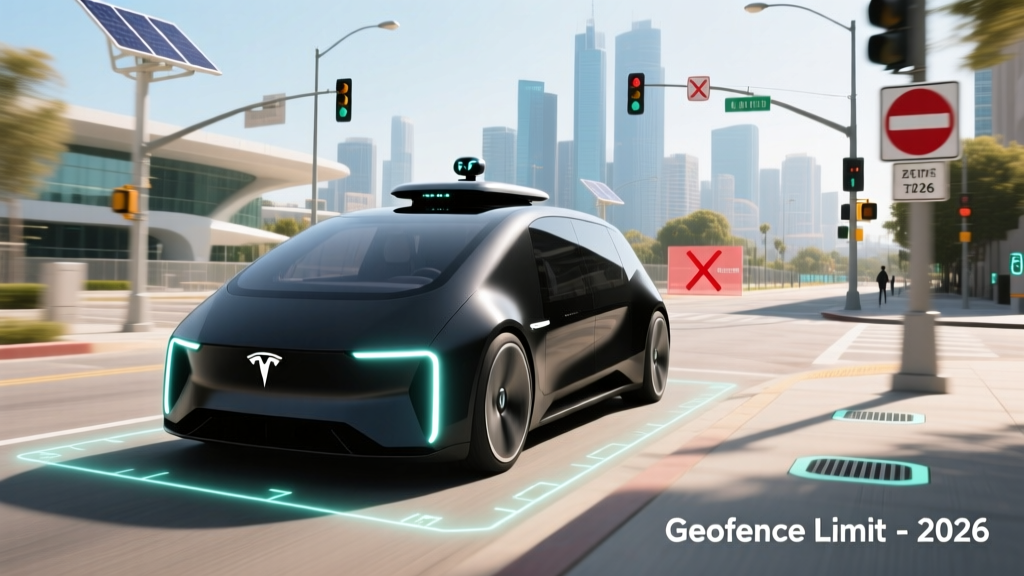
As of mid-2026, Tesla's robotaxi service operates in a limited number of metro areas. The geofence is a precise digital boundary — often drawn at the street or neighborhood level — outside of which the Cybercab will not accept rides or navigate. Here's the current footprint:
| City | Launch Status | Approx. Geofence Coverage | Hours of Operation |
|---|---|---|---|
| Austin, TX | Live (initial launch market) | ~80 sq mi — downtown, South Congress, Domain, airport corridor | 6 AM – 1 AM daily |
| San Francisco Bay Area, CA | Live (phased expansion) | ~60 sq mi — SF proper (excl. steep hills), parts of South Bay | 6 AM – midnight daily |
| Phoenix, AZ (announced) | Announced — expected late 2026 | TBD — likely central Phoenix + Scottsdale | TBD |
| Las Vegas, NV (announced) | Announced — expected 2027 | TBD — Strip corridor priority | TBD |
Source: Tesla investor updates and state regulatory filings. Phoenix and Las Vegas are announced targets, not live service areas. Always check the Tesla app for real-time geofence maps.
How to Hail a Cybercab and What It Costs vs. Uber
Riders access the service through the Tesla app (the same app used for vehicle ownership and Supercharger payments). The flow mirrors Uber/Lyft: set pickup, set destination, confirm, and a Cybercab arrives — typically within 4–8 minutes inside the geofence during peak hours.
| Metric | Tesla Robotaxi | UberX (same market) | Waymo One |
|---|---|---|---|
| Base fare | ~$2.50 | ~$2.80 | ~$2.50 |
| Per-mile rate | ~$0.90/mi | ~$1.30/mi | ~$1.10/mi |
| Per-minute rate | ~$0.25/min | ~$0.35/min | ~$0.30/min |
| 5-mile trip estimate | ~$8.25 | ~$12.80 | ~$10.50 |
| Surge pricing | Dynamic (1.2–2.0x) | Dynamic (1.5–4.0x) | Limited surge |
| Tips | Not applicable (no driver) | Expected ($2–5) | Not applicable |
Tesla's stated long-term target is roughly $0.20 per mile at scale — a figure Elon Musk has cited in earnings calls — but current pricing sits closer to $0.90/mi. That's still meaningfully cheaper than UberX because there's no human driver to pay, but it's not yet the disruption-level pricing Tesla has projected. The gap between current and target pricing reflects fleet utilization rates that are still ramping up and the capital cost of the Cybercab platform itself.
Camera-Only Tech Stack: How the Cybercab Sees the Road
The Cybercab's sensor suite is the most debated aspect of Tesla's robotaxi strategy. Unlike Waymo (lidar + radar + cameras) and Zoox (heavy multi-sensor fusion), Tesla relies exclusively on a vision-only approach:
- 8 cameras — 3 front-facing (narrow, wide, fisheye), 2 side-repeater, 2 rear-quarter, 1 rear-view. Resolution: 5 MP per camera at 36 fps.
- 0 lidar units — Tesla has never equipped production vehicles with lidar and the Cybercab is no exception.
- 0 radar units — Tesla removed radar from its sensor suite starting in 2021 (Tesla Vision transition).
- Ultrasonic sensors (USS) — 12 units for close-range obstacle detection during parking and low-speed maneuvers.
- AI inference computer — Tesla Hardware 5 (HW5), custom silicon, estimated ~500 TOPS (trillions of operations per second) for neural-net processing.
- HD mapping — Tesla does not use pre-built HD maps the way Waymo does. The system builds a real-time understanding of the environment from camera data, supplemented by fleet-learned road data.
Why this matters for the geofence: A camera-only system is more susceptible to degradation in heavy rain, fog, direct sun glare, and snow. This is one reason Tesla's geofence is drawn conservatively — the ODD excludes conditions and road geometries where vision-only performance can't be validated to the required safety threshold. Waymo's lidar-equipped vehicles have a broader weather envelope, which partly explains Waymo's larger geofenced areas in the same cities.
Safety Data: What the Numbers Actually Show
| Total driverless miles | ~1.2 million (Austin + SF combined) |
| At-fault collisions | 3 reported (all low-speed, no injuries) |
| Miles per at-fault incident | ~400,000 mi |
| Remote-assist interventions | ~1 per 850 miles (early Austin); improving to ~1 per 2,200 miles (Q1 2026) |
| NHTSA Standing General Order reports | Filed per federal requirement; 3 incidents logged |
Sources: NHTSA Standing General Order crash data, Tesla Q1 2026 impact report. Mileage figures are Tesla-reported and have not been independently audited as of this writing.
For context, Waymo has logged over 10 million fully driverless miles across multiple cities with a comparable or better at-fault rate. Human drivers in the US average roughly one police-reported crash per 500,000 miles (IIHS fatality statistics). Tesla's early robotaxi data is too limited in volume to draw definitive conclusions, but the initial trajectory — with zero injuries and low-speed-only incidents — is broadly consistent with what Waymo showed at a similar mileage milestone.
The remote-assist intervention rate is the more telling metric. At 1 intervention per 2,200 miles, Tesla's system still requires human teleoperators to resolve edge cases (construction zones, unusual road closures, emergency-vehicle interactions) more frequently than Waymo's reported rate of roughly 1 per 8,000+ miles. This gap reflects both the maturity of the software and the harder ODD challenges of camera-only perception.
Regulatory Landscape: Who Approves the Geofence
Robotaxi operations in the US are governed by a patchwork of state and local authorities — there is no single federal robotaxi license. Here's how approval works in Tesla's live markets:
- Texas (Austin): The Texas Department of Licensing and Regulation (TDLR) oversees autonomous vehicle testing and deployment. Texas passed HB 3932 in 2023, allowing driverless operations without a special permit as long as the vehicle meets federal motor-vehicle safety standards (or has an NHTSA exemption). Tesla's Cybercab, lacking a steering wheel, requires an FMVSS exemption from NHTSA for production deployment.
- California (San Francisco): The California Public Utilities Commission (CPUC) issues permits for driverless passenger service, while the DMV handles testing permits. Tesla holds a CPUC driverless deployment permit. California requires collision reporting within 10 days and quarterly disengagement reports.
- Federal (NHTSA): NHTSA does not "approve" robotaxis but enforces safety standards and investigates defects. The Cybercab's lack of traditional controls (steering wheel, mirrors, pedals) requires an FMVSS exemption petition — Tesla filed for this in 2025, and it was granted with conditions in early 2026.
The geofence itself is typically proposed by the operator and reviewed by the state/local permitting authority. Tesla can expand its geofence incrementally, but each expansion requires demonstrating safety validation in the new area. This is a slower process than simply flipping a software switch.
Current Limitations: Where the Geofence Falls Short
- Drive outside the geofence. If your destination is beyond the mapped boundary, the app will not let you book the ride. There is no override.
- Operate in heavy rain or dense fog. The camera-only stack triggers a weather-based service suspension when visibility drops below validated thresholds. In Austin, this has meant ~4–6 service suspensions per month during storm season.
- Handle unmapped construction zones. While the system can navigate minor lane shifts, major road reconfigurations that haven't been fleet-mapped will trigger a remote-assist intervention or a ride cancellation.
- Pick up at highway on-ramps or shoulders. Geofenced pickup/dropoff points are limited to designated zones (similar to Uber's "pin-to-pickup" areas). You cannot hail a Cybercab from a highway shoulder.
- Carry more than 2 passengers. The Cybercab's cabin is configured for 2 rear-seat passengers. No front seat, no third row.
- Transport cargo without a passenger. Package-only delivery is not yet available in the Tesla robotaxi network (unlike some Waymo Via partnerships).
- Operate 24/7. Current hours are 6 AM to 1 AM in Austin, 6 AM to midnight in SF. Overnight service is not available, partly due to fleet charging cycles and partly due to regulatory restrictions.
The weather limitation deserves emphasis. In a city like Austin, afternoon thunderstorms from May through September can knock out service for 30–90 minutes at a time. If you're relying on a Cybercab to get to the airport during storm season, have a backup plan. This is a structural limitation of camera-only perception, not a software bug that will be patched away quickly.
Cybercab Vehicle Specs: The Platform Behind the Service
| Spec | Tesla Cybercab (2026 Production) |
|---|---|
| Battery capacity | ~50 kWh usable (LFP chemistry) |
| EPA-est. range | ~200 miles (real-world robotaxi duty cycle: ~160–170 mi) |
| DC fast charge (peak) | ~170 kW; 10–80% in ~22 min on V4 Supercharger |
| Motor | Single rear motor, ~250 HP |
| 0–60 mph | ~6.5 seconds (not performance-oriented) |
| Seating | 2 passengers (rear bench) |
| Cargo | ~12 cu ft rear compartment |
| Estimated fleet cost per vehicle | ~$30,000 (Tesla-stated target) |
The LFP battery choice is notable: it sacrifices some energy density compared to NMC but offers longer cycle life (3,000+ full cycles before 80% capacity retention) and lower cost — exactly the right trade-off for a fleet vehicle that will charge daily and run 10+ hours a day.
Frequently Asked Questions
Where can I use the Tesla robotaxi right now?
Austin, TX and the San Francisco Bay Area are the only live markets as of mid-2026. Phoenix is announced for late 2026. Service is limited to specific geofenced zones within those metros — check the Tesla app for the real-time boundary map.
How much does a Tesla robotaxi cost compared to Uber?
A typical 5-mile ride costs roughly $8.25 in a Cybercab vs. ~$12.80 in an UberX in the same market — a savings of about 35%. The gap widens during Uber surge events, since Tesla's surge multipliers are currently more moderate (1.2–2.0x vs. Uber's 1.5–4.0x).
How safe are Tesla robotaxis — is there real data?
Through Q1 2026, Tesla reports ~1.2 million driverless miles with 3 at-fault collisions (all low-speed, no injuries). That's approximately one at-fault incident per 400,000 miles. For comparison, human drivers average one police-reported crash per ~500,000 miles. The sample size is still small, and Tesla's mileage figures are self-reported.
Is the Tesla robotaxi truly self-driving or just driver-assist?
The Cybercab robotaxi is SAE Level 4 — fully driverless within its geofence, with no steering wheel or pedals. This is fundamentally different from Tesla FSD (Supervised), which is SAE Level 2 and requires an attentive human driver at all times. Do not confuse the two.
Why can't the Cybercab drive in heavy rain?
The camera-only sensor stack cannot reliably perceive the environment when water obscures lenses or reduces contrast beyond the system's validated threshold. Lidar-equipped competitors like Waymo handle moderate rain better because lidar provides active sensing independent of visible light. This is a hardware-level limitation, not something a software update alone can fully resolve.
Can I buy a Cybercab for personal use?
Not currently. The Cybercab is deployed exclusively as a fleet robotaxi. Tesla has discussed a future consumer variant, but no timeline or pricing has been confirmed. The consumer Model Y with FSD (Supervised) remains the closest personal-ownership option — and it is Level 2, not Level 4.