Why Blind Spot Mirror Placement Matters More on EVs Than You Think
If you drive a modern electric vehicle equipped with blind-spot monitoring (BSM), rear cross-traffic alert (RCTA), or a full Level 2 driver-assist suite, you might assume physical blind spot mirrors are redundant. They're not. Even the most advanced sensor arrays have limitations — heavy rain, dirty camera lenses, and certain merge geometries can leave gaps that a properly positioned convex mirror fills instantly.
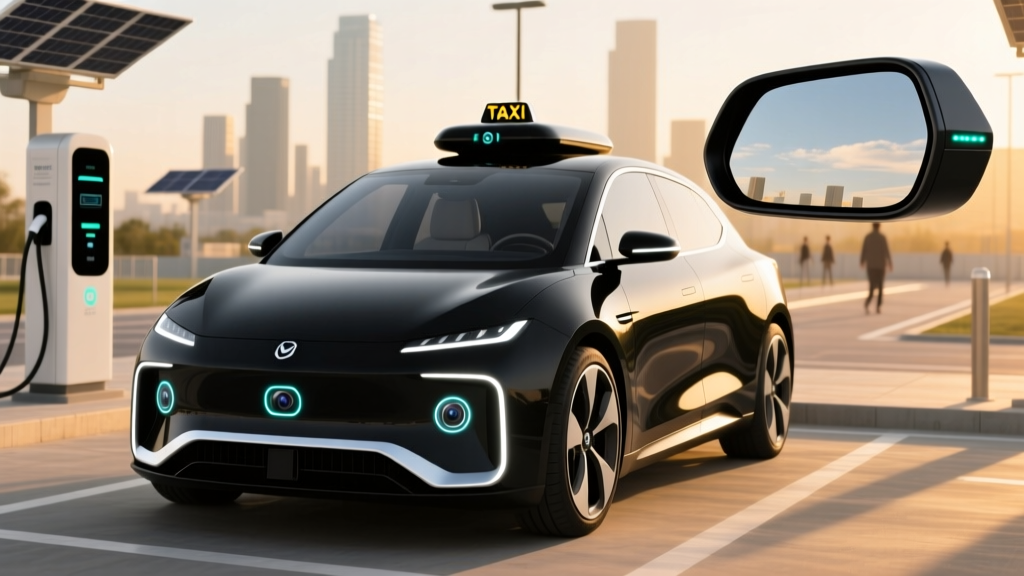
But here's the catch: slapping an aftermarket blind spot mirror on the wrong part of your EV's side mirror housing can interfere with camera modules, radar sensors, and even the aerodynamic efficiency that gives EVs their EPA-rated range. This guide covers the best blind spot mirror placement specifically for electric vehicles equipped with ADAS (Advanced Driver Assistance Systems), including exact positioning, sensor-interference risks, and how add-on mirrors complement — not replace — your car's built-in tech.
What Blind Spot Monitoring Actually Does (and How It Works)
Before positioning an add-on mirror, it's worth understanding what your EV's factory BSM system uses for detection. Most modern EVs employ one of three sensor configurations:
| Sensor Type | How It Works | Typical Detection Range | Common EVs Using It |
|---|---|---|---|
| Short-range radar (24 GHz or 77 GHz) | Emits radio waves that bounce off nearby vehicles; calculates distance and relative speed | ~10–30 meters to each rear quarter | Tesla Model 3/Y (post-2023 camera-only shift ended radar; Hyundai Ioniq 5/6, Ford Mustang Mach-E, BMW i4 still use radar) |
| Ultrasonic sensors | High-frequency sound waves detect objects at close range; primarily for parking but some BSM overlap | ~0.2–5 meters | Often combined with radar/camera systems across most OEMs |
| Camera-based (side repeater/fender cameras) | Image recognition algorithms identify vehicles in adjacent lanes using side-mounted cameras | ~15–40 meters, dependent on visibility | Tesla (camera-only since ~2022–2023), Rivian R1T/R1S, Lucid Air |
Each sensor type has blind spots of its own — literally. Radar can struggle with stationary objects at certain angles. Cameras degrade in fog, heavy rain, or when the lens is obscured by road grime. This is exactly where a physical convex blind spot mirror earns its keep.
Best Blind Spot Mirror Placement: Exact Positioning for EV Side Mirrors
The optimal position depends on your EV's mirror housing design and where the OEM placed its ADAS sensors and cameras. Here are the rules:
Rule 1: Never Cover a Camera Lens or Radar Window
Many EVs house side repeater cameras or radar modules in the lower outer corner of the mirror housing or on the fender just below the mirror. On the Tesla Model 3 and Model Y, the side repeater cameras sit in the fender — not the mirror itself — so the mirror glass is safe for an add-on. On the Hyundai Ioniq 5, the blind-spot camera (used for Blind-Spot View Monitor, which projects a camera feed into the digital cluster) is embedded in the mirror housing. Placing a stick-on convex mirror over or adjacent to that camera aperture will block it entirely.
Rule 2: Use the Outer Lower Quadrant of the Mirror Glass
For most EVs, the best blind spot mirror placement is the outer (away from the car) lower corner of the existing flat mirror glass. This position:
- Widens the field of view into the adjacent lane without obstructing the main mirror's rearward sightline
- Stays clear of integrated turn-signal LEDs embedded in the mirror housing's upper edge
- Avoids most camera and radar modules, which tend to be mounted on the housing body rather than the glass
- Matches the natural eye-scan pattern: drivers glance at the main mirror center, then flick to the outer lower quadrant for the wider angle
Rule 3: Choose the Right Convex Mirror Size
A 2-inch (50 mm) round convex mirror is the sweet spot for most EV side mirrors. Larger 3-inch mirrors can obscure too much of the flat mirror's surface. On EVs with smaller mirror housings — like the Chevrolet Equinox EV or Nissan Ariya — stick with 1.5-inch to 2-inch diameter add-ons.
Rule 4: Adjust for Your Specific EV's Geometry
Some EVs have notably different mirror designs that affect placement:
- Tesla Model 3 (2024+ refresh): The mirror glass is relatively large and flat. Place the convex mirror in the lower-outer quadrant, roughly at the 7 o'clock position on the driver's side and 5 o'clock on the passenger side.
- Ford Mustang Mach-E: The mirror housing is compact, and the BLIS (Blind Spot Information System) indicator is integrated into the glass itself. Place the add-on mirror below and outboard of the BLIS icon — do not cover the indicator LED.
- Rivian R1S / R1T: Large mirror housings with fender-mounted cameras. The glass surface is clear of sensors, so standard lower-outer placement works. However, the mirrors are heated and auto-dimming — use adhesive-rated-for-heat convex mirrors to prevent peeling.
- Hyundai Ioniq 5 / Kia EV6: If your trim includes Blind-Spot View Monitor (BVSM), the camera is in the lower mirror housing. Place the convex mirror on the upper-outer quadrant of the glass instead, to avoid blocking the camera entirely.
How Add-On Blind Spot Mirrors Interact with ADAS Features
A common concern among EV owners: will an aftermarket blind spot mirror confuse my car's ADAS? The short answer is no — with caveats.
Your EV's blind-spot monitoring system uses sensors (radar or camera) that are physically separate from the mirror glass surface. A small convex mirror adhered to the glass does not emit or block radar signals, and it won't appear in the field of view of fender-mounted cameras. However, there are edge cases:
- Camera-based BSM systems (e.g., Tesla's camera-only approach, Hyundai's Blind-Spot View Monitor) — if the convex mirror physically covers or is directly in front of a camera lens, the feature will malfunction or display an error.
- Auto-dimming mirrors — some convex mirrors with strong adhesives can damage the electrochromic coating when removed. Use static-cling or removable-adhesive types on auto-dimming glass.
- Heated mirrors — extreme heat cycling can weaken adhesive over time. Look for mirrors rated for -20°F to 160°F operation.
- Lane-change assist features (e.g., Tesla Autopilot lane changes, GM Super Cruise lane change) rely on the car's sensors, not the physical mirror. The add-on mirror won't affect these features, but you should still visually verify the lane is clear before initiating a change — even with Level 2 automation.
Blind Spot Mirror Placement vs. Factory BSM: A Comparison
| Feature | Factory BSM System | Add-On Convex Mirror |
|---|---|---|
| Detection method | Radar, camera, or ultrasonic sensors | Optical — your own eyes |
| Alert type | Visual indicator in mirror housing, audible chime, haptic (steering wheel vibration on some models) | Visual only — you must glance at the mirror |
| Weather performance | Radar: good in rain/fog. Camera: degrades in heavy precipitation, dirt, or glare | Convex mirror: also affected by rain and dirt, but no electronics to fail |
| Night performance | Sensors work regardless of lighting | Relies on ambient light and headlight illumination — less effective at night on unlit roads |
| Cost | Included on most mid-to-high EV trims; some base trims require a package ($300–$1,500 depending on OEM) | $5–$20 per pair |
| SAE Level | Level 0 (warning only) or Level 2 (when integrated with lane-keeping/lane-change assist) | N/A — purely passive, no automation |
| Best use case | Highway driving, lane changes, cross-traffic alerts when reversing | Low-speed merges, parking, backing out of tight spaces, verifying sensor alerts |
Which EV Trims Include Blind Spot Monitoring in 2026?
Blind spot monitoring has become nearly standard across the EV market, but availability still varies by trim. Here's a snapshot for popular 2026 models:
| EV Model | BSM Standard? | Feature Name | Base Trim MSRP (2026) | Notes |
|---|---|---|---|---|
| Tesla Model 3 | Yes (all trims) | Blind Spot Camera / Autopilot BSM | ~$38,990 | Camera-only; visual alert on center display and mirror indicator. No radar. |
| Tesla Model Y | Yes (all trims) | Blind Spot Camera / Autopilot BSM | ~$44,990 | Same camera-only system as Model 3. |
| Hyundai Ioniq 5 | SEL trim and above | Blind-Spot Collision-Avoidance Assist (BCA) | ~$42,600 (SEL) | Blind-Spot View Monitor (camera feed in cluster) on Limited trim only (~$50,200). |
| Ford Mustang Mach-E | Yes (all trims) | BLIS (Blind Spot Information System) | ~$42,995 | Includes cross-traffic alert. Standard on Select, Premium, GT. |
| Chevrolet Equinox EV | LT trim and above | Side Blind Zone Alert | ~$34,900 (LT) | Not on base 2LT; standard on RS and above. |
| BMW i4 | Yes (all trims) | Active Blind Spot Detection | ~$57,900 | Standard across eDrive40 and M50 trims. |
| Rivian R1S | Yes (all trims) | Blind Spot Warning | ~$79,900 | Camera + radar fusion; includes rear cross-traffic. |
Source: Manufacturer specification pages and IIHS vehicle ratings for feature availability by trim.
The Cost Question: Factory BSM vs. Aftermarket Mirrors vs. Subscriptions
One advantage EV owners have: blind spot monitoring is rarely locked behind a subscription. Unlike features such as Tesla's Full Self-Driving (Supervised) or GM's Super Cruise, BSM is typically a one-time hardware inclusion. Here's the cost breakdown:
| Option | Cost | Recurring Fee? | Availability |
|---|---|---|---|
| Aftermarket convex blind spot mirrors (pair) | $5–$20 | No | Universal — any EV |
| Factory BSM (included in trim/package) | $0–$1,500 (as part of option package on lower trims) | No | Model/trim dependent |
| Tesla FSD (Supervised) — includes enhanced BSM visualization | $8,000 one-time or $99/month | Yes (if subscribed monthly) | Tesla vehicles only |
| GM Super Cruise (includes lane-change with BSM integration) | $2,200–$2,500 option; after trial, ~$25/month | Yes (after included trial period, typically 3 years) | Select GM EVs (Cadillac Lyriq, Chevy Silverado EV, Equinox EV on higher trims) |
| Hyundai/Kia Highway Driving Assist 2 (HDA2) — includes lane-change assist with BSM | Included on SEL/Limited trims | No | Ioniq 5/6, EV6, EV9 higher trims |
For the vast majority of EV owners, factory BSM comes bundled at no extra recurring cost. The aftermarket convex mirror is a $10 complement — not a replacement — for your car's sensor suite.
Step-by-Step: Installing Blind Spot Mirrors on Your EV
- Clean the mirror glass thoroughly with isopropyl alcohol. Any residue will weaken adhesive bond.
- Identify sensor/camera locations on your mirror housing. Consult your owner's manual or look for small lens apertures or radar-transparent panels on the housing's lower edge.
- Position the convex mirror in the lower-outer quadrant of the glass (or upper-outer if your EV has a housing-mounted BSM camera). Do NOT adhere it yet.
- Sit in the driver's seat and adjust the main mirror to your normal driving position. Then check whether the convex mirror gives you a clear view of the adjacent lane roughly 1–2 car lengths behind your rear bumper.
- Peel the adhesive backing and press firmly for 30 seconds. Allow 24 hours before car washes or high-speed driving.
- Test your BSM system by driving past a vehicle in the adjacent lane. Confirm the factory indicator still activates and that the convex mirror provides a complementary visual.
Real-World Limitations You Should Know
Both factory BSM and add-on convex mirrors have real-world limitations that no marketing brochure will emphasize:
- High-speed differentials: Most BSM systems are calibrated for vehicles approaching at up to ~15–20 mph faster than your speed. A motorcycle or bicycle approaching at 40+ mph relative speed may not trigger an alert in time. A convex mirror gives you a visual earlier, but only if you look.
- Stationary objects: BSM systems typically filter out stationary objects (guardrails, parked cars) to avoid false alerts. If you're merging toward a stationary obstacle, neither BSM nor a convex mirror set for "moving vehicle" distances may help.
- Cold weather and condensation: In sub-freezing temperatures, mirror glass can fog or ice over. Most EVs have heated mirrors (the Tesla Model Y, Ioniq 5, and Mach-E all include heated side mirrors standard), which clears the main glass but may cause adhesive degradation on stick-on convex mirrors over time.
- Towing: If you tow with your EV (e.g., Rivian R1T rated for 11,000 lbs, Ford F-150 Lightning at 10,000 lbs), a trailer blocks the rear radar and camera fields. BSM becomes unreliable. Convex mirrors become essential — consider clip-on towing mirrors with integrated convex sections.
For detailed safety data on ADAS effectiveness, the NHTSA's vehicle safety resources and IIHS advanced driver assistance research provide ongoing testing and crash-prevention statistics.
Frequently Asked Questions
Does adding a convex blind spot mirror void my EV warranty?
No. A stick-on convex mirror on the glass surface does not modify any electrical system, sensor, or structural component. Under the Magnuson-Moss Warranty Act, an OEM cannot void your warranty for an unrelated aftermarket accessory. However, if the adhesive damages the mirror's auto-dimming or heating element during removal, that specific repair may not be covered.
Is blind spot monitoring the same as lane-change assist?
No. Blind spot monitoring (BSM) is a warning-only system (SAE Level 0 for the BSM function alone). Lane-change assist — found in Tesla Autopilot, GM Super Cruise, and Hyundai HDA2 — is a Level 2 feature that can actively steer the vehicle into an adjacent lane, using BSM data as one input. The driver must still confirm the maneuver and remain engaged.
Can I use blind spot mirrors on a Tesla with camera-only Autopilot?
Yes. Tesla's side repeater cameras are mounted in the fender, not on the mirror glass. A convex mirror on the glass does not obstruct any camera. The in-cabin visualization of nearby vehicles on the Tesla display uses those fender cameras and is unaffected by a glass-mounted add-on.
What's the best type of convex mirror for EV use?
Look for: (1) glass rather than acrylic (more scratch-resistant, clearer optics), (2) a 3R convex curvature (roughly 180° field of view), (3) weather-rated adhesive (-20°F to 160°F), and (4) a 2-inch diameter. Brands like Ampper and Utopia make EV-compatible options in the $8–$15 range per pair.
Do I still need blind spot mirrors if my EV has a 360° camera system?
A 360° camera system (available on the Hyundai Ioniq 5 Limited, Rivian R1S, BMW iX) is excellent for low-speed parking and obstacle awareness. However, most OEMs disable the 360° view above ~15–20 mph. For highway-speed lane changes, you still need either the BSM indicator or a physical convex mirror — ideally both.
Final Positioning Summary
The best blind spot mirror placement for most EVs in 2026 is the lower-outer quadrant of the flat mirror glass, sized at 2 inches, positioned to complement — not obstruct — your vehicle's factory ADAS sensors and cameras. For EVs with housing-mounted BSM cameras (notably Hyundai/Kia models with Blind-Spot View Monitor), shift to the upper-outer quadrant. Always verify that the add-on mirror doesn't cover any camera lens, radar window, or indicator LED. A $10 pair of convex mirrors won't replace your car's radar or cameras, but it fills the gaps that even the best sensor suites leave open — and in a merge situation, that redundancy is the whole point.