If you're shopping for a Tesla Model 3 and weighing whether to stick with the standard driver-assist suite or pay extra for Full Self-Driving, you need clarity on what each tier actually delivers on the road. The marketing names—Autopilot, Enhanced Autopilot, FSD (Supervised)—obscure more than they reveal. This guide strips away the branding and tells you exactly what Tesla Model 3 Autopilot does in 2026, what it costs, where it fails, and how it stacks up against Ford BlueCruise and GM Super Cruise.
What Tesla Model 3 Autopilot Actually Does
Standard Autopilot on the 2026 Tesla Model 3 bundles two core features:
- Traffic-Aware Cruise Control (TACC): Maintains a set speed and automatically adjusts to keep a safe following distance from the vehicle ahead, including in stop-and-go traffic.
- Autosteer: Provides active lane-centering on marked highways, using camera-based vision to keep the vehicle positioned within lane lines.
Together, these form a hands-on, eyes-on lane-centering adaptive cruise system. It's designed primarily for divided, limited-access highways. On surface streets, Autosteer can activate in some scenarios, but its behavior is less predictable and Tesla recommends heightened driver vigilance.
Tesla Autopilot—and even the upgraded FSD (Supervised)—is classified as SAE Level 2 driver assistance. This means the system handles steering and speed simultaneously, but the driver must remain fully engaged: hands on the wheel (or providing steering-torque input), eyes on the road, ready to take over at any moment. This is not autonomous driving. Only Level 4 services like Waymo operate without a human driver in the loop.
Hardware Behind the System: Tesla Vision in 2026
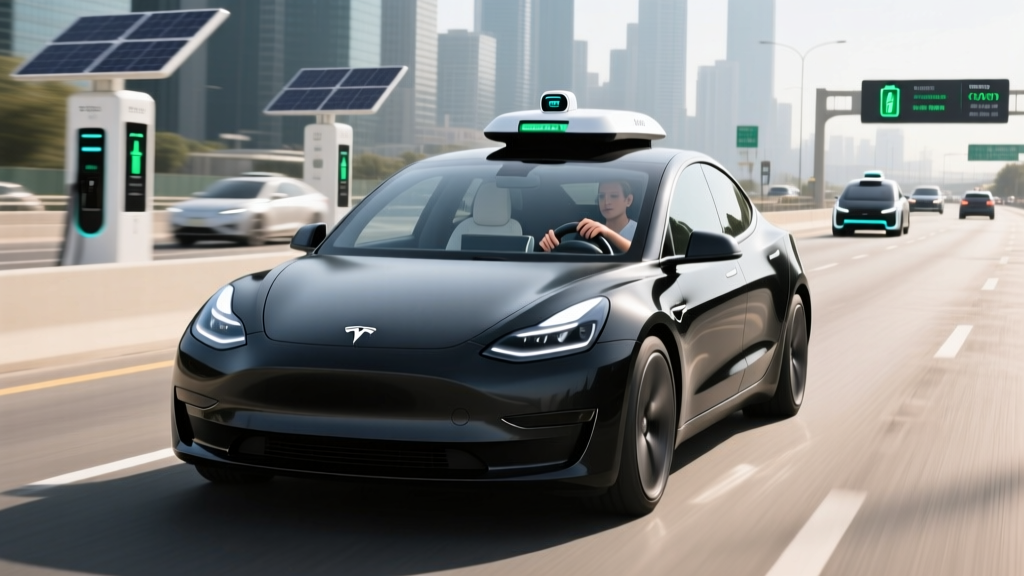
The 2026 Model 3 runs on Tesla's vision-only architecture—no radar, no ultrasonic sensors (USS were phased out starting in 2022). The sensor suite consists of:
- 8 cameras providing 360-degree surround view (front narrow/main/wide, left/right forward-facing repeaters, left/right rearward-facing repeaters, rear-view)
- High-resolution front cameras upgraded on the "Highland" refresh (late 2023 onward) with improved low-light performance
- Neural network processing via Tesla's HW4 (Hardware 4) computer, which delivers higher frame-rate camera processing and greater inference throughput than the prior HW3
The absence of radar and lidar means the system relies entirely on camera-derived depth estimation and object classification. This works well in clear conditions but introduces specific failure modes that radar-equipped competitors don't share—more on that below.
| Feature | Autopilot (Standard) | FSD (Supervised) |
|---|---|---|
| Traffic-Aware Cruise Control | ✓ | ✓ |
| Autosteer (lane centering) | ✓ | ✓ |
| Auto Lane Change | ✗ | ✓ |
| Navigate on Autopilot (highway interchanges) | ✗ | ✓ |
| Autopark | ✗ | ✓ |
| Summon / Smart Summon | ✗ | ✓ |
| Traffic Light & Stop Sign Control | ✗ | ✓ |
| City Street Autosteer | ✗ | ✓ |
Autopilot vs. FSD (Supervised): Cost Breakdown
Every 2026 Tesla Model 3—whether the base Rear-Wheel Drive ($38,990 MSRP), Long Range AWD ($42,490), or Performance ($47,490)—ships with standard Autopilot at no additional cost. The upgrade path is FSD (Supervised), which Tesla offers through two payment models:
| Option | Cost | Notes |
|---|---|---|
| One-Time Purchase | $8,000 | Transfers to the car, not the owner; adds resale value (marginally) |
| Monthly Subscription | $99/month | Cancel anytime; best for testing or seasonal use |
| Standard Autopilot | Included | TACC + Autosteer on all trims at no extra charge |
Breakeven math: At $99/month, the subscription equals the $8,000 purchase price at roughly 81 months (6.75 years). If you plan to keep the car longer than that and use FSD regularly, purchasing makes financial sense. If you're uncertain about the feature's value to you, the subscription is the lower-risk entry point.
Note: Tesla has historically offered FSD transfers between vehicles during promotional periods, but this is not a permanent policy. As of 2026, FSD generally stays with the vehicle it was purchased on.
Real-World Limitations: Where Autopilot Struggles
- It does not drive autonomously. You are the driver. NHTSA has issued standing investigations into Autopilot-related crashes involving stationary emergency vehicles.
- It does not reliably handle construction zones, temporary lane shifts, or faded/missing lane markings.
- It does not recognize all road debris, animals, or pedestrians with the reliability of a human driver.
- It does not function identically in heavy rain, fog, snow, or direct sun glare—camera-only systems degrade when lenses are obscured or visibility drops.
Weather and Visibility
Tesla Vision depends on clear camera lenses. Heavy rain can scatter light across the front camera, causing phantom braking or lane-centering hesitation. Snow accumulation on cameras (particularly the side repeaters mounted in the front fenders) can disable Autosteer entirely until cleared. Direct low-angle sunlight can temporarily saturate the forward cameras. In our experience, Autopilot performs excellently in dry, overcast, or mild conditions but requires the driver to take over more frequently in winter storms or torrential rain than radar-equipped systems like GM's Super Cruise.
Phantom Braking
Phantom braking—where the vehicle decelerates unexpectedly without a visible obstacle—remains a documented issue with Tesla's vision system. IIHS research has highlighted driver-monitoring concerns with Tesla's system. While software updates have reduced the frequency, it still occurs, particularly when the system misinterprets shadows, overpasses, or roadside structures as obstacles. Drivers following closely behind a Tesla on Autopilot should be aware of this behavior.
Highway vs. Surface Streets
Standard Autopilot is at its best on well-marked, divided highways with consistent lane geometry. Merge lanes, tight curves, and complex interchanges require driver intervention even with FSD's Navigate on Autopilot. On surface streets without FSD, Autosteer may engage but will struggle with unprotected left turns, unmarked intersections, and bike lanes.
How Tesla Autopilot Compares to Ford BlueCruise and GM Super Cruise
| Attribute | Tesla Autopilot / FSD | Ford BlueCruise | GM Super Cruise |
|---|---|---|---|
| SAE Level | Level 2 | Level 2 | Level 2 |
| Hands-Free on Approved Roads? | No (torque monitoring) | Yes (eyes-on via IR camera) | Yes (eyes-on via IR camera) |
| Sensor Suite | Cameras only | Cameras + radar | Cameras + radar + LiDAR map |
| Road Coverage | Any marked road (with limits) | ~130,000+ miles of pre-mapped divided highways | ~750,000+ miles of pre-mapped roads (US/Canada) |
| Driver Monitoring | Steering torque + camera | Infrared eye-tracking camera | Infrared eye-tracking camera |
| Auto Lane Change | FSD only | Yes (BlueCruise 1.0+) | Yes (on mapped roads) |
| Cost | Autopilot: free / FSD: $8K or $99/mo | ~$2,100 (2-year) then $750/2yr renewal | Included 3 yrs, then ~$25/mo |
The key distinction: Ford BlueCruise and GM Super Cruise allow true hands-free driving on pre-mapped highways, monitored by an infrared camera that tracks your gaze. Tesla's Autopilot requires steering-torque input (you must apply slight pressure to the wheel) and, while it uses a cabin camera for attention monitoring, it does not permit hands-free operation. Tesla's advantage is geographic breadth—it will attempt to steer on virtually any marked road, not just pre-mapped highways. The trade-off is less predictability and more frequent edge-case disengagements.
Safety Record and Regulatory Context
Tesla publishes quarterly safety data. According to Tesla's Q4 2025 vehicle safety report, vehicles with Autopilot engaged recorded one crash for every ~4.3 million miles driven, compared to one crash per ~1.4 million miles for Tesla vehicles without Autopilot, and the US average of approximately one crash per ~670,000 miles (NHTSA national data).
However, these figures require context:
- Autopilot is used disproportionately on divided highways—the safest driving environment—which inflates its apparent advantage.
- Tesla's data is self-reported and not independently audited in the same way NHTSA or IIHS data is.
- NHTSA's Standing General Order requires Tesla (and all ADAS manufacturers) to report crashes involving Level 2+ systems. Multiple investigations into Autopilot behavior near emergency scenes have been opened and remain active.
The takeaway: Autopilot, when used attentively on appropriate roads, is a safety net that reduces fatigue and likely reduces certain crash types (rear-end collisions, lane-departure). It is not a substitute for an alert driver.
Which 2026 Model 3 Trims Include Autopilot?
Standard Autopilot (TACC + Autosteer) is included on every 2026 Model 3 trim at no extra charge:
- Model 3 Rear-Wheel Drive: $38,990 MSRP — includes Autopilot, 272-mile EPA range, 0-60 in 5.8 seconds
- Model 3 Long Range AWD: $42,490 MSRP — includes Autopilot, 341-mile EPA range, 0-60 in 4.2 seconds
- Model 3 Performance: $47,490 MSRP — includes Autopilot, 315-mile EPA range, 0-60 in 2.9 seconds
FSD (Supervised) is available as an add-on to any trim for $8,000 one-time or $99/month. There is no hardware difference between Autopilot-equipped and FSD-equipped Model 3 vehicles—all 2026 Model 3s ship with HW4 and the full camera suite. The upgrade is purely a software unlock.
Decision Framework: Should You Pay for FSD?
- Your driving is primarily highway commuting on well-marked roads
- You want adaptive cruise + lane centering and nothing more
- You're budget-conscious and see $8,000 as better spent elsewhere
- You're skeptical of beta software and prefer predictable, bounded features
- You drive 20,000+ miles/year on varied road types and want reduced cognitive load
- You value auto lane changes, Navigate on Autopilot, and Smart Summon for daily convenience
- You want to subscribe at $99/month and evaluate before committing to the purchase
- You believe Tesla will eventually achieve broader autonomous capability and want to be on the upgrade path
Frequently Asked Questions
Is Tesla Model 3 Autopilot self-driving?
No. Tesla Autopilot and FSD (Supervised) are both SAE Level 2 driver-assistance systems. The driver must remain fully attentive, with hands on or applying torque to the steering wheel, and eyes on the road at all times. Tesla's own owner's manual states this explicitly. Only Level 4 robotaxi services like Waymo operate without a human driver.
Does standard Autopilot work on city streets?
Standard Autopilot's Autosteer can technically activate on some surface streets, but it is optimized for divided highways. Behavior at intersections, roundabouts, and unmarked roads is unreliable. FSD (Supervised) extends Autosteer to city streets with traffic-light and stop-sign recognition, but still requires full driver supervision.
How much does FSD cost on a 2026 Model 3?
FSD (Supervised) costs $8,000 as a one-time purchase or $99 per month as a subscription. Standard Autopilot (TACC + Autosteer) is included free on all trims.
Does Autopilot work in snow and heavy rain?
Camera-only Tesla Vision degrades in heavy precipitation, snow accumulation on lenses, and dense fog. Autosteer may disengage and require the driver to take over. In these conditions, radar-equipped competitors like GM Super Cruise may maintain functionality longer, though all Level 2 systems have weather limits.
Can I transfer FSD to a new Tesla?
Generally, no. FSD stays with the vehicle it was purchased on. Tesla has occasionally offered limited-time transfer promotions, but these are not standard policy. If resale value matters, a one-time FSD purchase may add modest value to the car at trade-in.
Is Autopilot safer than driving manually?
Tesla's self-reported data suggests lower crash rates with Autopilot engaged, but this data reflects highway-heavy usage and isn't independently verified. Used attentively on appropriate roads, Autopilot reduces fatigue and can prevent certain crash types. It is not a replacement for an alert driver.