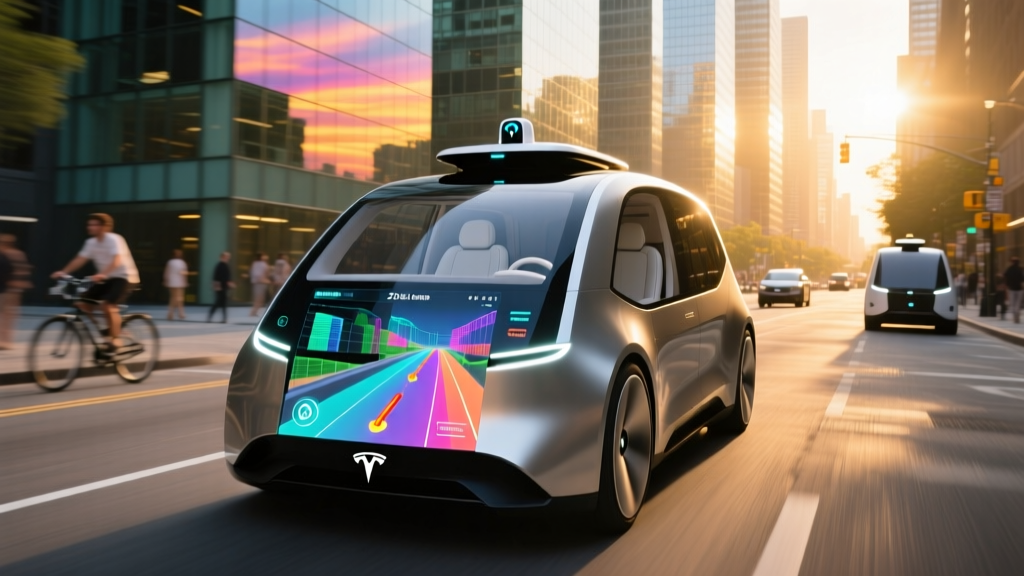
The $99/Month Question: What Does "Full Self-Driving" Actually Mean?
If you've browsed Tesla's configurator or seen headlines about autonomous vehicles, you've likely encountered the term Full Self-Driving. Tesla offers its FSD (Supervised) capability as a full self driving subscription at $99 per month (or a one-time $8,000 purchase as of 2026). But here's the critical distinction that most marketing glosses over: Tesla's FSD is not a robotaxi service. It is a Level 2 driver-assistance system that requires your constant attention, hands on or near the wheel, and eyes on the road at all times.
Meanwhile, true driverless robotaxis from Waymo and Cruise operate at SAE Level 4 — meaning no human driver is needed within their approved service areas. These are fundamentally different products serving fundamentally different use cases. This guide breaks down exactly what you get with each, where they operate, what they cost, and what the safety data actually shows.
| Level | Name | Who Drives? | Real-World Example |
|---|---|---|---|
| Level 0 | No Automation | Human | Basic cruise control |
| Level 1 | Driver Assistance | Human | Adaptive cruise OR lane-keep |
| Level 2 | Partial Automation | Human (always) | Tesla FSD, GM Super Cruise, Ford BlueCruise |
| Level 3 | Conditional Automation | System (human on standby) | Mercedes DRIVE PILOT (limited markets) |
| Level 4 | High Automation | System (no driver) | Waymo One, Zoox |
| Level 5 | Full Automation | System (everywhere) | Does not yet exist commercially |
Source: SAE International J3016
Tesla FSD (Supervised): What the Subscription Actually Includes
Tesla's Full Self-Driving (Supervised) package, available as a full self driving subscription at $99/month or $8,000 outright, bundles several advanced driver-assistance features on top of the standard Autopilot that comes with every Tesla:
- Navigate on Autopilot: Automatic highway on-ramp to off-ramp guidance, including lane changes and interchange navigation
- Auto Lane Change: Suggests and executes lane changes on highways when the driver confirms
- Autopark: Parallel and perpendicular parking assistance
- Summon / Smart Summon: Moves the vehicle short distances in parking lots (driver must monitor via app)
- Traffic Light and Stop Sign Control: Detects and responds to traffic signals and stop signs
- City Street Driving: Navigates urban intersections, turns, and complex road scenarios
The word "Supervised" is doing heavy lifting here. Tesla's own owner's manual and on-screen warnings make clear: the driver must remain attentive, keep hands on the steering wheel (or demonstrate attentiveness via the cabin camera), and be prepared to take over at any moment. FSD does not make the Tesla a self-driving car — it makes it a car with an exceptionally capable Level 2 assist system.
Where FSD Works
Unlike geofenced robotaxis, Tesla FSD operates on virtually any road in the United States and Canada where Tesla has deployed the software. There is no approved-city restriction. However, performance varies dramatically by road complexity, weather conditions, and mapping quality. Rural roads with faded lane markings, construction zones, and unmapped new developments will degrade FSD's confidence and increase driver takeover frequency.
Waymo One: The Robotaxi You Can Actually Summon Today
Waymo, Alphabet's autonomous driving subsidiary, operates Waymo One — a commercial robotaxi service where you open an app, request a ride, and a driverless vehicle (a Jaguar I-PACE equipped with Waymo's 5th-generation Driver system, and increasingly the Zeekr RT custom robotaxi) picks you up. No human behind the wheel. No steering wheel interaction required from you.
Where Can I Use Waymo Right Now?
| City | Status (2026) | Service Area Notes |
|---|---|---|
| Phoenix, AZ | Fully operational | Largest coverage area (~315 sq mi); airport service to PHX |
| San Francisco, CA | Fully operational | City-wide coverage; 24/7 service |
| Los Angeles, CA | Fully operational | Expanded coverage across central LA and Westside |
| Austin, TX | Operational (expanding) | Downtown and surrounding corridors; Uber integration available |
Waymo has announced plans for additional cities, but only the above are confirmed operational for public ridership as of early 2026. Source: Waymo One
How Safe Are Robotaxis? The Real Data
Waymo: As of late 2025, Waymo reported over 30 million fully driverless miles completed. Their published safety data (submitted to NHTSA) indicates a fatal crash rate approximately 85% lower than the human benchmark for equivalent urban driving environments, and a ~57% reduction in injury-causing crashes. However, these figures compare Waymo's geofenced, low-speed urban operations against the national average, which includes rural highways and impaired driving.
Tesla FSD: Tesla publishes periodic safety reports claiming approximately 1 major crash per ~4-5 million miles driven with FSD engaged, compared to the U.S. average of ~1 per 670,000 miles. Independent researchers have noted that Tesla's methodology is not peer-reviewed and that FSD's operational domain (highway-heavy, driver-monitored) differs significantly from urban robotaxi driving. NHTSA's Standing General Order requires both companies to report crashes involving automated systems.
Contextualizing the Numbers
Safety comparisons between Level 2 and Level 4 systems are inherently apples-to-oranges. Waymo operates in dense, complex urban environments at lower speeds but without any human fallback. Tesla FSD operates everywhere, including high-speed highways, but always has a human ready to intervene. Neither dataset tells the complete story:
- Waymo's edge cases: Construction zone rerouting, double-parked delivery trucks, and unusual pedestrian behavior have caused Waymo vehicles to stop unexpectedly in traffic lanes, occasionally causing congestion or minor rear-end collisions by human drivers behind them.
- Tesla FSD's edge cases: Phantom braking on highways, misidentification of roadside obstacles, and difficulty with unprotected left turns in heavy traffic remain documented concerns. NHTSA has investigated multiple Tesla Autopilot/FSD-related crashes, particularly involving stationary emergency vehicles.
Cost Comparison: FSD Subscription vs Robotaxi vs Rideshare
The economics depend entirely on your use case — daily commute in your own vehicle versus occasional point-to-point rides.
| Service | Pricing Model | Typical Cost (5-mile urban trip) | Monthly Cost (daily 10-mi commute) |
|---|---|---|---|
| Tesla FSD Subscription | $99/month flat | $0 marginal (you own the car) | $99 + electricity (~$15-25) |
| Waymo One | Per-ride pricing | $8-15 (comparable to UberX) | $176-330 |
| UberX / Lyft | Per-ride pricing | $10-18 | $220-396 |
| Personal driving (no FSD) | Fuel/electricity + depreciation | $1-3 (EV electricity only) | $22-65 (electricity only) |
The math: If you already own a Tesla and drive daily, the $99/month FSD subscription is the cheapest way to access advanced driver-assist features — but you're still the driver. If you don't own a car and need rides within a Waymo city, Waymo One is priced competitively with Uber/Lyft, sometimes slightly cheaper during non-surge periods. Waymo also offers promotional pricing in new markets to build ridership.
Technology Stack: Cameras vs Lidar and the Sensor Debate
The engineering philosophies behind Tesla FSD and Waymo's robotaxi diverge sharply at the hardware level, and this has direct implications for capability and safety.
Tesla: Camera-Only (Tesla Vision)
Since 2022, Tesla has removed all radar and ultrasonic sensors from its vehicles, relying exclusively on a suite of 8 external cameras processed through the HW4 (or newer) computer. Tesla's neural network approach uses end-to-end deep learning trained on billions of miles of real-world driving video. The argument: human eyes are cameras, so a sufficiently advanced vision system should replicate human driving.
Limitations: Camera-only systems struggle with depth perception in low-contrast scenarios (fog, direct sun glare, darkness without street lighting), and cannot directly measure the distance and velocity of objects the way lidar can. Tesla compensates with sophisticated software estimation, but edge cases in adverse conditions remain a known weakness.
Waymo: Multi-Sensor Fusion (Lidar + Cameras + Radar)
Waymo's 5th-generation Driver system employs a roof-mounted custom lidar array (providing a real-time 3D point cloud of the environment), multiple cameras for color/sign recognition, and radar for velocity detection. The 6th-generation system (deploying on newer vehicles) adds improved range and resolution. This sensor redundancy means Waymo vehicles can "see" through conditions that might blind a camera-only system.
Trade-off: The multi-sensor stack costs tens of thousands of dollars per vehicle, making it viable only for fleet-operated robotaxis — not consumer vehicles. A Waymo-equipped Jaguar I-PACE has an estimated sensor and compute cost north of $100,000 beyond the base vehicle.
Current Limitations: What Neither System Can Do
- Weather: Heavy rain, snow, fog, and ice degrade both camera and lidar performance. Waymo may pause service in severe weather; Tesla FSD will issue warnings and may disengage, returning control to you with minimal notice.
- Geofencing (Waymo): Waymo One operates only within mapped, approved zones. Request a ride outside the geofence and the app will decline. Expanding these zones requires extensive testing and regulatory approval — it doesn't happen by software update alone.
- Construction zones: Both systems struggle with temporary lane reconfigurations, flaggers, and missing lane markings. Waymo may pull over and wait; Tesla FSD may attempt navigation but with reduced confidence.
- Unprotected left turns: A known challenge for all automated systems in heavy traffic. Both Waymo and Tesla FSD have shown overly conservative or occasionally hesitant behavior at complex intersections.
- Emergency vehicles: NHTSA investigations have documented cases where Tesla Autopilot/FSD failed to detect stationary emergency vehicles with flashing lights. Waymo handles these better due to lidar detection but has also had documented stops near emergency scenes.
- No highway robotaxi (yet): Waymo's current service is urban/suburban surface streets only. No Level 4 robotaxi operates on limited-access highways at 65+ mph commercially in the U.S.
Regulatory Landscape: Who Approves What
The regulatory environment for automated driving in the U.S. is fragmented between federal and state authority:
- Federal (NHTSA): The National Highway Traffic Safety Administration sets vehicle safety standards and investigates crashes. NHTSA's Standing General Order requires manufacturers and operators to report crashes involving SAE Level 2-5 systems within 24 hours for serious incidents.
- State — California (DMV + CPUC): California requires a permit from the DMV for testing and from the California Public Utilities Commission (CPUC) for commercial robotaxi service. Waymo holds both. Cruise's permit was suspended in late 2023 following a serious incident in San Francisco, and the company has been gradually returning to service under stricter oversight.
- State — Arizona: Arizona has a permissive regulatory environment with no specific state-level robotaxi permit required beyond standard business licensing and NHTSA compliance, which is why Phoenix became Waymo's first commercial market.
- State — Texas: Texas passed autonomous vehicle legislation allowing driverless operation with a licensed operator. Austin has become a key expansion market for Waymo, including integration with Uber's app.
- Tesla FSD: As a Level 2 system, Tesla FSD does not require special state permits for deployment. It is regulated under existing ADAS frameworks. However, multiple state regulators and the NHTSA have scrutinized Tesla's marketing language around "Full Self-Driving" for potential consumer confusion.
The Verdict: Which Approach Fits Your Needs?
Choose the Tesla FSD Subscription ($99/mo) If:
- You already own (or plan to buy) a Tesla and want the most advanced driver-assist for highway commuting and city navigation
- You understand you remain the responsible driver and must stay engaged at all times
- You drive frequently outside robotaxi service areas (rural routes, interstates, other states)
- You value the convenience of your own vehicle and don't want per-ride charges
Choose Waymo One (Per-Ride Pricing) If:
- You live in or visit Phoenix, San Francisco, Los Angeles, or Austin and need point-to-point rides
- You want a truly driverless experience with no attention requirement
- You don't own a car or prefer not to drive in congested urban environments
- You're comfortable with geofenced service boundaries and potential weather-related cancellations
Neither system represents "full self-driving" in the Level 5, go-anywhere, do-anything sense. Tesla's FSD subscription gives you a remarkably capable co-pilot for your own car. Waymo gives you a genuine chauffeur — but only within carefully mapped city limits. The right choice depends on whether you need assistance driving your own vehicle or a replacement for rideshare entirely.
Frequently Asked Questions
Is Tesla's Full Self-Driving actually self-driving?
No. Tesla FSD (Supervised) is an SAE Level 2 driver-assistance system. Despite the name, it requires continuous driver supervision. You are legally and operationally the driver at all times. Tesla's own documentation and in-car warnings state this explicitly. Only Level 4 systems like Waymo operate without a human driver.
Can I cancel the Tesla FSD subscription at any time?
Yes. The $99/month FSD subscription can be cancelled through your Tesla account. You lose access to FSD features at the end of your billing cycle but retain standard Autopilot functionality. If you purchase FSD outright for $8,000, it is tied to the vehicle (non-transferable to a new owner in most cases, though Tesla has occasionally offered transfers as promotions).
How much does a Waymo ride cost compared to Uber?
Waymo One pricing is generally comparable to UberX, typically ranging from $8-15 for a 5-mile urban trip depending on demand and time of day. Waymo does not currently implement surge pricing the way Uber/Lyft do, though promotional pricing in newer markets can make rides significantly cheaper. For a daily 10-mile round-trip commute, expect $176-330/month with Waymo versus $99/month for Tesla FSD (plus your vehicle costs).
Has a Waymo robotaxi ever been in a serious crash?
Waymo has reported incidents to NHTSA as required by the Standing General Order. Most documented incidents involve minor collisions — typically another human driver rear-ending a Waymo vehicle that stopped cautiously, or low-speed sideswipe contacts in complex intersections. Waymo has not reported a fatality caused by its autonomous system during fully driverless operations. However, the total driverless mileage (~30+ million miles) is still small compared to the trillions of human-driven miles annually, so statistical certainty remains limited. For current data, check NHTSA's automation crash reporting portal.
Will Tesla ever launch a true robotaxi service?
Tesla has announced plans for a robotaxi product (the "Cybercab" concept), and CEO Elon Musk has repeatedly projected timelines for unsupervised FSD. As of early 2026, no Tesla robotaxi service is operational, and Tesla has not obtained the regulatory approvals required for driverless commercial operation in any U.S. state. Any future Tesla robotaxi would need to transition from Level 2 to Level 4 certification — a significant regulatory and engineering hurdle. Treat announced timelines as preliminary.
What happens if Tesla FSD encounters a situation it can't handle?
FSD will issue escalating visual and audio alerts requesting driver takeover. If the driver does not respond, the system will gradually decelerate, activate hazard lights, and bring the vehicle to a stop in the current lane (or attempt to pull to the shoulder if conditions allow). This is why driver attentiveness monitoring is mandatory — the system's fallback strategy depends on timely human intervention.