Tesla FSD Transfer in 2026: What Changed Since the 2025 Policy
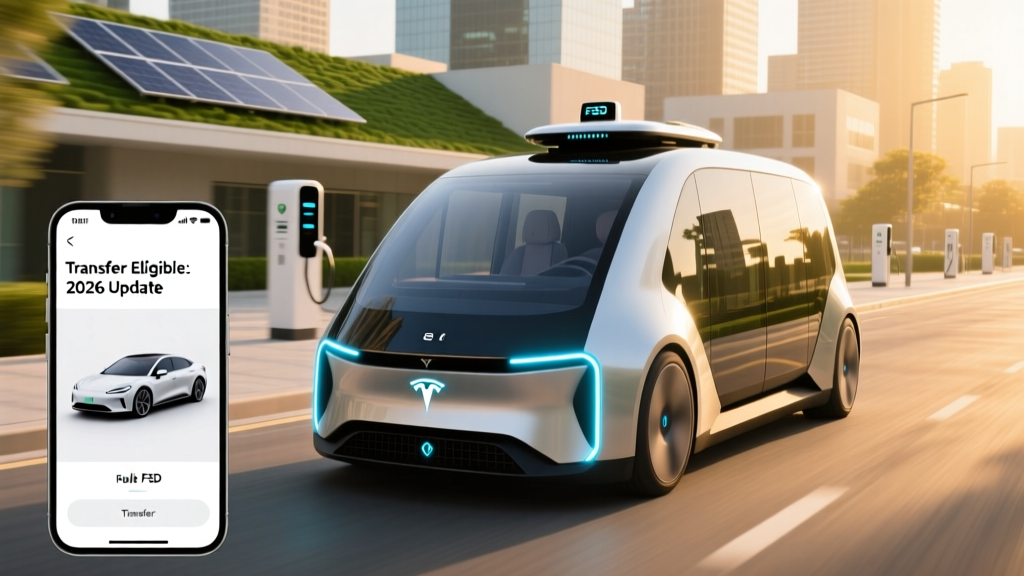
If you paid $8,000 (or more) for Tesla's Full Self-Driving (Supervised) capability on a previous vehicle, one question dominates your next purchase decision: does that investment follow you to a new car? The Tesla FSD transfer 2025 policy — introduced as a limited-time promotion and later extended — fundamentally changed how Tesla treats its software investment. As of early 2026, Tesla continues to offer FSD transferability under specific conditions, but the rules have tightened compared to the original promotional window.
This guide breaks down exactly what the FSD transfer entails in 2026, how FSD (Supervised) actually performs as a driver-assistance system, its real-world limitations, and whether transferring makes financial sense versus subscribing on a new vehicle.
SAE Automation Level: Level 2 — Not Self-Driving
Tesla Full Self-Driving (Supervised) is a SAE Level 2 driver-assistance system. Despite the "Full Self-Driving" name, the driver must remain fully engaged, keep hands on the steering wheel (or demonstrate attention via the cabin camera), and be prepared to take over at any moment. Only Level 4 systems like Waymo's robotaxi service operate without a human driver in defined geographic areas. Tesla FSD does not qualify as autonomous under any regulatory framework, including NHTSA's definitions.
How the Tesla FSD Transfer Works in 2026
Tesla's FSD transfer policy allows owners who purchased FSD outright (a one-time $8,000 fee as of 2025–2026 pricing) on a previous Tesla to move that license to a newly purchased Tesla. Here are the core rules as currently structured:
- Eligibility: You must have purchased FSD as a one-time buy (not a monthly subscriber) on your existing Tesla vehicle.
- New vehicle requirement: The transfer applies only when you purchase or order a new Tesla directly from Tesla — it does not apply to used Tesla purchases from third-party dealers.
- Timing window: The original 2025 promotion required the new vehicle order within a defined window. Tesla has continued offering transfers in 2026, but you should confirm current terms with your Tesla advisor at order time, as the company reserves the right to modify or end the program.
- Non-transferable to other owners: The FSD license transfers to your next Tesla, not to another person. If you sell your current car, the FSD stays with that vehicle (adding resale value) — you cannot extract it to sell separately.
- One-time transfer: Historically, Tesla has structured these as single-use transfers. Check whether your specific account qualifies for repeated transfers on subsequent purchases.
The financial logic is straightforward: if you paid $8,000 for FSD on a Model 3 in 2023, transferring it to a 2026 Model Y saves you from paying $8,000 again — effectively making FSD a one-time lifetime purchase tied to you as an owner rather than a single VIN.
What Tesla FSD (Supervised) Actually Does
FSD (Supervised) is Tesla's most advanced driver-assistance package, building on the standard Autopilot system that comes included with every new Tesla. Here is a technical breakdown of its capabilities and hardware:
Sensor Suite and Hardware
All 2026 Tesla vehicles ship with Hardware 4 (HW4), which includes:
- 8 surround cameras (front narrow, front wide, front main, left/right repeaters, left/right rear, rear-view) providing 360-degree visibility
- Cabin-facing camera for driver attention monitoring
- 12 ultrasonic sensors (removed on some 2023+ builds, now relying on Tesla Vision camera-only processing)
- No radar — Tesla transitioned to a pure vision (camera-only) architecture starting in 2021–2022, removing millimeter-wave radar from new production
The HW4 computer processes camera feeds through Tesla's neural network, which handles object detection, lane recognition, path planning, and control inputs (steering, acceleration, braking) in real time.
Feature Capability Breakdown
| Feature | What It Does | Included In |
|---|---|---|
| Traffic-Aware Cruise Control | Maintains set speed and following distance; adjusts for traffic ahead | Basic Autopilot (standard) |
| Autosteer | Keeps vehicle centered in clearly marked highway lanes | Basic Autopilot (standard) |
| Navigate on Autopilot | Suggests and executes lane changes, takes highway exits based on navigation route | FSD (Supervised) |
| Auto Lane Change | Executes lane changes when turn signal is activated (or automatically with NoA) | FSD (Supervised) |
| Autopark | Identifies parking spaces and performs parallel/perpendicular parking maneuvers | FSD (Supervised) |
| Smart Summon | Navigates the vehicle to the driver in a parking lot at low speed | FSD (Supervised) |
| Traffic Light & Stop Sign Control | Detects and responds to traffic lights and stop signs (requires driver confirmation) | FSD (Supervised) |
| City Streets (FSD) | Navigates urban roads, makes turns, handles intersections on a set route | FSD (Supervised) |
Real-World Limitations: Where FSD Falls Short
What FSD (Supervised) Does NOT Do
- It does not drive autonomously. You are the driver. NHTSA classifies this as Level 2 — full attention is legally and practically required at all times.
- Heavy rain, fog, snow, and direct sun glare degrade performance. The camera-only system has no radar fallback. Reduced visibility means reduced capability — expect more frequent disengagements in bad weather.
- Faded or missing lane markings cause confusion. Construction zones, rural roads, and recently repaved highways without fresh striping are common failure points.
- Unprotected left turns and complex intersections remain edge cases. City Streets FSD handles many intersections, but multi-lane roundabouts, unusual signal phasing, and ambiguous right-of-way scenarios require driver takeover.
- Phantom braking still occurs. The system may brake unexpectedly for shadows, overpasses, or objects it misclassifies — a known issue documented in NHTSA complaint databases and owner reports.
- It does not replace insurance or liability. You are responsible for every action the vehicle takes while FSD is engaged.
In real-world highway use, FSD performs well on well-marked interstates with moderate traffic — handling lane keeping, speed management, and navigation-based lane changes competently. City Streets performance has improved significantly through 2025–2026 neural network updates (Tesla's v13.x branch), but it remains a system that requires constant supervision, not a chauffeur.
FSD Cost: Transfer vs. New Purchase vs. Subscription
Understanding the economics of FSD requires comparing the three ways to access it on a 2026 Tesla:
| Option | Cost | Tied To | Transferable? |
|---|---|---|---|
| FSD One-Time Purchase | $8,000 (2025–2026 pricing) | Vehicle VIN | Yes, under current transfer policy to your next new Tesla |
| FSD Monthly Subscription | $99/month | Tesla account + vehicle | No — cancel anytime, re-subscribe on next car |
| FSD Transfer (from prior purchase) | $0 additional | Owner account | One-time, to a new Tesla purchase |
| Basic Autopilot | $0 (included) | All new Teslas | N/A — standard equipment |
The break-even math: If you plan to keep your next Tesla for 6+ years, the $8,000 one-time purchase (or transfer) beats the $99/month subscription ($7,128 over 6 years). If you change vehicles every 3 years or are uncertain about long-term Tesla ownership, the $99/month subscription avoids sunk-cost risk — and you avoid needing to navigate the transfer policy entirely.
How FSD Compares to Competing Level 2 Systems
| System | Brand | Monthly Cost | One-Time Cost | Hands-Free? | Highway Only? |
|---|---|---|---|---|---|
| FSD (Supervised) | Tesla | $99/mo | $8,000 | No (attention monitoring) | No — city + highway |
| Super Cruise | GM (Cadillac, Chevy) | ~$25/mo after trial | Included on select trims | Yes (on mapped highways) | Yes — ~750,000 mi of mapped roads |
| BlueCruise | Ford | $75/yr or $2,100 one-time | $2,100 | Yes (on approved highways) | Yes — ~130,000 mi of divided highways |
| Autopilot (basic) | Tesla | $0 | $0 (included) | No | Primarily highway |
| ProPILOT Assist 2.0 | Nissan | $0 (included) | $0 | Yes (on mapped highways) | Yes |
The key differentiator: Tesla FSD (Supervised) is the only consumer system that attempts city-street navigation at scale. GM's Super Cruise and Ford's BlueCruise offer hands-free driving on pre-mapped divided highways — a narrower scope but one where the driver can legally remove hands from the wheel (while maintaining visual attention). Tesla's system covers more road types but never allows hands-free operation, which can feel like a paradox to buyers expecting more from "Full Self-Driving."
Which Tesla Models Include FSD and How to Get It
FSD (Supervised) is available as an add-on across the entire 2026 Tesla lineup:
- Model 3 (all trims: Rear-Wheel Drive, Long Range, Performance) — FSD available as $8,000 purchase or $99/mo subscription
- Model Y (Long Range, Performance, and the refreshed Juniper platform) — FSD available
- Model S (Long Range, Plaid) — FSD available
- Model X (Long Range, Plaid) — FSD available
- Cybertruck (AWD, Cyberbeast) — FSD available
No Tesla model ships with FSD as standard equipment. Basic Autopilot (Traffic-Aware Cruise Control + Autosteer) is included on every new Tesla at no additional cost. The FSD upgrade is always a separate purchase or subscription decision.
If you are transferring FSD from a prior vehicle, the license is applied to your new Tesla at delivery — confirm with your Tesla advisor that the transfer is reflected in your account before taking possession.
Should You Transfer FSD or Subscribe on Your New Tesla?
The decision framework depends on your ownership pattern and confidence in Tesla's trajectory:
Choose FSD Transfer If:
- You already own an outright FSD license and are buying a new Tesla
- You plan to keep the new vehicle 4+ years
- You use FSD regularly on highway commutes and find it reduces fatigue
- You want to avoid recurring subscription costs
Choose the $99/Month Subscription If:
- You don't currently own FSD and are unsure how much you'll use it
- You change vehicles frequently (every 2–3 years)
- You primarily drive in conditions where FSD struggles (heavy snow, construction-heavy areas)
- You want to evaluate FSD's current capabilities before committing $8,000
Frequently Asked Questions
Can I transfer my FSD to a used Tesla I buy from a dealer?
No. The FSD transfer policy applies only when you purchase or order a new Tesla directly from Tesla. Buying a used Tesla from a third-party dealer or private party does not qualify for the transfer — though if that used Tesla already has FSD on its VIN, it will carry over with the vehicle.
Does FSD transfer if I trade in my current Tesla?
Yes, if you are ordering a new Tesla as your next vehicle. The FSD license on your trade-in is separate from the vehicle itself — the trade-in vehicle retains FSD for its next owner (which may improve your trade-in value), while your FSD license moves to your new order.
Is Tesla FSD actually self-driving?
No. Tesla FSD (Supervised) is a SAE Level 2 system. You must remain the active driver at all times — monitoring the road, maintaining steering input or attention as detected by the cabin camera, and ready to intervene immediately. The "Full Self-Driving" name is a product name, not a description of capability. For context, IIHS and safety researchers consistently emphasize that Level 2 systems require full driver engagement.
What happens to my FSD if Tesla discontinues the transfer program?
Tesla's transfer policy has been offered as a promotional program that the company can modify or end. If you have already transferred FSD to your current vehicle, that license is applied and should persist. If the program ends before your next purchase, you would need to repurchase or subscribe on your next vehicle. Monitor Tesla's official communications or consult your Tesla advisor for the latest terms.
Does the FSD monthly subscription transfer between vehicles?
The subscription is tied to your Tesla account and a specific vehicle. When you get a new Tesla, you can cancel the subscription on your old car and re-subscribe on the new one at $99/month — there is no formal "transfer" needed, just account management through the Tesla app.
How does FSD perform in winter and bad weather?
Tesla's camera-only (Tesla Vision) system is more susceptible to weather degradation than radar-equipped systems. Heavy rain, snow accumulation on cameras, fog, and direct low-angle sun glare can cause the system to reduce capability or disengage. Keep all camera lenses clean and expect to take over more frequently in adverse conditions. This is a documented limitation of vision-only architectures.