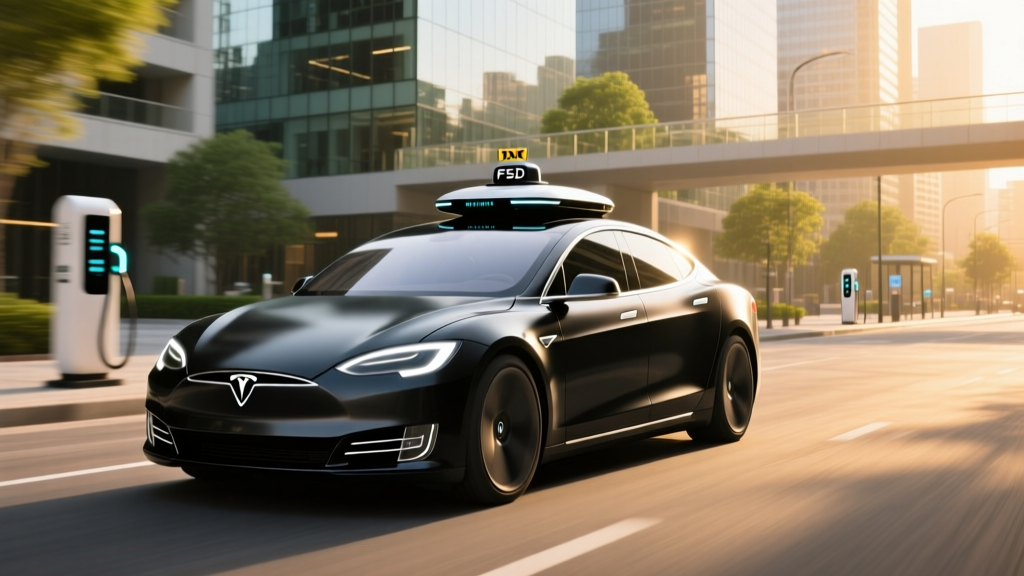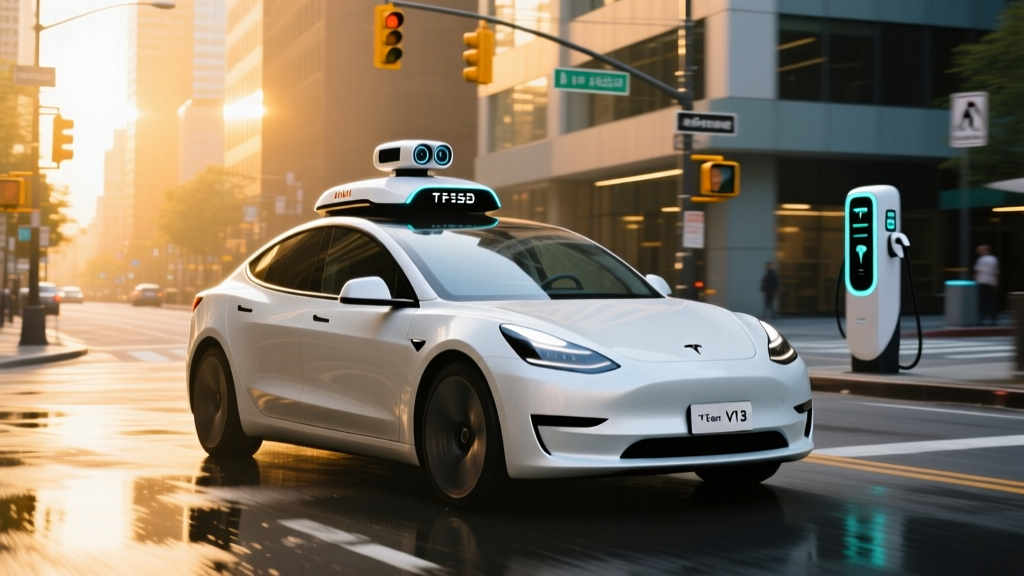
Tesla's Full Self-Driving (Supervised) software—often searched as FSD 3, FSD v13, or simply "Tesla FSD"—remains one of the most talked-about and misunderstood driver-assistance systems on the road. Despite the name, it is not a self-driving system. It is a SAE Level 2 driver-assistance feature that requires continuous human supervision, hands-on (or hands-attentive) engagement, and full responsibility for the vehicle's operation. What it is, in 2026, is the most widely deployed vision-based ADAS in the U.S., running on millions of Tesla vehicles across city streets, highways, and parking lots.
This guide breaks down exactly what FSD (Supervised) does in its current v13.x iteration, the hardware and sensor stack behind it, its real-world strengths and failure modes, what it costs, which Teslas support it, and how it compares to Ford BlueCruise, GM Super Cruise, and the new wave of camera+radar systems from Hyundai/Kia and BMW.
What Tesla FSD (Supervised) Actually Does
FSD (Supervised) is the top tier of Tesla's driver-assistance stack, layered above Basic Autopilot (standard on every new Tesla) and Enhanced Autopilot (a mid-tier option that was sunset for new purchases in the U.S. in 2024 but remains active on older cars). FSD (Supervised) extends Autopilot's highway lane-keeping and traffic-aware cruise control to surface streets: it can navigate intersections, make protected and unprotected turns, respond to traffic lights and stop signs, yield to pedestrians, and handle lane changes in urban environments without a navigation destination set.
| Function | Supported? | Conditions / Notes |
|---|---|---|
| Traffic-Aware Cruise Control | Yes | All roads, 0–90+ mph |
| Autosteer (lane centering) | Yes | Highways + surface streets |
| Auto Lane Change | Yes | Driver confirmation optional; suggest mode default |
| Traffic light & stop sign control | Yes | Identifies and responds; driver must verify |
| City-street navigation (no nav set) | Yes | v13.x removed nav-dependency for urban driving |
| Parking (parallel, perpendicular, pull-through) | Yes | Actually Smart Summon / Park Seek included |
| Smart Summon (lot navigation to driver) | Yes | Private lots only, low speed, supervised |
| Highway on/off-ramp handling | Yes | Nav-guided or driver-initiated |
| Hands-off driving | No | Camera-based driver monitoring enforced |
| Driver inattention tolerance | No | Escalating warnings → disengagement |
Under the hood, FSD v13 uses a pure end-to-end neural network architecture introduced in v12 and refined through 2025/2026. Rather than modular code stacks for lane detection, object tracking, and path planning, a single vision transformer ingests camera frames and outputs steering, acceleration, and braking commands directly. The result is noticeably more human-like behavior—smoother lane positioning, more confident unprotected left turns, better gap acceptance at four-way stops—compared to the rule-based v11 and earlier.
Sensors and Hardware: What's Watching the Road
Tesla abandoned radar and ultrasonic sensors years ago. Every new Model 3, Model Y, Model S, Model X, and Cybertruck ships with Hardware 4 (HW4), which includes:
- 8 cameras (front main + narrow telephoto, left/right front pillars, left/right rear fenders, rear backup) — higher-resolution sensors than HW3, with improved low-light performance
- No radar (removed from production starting 2021)
- No ultrasonic sensors (removed starting late 2022; replaced by vision-based "Tesla Vision" proximity estimation)
- Higher-throughput inference computer running the FSD neural nets at ~36+ fps
This vision-only approach is the defining technical difference between Tesla and every other OEM. Ford, GM, Hyundai, BMW, and Mercedes pair cameras with radar (and in some cases, lidar on higher-tier systems). Tesla's bet is that a sufficiently trained neural net can extract depth and velocity from camera data alone. In most conditions, it works well. In edge cases—heavy rain, direct sun glare, faded lane markings, construction zones with contradictory signage—the lack of redundant radar sensing shows up as occasional phantom braking, hesitation, or misread obstacles.
The SAE Level 2 Reality Check
Per SAE J3016, FSD (Supervised) is Level 2: the system provides combined longitudinal and lateral control, but the human driver is the driving authority at all times. You must supervise, remain attentive, and be ready to take over instantly. This is the same SAE classification as basic Autopilot, Ford BlueCruise, GM Super Cruise, and Toyota Safety Sense. It is not Level 3 (conditional automation, where the OEM assumes liability in defined conditions—like Mercedes Drive Pilot on the EQS in Nevada/California at ≤40 mph) and it is not Level 4 (driverless, like Waymo One in Phoenix, SF, and LA).
Tesla added the "(Supervised)" suffix in mid-2024 specifically to address regulatory and consumer confusion following NHTSA scrutiny and a class-action lawsuit over the "Full Self-Driving" name. The distinction matters legally: in any collision while FSD (Supervised) is engaged, the driver bears full liability, not Tesla.
Real-World Capabilities and Where FSD (Supervised) Shines
Based on extensive real-world use across Model Y Long Range (2025 refresh) and Cybertruck AWD in the 2025–2026 timeframe, FSD v13.x delivers its best performance in these scenarios:
- Suburban arterial roads with clear lane markings and predictable traffic flow — lane-keeping is steady, turns are smooth, and the system handles multi-lane intersections with dedicated turn lanes confidently.
- Highway driving — on/off-ramp transitions, lane changes around slower traffic, and traffic-aware cruise remain among the best in the segment. Tesla's visualization of surrounding vehicles (cars, trucks, motorcycles, cones, debris) is industry-leading.
- Roundabouts — a former weak point, v13 handles single- and multi-lane roundabouts far more smoothly than v11/v12, yielding and exiting appropriately in most cases.
- Night driving on well-lit roads — HW4 cameras are a meaningful step up from HW3 in low light.
- Parking lot navigation (Smart Summon) — genuinely useful in large retail lots, though still occasionally hesitant around shopping carts and pedestrians.
Honest Limitations: Where FSD (Supervised) Falls Short
- Drive without supervision. Interior camera monitoring will issue escalating warnings and disengage the system if you look away, use a phone, or close your eyes.
- Handle severe weather reliably. Heavy rain, fog, and snow on the camera lenses degrade performance quickly. Tesla's owner manual explicitly advises disabling Autopilot/FSD in these conditions.
- Navigate unmapped or poorly marked rural roads. Without clear lane lines, the system may default to following the road edge or disengage.
- Obey temporary construction-zone signage consistently. Conflicting lane markings, orange barrels, and flaggers remain a failure mode.
- Guarantee correct traffic-light state interpretation. The system may proceed on a stale green or hesitate on a fresh green. Verification is the driver's job.
- Avoid all phantom braking events. Though dramatically reduced in v13 vs. v11, sudden deceleration on clear highways still occurs, particularly under overpasses and bridges.
- Replace an attentive driver. Per NHTSA guidance on ADS, Level 2 systems require the same vigilance as manual driving.
The most common real-world complaint in owner communities (Tesla Motors Club, Reddit r/TeslaLounge) is not catastrophic failure but inconsistency: the same intersection may be handled perfectly on Monday and hesitantly on Thursday. This is a characteristic of end-to-end neural nets, which lack deterministic, explainable behavior.
Cost and Availability: What You'll Actually Pay in 2026
FSD (Supervised) is available on every current-production Tesla — Model 3, Model Y, Model S, Model X, and Cybertruck — but it is not standard. Basic Autopilot (TACC + Autosteer) ships on every car. FSD (Supervised) is a paid add-on with two purchase paths:
| Option | Cost | Notes |
|---|---|---|
| One-time purchase | $8,000 | Tied to the vehicle; transfers with resale. Reduced from $15,000 in April 2024. |
| Monthly subscription | $99/month | Cancel anytime; does not add resale value. |
| Included with vehicle | $0 | No current Tesla trim bundles FSD as standard (unlike Ford BlueCruise 1-year trials on some trims). |
| FSD Transferability (promo) | Varies | Tesla periodically runs promos allowing FSD transfer from a trade-in to a new purchase — check Tesla.com for current offers. |
For most buyers, the $99/month subscription is the financially rational choice unless you plan to keep the car 7+ years. At $99/mo, you pay $8,000 equivalent in ~6.7 years—and the subscription lets you pause or cancel during months you don't use it. The one-time purchase only makes sense if you (a) are certain you'll keep the vehicle long-term and (b) value the marginal resale uplift (historically, FSD recoups ~30–50% of its purchase price at trade-in, per iSeeCars data).
Federal §30D EV tax credit rules (IRS guidance) do not apply to software add-ons like FSD. The credit is calculated on the base vehicle MSRP (subject to the $55,000 sedan / $80,000 SUV-truck cap, income limits, and battery-sourcing requirements). FSD's $8,000 price is not factored into credit eligibility.
How FSD (Supervised) Compares to BlueCruise, Super Cruise, and Others
Tesla's system is often compared to Ford's BlueCruise and GM's Super Cruise, but the philosophies differ fundamentally:
- Tesla FSD (Supervised) — works on virtually any road in the U.S./Canada (surface streets included), vision-only, hands-on/eyes-on required. Broadest coverage, most ambitious scope.
- Ford BlueCruise 1.5 — hands-free on ~130,000 miles of pre-mapped divided highways only. Uses cameras + radar + driver-facing camera. Excellent in its domain (highway cruising), but no surface-street capability. Available on Mustang Mach-E, F-150 Lightning, Explorer; $2,100 one-time or ~$75/mo subscription after initial trial.
- GM Super Cruise / Ultra Cruise — hands-free on 750,000+ miles of pre-mapped roads (including some surface streets for Ultra Cruise on the Cadillac Celestiq and 2025+ CT5). LiDAR-mapped + cameras + radar. More geofenced than Tesla but rock-solid within its domain.
- Mercedes Drive Pilot — the only true Level 3 system in the U.S. (NV and CA only), allowing hands-off, eyes-off driving at ≤40 mph in heavy highway traffic. Mercedes assumes liability when engaged. Available only on EQS and S-Class, ~$2,500 option. Narrow domain but genuine legal autonomy within it.
If you prioritize coverage and ambition, Tesla FSD wins. If you prioritize hands-off highway comfort within a known-good domain, BlueCruise and Super Cruise are more polished today. If you want legal OEM liability, only Mercedes Drive Pilot qualifies—and it's severely limited in scope.
Safety Data and the Supervision Question
Tesla publishes a quarterly Vehicle Safety Report claiming one crash per ~5–7 million miles driven with Autopilot engaged, versus ~1 per 650,000 miles without. These numbers should be interpreted with caution: Tesla's Autopilot miles are overwhelmingly highway miles in good conditions (the lowest-risk driving environment), while the "without Autopilot" pool includes all city, night, and adverse-weather driving. It is not an apples-to-apples comparison.
NHTSA's Standing General Order data on ADAS-related crashes shows Tesla vehicles are disproportionately represented in Level 2 crash reports, but this is partly a reporting artifact: Tesla's fleet is large, heavily instrumented, and automatically reports incidents that other OEMs' vehicles do not. NHTSA's ADS reporting page is the authoritative source for ongoing data.
The practical takeaway: FSD (Supervised) is a convenience and workload-reduction tool, not a safety system that lets you disengage. The driver who treats it as "co-pilot" rather than "auto-pilot" gets the most value; the driver who zones out creates the exact failure mode NHTSA is regulating against.
Frequently Asked Questions
Is Tesla FSD actually self-driving?
No. FSD (Supervised) is SAE Level 2 driver assistance. The driver must remain attentive, supervise the system, and be prepared to take over at any moment. Liability for crashes remains with the driver. Only Mercedes Drive Pilot (Level 3, limited) and Waymo/Zoox robotaxis (Level 4, geofenced) shift liability to the OEM or operator.
What does "FSD 3" mean? Is that a real version?
"FSD 3" is not an official Tesla version name. Tesla's public FSD versions have progressed from v10 → v11 → v12 → v13 as of 2026. Searches for "FSD 3" typically refer either to FSD v13, to the third-generation FSD computer (HW3, now superseded by HW4), or to confusion with Tesla's internal naming. The currently shipping system is FSD (Supervised) v13.x on HW4 vehicles.
Can I buy FSD on a used Tesla?
Yes, if the used vehicle already has FSD purchased and attached to it—FSD transfers with the car at resale. You cannot buy FSD from Tesla to add to a used car that didn't ship with it purchased. Subscription FSD is available on any Tesla with HW3 or newer, regardless of original purchase status.
Does FSD work in bad weather?
Performance degrades significantly in heavy rain, fog, snow, and when camera lenses are dirty or obscured. Tesla's owner manual instructs drivers to disable Autopilot and FSD in these conditions. Radar-equipped competitors (BlueCruise, Super Cruise) handle moderate precipitation more gracefully thanks to sensor redundancy.
Will FSD ever become Level 4 or Level 5?
Tesla has projected unsupervised FSD capability "next year" since 2016. As of 2026, unsupervised FSD has not shipped to consumers, and Tesla has not received regulatory approval for driverless operation in any U.S. jurisdiction. Treat any timeline claims as preliminary. For actual driverless service today, Waymo One operates Level 4 robotaxis in Phoenix, San Francisco, and Los Angeles.
Is the $8,000 one-time purchase worth it vs. the $99 subscription?
Break-even is ~6.7 years. If you keep the car longer and value the partial resale uplift (~$2,500–$4,000 at trade-in), the purchase may pencil out. Otherwise, the subscription is more flexible and doesn't lock capital into a depreciating software asset.
Tesla FSD (Supervised) in 2026 is a genuinely capable, genuinely supervised driver-assistance system—the broadest-coverage Level 2 ADAS on the market, with meaningful v13 improvements in urban driving smoothness. It is not self-driving, it is not fail-safe, and it is not a substitute for attention. For buyers who understand those constraints, it's a compelling $99/month upgrade that meaningfully reduces commute fatigue. For buyers expecting autonomy, it will disappoint—and the supervision requirement is non-negotiable.