The Level 5 Self-Driving Car: Separating Marketing From Reality
Search for "level 5 self-driving car" and you will find a tangle of concept renders, CEO promises, and investor decks. The reality as of 2026 is far more specific: no production vehicle sold to consumers operates at SAE Level 5 autonomy anywhere in the world. What does exist is a growing network of Level 4 robotaxi services that operate without a human driver — but only within tightly defined geographic zones, under specific conditions, and under regulatory permits that vary city by city.
Understanding where the technology actually stands requires precision about the SAE automation scale, because the gap between Level 2 (what Tesla FSD Supervised and GM Super Cruise offer) and Level 4 (what Waymo and Zoox operate) is not incremental — it is a fundamental shift in who bears responsibility for driving. This guide maps exactly what is live, what it costs, how safe it is, and why Level 5 remains a research horizon, not a product you can buy.
SAE Automation Levels: Where Every System Actually Sits
The Society of Automotive Engineers defines six levels of driving automation, from zero to five. Consumer confusion almost always stems from conflating adjacent levels. Here is the precise breakdown:
| SAE Level | Name | Who Drives | Who Is Liable | 2026 Examples |
|---|---|---|---|---|
| Level 0 | No Automation | Human | Human | Basic cruise control, warnings only |
| Level 1 | Driver Assistance | Human (system assists one axis) | Human | Adaptive cruise OR lane-keeping |
| Level 2 | Partial Automation | Human (system assists both axes) | Human | Tesla Autopilot/FSD Supervised, GM Super Cruise, Ford BlueCruise, Toyota Safety Sense |
| Level 3 | Conditional Automation | System (in narrow conditions); human on standby | Manufacturer (when engaged) | Mercedes Drive Pilot (limited markets, ≤40 mph traffic jams) |
| Level 4 | High Automation | System (within ODD — no human needed) | Operator/manufacturer | Waymo One, Zoox, Baidu Apollo Go (China) |
| Level 5 | Full Automation | System (all conditions, all roads, no human input) | System | Does not exist in production anywhere |
The critical distinction: Level 2 systems — even those branded "Full Self-Driving" — require continuous driver supervision. You are the driver. Level 4 robotaxis have no steering wheel, no pedals, and no expectation of human intervention — but only within their Operational Design Domain (ODD), a geofenced area with mapped routes and approved conditions. Level 5 would mean a vehicle that can handle a rural dirt road in a blizzard with no prior mapping. No such system exists.
Where Can You Actually Use a Robotaxi Right Now?
Level 4 robotaxi services have expanded steadily but remain concentrated in specific metro areas. Here is the current live-service map as of early 2026:
| Service | Operator | Live Cities (2026) | Hours | Vehicle |
|---|---|---|---|---|
| Waymo One | Waymo (Alphabet) | Phoenix metro, San Francisco, Los Angeles, Austin | 24/7 in most zones | Jaguar I-PACE (custom sensor suite), Hyundai Ioniq 5 (newer fleet) |
| Zoox | Zoox (Amazon) | Las Vegas (Strip corridor), Foster City CA (limited) | Limited hours | Zoox purpose-built vehicle (bidirectional, no steering wheel) |
| Baidu Apollo Go | Baidu | Beijing, Wuhan, Chongqing, Shenzhen (China) | Extended hours | Apollo RT6 (custom) |
| Cruise | GM/Cruise | Suspended — phased restart in select markets | Limited | Chevrolet Bolt EV / Origin (pending) |
Waymo One remains the most widely available driverless service in the United States. In Phoenix, the service covers a substantial portion of the East Valley and has expanded into central and north Phoenix. San Francisco operations cover most of the city proper. Los Angeles service spans from downtown through the Westside and into parts of the Valley. Austin launched in late 2025 with a defined central zone.
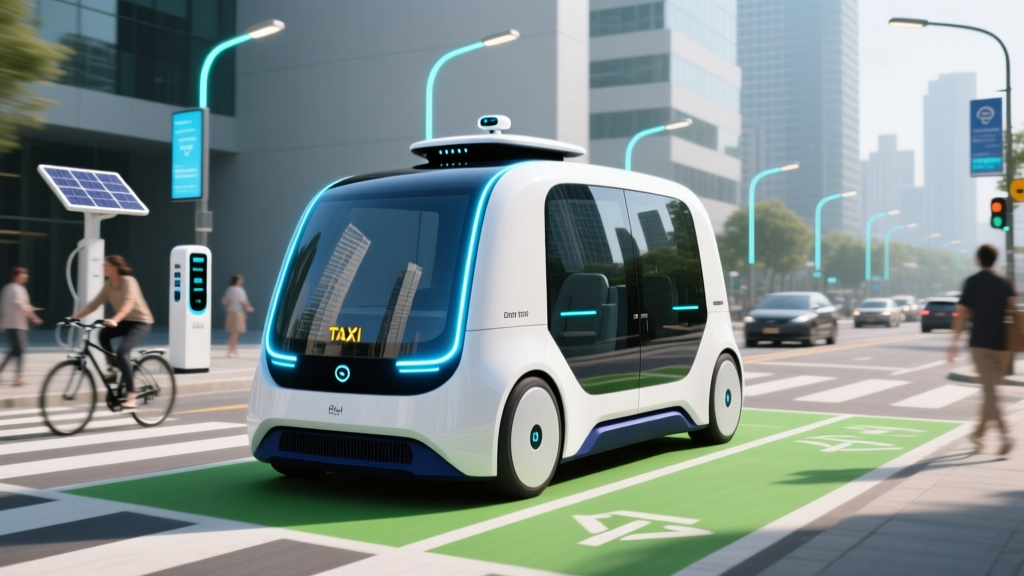
Zoox operates its purpose-built vehicle — a compact, bidirectional pod with no steering wheel or pedals — on the Las Vegas Strip and in Foster City, California. The Las Vegas service is the closest most visitors can get to riding in a true driverless vehicle without living in a Waymo city.
Cruise, once the second-largest US operator, suspended nationwide operations in late 2023 after a serious incident in San Francisco and has been conducting a phased, heavily supervised restart. As of 2026, fully driverless (no safety operator) Cruise rides remain limited.
Robotaxi Pricing: How Does It Compare to Uber and Lyft?
Pricing varies by city, time of day, and trip distance, but robotaxi fares are broadly competitive with UberX and Lyft standard rides — and occasionally cheaper during non-surge periods.
| Service | Base Fare | Per-Mile Rate | Per-Minute Rate | Avg 5-Mile Trip |
|---|---|---|---|---|
| Waymo One (SF) | ~$3.50 | ~$1.25 | ~$0.35 | $11–$15 |
| UberX (SF avg) | ~$3.00 | ~$1.40 | ~$0.40 | $12–$18 |
| Lyft (SF avg) | ~$3.00 | ~$1.35 | ~$0.38 | $11–$17 |
| Waymo One (Phoenix) | ~$2.80 | ~$1.10 | ~$0.30 | $9–$13 |
| UberX (Phoenix avg) | ~$2.50 | ~$1.20 | ~$0.32 | $10–$15 |
Waymo does not implement traditional surge pricing, which can make it significantly cheaper than Uber or Lyft during peak demand windows — Friday evenings, concert nights, or airport rushes. However, Waymo's availability is limited by fleet size; during high-demand periods, wait times can stretch to 15–25 minutes compared to 3–5 minutes for rideshare.
To use Waymo One, download the Waymo app, create an account, and request a ride within the service zone. The app displays the exact pickup spot (often a specific corner or designated pull-over area), the vehicle's license plate, and a real-time map. When the vehicle arrives, you tap a button on the rear door or scan a code to unlock. Inside, a screen confirms your destination and provides a "start ride" button. There is no driver to interact with.
Safety Data: What the Numbers Actually Show
Robotaxi safety is the most scrutinized question in autonomous driving. The data is imperfect but increasingly specific.
Context matters enormously here. Robotaxis operate primarily in dense urban environments at moderate speeds (typically under 45 mph), which reduces the severity of any collisions that do occur. Most Waymo-involved incidents documented in NHTSA's standing general order have been low-speed, rear-end, or sideswipe contacts — frequently caused by other human-driven vehicles striking the robotaxi.
The Cruise suspension in late 2023 illustrates the stakes. A Cruise vehicle in San Francisco struck a pedestrian who had been thrown into its path by a human-driven car, then dragged the pedestrian while pulling to the curb. The incident, and Cruise's subsequent handling of data disclosure to regulators, led to permit revocation by the California DMV and a nationwide operational pause. This single event demonstrates that Level 4 systems, while generally safe in routine scenarios, can fail in complex edge cases involving multi-vehicle interactions and vulnerable road users.
For comparison, the Insurance Institute for Highway Safety (IIHS) notes that human drivers in the US experience approximately 1.35 fatalities per 100 million vehicle miles traveled (2022 data). Robotaxi fleets have not logged enough miles to produce statistically robust fatality-rate comparisons, but the available data on injury and property-damage crashes suggests performance at or above the human average within their ODD.
The Technology Stack: How Level 4 Robotaxis See the World
Current Level 4 robotaxis rely on a multi-sensor fusion approach — a fundamentally different architecture from the camera-only system Tesla uses for FSD Supervised (Level 2).
Typical Level 4 Sensor Suite (Waymo 6th-Generation)
- LiDAR: Multiple roof-mounted and bumper-mounted LiDAR units providing a 360° 3D point cloud out to 500+ meters. LiDAR is independent of ambient light — it performs identically at noon and midnight.
- Cameras: High-resolution cameras (visible spectrum) for lane marking detection, traffic signal state, text recognition (street signs, construction signage), and object classification.
- Radar: Imaging radar units for velocity detection of moving objects and performance in rain or fog where LiDAR and cameras degrade.
- Audio sensors: External microphones to detect sirens from emergency vehicles.
- HD maps: Centimeter-precision pre-mapped routes updated frequently. The vehicle localizes itself against this map in real time.
- Compute: Custom onboard computing platforms processing terabytes of sensor data per hour, running perception, prediction, and planning models.
The reliance on HD maps and geofencing is what makes these systems Level 4 rather than Level 5. The vehicle knows its operating area intimately — every lane width, every signal position, every construction-zone update. Take it outside that mapped zone and the system cannot function. This is a deliberate engineering trade-off: by constraining where the vehicle operates, engineers can achieve extremely high reliability within that zone without needing the general intelligence that Level 5 would require.
Camera-only approaches (Tesla's FSD architecture) argue that LiDAR is unnecessary and that neural networks trained on billions of camera frames can match or exceed multi-sensor fusion. As of 2026, no camera-only system operates at Level 4 without a safety driver. Tesla FSD Supervised remains Level 2 — the driver must remain attentive and is legally responsible for the vehicle at all times.
Regulatory Landscape: Who Approves Robotaxi Operations?
Robotaxi deployment in the United States requires approval from multiple overlapping authorities:
- State DMVs or equivalent: Issue testing and deployment permits. California's DMV and Public Utilities Commission (CPUC) have historically been the most influential regulators, given the concentration of AV development in the state.
- NHTSA (federal): Sets vehicle safety standards (FMVSS). Current standards assume a human driver — steering wheels, mirrors, pedals. NHTSA has issued exemptions for vehicles like the Zoox and GM Cruise Origin that lack these features, but the exemption process is case-by-case and limited in volume.
- City and county governments: Control local road access, curb management, and can impose operational restrictions. San Francisco's Board of Supervisors, for example, has held contentious hearings on robotaxi expansion and imposed conditions on fleet size and operating hours.
- State public utility commissions: In some states, robotaxi services are regulated as transportation network companies or common carriers, requiring separate authorization.
The patchwork nature of regulation means a service approved in Phoenix may face entirely different requirements in Austin or Los Angeles. There is no single federal "robotaxi license." Each market launch requires separate permitting, and local political opposition — often driven by incidents, traffic disruptions, or labor concerns — can delay or restrict expansion indefinitely.
Current Limitations: What Level 4 Robotaxis Cannot Do
The limitations of current robotaxi services are not minor edge cases — they are fundamental constraints that define why Level 5 remains distant.
- Geofencing: Vehicles cannot operate outside their pre-mapped service area. If your destination is 200 feet outside the zone, the service will not serve it. Trips that cross zone boundaries are rejected.
- Weather: Heavy rain, snow, fog, and ice degrade LiDAR and camera performance. Waymo operates in light rain in San Francisco and Phoenix but will suspend service or refuse trips during severe weather. Snow-covered roads — where lane markings and curbs are invisible — are effectively no-go zones for all current Level 4 systems.
- Construction zones: While systems can handle mapped, static construction zones, unexpected road closures or rapidly changing temporary lane configurations can cause the vehicle to stop and wait for remote assistance. This can result in the vehicle sitting stationary in a travel lane until a remote operator provides guidance.
- Complex multi-point interactions: Four-way stops with ambiguous right-of-way, uncontrolled intersections with heavy pedestrian flow, and scenarios involving human hand signals (e.g., a police officer directing traffic) remain challenging. The Cruise pedestrian incident in San Francisco involved precisely this kind of complex, multi-agent scenario.
- No highway driving (most services): Waymo's Phoenix and Austin services include some freeway segments, but most robotaxi operations are urban and suburban surface streets. High-speed highway driving at 70+ mph requires different perception ranges and reaction times that most current Level 4 deployments do not address.
- Pickup/dropoff precision: Vehicles pull to a designated spot, which may not be the exact building entrance you want. In dense urban areas, this can mean a short walk from the dropoff point to your actual destination.
- No special accommodations: Current robotaxis cannot assist with wheelchairs, car seats, large cargo, or pets (service animals excepted). The Zoox vehicle is designed for accessibility, but most Waymo I-PACE vehicles require standard passenger entry.
- Fleet availability: With finite vehicles in each city, wait times during peak demand can exceed 20 minutes. The service is not yet at the ubiquity of Uber or Lyft in any market.
These limitations collectively explain why Level 5 — a system that handles any road, any weather, any scenario, anywhere — is not a matter of incremental software updates. It requires solving problems in general-purpose perception, prediction, and decision-making that remain open research questions in artificial intelligence.
Why Level 5 Remains a Research Horizon
A true Level 5 self-driving car would need to handle scenarios that even experienced human drivers find challenging: navigating an unmapped rural road with faded lane markings in heavy rain, interpreting the hand gestures of a construction flagger, driving on a beach or a frozen lake, or operating in a country whose traffic conventions it has never encountered. Solving this requires what AI researchers call "general intelligence" — the ability to reason about novel situations without prior training data for every specific case.
Current Level 4 systems achieve their impressive safety records precisely by avoiding these scenarios. They operate in mapped, monitored, constrained environments where the set of possible situations is bounded. This is excellent engineering and genuinely useful transportation — but it is categorically different from Level 5.
Industry timelines for Level 5 have consistently slipped. Promises of "five years away" have been a feature of autonomous driving discourse since at least 2016, and the horizon has not materially shortened. The more realistic framing is that Level 4 will continue to expand geographically and operationally over the next decade, while Level 5 remains a long-term research goal without a credible production timeline.
Frequently Asked Questions
Is there a Level 5 self-driving car I can buy in 2026?
No. No production vehicle sold to consumers operates at SAE Level 5. The most advanced consumer systems (Tesla FSD Supervised, GM Super Cruise, Ford BlueCruise) are Level 2 — they assist with steering and acceleration but require continuous driver attention. Mercedes-Benz offers Level 3 (Drive Pilot) in limited markets under very narrow conditions (traffic jams under 40 mph on specific highways). Level 4 exists only in commercial robotaxi fleets, not in vehicles you can purchase.
Where can I ride in a driverless robotaxi today?
In the United States, Waymo One operates fully driverless rides in Phoenix, San Francisco, Los Angeles, and Austin. Zoox operates its purpose-built driverless vehicle in Las Vegas and Foster City, CA. In China, Baidu Apollo Go operates in Beijing, Wuhan, Chongqing, and several other major cities. Availability within each city is limited to specific geofenced zones.
How much does a Waymo ride cost compared to Uber?
Waymo One pricing is generally comparable to UberX, typically within $1–$3 of an equivalent Uber or Lyft trip. Waymo does not use surge pricing, so it can be substantially cheaper during peak demand periods. A typical 5-mile trip in San Francisco costs $11–$15 on Waymo versus $12–$18 on UberX (non-surge). Wait times may be longer due to smaller fleet sizes.
Are robotaxis safer than human drivers?
Available data from Waymo suggests its vehicles are involved in injury-causing crashes at approximately 85% lower rates than the human benchmark in comparable urban driving environments, and property-damage crashes at roughly 55% lower rates. However, robotaxis operate in constrained, lower-speed urban environments and have not accumulated enough miles for statistically robust fatality-rate comparisons. The Cruise pedestrian incident in 2023 demonstrates that serious failures can occur in complex edge cases.
What is the difference between Tesla FSD and a Waymo robotaxi?
Tesla Full Self-Driving (Supervised) is a Level 2 driver-assistance system. Despite the "Full Self-Driving" name, it requires continuous driver supervision — you are legally and practically the driver at all times. It uses cameras only (no LiDAR). Waymo's robotaxi is a Level 4 system: there is no driver, no steering wheel, and no expectation of human intervention, but it operates only within a geofenced, pre-mapped area using LiDAR, cameras, radar, and HD maps. The two systems are fundamentally different in architecture, capability, and legal responsibility.
When will Level 5 self-driving cars be available?
There is no credible production timeline for Level 5 autonomy. The technology requires solving general-purpose perception and decision-making problems that remain open research challenges. Level 4 services will likely continue expanding to more cities and handling more scenarios over the coming decade, but Level 5 — a car that can drive anywhere, in any condition, with no human input — is not imminent. Industry timelines have consistently slipped for over a decade.
Can robotaxis drive in snow or heavy rain?
Current Level 4 robotaxis have significant weather limitations. Waymo operates in light rain but suspends service during severe weather. Snow-covered roads, where lane markings and curbs are obscured, are effectively inoperable for all current Level 4 systems. This is one of the primary reasons Level 4 services are concentrated in cities with mild climates like Phoenix, Los Angeles, and Austin.