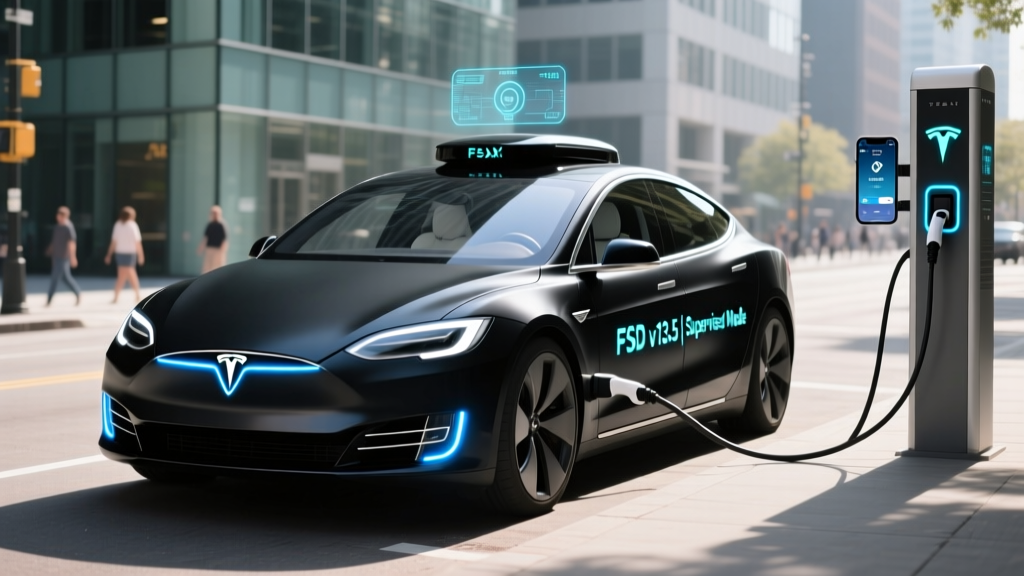
Tesla's Full Self-Driving (Supervised) remains one of the most debated technologies in the auto industry. Despite the name, it does not make any Tesla vehicle autonomous. What it does offer is an advanced Level 2 driver-assistance suite that handles a widening range of real-world scenarios — city streets, highways, parking lots — while demanding continuous driver attention. If you are evaluating whether to purchase or subscribe in 2026, this guide breaks down the exact hardware, software behavior, pricing, and practical limitations you need to know before spending a dollar.
What Tesla FSD Supervised Actually Does
Tesla FSD (Supervised) builds on the company's standard Autopilot system, adding capabilities that extend beyond highway lane-centering and adaptive cruise control. As of the current software generation, FSD Supervised includes:
- Traffic-Aware Cruise Control: Matches speed to surrounding vehicles and road conditions.
- Autosteer: Centers the vehicle in clearly marked lanes on highways and city streets.
- Auto Lane Change: Executes lane changes based on navigation route or driver-confirmed prompts.
- Navigate on Autopilot: Handles highway on-ramps, off-ramps, and interchanges based on the navigation route.
- Traffic Light and Stop Sign Control: Detects and responds to traffic signals and stop signs, slowing or stopping the vehicle.
- City Street Autosteer: Navigates urban intersections, turns, and complex lane configurations.
- Smart Summon: Moves the vehicle through parking lots to the driver's location (low-speed, supervised).
- Autopark: Handles parallel and perpendicular parking maneuvers.
Tesla FSD Supervised is classified as SAE Level 2 under the SAE J3016 standard. This means the system can control steering, acceleration, and braking under certain conditions, but the driver must remain fully engaged — hands on or near the wheel, eyes on the road, ready to intervene at any moment. The vehicle is not driving itself. You are. The system is assisting.
The "Supervised" qualifier Tesla added to the FSD branding is a direct acknowledgment of this regulatory and technical reality. It distinguishes the consumer product from Tesla's internal robotaxi ambitions (which target SAE Level 4 in geofenced areas) and from the marketing impression that the car can operate without a human driver.
Hardware and Sensor Architecture
Tesla's approach to FSD differs fundamentally from competitors. While most advanced ADAS platforms (GM Super Cruise, Ford BlueCruise, Mercedes Drive Pilot) rely on a sensor fusion stack combining cameras, radar, ultrasonic sensors, and in some cases LiDAR, Tesla has committed to a camera-only vision system branded as "Tesla Vision."
| Component | Specification | Role |
|---|---|---|
| Cameras | 8 surround cameras (up to 5 MP resolution on HW4) | 360° environmental perception, object detection, lane reading, traffic sign recognition |
| Radar | Removed (as of 2022+ production) | N/A — no radar redundancy |
| Ultrasonic Sensors | Removed (as of late 2022+ production) | N/A — vision-based parking/proximity |
| Compute Platform | HW4 (AI4) — dual custom FSD SoCs | Neural network inference at ~300+ TOPS |
| GPS/IMU | High-precision GPS + inertial measurement unit | Positioning and motion tracking |
The shift to pure vision was controversial. Tesla argues that neural networks trained on billions of miles of camera data can match or exceed sensor-fusion systems, and that cameras are the only sensor that can read lane markings, traffic signs, and signal states the way a human driver does. Critics — including safety researchers and competing automakers — point to the loss of radar and ultrasonic redundancy, noting that cameras can be blinded by direct sun glare, heavy rain, fog, and snow in ways that radar and LiDAR are not.
Vehicles built from approximately mid-2023 forward ship with HW4 (also called AI4), which features higher-resolution cameras and improved compute. Older HW3 vehicles can still run FSD Supervised but may receive software updates at a different cadence.
Real-World Capabilities: Where FSD Supervised Excels
Based on extensive real-world use across multiple Tesla models and software versions, FSD Supervised performs most competently in the following scenarios:
- Divided highways with clear lane markings: Smooth lane-centering, appropriate speed management, confident on-ramp to off-ramp navigation.
- Suburban arterial roads: Handles multi-lane roads with moderate traffic, protected turn lanes, and standard signalized intersections.
- Stop sign and red light compliance: Generally detects and stops for traffic controls, though driver confirmation is often required before proceeding.
- Navigation-based routing: Follows the programmed route through highway interchanges and exits with minimal intervention on well-mapped roads.
The system has improved substantially in city-street navigation over successive software releases. Turn handling at intersections, lane selection in complex multi-lane configurations, and merging behavior have all seen measurable refinement. On a well-marked suburban route in clear weather, FSD Supervised can manage miles at a stretch without requiring driver takeover — though you must remain attentive throughout.
Real-World Limitations: Where You Must Intervene
- It does not drive autonomously. You are legally and operationally responsible for the vehicle at all times.
- It does not guarantee detection of all obstacles, pedestrians, cyclists, or animals — especially in low-light or cluttered environments.
- It does not handle construction zones reliably. Cones, shifted lanes, and temporary signals can confuse the vision system.
- It does not perform well in heavy rain, fog, snow, or when cameras are obstructed by dirt, ice, or direct sun glare.
- It does not read the intent of other drivers. Cutting-in vehicles, erratic pedestrians, and ambiguous right-of-way scenarios require human judgment.
- It does not operate without a licensed, attentive driver in the seat. The system monitors steering-wheel torque and/or cabin camera attention.
The most common real-world disengagement scenarios include:
- Construction zones: The system may not recognize temporary lane shifts, barrels, or flaggers. Expect to take over immediately.
- Faded or conflicting lane markings: Old markings visible alongside new ones can cause erratic lane-centering or phantom lane-change attempts.
- Unprotected left turns across traffic: The system can be overly cautious or misjudge gaps in oncoming traffic, requiring the driver to complete the maneuver.
- Roundabouts: Performance varies widely by geometry. Simple single-lane roundabouts are often handled; multi-lane configurations with multiple exits frequently require intervention.
- Adverse weather: Heavy rain on the camera housing, snow accumulation on lenses, and dense fog degrade perception. The system may issue a "camera visibility reduced" warning and limit or disengage features.
- Phantom braking: The system occasionally brakes unexpectedly for perceived obstacles that do not exist — an overpass shadow, a roadside sign, or a vehicle in an adjacent lane. This remains a documented concern across NHTSA complaint databases.
Cold-weather operation deserves specific mention. In freezing temperatures, camera lenses can ice over rapidly, and road salt spray creates persistent film. Owners in northern climates report significantly more FSD disengagements in winter months. Keeping cameras clean and using the preconditioning feature before departure helps but does not eliminate the issue.
Pricing: Purchase vs. Subscription in 2026
Tesla offers FSD Supervised through two pricing models. The economics favor different buyers depending on ownership horizon and use case.
| Option | Cost | Transferability | Best For |
|---|---|---|---|
| One-Time Purchase | $8,000 (current price as of 2025-2026) | Non-transferable between vehicles; tied to the car | Long-term owners (5+ years), high-mileage drivers, buyers who want to avoid recurring charges |
| Monthly Subscription | $99/month | Tied to your Tesla account; active on whichever eligible Tesla you own | Short-term owners, drivers testing the feature, those who drive primarily in conditions where FSD adds limited value |
A few financial considerations:
- Break-even: At $99/month, the subscription reaches the $8,000 purchase price in approximately 81 months (6.75 years). If you plan to keep your Tesla longer than that, the purchase is cheaper — but only if you use FSD regularly.
- Standard Autopilot is included: Every new Tesla ships with Basic Autopilot (Traffic-Aware Cruise Control + Autosteer on highways) at no extra cost. FSD Supervised is an upgrade on top of that baseline.
- No federal tax credit for FSD: The IRS §30D clean vehicle credit applies to the vehicle itself, not to software add-ons. FSD purchase or subscription cost does not qualify for any federal incentive.
- Used Tesla transfers: Tesla occasionally allows FSD transfers during promotional periods, but the default policy is that FSD purchased outright stays with the vehicle (increasing its resale value modestly), while subscriptions do not transfer.
- Insurance impact: Some insurers offer modest discounts for ADAS-equipped vehicles, but FSD specifically is not universally recognized as a discount-qualifying feature. Check with your carrier.
Which Tesla Models Include FSD Supervised?
FSD Supervised is not standard equipment on any Tesla model. It is available as a purchase or subscription add-on across the current lineup:
| Model | Basic Autopilot (Included) | Enhanced Autopilot (EAP)* | FSD Supervised (Add-On) |
|---|---|---|---|
| Model 3 (Highland / current) | Standard | $6,000 purchase | $8,000 purchase / $99/mo |
| Model Y (current / Juniper) | Standard | $6,000 purchase | $8,000 purchase / $99/mo |
| Model S (current) | Standard | $6,000 purchase | $8,000 purchase / $99/mo |
| Model X (current) | Standard | $6,000 purchase | $8,000 purchase / $99/mo |
| Cybertruck | Standard | Available | $8,000 purchase / $99/mo |
*Enhanced Autopilot (EAP) includes Navigate on Autopilot, Auto Lane Change, Autopark, and Summon — but excludes City Street Autosteer and Traffic Light/Stop Sign Control. It sits between Basic Autopilot and FSD Supervised in capability and price.
All current-production Tesla vehicles ship with HW4/AI4 hardware, meaning they are technically capable of running the full FSD Supervised software stack. The differentiation is purely software-locked: you pay to unlock the features.
How FSD Supervised Compares to Competing Systems
Tesla's camera-only approach and aggressive feature set make FSD Supervised unique, but it is not the only advanced Level 2 system on the market. Here is how it stacks up against key competitors in practical terms:
| Feature | Tesla FSD Supervised | GM Super Cruise | Ford BlueCruise | Mercedes Drive Pilot |
|---|---|---|---|---|
| SAE Level | Level 2 | Level 2 | Level 2 | Level 3 (limited conditions) |
| Hands-Free Allowed | No — steering wheel torque / camera monitoring | Yes — on pre-mapped divided highways | Yes — on pre-mapped divided highways | Yes — up to 60 mph on approved highways (eyes off) |
| City Street Operation | Yes (supervised) | Limited (newer versions expanding) | No (highway only) | No (highway only, limited conditions) |
| Sensor Stack | Cameras only | Cameras + LiDAR + radar + HD maps | Cameras + radar | Cameras + LiDAR + radar + HD maps |
| Geo-Fencing | No — operates on any road | Yes — ~750,000+ miles of pre-mapped roads | Yes — ~130,000+ miles of pre-mapped roads | Yes — approved highway segments only |
| Driver Monitoring | Cabin camera + steering torque | IR camera (eye tracking) | IR camera (eye tracking) | Camera + readiness monitoring |
| Cost | $8,000 or $99/mo | Included on select trims; ~$2,200 on others | $2,100 (2-year trial) then ~$75/mo | ~$2,500/year subscription (S-Class/EQS) |
The critical distinction: GM Super Cruise and Ford BlueCruise allow true hands-free driving on mapped highways, using infrared driver-monitoring cameras to ensure your eyes remain on the road. Tesla FSD Supervised covers a broader range of road types (including city streets) but does not permit hands-free operation. Mercedes Drive Pilot is the only system currently certified at SAE Level 3 in the U.S. (in Nevada and California), meaning the automaker accepts liability during system operation — but only under very narrow conditions (approved highways, under 60 mph, clear weather).
If your priority is hands-free highway cruising on road trips, Super Cruise is arguably the more relaxing experience. If you want the broadest coverage across road types and are willing to maintain active supervision, FSD Supervised offers more versatility.
Safety Data and Regulatory Context
Tesla publishes quarterly safety reports claiming that vehicles operating with Autopilot engaged record fewer crashes per million miles than the U.S. average. However, these reports have drawn scrutiny for methodological limitations — primarily that Autopilot is used disproportionately on divided highways (the safest road type), making direct comparison to the national average (which includes urban, rural, and adverse-condition driving) statistically imprecise.
The National Highway Traffic Safety Administration (NHTSA) has opened and maintained multiple investigations into Tesla's Autopilot and FSD systems, including incidents involving collisions with stationary emergency vehicles and the adequacy of Tesla's driver-engagement safeguards. As of 2026, some investigations remain open. The Insurance Institute for Highway Safety (IIHS) has consistently rated partial-automation systems across all brands as not meeting its criteria for safe driver monitoring, a critique that applies to Tesla's system as well.
For buyers, the practical takeaway is this: FSD Supervised is a capable driver-assistance tool, not a safety guarantee. It can reduce fatigue on long drives and handle routine navigation tasks, but it introduces its own failure modes — phantom braking, misread lane markings, vision degradation in weather — that require a driver who is genuinely paying attention, not one who has mentally checked out.
Frequently Asked Questions
Is Tesla FSD Supervised actually self-driving?
No. FSD Supervised is an SAE Level 2 driver-assistance system. The driver must remain fully engaged — hands near the wheel, eyes on the road — at all times. The vehicle cannot operate without a licensed driver in the seat. Tesla's "Supervised" branding is explicit about this requirement. True self-driving (SAE Level 4) in the U.S. is currently limited to geofenced robotaxi services like Waymo in select cities.
Can I use FSD Supervised on any road?
Unlike Super Cruise or BlueCruise, which are restricted to pre-mapped highway segments, FSD Supervised can be activated on virtually any public road. However, performance quality varies enormously. It excels on well-marked highways and suburban roads but can struggle with unmapped roads, construction zones, rural roads with no lane markings, and complex urban environments.
Does FSD Supervised improve over time?
Yes. Tesla delivers over-the-air software updates that refine neural network performance, add features, and address identified failure modes. Vehicles with HW4/AI4 hardware generally receive the most current software capabilities. However, improvement is incremental, not transformational — each update refines existing behavior rather than fundamentally expanding the system's operational design domain.
What happens if I ignore the attention warnings?
If the cabin camera or steering-torque sensor determines you are not paying attention, the system issues escalating visual and audible warnings. Continued inattention results in FSD disengagement for the remainder of that drive cycle. Repeated violations can lead to a temporary "FSD suspension" — a one-week (or longer) lockout from the feature. Tesla's driver-monitoring enforcement has become stricter in recent software versions.
Is FSD Supervised worth $8,000?
It depends on your driving patterns and expectations. If you commute daily on congested highways or frequently take long road trips and value reduced mental fatigue, FSD Supervised can meaningfully improve the driving experience. If you primarily drive in adverse weather, construction-heavy areas, or unmapped rural roads, the system's limitations may frustrate you more than they help. The $99/month subscription is a low-risk way to evaluate whether the feature justifies the cost for your specific use case before committing to the full purchase price.
Does FSD Supervised affect my Tesla's insurance premium?
Possibly, but not uniformly. Some insurers recognize ADAS features as discount-qualifying; others do not specifically account for FSD. Tesla Insurance (available in select states) uses real-time driving data, including Autopilot/FSD usage, in its pricing model. Contact your insurer directly for a quote comparison with and without the feature.