What the Tesla FSD Subscription Actually Delivers
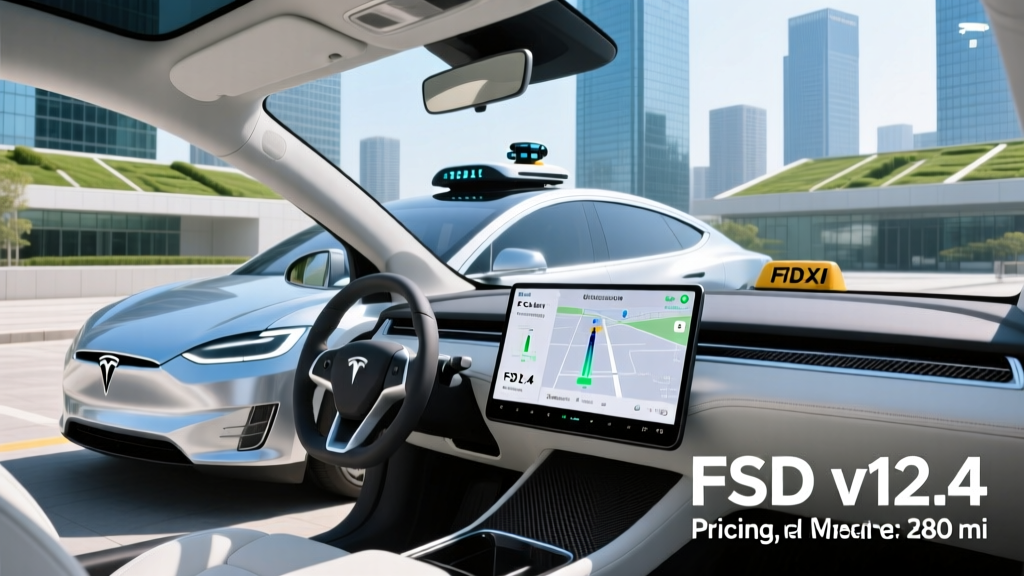
Tesla's Full Self-Driving (FSD) capability — now branded as FSD (Supervised) — remains one of the most talked-about and misunderstood driver-assistance systems on the road. Despite the "Full Self-Driving" name, it is a Level 2 system that requires continuous driver attention. For 2026, Tesla offers FSD as a $99/month subscription or a $8,000 one-time purchase, available across the Model 3, Model Y, Model S, and Model X lineup.
FSD (Supervised) builds on Tesla's standard Autopilot (which includes Traffic-Aware Cruise Control and Autosteer) by adding:
- Auto Lane Change: Initiates and completes highway lane changes based on navigation route and surrounding traffic.
- Navigate on Autopilot: Actively guides the vehicle from highway on-ramp to off-ramp, including interchange handling.
- Autopark: Detects parallel and perpendicular parking spaces and steers the vehicle into them.
- Summon / Smart Summon: Moves the vehicle short distances in parking lots via the Tesla app (Smart Summon navigates to the driver within a limited range).
- Traffic Light and Stop Sign Control: Detects and responds to traffic signals and stop signs, slowing or stopping the vehicle accordingly.
- City Streets (Supervised): Handles turns, intersections, and urban driving scenarios — the most complex component of the FSD stack.
FSD (Supervised) is classified as SAE Level 2 per the Society of Automotive Engineers. The driver must remain fully engaged — hands near or on the wheel, eyes on the road — at all times. Tesla's cabin camera monitors driver attention, and the system will issue escalating warnings and eventually disengage if attention lapses. This is not autonomous driving. Level 4 services like Waymo operate without any human driver in defined zones; FSD does not reach that threshold anywhere.
How FSD Works: Hardware and Sensor Architecture
Tesla's approach diverges sharply from competitors. While Ford's BlueCruise and GM's Super Cruise rely on a fusion of cameras, radar, and in some cases LiDAR, Tesla has committed to a camera-only (Tesla Vision) architecture since removing radar and ultrasonic sensors from production vehicles starting in 2022-2023.
| Component | Specification |
|---|---|
| Camera count | 8 exterior cameras (surround-view) |
| Radar | Removed (Tesla Vision only, HW4) |
| Ultrasonic sensors | Removed (Tesla Vision only, HW4) |
| Compute platform | Hardware 4 (HW4) — dual-chip FSD computer, ~2x processing over HW3 |
| Interior monitoring | Cabin-facing camera for driver attention enforcement |
| AI approach | End-to-end neural network (v12+), trained on fleet video data |
The shift to an end-to-end neural network (introduced with FSD v12 in early 2024 and iterated through 2025-2026) replaced most hand-coded rules with a vision-based model that processes raw camera input directly into driving decisions. In practice, this has made FSD behavior smoother and more human-like in many scenarios — but it also means the system can make errors that are harder to predict, since its decision-making is learned rather than rule-based.
Cost Breakdown: Subscription vs. One-Time Purchase
Tesla structures FSD pricing in two tiers, and the math depends heavily on how long you plan to keep the vehicle.
| Option | Cost | Notes |
|---|---|---|
| FSD (Supervised) Subscription | $99/month | Cancel anytime; no long-term commitment. Transfers only to your Tesla account, not to a new vehicle. |
| FSD (Supervised) Purchase | $8,000 | One-time. Tied to the vehicle, transfers to new owner if you sell. Adds to vehicle trade-in/appraisal value (partially). |
| Standard Autopilot | Included | Traffic-Aware Cruise Control + Autosteer (lane centering on marked highways). No subscription needed. |
| Enhanced Autopilot | $6,000 | Adds Navigate on Autopilot, Auto Lane Change, Autopark, Summon. No city-streets capability. |
The breakeven point: At $99/month, the subscription reaches $8,000 in approximately 81 months (6.75 years). If you plan to own your Tesla for fewer than ~5-6 years, the subscription is the clear financial winner. If you'll keep the car longer — or believe FSD purchase adds meaningful resale value — the upfront buy may make sense.
One important caveat: Tesla has periodically offered FSD transfer promotions (allowing a one-time transfer of a purchased FSD license to a new Tesla). These are promotional, not guaranteed, and should not be factored into your purchase decision unless active at the time of buying.
Which Tesla Models and Trims Include FSD?
FSD (Supervised) is available as an add-on across the entire 2026 Tesla lineup, but hardware compatibility matters:
- Model 3 (Highland/2024+ refresh): All trims ship with HW4. FSD subscription or purchase available on any trim.
- Model Y (Juniper/2025+ refresh): HW4 standard. FSD available across all trims.
- Model S / Model X (current generation): HW4 retrofits and new-production HW4 units. FSD available.
- Cybertruck: HW4 standard. FSD available, though feature parity with sedan/SUV platforms has historically lagged by several software releases.
- Older HW3 vehicles (pre-2023 production): Tesla has indicated HW3 vehicles will continue to receive FSD updates, but the compute ceiling is lower. Some advanced neural network features may be constrained on HW3 hardware.
No Tesla model comes with FSD as standard equipment — it is always an optional upgrade on top of the vehicle's base MSRP. Standard Autopilot is included with every new Tesla.
Real-World Capabilities and Honest Limitations
Having tested FSD (Supervised) across highway, suburban, and dense urban environments, here's a grounded assessment of what it handles well and where it still struggles.
Where FSD Performs Well
- Highway driving: Lane centering, adaptive cruise, and automated lane changes on well-marked interstates are FSD's strongest use case. Navigate on Autopilot handles ramp-to-ramp transitions smoothly in most conditions.
- Suburban arterial roads: With clear lane markings and moderate traffic, FSD manages speed, following distance, and gentle curves competently.
- Traffic light/stop sign compliance: The system reliably detects signals and stops appropriately — though it occasionally pauses unnecessarily at all-way stops when no cross-traffic exists.
Where FSD Falls Short
- Construction zones: Barrel lines, shifted lanes, and temporary markings frequently confuse the system. Expect to take over.
- Heavy rain, fog, snow: Camera-only architecture means visibility degradation directly impacts performance. FSD will restrict itself or disengage in poor weather more aggressively than radar-equipped competitors.
- Unprotected left turns: Complex intersections with oncoming traffic and multiple turn lanes remain challenging. Hesitation or overly aggressive timing can occur.
- Faded or absent lane markings: Rural roads and older infrastructure without clear paint cause the system to struggle or disengage.
- Edge-case pedestrians/cyclists: While generally good at detection, unusual trajectories (jaywalkers, cyclists in mixed traffic) require driver readiness.
- Phantom braking: Sudden, unnecessary deceleration on highways — particularly near overpasses or shadows — remains a documented issue. NHTSA has received numerous consumer complaints on this behavior across Tesla models.
Cold-weather note: In sub-freezing temperatures, camera lenses can accumulate ice or condensation, triggering FSD degradation or unavailability. Unlike radar-based systems that can partially see through precipitation, Tesla Vision has no fallback sensor for this scenario. Keeping cameras clean and using the vehicle's preconditioning helps, but winter FSD reliability is measurably lower than in clear conditions.
FSD vs. Competing Driver-Assist Systems
Tesla's FSD doesn't operate in a vacuum. Here's how it compares to the major Level 2 competitors available in 2026:
| Feature | Tesla FSD (Supervised) | GM Super Cruise | Ford BlueCruise | Mercedes Drive Pilot |
|---|---|---|---|---|
| SAE Level | Level 2 | Level 2 | Level 2 | Level 3 (limited) |
| Hands-free allowed? | No (hands-on/near wheel) | Yes (mapped highways, eyes monitored) | Yes (mapped highways, eyes monitored) | Yes (specific conditions, ≤40 mph) |
| City streets? | Yes (supervised) | Limited (door-to-door on mapped routes) | No (highway only) | No |
| Sensor suite | Camera only | Camera + radar + LiDAR | Camera + radar | Camera + radar + LiDAR |
| Subscription cost | $99/mo or $8,000 | $25/mo (after trial) or $2,500 | $75/mo or $2,100 | $2,500/yr (included in select EQS/S-Class) |
| Geofenced? | No (any road) | Yes (400,000+ mi mapped) | Yes (130,000+ mi mapped) | Yes (select highways, NV/CA) |
Key takeaway: Tesla FSD offers the broadest geographic coverage (no geofencing) and the most ambitious feature set (city streets). However, Super Cruise and BlueCruise offer genuine hands-free driving on mapped highways — something FSD still does not permit. Mercedes' Drive Pilot is the only Level 3 consumer system in the US, allowing the driver to legally disengage under strict conditions (low speed, mapped freeways, good weather), but availability is limited to Nevada and California on the EQS and S-Class.
Safety Record and Regulatory Context
Tesla publishes quarterly safety reports, and FSD-equipped vehicles show lower crash rates per million miles than the US average. However, these statistics encompass all Tesla driving (including manual), and selection bias (FSD users may be more cautious) complicates direct comparison.
NHTSA has opened multiple investigations into Tesla's Autopilot/FSD system, particularly around crashes involving stationary emergency vehicles and phantom braking events. As of 2026, no federal recall has mandated FSD removal, but software updates have been required to address specific behaviors (e.g., rolling stop adjustments, increased driver monitoring strictness).
IIHS research consistently shows that Level 2 systems, including Tesla's, can lead to driver complacency — the "automation paradox" where drivers over-trust the system and under-monitor the road. Tesla's cabin camera monitoring is designed to counteract this, but studies suggest gaze monitoring is less robust than the steering-wheel torque sensors used by some competitors.
Is the FSD Subscription Worth It?
The answer depends on your driving profile:
- You drive frequently on highways and want Navigate on Autopilot for long commutes.
- You plan to keep your Tesla for fewer than 5-6 years.
- You want to test FSD's city-streets capability before committing to an $8,000 purchase.
- You're curious about the technology and want the flexibility to cancel.
Skip FSD (stick with standard Autopilot) if:
- Your driving is primarily short urban trips where FSD's overhead isn't justified.
- You live in an area with harsh winters where camera-only limitations will frequently restrict the system.
- You prefer hands-free highway driving — Super Cruise or BlueCruise on a GM/Ford vehicle may better serve you.
- You don't trust the system enough to justify the monthly cost given that you'll still need to supervise constantly.
Standard Autopilot — included with every Tesla — already provides excellent adaptive cruise control and lane centering for highway use. For many owners, that's sufficient, and the $99/month FSD subscription adds value primarily through city-streets capability and automated parking features that are convenient but not essential.
Frequently Asked Questions
Can I cancel the FSD subscription at any time?
Yes. The $99/month FSD subscription can be cancelled through your Tesla account at any time with no penalty. Features revert to standard Autopilot upon cancellation.
Does FSD transfer if I sell my Tesla?
If you purchased FSD outright ($8,000), it stays with the vehicle and transfers to the new owner. The monthly subscription does not transfer — it's tied to your Tesla account, not the car.
Is Tesla FSD actually self-driving?
No. FSD (Supervised) is an SAE Level 2 driver-assistance system. The driver must remain fully attentive, with hands on or near the steering wheel, and be prepared to take over immediately at any time. It is not autonomous.
Does FSD work in bad weather?
FSD performance degrades significantly in heavy rain, snow, and fog due to its camera-only architecture. The system may issue warnings, restrict functionality, or disengage entirely. In cold weather, iced or fogged cameras further limit availability.
What hardware do I need for FSD?
All 2026 Tesla vehicles ship with Hardware 4 (HW4), which is fully compatible with FSD (Supervised). Vehicles produced before mid-2023 may have HW3, which still supports FSD but with lower compute headroom for future neural network updates.
How does FSD compare to GM Super Cruise?
Super Cruise allows genuine hands-free driving on over 400,000 miles of mapped highways, using LiDAR, radar, and cameras. FSD covers any road but requires hands on/near the wheel. Super Cruise is more reliable on its mapped routes; FSD is more versatile geographically but demands more driver engagement.
Will FSD ever become truly autonomous?
Tesla has predicted full autonomy for years, and timelines have consistently slipped. As of 2026, FSD remains Level 2. Regulatory approval for Level 4 consumer vehicles (without a human driver) does not currently exist in the US outside of commercial robotaxi operations like Waymo. Treat any future autonomy claims with appropriate skepticism.