Tesla's Full Self-Driving (Supervised) remains one of the most debated features in the EV world — and one of the most misunderstood. With a $8,000 one-time purchase price or a $99/month subscription in 2026, many owners are asking a practical financial question: does paying for FSD actually lower your auto insurance premium? The short answer is complicated, and it depends heavily on your insurer, your state, and how you define the feature's actual capabilities.
This guide cuts through the marketing noise. We'll examine what FSD Supervised actually does from a technical standpoint, why insurers remain cautious about offering discounts, which carriers currently recognize Tesla's driver-assistance tech, and what real-world ownership data tells us about safety outcomes.
What Tesla FSD Supervised Actually Does
Full Self-Driving (Supervised) is Tesla's highest-tier driver-assistance package, layered on top of the standard Autopilot system that ships with every new Tesla. Here's what the system handles in its current 2026 iteration:
| Feature | What It Does | Availability |
|---|---|---|
| Traffic-Aware Cruise Control | Maintains set speed and following distance | Standard (Autopilot) |
| Autosteer | Keeps vehicle centered in marked lanes | Standard (Autopilot) |
| Navigate on Autopilot | Suggests lane changes, handles highway interchanges | FSD only |
| Auto Lane Change | Executes lane changes based on navigation route | FSD only |
| Autopark | Parallel and perpendicular parking assist | FSD only |
| Summon / Smart Summon | Moves car to owner in parking lots via app | FSD only |
| Traffic Light & Stop Sign Control | Detects and responds to signals and signs | FSD only |
| City Street Autosteer | Navigates urban roads, turns, and intersections | FSD only |
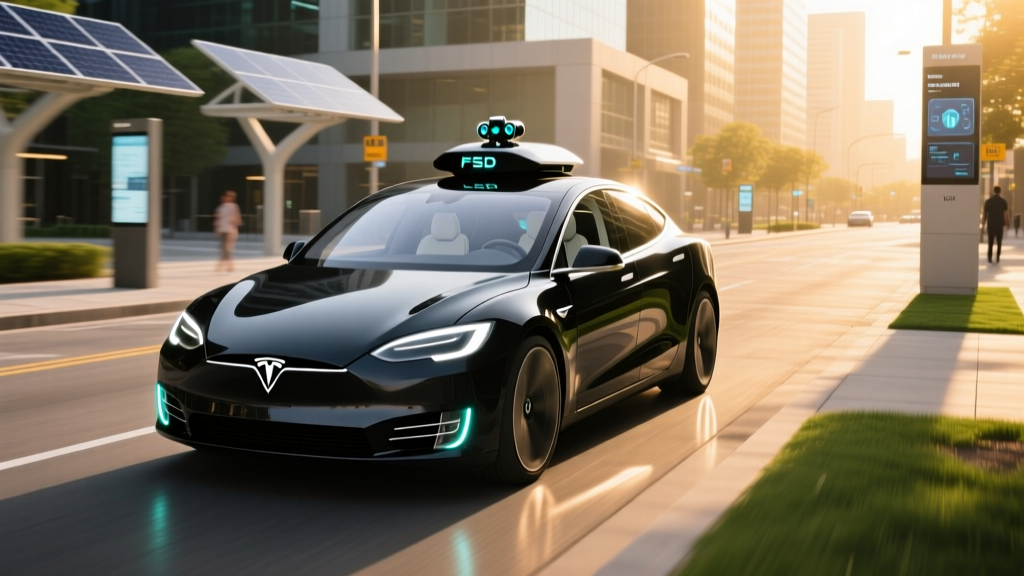
Technically, FSD Supervised relies on a vision-only architecture — Tesla removed ultrasonic sensors and radar from its vehicles starting in 2022–2023, depending on the model. The system processes input from eight external cameras (front, front-side, rear-side, and rear) through Tesla's custom HW4.0 (or HW5.0 on newer builds) neural-network processor. There is no LiDAR and no radar redundancy, which sets Tesla apart from competitors like GM's Super Cruise and Ford's BlueCruise that incorporate radar and, in some cases, LiDAR alongside cameras.
Despite the "Full Self-Driving" name, FSD Supervised is classified as SAE Level 2 — a partial driver-assistance system. Per the SAE J3016 standard, Level 2 means the system can control steering and acceleration simultaneously, but the human driver must remain fully engaged, monitor the environment at all times, and be prepared to take over instantly. This is not autonomous driving. Only Level 4 systems (like Waymo's driverless robotaxi service) operate without a human supervisor.
The Insurance Discount Question: Where Insurers Stand
The core tension is straightforward: Tesla markets FSD as an advanced safety feature, but insurers see a Level 2 system that still requires full driver attention — and whose name may encourage over-reliance. As of early 2026, the insurance landscape for FSD breaks down as follows:
Tesla Insurance
Tesla's own insurance product, available in most U.S. states, uses a real-time Safety Score (0–100) that factors in driving behavior — including how the driver uses Autopilot and FSD. Drivers who consistently engage Autopilot on highway miles and maintain high safety scores can see premiums 20–40% lower than comparable carriers, according to Tesla's own disclosures. However, this discount is driven by the telematics-based Safety Score overall, not exclusively by FSD ownership. A driver who never purchases FSD but scores well on the Safety Score can achieve similar rates.
Third-Party Insurers
Major national carriers — including State Farm, GEICO, Progressive, and Allstate — do not currently offer a specific discount for FSD or Autopilot. Some carriers offer general "advanced driver-assistance system" (ADAS) discounts (typically 5–10%) for features like automatic emergency braking and lane-keeping assist, which Teslas include as standard. But FSD's city-street driving and Navigate on Autopilot features are not recognized as discount-qualifying by these carriers.
The reason is actuarial: insurers require large-scale, peer-reviewed loss data demonstrating that a specific feature reduces claim frequency or severity. While NHTSA data and IIHS studies show that automatic emergency braking and basic lane-keeping reduce rear-end and lane-departure crashes, the data on advanced Level 2 systems like FSD city-street driving is still evolving. Some studies have raised concerns about driver complacency with advanced systems.
State-Specific Variations
Insurance regulation is state-level in the U.S. A handful of states mandate that insurers offer discounts for specific passive anti-theft or safety features. No state currently mandates a discount for Level 2 ADAS specifically. If you're shopping for insurance, ask your agent directly about ADAS discounts and whether your carrier distinguishes between standard Autopilot (included) and FSD (paid add-on). In most cases, they do not.
FSD Cost Breakdown: Purchase vs. Subscription
Understanding whether FSD is financially worthwhile — insurance discount or not — requires a clear picture of what it costs.
| Option | Cost (2026) | Notes |
|---|---|---|
| One-time purchase | $8,000 | Transfers to the car, not the owner; included at resale |
| Monthly subscription | $99/month | Cancel anytime; tied to your Tesla account, not the vehicle |
| Standard Autopilot | $0 (included) | TACC + Autosteer on highways; no city-street or Navigate on Autopilot |
The subscription model makes financial sense for drivers who want to test FSD or use it primarily on road trips. At $99/month, you'd need to keep the subscription for roughly 6.7 years to equal the one-time $8,000 purchase. However, if you sell your Tesla, the $8,000 purchase stays with the vehicle (potentially aiding resale value), while the subscription simply ends.
For insurance purposes: since no major third-party carrier offers an FSD-specific discount, the $8,000 purchase or $99/month fee should be viewed as a convenience and technology expense, not an insurance-offset investment. Tesla Insurance's Safety Score discount applies regardless of whether you've purchased FSD.
Which Tesla Models Include FSD?
FSD Supervised is available as an add-on across Tesla's entire 2026 lineup. It is never standard — you must purchase or subscribe. Standard Autopilot (TACC and basic Autosteer) ships with every new Tesla at no additional cost.
| Model | Standard Autopilot | FSD Availability | Hardware |
|---|---|---|---|
| Model 3 (2026 refresh) | Included | $8,000 or $99/mo | HW4.0 / HW5.0 |
| Model Y (2026 Juniper) | Included | $8,000 or $99/mo | HW4.0 / HW5.0 |
| Model S / X (2026) | Included | $8,000 or $99/mo | HW4.0 |
| Cybertruck | Included | $8,000 or $99/mo | HW4.0 |
Important: vehicles built before mid-2019 with HW2.5 or earlier hardware cannot run the current FSD neural-network stack. If you're buying a used Tesla and FSD matters, verify the hardware generation via the vehicle's software menu before purchase.
Real-World Limitations: What FSD Cannot Do
- Driver supervision is mandatory. Tesla's cabin camera monitors eye gaze. Repeated warnings for inattention will escalate to FSD suspension for the remainder of the trip — and can affect your Tesla Insurance Safety Score.
- Weather degradation. Heavy rain, fog, snow, and direct sun glare can impair camera-only perception. The system will alert the driver and may disengage, requiring immediate manual control.
- Construction zones. Temporary lane markings, shifted lanes, and cone-only boundaries remain challenging. FSD may follow old lane lines or fail to recognize temporary routing.
- Unprotected left turns. City-street FSD handles many intersections, but complex unprotected left turns across heavy traffic can result in hesitation or overly conservative behavior that disrupts traffic flow.
- Unmarked roads. Rural roads without clear lane markings, faded paint, or gravel shoulders can cause Autosteer to disengage or behave unpredictably.
- Emergency vehicles. While FSD can detect emergency vehicle lights, it may not always yield or pull over as quickly as a attentive human driver.
In real-world testing across varied conditions, FSD Supervised in its current build handles highway driving with high confidence — lane changes, on-ramp to off-ramp navigation, and speed adjustments in traffic are generally smooth. City-street performance has improved substantially but remains variable by geography. Well-mapped, clearly marked suburban arterials in Phoenix or Austin perform far better than narrow, poorly marked streets in older East Coast cities.
How FSD Compares to Competing ADAS Systems
| System | Brand | SAE Level | Hands-Free? | Cost | Geofenced? |
|---|---|---|---|---|---|
| FSD Supervised | Tesla | Level 2 | No (hands-on-wheel or gaze monitoring) | $8,000 / $99/mo | No — available on all roads |
| Super Cruise | GM (Cadillac, Chevy) | Level 2 | Yes (on mapped highways) | ~$2,500 or included on select trims | Yes — 750,000+ mi of mapped roads |
| BlueCruise | Ford / Lincoln | Level 2 | Yes (on mapped highways) | $2,100 or $75/mo (after trial) | Yes — 130,000+ mi of divided highways |
| Drive Pilot | Mercedes-Benz | Level 3 | Yes (under 40 mph, specific conditions) | $2,500/yr subscription | Yes — approved highways in NV and CA only |
Mercedes-Benz's Drive Pilot is currently the only NHTSA-recognized Level 3 system available to U.S. consumers, meaning the manufacturer accepts liability during approved operation. However, it's limited to specific highway conditions under 40 mph in Nevada and California. GM's Super Cruise and Ford's BlueCruise offer true hands-free driving on mapped highways — something Tesla's FSD still requires driver gaze monitoring for — but they don't handle city streets.
None of these competing systems currently qualify for dedicated insurance discounts from major carriers, either. The ADAS-discount landscape is still in its infancy industry-wide.
The Bottom Line on FSD and Insurance Savings
If you're considering FSD primarily to save on insurance, the math doesn't support it in 2026. No major third-party insurer offers an FSD-specific discount, and Tesla Insurance's savings come from the Safety Score telematics system — not from FSD ownership itself. The $8,000 purchase or $99/month subscription should be evaluated on its own merits: do you value the convenience of highway navigation, automated parking, and city-street assist enough to pay for it?
For maximum insurance savings with a Tesla, focus on maintaining a high Safety Score by using Autopilot responsibly on highway miles, avoiding hard braking events, and keeping annual mileage moderate. These behavioral factors — not the FSD purchase — are what drive Tesla Insurance premiums down.
Frequently Asked Questions
Does having FSD lower my insurance premium with State Farm, GEICO, or Progressive?
As of 2026, no major national carrier offers a specific discount for Tesla FSD. Some carriers offer small (5–10%) ADAS discounts for automatic emergency braking and lane-keeping, which are standard on all Teslas regardless of FSD purchase. Ask your agent about available ADAS discounts, but don't expect FSD to qualify separately.
Does Tesla Insurance give a discount for using Autopilot or FSD?
Tesla Insurance uses a real-time Safety Score that rewards consistent Autopilot use on highways, smooth driving, and low mileage. High Safety Scores can reduce premiums by 20–40%. However, this discount is available to all Tesla drivers — you don't need to purchase FSD to achieve a high score. Standard Autopilot (included free) is sufficient.
Is FSD actually self-driving?
No. FSD Supervised is SAE Level 2, which means the driver must remain fully engaged and supervise the system at all times. Tesla's cabin camera enforces attention monitoring. Only Level 4 systems like Waymo's robotaxi operate without a human driver. The "Full Self-Driving" name is a product branding choice, not a technical classification.
Is the $8,000 FSD purchase worth it over the $99/month subscription?
It depends on your ownership timeline. At $99/month, the subscription equals $8,000 in about 6.7 years. If you plan to keep your Tesla longer than that, the purchase saves money — and it transfers to the next owner at resale. If you switch cars frequently or only want FSD for road trips, the subscription offers flexibility with no long-term commitment.
Can FSD handle bad weather like rain and snow?
Tesla's vision-only system is more susceptible to weather degradation than radar-equipped competitors. Heavy rain, snow accumulation on cameras, fog, and direct sun glare can reduce system confidence or trigger disengagement. Always be prepared to take over immediately in adverse conditions. Keep cameras clean and free of ice or dirt.
Will insurance companies eventually offer FSD discounts?
It's possible but not imminent. Insurers need large-scale actuarial data proving that advanced Level 2 systems reduce claims. As more peer-reviewed studies are published and as systems evolve toward Level 3 or 4, carriers may introduce discounts. For now, the industry treats FSD as a convenience feature, not a proven risk-reduction technology.