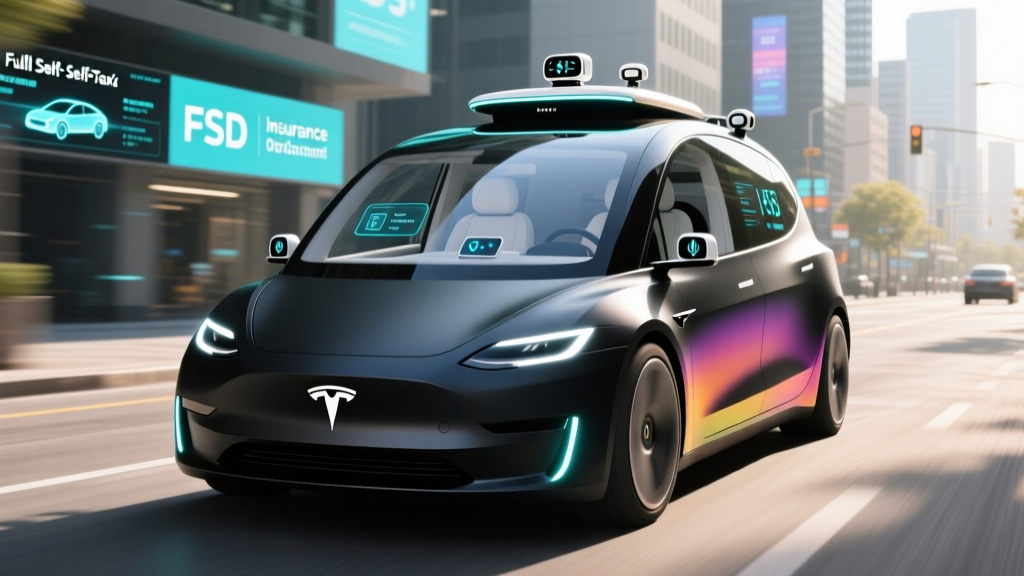
Tesla has quietly built one of the most data-driven insurance programs in the auto industry. By leveraging the telemetry already collected by its Full Self-Driving (Supervised) system, the company offers insurance premiums that can undercut traditional carriers — but only if your driving behavior cooperates. In 2026, Tesla bundles FSD usage with in-house insurance discounts through its real-time Safety Score mechanism, creating a feedback loop between how you drive and what you pay each month.
This guide breaks down exactly how the Tesla Insurance and FSD bundle works, what FSD (Supervised) actually does on the road, where the system falls short, and whether the combined cost makes financial sense compared to competing ADAS platforms from Ford, GM, and others.
What Tesla Full Self-Driving (Supervised) Actually Does
Tesla's Full Self-Driving (Supervised) — often abbreviated FSD — is the company's most advanced driver-assistance package. It builds on the base Autopilot system with additional capabilities designed for both highway and city street use.
| Feature | Description | Environment |
|---|---|---|
| Traffic-Aware Cruise Control | Maintains set speed, adjusts for vehicles ahead | Highway / City |
| Autosteer | Active lane centering with lane-change assistance | Highway / City |
| Auto Lane Change | Suggests and executes lane changes based on navigation route | Highway |
| Navigate on Autopilot | On/off-ramp guidance, toll-road and interchange routing | Highway |
| City Street Autosteer | Traffic light and stop sign recognition, intersection handling | City streets |
| Smart Summon | Navigates parking lots to driver's location (low-speed) | Parking lots |
| Autopark | Parallel and perpendicular parking automation | Parking |
Under the hood, Tesla's vision-only approach relies on a suite of cameras — typically 8 external cameras providing 360-degree coverage — processed through the Hardware 4 (AI4) computer. Tesla removed ultrasonic sensors and radar from new production vehicles beginning in 2022–2023, betting entirely on neural-network-driven vision processing. This architecture is fundamentally different from competitors like GM's Super Cruise or Ford's BlueCruise, which supplement cameras with LiDAR-mapped HD routes or radar arrays.
SAE Automation Level: Level 2
Critical clarification: Despite the "Full Self-Driving" branding, Tesla FSD (Supervised) is classified as SAE Level 2 driver assistance. This means the system can control steering, acceleration, and braking simultaneously — but the driver must remain fully engaged, hands on or near the wheel, and eyes on the road at all times. The driver is legally responsible for every action the vehicle takes. Only Level 4 systems, such as Waymo's robotaxi service operating in geofenced areas, qualify as truly driverless. For the SAE J3016 framework, visit SAE International.
How Tesla Insurance Uses Your FSD Safety Score
Tesla Insurance, available in a growing number of U.S. states, uses a real-time Safety Score that ranges from 0 to 100. This score is calculated from five driving behaviors that the vehicle's sensors and cameras already monitor during every trip:
- Forward Collision Warning — How often hard-braking events are triggered per 1,000 miles
- Hard Braking — Sudden deceleration events beyond normal thresholds
- Aggressive Turning — Lateral acceleration spikes during cornering
- Unsafe Following — Time spent too close to the vehicle ahead
- Forced Autopilot Disengagement — Instances where the system warns the driver to take over and they fail to respond promptly
Drivers who activate FSD (Supervised) during their commutes tend to generate fewer hard-braking and collision-warning events, because the system's predictive cruise control and lane management smooth out driving patterns. Tesla has structured its insurance program so that higher Safety Scores — typically 90 and above — translate directly into lower monthly premiums. In practice, Tesla has advertised discounts of up to 20–30% off comparable market-rate premiums for top-scoring drivers in eligible states.
The insurance program is currently available in states including Arizona, California, Colorado, Illinois, Maryland, Minnesota, Nevada, Ohio, Oregon, Texas, Utah, and Virginia, though availability expands periodically. Premiums are recalculated monthly based on the rolling Safety Score, meaning a month of distracted driving can immediately raise your next bill.
What FSD (Supervised) and Tesla Insurance Do NOT Do
- FSD does not drive autonomously. You must supervise at all times. If you are inattentive and an incident occurs, you are liable — not Tesla.
- The Safety Score is not optional if you enroll in Tesla Insurance's real-time premium model. Your driving data is continuously evaluated.
- Insurance availability is state-limited. Not all Tesla owners can access the in-house product. Check Tesla's insurance page for current state availability.
- FSD does not handle all weather. Heavy rain, snow, fog, and construction zones degrade camera performance and can cause sudden disengagement.
FSD Pricing: Purchase, Subscription, and the Insurance Offset
In 2026, Tesla offers FSD (Supervised) through two pricing models:
| Option | Cost | Notes |
|---|---|---|
| One-Time Purchase | $8,000 | Tied to the vehicle; transfers if you sell the car with FSD enabled. Non-refundable. |
| Monthly Subscription | $99/month | Cancel anytime. Does not transfer between vehicles. No long-term commitment. |
The insurance discount partially offsets these costs. Consider a simplified scenario: if a comparable traditional insurance policy costs $180/month and Tesla Insurance quotes $140/month for a driver with a 95 Safety Score, that $40/month savings reduces the effective FSD subscription cost from $99 to a net $59/month. Over 12 months, the insurance discount saves $480 — meaningful, though it does not fully cover the subscription price.
For the one-time $8,000 purchase, the insurance savings take roughly 16–20 months to "pay back" the FSD investment purely through premium reductions, assuming the discount remains stable. Beyond that point, the combined FSD + lower-insurance arrangement produces net savings — but only if you maintain a high Safety Score consistently.
Which Tesla Models Include FSD and Insurance Eligibility
FSD (Supervised) is available as an add-on across Tesla's entire 2026 lineup. No trim includes it standard — it must be purchased or subscribed to separately. Here's how it maps across models:
| System | Included Standard? | FSD Upgrade Available? | Models |
|---|---|---|---|
| Basic Autopilot | Yes (all models) | — | Model 3, Model Y, Model S, Model X, Cybertruck |
| Enhanced Autopilot (EAP) | No ($6,000 add-on) | Yes (upgrade to FSD) | Model 3, Model Y, Model S, Model X |
| Full Self-Driving (Supervised) | No ($8,000 or $99/mo) | — | All current models |
Tesla Insurance eligibility is not model-dependent but rather state-dependent. Any Tesla vehicle with active FSD or even basic Autopilot can enroll in Tesla Insurance where available, though the Safety Score benefits are most pronounced for drivers who regularly use FSD features.
Real-World Limitations: Where FSD Struggles
Having tested FSD (Supervised) across highway, suburban, and urban environments, several consistent limitations emerge that every prospective user should understand:
Weather degradation: Because Tesla relies solely on cameras, heavy rain, snow accumulation on lenses, and dense fog can cause the system to reduce speed limits, issue warnings, or disengage entirely. Unlike radar-equipped competitors, there is no redundant sensor to fall back on when visibility drops. In winter testing, camera obstruction from road salt spray required manual cleaning every 30–50 miles on some routes.
Construction zones: FSD struggles with temporary lane markings, shifted lanes, and cone-defined corridors. The system may attempt to follow old (faded) lane markings while ignoring temporary ones, requiring immediate driver takeover. NHTSA has investigated multiple incidents involving Tesla vehicles in construction zones; see NHTSA investigations for public records.
Phantom braking: The system occasionally brakes hard when no obstacle is present — often triggered by shadows, overpasses, or roadside signage that the vision system misclassifies. This remains one of the most reported complaints among Tesla owners and is a factor that can negatively impact your Safety Score, creating a perverse incentive where the system's own errors affect your insurance premium.
Unprotected left turns: In city-street mode, FSD can hesitate or make overly conservative decisions at unprotected left-turn intersections, sometimes stopping in the middle of the intersection when traffic patterns don't match its training data. Drivers should expect to intervene frequently in these scenarios.
Lane markings required: On rural roads without clearly painted lane lines, Autosteer may not engage or may drift. The system performs best on well-maintained interstates and suburban roads with high-contrast markings.
FSD vs. Competing ADAS: How Tesla's Insurance Bundle Compares
No other automaker currently bundles ADAS usage directly with an in-house insurance product the way Tesla does. However, competing Level 2 systems offer different trade-offs worth considering:
| Feature | Tesla FSD (Supervised) | GM Super Cruise | Ford BlueCruise | Hyundai/Kia HDA2 |
|---|---|---|---|---|
| SAE Level | Level 2 | Level 2 | Level 2 | Level 2 |
| Hands-Free? | No (hands-on-wheel monitoring) | Yes (on pre-mapped roads, eye-tracking required) | Yes (on pre-mapped roads, eye-tracking required) | No |
| City Street Capability | Yes (nationwide) | Limited (mapped roads only) | Limited (mapped roads only) | No |
| Sensor Suite | Cameras only | Cameras + LiDAR map + radar | Cameras + radar | Cameras + radar |
| Cost | $8,000 or $99/mo | Included on select trims; $2,500 option on others | $2,100 one-time or included on select trims | Included on higher trims |
| In-House Insurance Bundle | Yes (Safety Score discounts) | No | No | No |
| Mapped Road Coverage | No map dependency | ~750,000+ miles of compatible roads | ~130,000+ miles of divided highways | N/A |
The key differentiator is Tesla's lack of HD map dependency. FSD can theoretically operate on any road, whereas Super Cruise and BlueCruise only function on pre-mapped divided highways. However, GM and Ford's hands-free operation on those mapped routes — verified through driver-monitoring cameras — offers a more relaxed experience within their operational domain. Tesla requires continuous steering-wheel engagement even on simple interstate stretches.
Neither GM nor Ford offers an in-house insurance product tied to ADAS usage. Some third-party insurers offer telematics-based discounts (Progressive's Snapshot, Allstate's Drivewise), but these are not integrated with any specific ADAS platform the way Tesla Insurance is with FSD.
Is the FSD + Insurance Bundle Worth It? A Decision Framework
Who Benefits Most
Choose the FSD subscription + Tesla Insurance bundle if:
- You live in a state where Tesla Insurance is available and your current premium is above $150/month
- You commute on well-marked highways or suburban roads where FSD performs reliably
- You are a disciplined driver who can consistently maintain a Safety Score above 90
- You value city-street driver assistance beyond what hands-free highway-only systems offer
Who Should Skip It
Look elsewhere if:
- You live in a state where Tesla Insurance is not yet available
- You primarily drive in heavy snow, rain, or rural areas with poor lane markings
- You find the idea of continuous driving-data monitoring uncomfortable
- You want true hands-free highway driving — GM Super Cruise or Ford BlueCruise may suit you better on mapped routes
Frequently Asked Questions
Is Tesla FSD actually self-driving?
No. Tesla FSD (Supervised) is an SAE Level 2 driver-assistance system. The driver must remain attentive, keep hands on or near the steering wheel, and be prepared to take over at any moment. Tesla's own documentation and the product name suffix "(Supervised)" make this explicit. Level 4 driverless capability — where no human intervention is needed — is currently only available through commercial robotaxi services like Waymo in geofenced urban areas.
How much can I actually save on insurance with Tesla's Safety Score?
Savings vary by state, driving record, and vehicle model. Tesla has marketed potential savings of up to 20–30% off comparable premiums for drivers who maintain scores above 90. In dollar terms, a driver paying $180/month with a traditional carrier might see a Tesla Insurance quote of $130–$145/month. However, a low Safety Score (below 80) can result in premiums that are comparable to or higher than the open market.
Does using FSD improve my Safety Score automatically?
Not automatically, but indirectly, yes. FSD's traffic-aware cruise control and lane management tend to reduce hard-braking events and forward-collision warnings — two of the five Safety Score metrics. However, if FSD causes a phantom-braking event that registers as hard braking, it can negatively affect your score. The driver remains responsible for all vehicle behavior regardless of whether FSD is engaged.
Can I get Tesla Insurance without purchasing FSD?
Yes. Tesla Insurance is available to Tesla owners regardless of whether they have FSD, Enhanced Autopilot, or only basic Autopilot. However, the Safety Score mechanism applies to all enrolled drivers, and those who use Autopilot or FSD features regularly tend to generate fewer negative driving events, which can lead to lower premiums.
What happens to my Tesla Insurance if I sell my car?
Tesla Insurance is tied to the driver and vehicle combination. If you sell your Tesla, the policy ends for that vehicle. If you purchase another Tesla, you can enroll the new vehicle in Tesla Insurance (in eligible states), and your Safety Score history may carry over, though Tesla's specific portability policies should be confirmed directly with Tesla Insurance.
Is the $8,000 FSD purchase or $99/month subscription a better deal?
At $99/month, the subscription reaches $8,000 in approximately 6.7 years (81 months). If you plan to keep your Tesla longer than that and use FSD regularly, the one-time purchase is marginally cheaper in raw cost. However, the subscription offers flexibility — you can pause it during months when you don't drive much. Additionally, Tesla has occasionally offered promotional FSD transfers between vehicles, which can change the calculus. Neither option is refundable, and Tesla has adjusted pricing multiple times, so current terms should be verified at Tesla's Autopilot page.