When shoppers ask "how much does a Tesla self-driving car cost," they're usually mixing two very different questions: the price of buying a Tesla equipped with Full Self-Driving capability, and the cost of actually using an autonomous ride-hailing service. As of early 2026, these are not the same product — and understanding the distinction is critical before spending thousands on software or planning your daily commute around driverless rides.
The Reality: Tesla FSD Is Driver-Assist, Not a Robotaxi
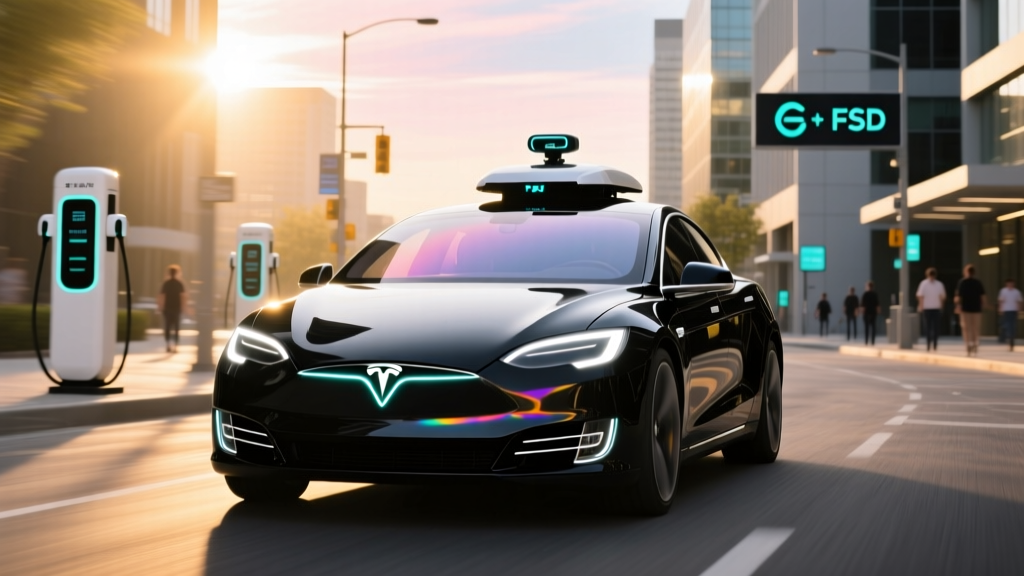
This distinction drives everything about cost. You can buy a Tesla and pay extra for FSD software, but you are purchasing an advanced driver-assist feature for your personal use — not access to a driverless taxi fleet. Tesla has discussed future robotaxi ambitions (sometimes branded as "Cybercab" or "Robotaxi" concepts), but as of 2026, no Tesla Level 4 driverless ride-hailing service is operational for consumers in any U.S. city.
What Tesla FSD Actually Costs in 2026
If you want a Tesla equipped with the company's most advanced driver-assist software, here's what you'll pay on top of the vehicle's base MSRP:
| FSD Purchase Option | Cost (2026) | Notes |
|---|---|---|
| FSD (Supervised) — One-time purchase | $8,000 | Tied to vehicle; non-transferable if you sell |
| FSD (Supervised) — Monthly subscription | $99/month | Cancel anytime; no long-term commitment |
| Enhanced Autopilot (no FSD) | $6,000 one-time | Lacks city-street auto-steer; highway-focused |
| Basic Autopilot | Included (no extra cost) | Traffic-aware cruise + lane centering on highways |
A new Tesla Model 3 Long Range AWD starts around $47,740 MSRP in 2026. Adding the $8,000 FSD purchase brings your total to roughly $55,740 before destination fees, taxes, or any applicable §30D federal tax credit. For buyers who qualify, the $7,500 point-of-sale credit (subject to MSRP caps, income limits, and battery-sourcing rules per IRS guidelines) can offset part of that cost — but FSD itself is not separately incentivized.
Waymo Robotaxi Pricing: What Driverless Rides Actually Cost
For consumers who want to experience a genuinely driverless ride today, Waymo One is the primary operational robotaxi service in the United States. Here's how typical fares compare to conventional rideshare:
| Ride Type | Typical Cost (5-mile trip) | Availability |
|---|---|---|
| Waymo One (robotaxi) | $12–$18 | Phoenix, San Francisco, Los Angeles, Austin (limited) |
| UberX (human driver) | $10–$16 | Nationwide |
| Lyft (human driver) | $9–$15 | Nationwide |
| Waymo via Uber app | $12–$18 (varies) | Select cities where integrated |
Waymo pricing is dynamic and distance-based, similar to Uber/Lyft surge models but without a human driver's labor cost factored in. In practice, a 5-mile Waymo ride in Phoenix typically costs $12–$18, competitive with UberX in the same market. Longer trips (15+ miles) can reach $30–$45, still roughly on par with rideshare but without the variability of driver ratings or vehicle quality.
Where Can You Actually Use a Robotaxi Right Now?
As of early 2026, operational robotaxi services are geographically limited. Here's where you can hail a driverless ride:
| Service | Cities (2026) | Service Area Notes |
|---|---|---|
| Waymo One | Phoenix metro, San Francisco, Los Angeles, Austin (expanding) | 24/7 in Phoenix/SF; limited hours in newer markets |
| Cruise (GM) | Limited restart in Phoenix (post-2023 suspension) | Slow, supervised relaunch; not full commercial service |
| Zoox (Amazon) | Las Vegas (limited test area), Foster City CA (testing) | Purpose-built vehicle; not yet broad public availability |
| Tesla Robotaxi | None (announced concept only) | No Level 4 service operational |
If you live outside these metros, robotaxi access is not yet an option. Waymo has announced expansion plans for additional cities, but timelines remain fluid and subject to regulatory approval in each jurisdiction.
Safety Data: What the Numbers Actually Show
Tesla's Autopilot/FSD safety data is reported differently. Tesla publishes quarterly safety statistics showing miles driven per crash event with Autopilot engaged, but these figures represent Level 2 driver-assist (with a human supervising), not Level 4 driverless operation. Direct comparison between Tesla's supervised miles and Waymo's unsupervised miles is methodologically problematic — the human driver in a Tesla is the safety backstop, while Waymo's system must handle all scenarios independently.
For context on regulatory oversight, NHTSA requires all ADS-equipped vehicles to report crashes within 24 hours. California's DMV also publishes annual disengagement reports for companies testing autonomous vehicles in the state, though reporting standards vary and "disengagement" definitions are not uniform across manufacturers.
Tesla's Camera-Only Stack vs. Waymo's Lidar+Sensor Fusion
The technology approaches behind Tesla FSD and Waymo robotaxis are fundamentally different, which affects both capability and cost structure:
Tesla FSD (Supervised): Relies exclusively on a vision-only sensor suite — multiple cameras (typically 8–12 depending on model year) feeding neural networks that interpret the environment in real-time. No lidar, no radar (in current hardware). This approach keeps hardware costs lower but places enormous demands on software to handle edge cases (construction zones, unusual obstacles, adverse weather) without redundant sensing.
Waymo (Level 4 robotaxi): Uses a multi-sensor fusion stack including lidar (roof-mounted and side units), radar, cameras, and external audio sensors. The vehicle maintains HD maps of its operational domain and is geofenced to approved areas. This redundancy increases per-vehicle hardware cost (estimated $100,000+ per vehicle for sensor suite and compute) but provides the safety margins required for unsupervised operation.
The cost difference explains why Waymo charges per ride (amortizing expensive hardware over thousands of trips) while Tesla sells FSD as a software add-on to consumer vehicles. You're buying different products with different safety architectures.
Current Limitations: What Neither System Handles Well
Both Level 2 driver-assist and Level 4 robotaxi systems have documented limitations that affect real-world usability:
- Weather degradation: Heavy rain, snow, fog, and ice can impair camera and lidar performance. Waymo may suspend service in severe weather; Tesla FSD performance degrades and requires increased driver vigilance.
- Geofence boundaries: Waymo operates only within approved operational design domains (ODDs). Drive outside the geofence and the service is unavailable. Tesla FSD has no geofence but also no Level 4 capability anywhere.
- Construction zones: Temporary lane shifts, missing lane markings, and flaggers present edge cases that both systems handle inconsistently. Human intervention is frequently required.
- Unprotected left turns: Complex multi-lane intersections with oncoming traffic remain challenging for all current ADS systems, particularly during high-traffic periods.
- Emergency vehicles: Detecting and appropriately yielding to approaching emergency vehicles (especially from behind or at oblique angles) is an ongoing development area.
- Pedestrian prediction: Jaywalking pedestrians, cyclists emerging from blind spots, and other unpredictable road users require conservative system behavior that can result in abrupt stops or delays.
The Bottom Line: What You're Actually Buying
If you're asking "how much does a Tesla self-driving car cost," the honest 2026 answer is: you can buy a Tesla with FSD (Supervised) for $8,000 extra (or $99/month), but you are purchasing advanced driver-assist — not a self-driving car. The vehicle requires your full attention and you remain legally responsible for its operation.
If you want a genuinely driverless ride today, Waymo One charges $12–$18 for a typical 5-mile trip in Phoenix, San Francisco, or Los Angeles — competitive with Uber/Lyft but only available in those specific metros.
Tesla's robotaxi ambitions remain announced concepts without operational Level 4 service. Waymo, Cruise, and Zoox are the companies currently navigating the regulatory, technical, and economic challenges of scaling driverless transportation. The technology is real but geographically constrained, and the path to ubiquitous robotaxi availability is measured in years, not months.
Frequently Asked Questions
Can I buy a Tesla and use it as a robotaxi to earn money?
No. Tesla FSD is a Level 2 driver-assist system that requires your supervision. Tesla does not currently operate a robotaxi network, and you cannot legally offer driverless rides to paying passengers in a Tesla. Some owners use their Teslas for Uber/Lyft (with themselves driving), but that's conventional rideshare, not autonomous operation.
Is Tesla's $8,000 FSD purchase worth it?
That depends on your use case and risk tolerance. FSD (Supervised) can reduce fatigue on long highway drives and handle some city-street navigation, but it requires constant supervision and makes mistakes that require immediate human intervention. Many owners find the $99/month subscription a lower-risk way to evaluate the feature before committing to the full purchase. The software is tied to the vehicle and does not transfer if you sell the car.
How do Waymo's costs compare to owning a car?
For low-mileage urban dwellers, Waymo can be cost-competitive with car ownership when you factor in insurance, maintenance, parking, and depreciation. A household driving 8,000 miles/year might spend $2,400–$3,600 annually on Waymo rides (at $0.30–$0.45/mile equivalent), versus $6,000–$10,000+ for car ownership costs. However, this math only works if you live in a Waymo service area and don't need a vehicle for trips outside the geofence.
Will Tesla ever launch a real robotaxi service?
Tesla has discussed robotaxi ambitions for years, including concepts like the "Cybercab." However, as of 2026, no Level 4 Tesla robotaxi service is operational or has received regulatory approval for driverless commercial operation. Timelines have repeatedly shifted, and the company's camera-only approach faces technical and regulatory hurdles that competitors with multi-sensor stacks are still working to overcome.
What happens if a Waymo robotaxi gets in an accident?
Waymo carries commercial insurance for its robotaxi operations, and passengers are not held liable for vehicle operation incidents. If a Waymo vehicle is involved in a crash, the company's insurance and legal framework handles claims. This differs from Tesla FSD, where the human driver remains legally responsible for the vehicle's operation regardless of whether Autopilot or FSD was engaged.