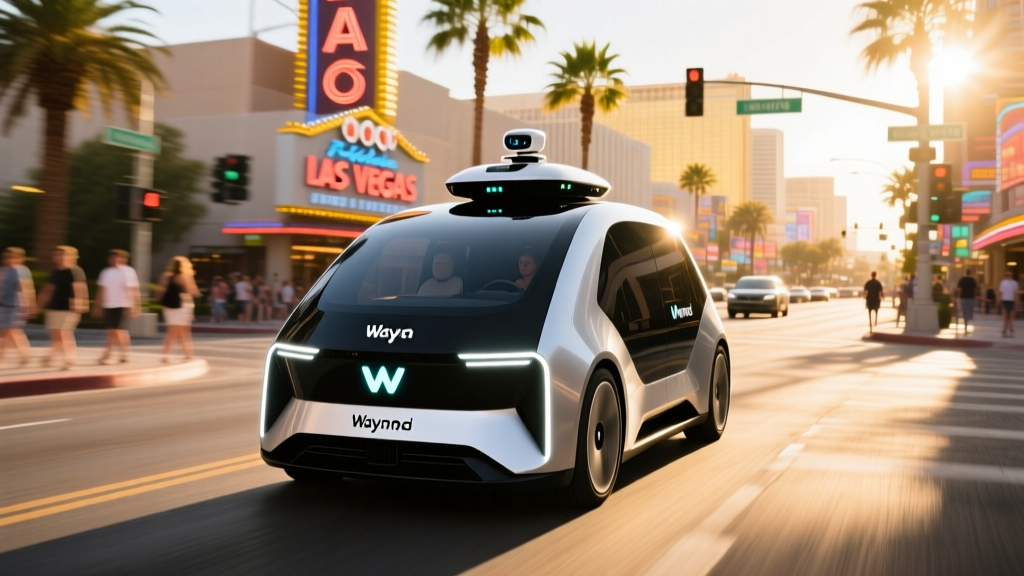
If you've spent any time on the Las Vegas Strip in 2026, you've likely spotted a white Jaguar I-PACE with a spinning lidar array on its roof or a boxy, steering-wheel-free pod gliding along Harbor Boulevard. Las Vegas has quietly become one of the most competitive robotaxi testing grounds in the United States, with multiple operators running commercial or semi-commercial services across the valley. But the landscape is fragmented, availability is tightly geofenced, and the experience varies wildly depending on which service you call.
This guide breaks down exactly which robotaxi services operate in Las Vegas right now, what they cost, how safe they are based on real incident and mileage data, and what limitations you'll encounter as a rider. Whether you're a visitor curious about hailing a driverless ride or a local weighing robotaxi against Uber, here's what you need to know.
Is a Vegas Robotaxi Truly Self-Driving? Understanding SAE Levels
Before calling a ride, it's critical to understand what "self-driving" actually means in this context. Consumer vehicles with features like Tesla Autopilot, Ford BlueCruise, or GM Super Cruise operate at SAE Level 2 — the driver must remain engaged, hands on or near the wheel, eyes on the road. These are driver-assist systems, not autonomous vehicles.
Robotaxis operating in Las Vegas are classified at SAE Level 4, meaning they perform all driving tasks within a defined operational design domain (ODD) — a specific geofenced area under certain conditions — without any human driver behind the wheel. There is no steering wheel or pedals in some vehicles (Zoox), while others retain them but have no driver present (Waymo).
| Level | Name | Driver Required? | Example |
|---|---|---|---|
| Level 2 | Partial Automation | Yes — full-time supervision | Tesla Autopilot, BlueCruise, Super Cruise |
| Level 3 | Conditional Automation | Yes — must take over when requested | Mercedes DRIVE PILOT (limited markets) |
| Level 4 | High Automation | No — within geofenced ODD | Waymo, Zoox, Motional |
| Level 5 | Full Automation | No — anywhere, any condition | Does not exist commercially |
The key takeaway: Vegas robotaxis are genuinely driverless within their service zones. No human is monitoring from the driver's seat. However, they are not Level 5 — they cannot operate everywhere, in all weather, or on any road. Remote fleet operators can intervene if a vehicle encounters a situation it cannot resolve, but they do not "joystick" the car in real time.
Where Can I Use a Robotaxi in Las Vegas Right Now?
Las Vegas hosts three primary robotaxi operators as of 2026, each with different coverage zones and access models. Availability changes frequently as companies expand geofences, so always check the respective app for live service areas.
| Operator | Vehicle | Service Zone | Access | Hours |
|---|---|---|---|---|
| Waymo | Jaguar I-PACE (5th-gen) | Strip corridor, downtown, Convention Center, Harry Reid Airport | Waymo One app — open to public | 24/7 |
| Zoox | Zoox purpose-built pod | Strip corridor (Mandalay Bay to Wynn), downtown Fremont | Zoox app — waitlist/partial public | ~8 AM – 2 AM |
| Motional | Hyundai Ioniq 5 | Limited Strip-area routes, select hotel pickup/dropoff | Via Uber/Lyft integration | Limited hours, varies |
Waymo has the broadest Las Vegas footprint. After expanding from its Phoenix and San Francisco roots, Waymo launched commercial rides on the Strip in late 2024 and has since extended coverage to include the Las Vegas Convention Center, downtown Las Vegas, and Harry Reid International Airport. Rides are available through the Waymo One app, which is open to any user — no waitlist as of early 2026.
Zoox, Amazon's autonomous vehicle subsidiary, operates its distinctive bidirectional pod vehicle (no steering wheel, facing seats) along a tighter geofence concentrated on the Strip and downtown. Access has been gradually opening through the Zoox app, though the service still operates with limited fleet size compared to Waymo.
Motional, the Hyundai-Aptiv joint venture, takes a different approach by integrating its Hyundai Ioniq 5-based robotaxis into the Uber and Lyft platforms. If you request a ride through Uber or Lyft in a covered zone, you may be matched with a Motional vehicle. Coverage is more limited and hours are restricted.
How Much Does a Vegas Robotaxi Cost vs. Uber and Lyft?
Pricing is one of the most common questions, and the answer depends on the operator. Here's how robotaxi fares compare to traditional rideshare for typical Vegas trips:
| Route | Waymo | UberX | Lyft |
|---|---|---|---|
| McCarran Airport → Bellagio (5 mi) | $18–$24 | $20–$30 | $19–$28 |
| Mandalay Bay → Venetian (4 mi) | $14–$19 | $16–$24 | $15–$22 |
| Convention Center → Fremont St (6 mi) | $22–$28 | $22–$35 | $20–$32 |
Waymo's pricing is broadly competitive with UberX and Lyft, and during surge periods, Waymo often undercuts rideshare because its pricing model doesn't spike as aggressively. Zoox has been offering promotional pricing (sometimes free or heavily discounted) during its early-access phase. Motional rides booked through Uber or Lyft are priced at standard rideshare rates.
One practical advantage of robotaxis: no tipping expectation. While the app may offer a tip option, there is no driver to tip, which effectively saves riders 15–20% compared to a standard rideshare fare with gratuity.
How Safe Are Vegas Robotaxis? The Real Data
Safety is the single most scrutinized aspect of robotaxi operations, and the data tells a nuanced story. Let's look at what we know from reported figures and regulatory filings.
- Total autonomous miles driven: Over 50 million fully driverless miles completed nationally as of early 2026, per Waymo's published safety reports.
- Injury-causing crash rate: Waymo reports its vehicles are involved in injury-causing crashes at roughly 85% lower rate than human drivers in comparable urban environments, based on internal benchmarking against NHTSA data.
- Contactless disengagement rate: Fewer than 1 critical disengagement per 100,000 miles in recent reporting periods.
- Notable incidents: Minor low-speed collisions have been reported in Phoenix and San Francisco, typically involving other human drivers striking the robotaxi. No fatalities attributed to Waymo's autonomous system in driverless mode.
Waymo's safety record is the most extensively documented because it has the largest operational fleet and longest commercial track record. The company publishes periodic safety performance data and submits incident reports to NHTSA under the Standing General Order for crash reporting, which requires all ADS-equipped vehicles to report crashes within one day.
Zoox and Motional have smaller operational footprints and fewer publicly available miles, making statistical comparison difficult. Zoox has reported minor incidents in its Las Vegas and San Francisco testing, typically involving low-speed contact with stationary objects or other vehicles. Motional paused some operations in 2023–2024 for safety review before resuming limited service.
For context, human drivers in the United States experience roughly 1.3 fatalities per 100 million vehicle miles traveled (NHTSA, 2024 data). Robotaxis operate at far lower speeds in geofenced urban corridors, and their sensor suites — lidar, radar, and cameras providing 360-degree perception — eliminate distracted and impaired driving, which account for the majority of human-caused crashes.
Under the Hood: Robotaxi Technology Stacks Explained
The three Vegas operators take different technical approaches, but all share a common foundation: redundant sensor arrays, high-definition maps, and AI-driven decision-making systems.
Waymo (Jaguar I-PACE)
Waymo's 5th-generation driver system uses a combination of lidar (custom-designed, roof-mounted and side-mounted units), radar (forward and corner units for velocity detection), and cameras (high-resolution, multiple focal lengths). The system builds a real-time 3D model of the environment and relies on HD maps for localization. Waymo does not use camera-only perception; lidar is central to its redundancy strategy.
Zoox (Purpose-Built Vehicle)
Zoox's custom vehicle features a symmetrical sensor layout with lidar, radar, and cameras on all four corners, providing overlapping 360-degree coverage. The vehicle is designed from the ground up for autonomy — no steering wheel, four-wheel steering, and bidirectional driving capability. The battery pack is approximately 33 kWh, sufficient for all-day urban operation at low speeds.
Motional (Hyundai Ioniq 5)
Motional integrates lidar (typically Luminar or similar), radar, and camera arrays into the Ioniq 5 platform. The Ioniq 5's 77.4 kWh battery (NMC chemistry) provides ample range for shift operations. Motional has emphasized its camera-lidar fusion approach and has invested heavily in simulation-based validation.
A critical distinction from Tesla's consumer FSD system: all three robotaxi operators rely on lidar as a primary sensor. Tesla's camera-only ("Tesla Vision") approach remains unique and controversial in the industry. Robotaxi companies argue that lidar provides essential depth perception redundancy that cameras alone cannot guarantee, especially in edge cases involving unusual lighting, occlusions, or sensor degradation.
Current Limitations: What a Vegas Robotaxi Cannot Do
Robotaxis in Las Vegas are Level 4, not Level 5. They cannot drive you anywhere you want, in any condition. Here are the real constraints riders encounter:
- Geofencing: Each service operates within a defined boundary. Request a ride outside the zone, and the app will not allow it. You cannot take a Waymo from the Strip to Red Rock Canyon or Lake Mead.
- Weather restrictions: While Las Vegas is relatively dry, heavy rain, flooding, or extreme dust storms can cause services to suspend operations. Lidar and camera performance degrades in heavy precipitation.
- Construction zones: Las Vegas is perpetually under construction. Robotaxis may reroute around major construction zones or, in some cases, be unable to complete a trip if the zone blocks the only viable route.
- Pickup/dropoff precision: Vehicles will only stop at designated or safe pull-over locations. You may need to walk a short distance from your exact requested spot to the nearest approved pickup point.
- No highway driving (Zoox): Zoox's low-speed pod vehicle is not designed for freeway-speed operation. Waymo's I-PACE can handle highway segments within its geofence.
- Wait times: Fleet sizes are still limited. During peak hours (weekend evenings, convention nights), wait times can exceed 15–20 minutes — longer than a typical Uber.
- Accessibility: Waymo's Jaguar I-PACE can accommodate a folding wheelchair but is not wheelchair-accessible in the ADA van sense. Zoox's pod includes a ramp-accessible variant in limited numbers.
The Regulatory Landscape: Who Approves Vegas Robotaxis?
Nevada was one of the first states to pass autonomous vehicle legislation, and the regulatory framework is split between state and local authorities:
- Nevada DMV: Issues autonomous vehicle testing and deployment permits. Companies must demonstrate minimum insurance coverage ($5 million per incident) and submit safety self-assessments.
- Nevada Office of Autonomous Vehicles: Oversees the broader regulatory framework, including data reporting requirements and incident investigation.
- Clark County and City of Las Vegas: Local jurisdictions manage road-use permits, pickup/dropoff zones, and coordination with local law enforcement and emergency services.
- NHTSA (Federal): Sets vehicle safety standards and requires crash reporting through the Standing General Order. NHTSA can investigate and issue recalls for ADS-equipped vehicles. See NHTSA's AV safety resources.
Nevada's regulatory posture is generally considered permissive compared to states like California, where the DMV and CPUC maintain tighter operational controls and can suspend permits (as seen with Cruise's 2023 suspension in San Francisco). This regulatory environment is one reason Las Vegas has attracted multiple operators.
How to Actually Ride a Vegas Robotaxi: Step by Step
- Download the app: Waymo One (iOS/Android) or Zoox (iOS/Android). For Motional, use your existing Uber or Lyft app.
- Set your pickup and dropoff: Both must be within the service zone. The app will show the geofenced boundary.
- Confirm your ride: You'll see the vehicle type, estimated wait time, and upfront fare. No surge pricing surprises with Waymo.
- Locate the vehicle: The app shows the vehicle's approach in real time. When it arrives, confirm the license plate or vehicle ID.
- Unlock and board: Tap "Start Ride" in the app to unlock the doors. Waymo's I-PACE opens the rear doors automatically once it confirms you're the right rider.
- Ride: Screens inside the vehicle show the route, current speed, and what the vehicle's sensors are detecting (other cars, pedestrians, cyclists). You can adjust climate and music.
- Arrive: The vehicle pulls over at the designated dropoff point. Doors unlock automatically. No tipping needed.
Frequently Asked Questions
Is a Vegas robotaxi really self-driving, or is there a remote driver?
There is no driver in the vehicle — no one behind the wheel, no one in the back seat controlling anything. The vehicle drives itself using onboard AI and sensors. Remote fleet operators monitor the fleet and can provide high-level guidance if a vehicle encounters an unusual situation (like rerouting around an unexpected road closure), but they do not steer, brake, or accelerate the vehicle remotely. This is SAE Level 4 autonomy.
Can I take a robotaxi from the Las Vegas airport?
Yes. Waymo has included Harry Reid International Airport in its Las Vegas service zone. You can request a ride from designated pickup areas at the airport to destinations on the Strip, downtown, and the Convention Center. Check the Waymo One app for exact pickup instructions at the terminal.
What happens if the robotaxi gets confused or stops?
If the vehicle encounters a situation it cannot resolve — such as an unmapped construction zone or an emergency vehicle blocking the road — it will pull over safely and contact a remote fleet operator. The operator can provide routing guidance. In-app support is also available. The vehicle will not proceed if it cannot do so safely.
Are Vegas robotaxis safe at night?
Waymo operates 24/7 in Las Vegas, and its sensor suite (lidar, radar, cameras with night-vision capability) does not degrade in darkness the way human vision does. Most incidents involving robotaxis nationally have been caused by other human drivers, not by the autonomous system failing to see. That said, nighttime brings more impaired drivers on Vegas roads, and robotaxis are programmed to drive defensively — which can mean longer routes or more cautious behavior.
How does robotaxi insurance work if there's a crash?
When you ride in a Waymo, Zoox, or Motional vehicle, the operating company carries commercial liability insurance (Nevada requires a minimum of $5 million per incident). You are not responsible for the vehicle. If a crash occurs, the operator's insurance handles claims. This is fundamentally different from riding in a personal vehicle with Level 2 driver-assist, where the human driver remains liable.
Will robotaxis replace Uber and Lyft in Las Vegas?
Not in the near term. Fleet sizes are still small, geofences are limited, and robotaxis cannot handle every trip type (large groups, airport runs with excessive luggage, trips outside the service zone). The more likely trajectory is coexistence: robotaxis handle routine point-to-point trips within dense corridors, while human-driven rideshare covers everything else. Uber and Lyft are already hedging by integrating Motional and other AV partners into their platforms.