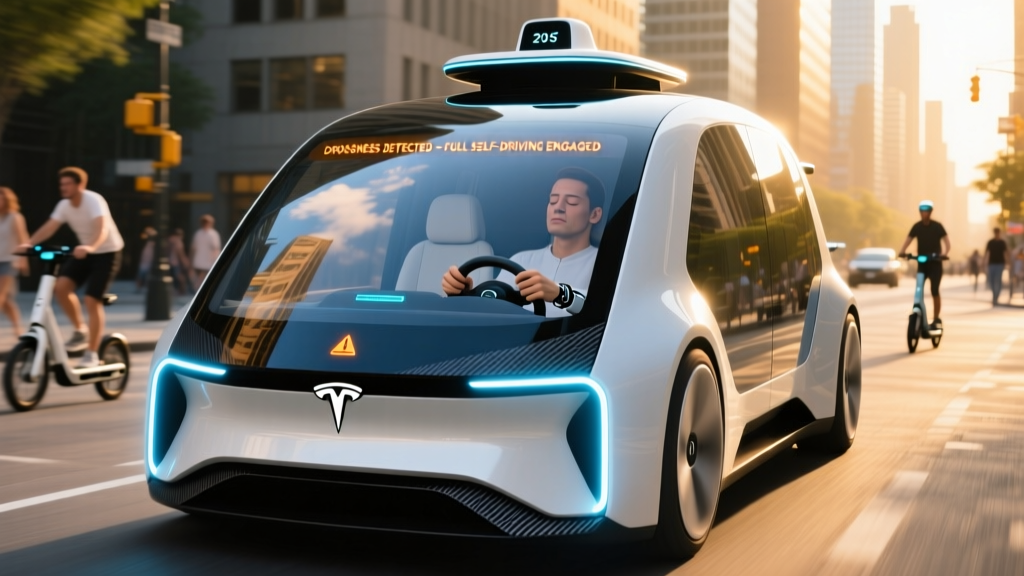
A recent over-the-air update introduced a new cabin-monitoring behavior in Tesla vehicles: when the system detects signs of driver drowsiness — slow blinks, head nods, or prolonged gaze aversion — the touchscreen displays an alert suggesting the driver engage Full Self-Driving (Supervised). On the surface, it sounds like a sensible safety net. But dig into what FSD actually is, what it can and cannot do, and the recommendation raises serious questions about automation complacency at a critical moment of driver impairment.
This article breaks down exactly what Tesla's drowsy-driver alert means, how FSD fits into the broader autonomous-vehicle landscape, and why conflating Level 2 driver-assist with Level 4 robotaxi service remains one of the most dangerous misunderstandings in the EV space.
What Tesla's Drowsy-Driver Alert Actually Does
Tesla's cabin camera, mounted above the rearview mirror on Model 3, Model Y, Model S, and Model X, continuously monitors driver attentiveness when Autopilot or FSD (Supervised) is active. The 2026 software update adds a proactive layer: if the system's algorithm detects microsleep indicators — eyelid closure duration, blink frequency reduction, head droop — before the driver has fully lost attention, it now surfaces a prompt recommending FSD engagement.
The logic is straightforward from Tesla's perspective. If a driver is getting tired, handing more of the longitudinal and lateral control to the vehicle's neural-net stack reduces immediate workload. FSD (Supervised) handles lane changes, navigation-guided exits, traffic-light recognition, and stop-sign compliance — tasks that require sustained cognitive attention from a fatigued driver.
But here's the critical problem: recommending that a drowsy person increase their reliance on a system that still requires their full supervision creates a paradox. The driver most likely to miss a disengagement request is the one being asked to trust the system more deeply.
Tesla's Autopilot and FSD (Supervised) are SAE Level 2 driver-assistance systems. The driver must remain fully engaged, monitor the environment at all times, and be prepared to take over instantly. This is fundamentally different from SAE Level 4 robotaxi services like Waymo One, where no human driver is present or required. There is no Tesla vehicle on public roads operating without a human driver responsible for the vehicle.
SAE Levels Explained: Why This Distinction Saves Lives
The Society of Automotive Engineers defines six levels of driving automation, and understanding them is non-negotiable for anyone using or evaluating any ADAS or autonomous feature.
| Level | Name | Who Drives | Current Examples |
|---|---|---|---|
| 0 | No Automation | Human does everything | Basic cruise control, warnings only |
| 1 | Driver Assistance | Human drives; system assists one axis | Adaptive cruise OR lane-keep (not both) |
| 2 | Partial Automation | Human supervises; system controls steering + speed | Tesla Autopilot, FSD (Supervised), BlueCruise, Super Cruise, Toyota Safety Sense |
| 3 | Conditional Automation | System drives in limited conditions; human must take over on request | Mercedes Drive Pilot (limited markets, ≤40 mph) |
| 4 | High Automation | System drives without human in defined ODD | Waymo One, Zoox (geofenced areas) |
| 5 | Full Automation | System drives everywhere, all conditions | Does not exist commercially |
Tesla's FSD (Supervised) sits firmly at Level 2. It can be impressive — navigating complex urban intersections, handling unprotected left turns, recognizing construction cones — but every maneuver occurs under the legal and operational assumption that a competent, alert human is ready to intervene within seconds. A drowsy driver is, by definition, not that person.
How FSD (Supervised) Works: The Technology Stack
Unlike Waymo's multi-sensor approach, Tesla relies exclusively on a vision-only architecture. Here's how the two philosophies compare:
- 8 cameras (surround-view)
- No lidar, no radar (removed since 2022)
- Neural-net vision processing (HW4/AI5 computer)
- Operates on any road, no geofence
- Requires human supervision (Level 2)
- Custom lidar array (5th-gen)
- Multiple radar units
- 29+ cameras
- HD-mapped, geofenced service areas
- No human driver needed (Level 4)
Tesla's vision-only approach offers broad geographic coverage — FSD can theoretically activate on any road in the US. But it trades the redundancy of lidar and radar for a single-sensor-modality architecture that must infer depth, velocity, and object classification from pixels alone. In clear daylight, this works remarkably well. In heavy rain, direct sun glare, fog, or nighttime scenarios with poor lane markings, the system's confidence drops — and it may disengage with little warning.
For a drowsy driver, a sudden disengagement request is the worst-case scenario. Reaction time when fatigued can exceed 3-4 seconds; NHTSA research shows that at 65 mph, a 3-second delay covers 286 feet of uncontrolled travel.
Real Safety Data: FSD, Autopilot, and the Broader Picture
Tesla publishes quarterly safety reports, and independent researchers have scrutinized them heavily. Here's what the available data shows as of early 2026:
- With Autopilot engaged: 1 crash per 4.26 million miles driven
- Without Autopilot (Tesla vehicles): 1 crash per 1.48 million miles
- US average (all vehicles): 1 crash per ~670,000 miles (NHTSA)
Note: Tesla's data is self-reported and does not isolate for road type, weather, or driver demographics. Autopilot is primarily used on highways, which are statistically safer than urban roads. Direct comparison to the NHTSA average is methodologically imperfect.
NHTSA's Standing General Order requires manufacturers to report crashes involving Level 2+ systems. Between 2021 and 2025, Tesla vehicles with Autopilot or FSD active were involved in over 1,800 reported incidents under this mandate — the highest volume of any manufacturer, reflecting both Tesla's market share in ADAS-equipped vehicles and its fleet's high utilization of these features.
The drowsy-driver alert is a response to a real problem: NHTSA attributes approximately 100,000 police-reported crashes annually to drowsy driving, resulting in roughly 1,550 fatalities. But the question is whether shifting control to a Level 2 system — rather than prompting the driver to pull over — is the appropriate intervention.
Where True Robotaxi Services Operate Today
While Tesla's FSD is a driver-assist system available nationwide, actual driverless robotaxi services (Level 4) operate in specific, geofenced areas with regulatory approval. Here's the current landscape:
| Service | Operational Cities | Hours | SAE Level | Human Driver? |
|---|---|---|---|---|
| Waymo One | Phoenix (metro), San Francisco, Los Angeles, Austin | 24/7 in most areas | Level 4 | No |
| Zoox | Las Vegas (limited), Foster City, CA (testing) | Limited hours | Level 4 | No |
| Cruise | Suspended operations (post-2023 incident review); limited testing in Phoenix, Dallas | N/A | Level 4 | No (when active) |
| Tesla (Robotaxi/Cybercab) | Announced; no commercial service launched | N/A | Claimed L4+ (unverified) | Announced driverless |
Waymo One remains the only scaled, commercial, driverless robotaxi service in the US as of 2026. Its 6th-generation hardware platform, deployed across a fleet of Jaguar I-PACE vehicles, has accumulated over 40 million fully driverless miles across its service areas. Waymo's published safety data indicates a 85% reduction in injury-causing crash involvement compared to human benchmarks in comparable urban environments.
Pricing: Robotaxi vs. Rideshare vs. FSD Ownership
The economic models differ fundamentally. Robotaxis charge per ride; Tesla FSD is a feature you own (or subscribe to) on a vehicle you drive yourself.
| Option | Cost Structure | Typical 5-Mile Urban Ride | Availability |
|---|---|---|---|
| Waymo One | Per-ride fare (base + per-mile + per-min) | $12–$18 | Phoenix, SF, LA, Austin |
| Uber/Lyft | Per-ride fare (surge pricing variable) | $10–$22 | Nationwide |
| Tesla FSD (Supervised) | $8,000 one-time purchase or $99/month subscription | $0 incremental (you own/drive the car) | Any Tesla with HW3+ nationwide |
| Tesla FSD (Transfer) | Included with qualifying new vehicle purchase (promotional periods vary) | $0 incremental | New Tesla purchases |
If you already own a Tesla, engaging FSD doesn't cost extra per mile — it's a feature of the car. The drowsy-driver alert, then, isn't steering you toward a paid service; it's recommending you activate a capability already in the vehicle. The economic comparison isn't relevant to the alert itself, but it matters for understanding Tesla's long-term strategy: building a user base familiar with high-engagement ADAS as a bridge toward a future driverless service that doesn't yet exist commercially.
Current Limitations of FSD (Supervised) — Especially for Impaired Drivers
- Construction zones with non-standard signage, shifted lanes, or flaggers — the system may misread temporary markings or fail to recognize a human directing traffic.
- Severe weather — heavy rain, snow, fog, or ice significantly degrade camera performance and may cause sudden disengagement.
- Unmapped or recently modified roads — new highway exits, changed intersection layouts, or rural roads without clear markings.
- Emergency vehicles — FSD may not reliably pull over for approaching ambulances or police, especially at night.
- Railroad crossings — the system does not consistently stop at unmarked or uncontrolled rail crossings.
- Edge-case pedestrians and cyclists — jaywalkers, cyclists in blind spots, or pedestrians emerging from behind obstacles.
For a drowsy driver, every one of these limitations is amplified. A well-rested driver can compensate for a system miss in 1-2 seconds. A fatigued driver may need 3-5 seconds — at highway speed, that's the difference between a correction and a collision.
The Regulatory Landscape: Who Oversees This?
Level 2 driver-assistance systems like Tesla's Autopilot and FSD fall under a patchwork of federal and state oversight:
- NHTSA (federal): Issues safety defect investigations, Standing General Orders for crash reporting, and can mandate recalls. In 2024-2025, NHTSA opened multiple investigations into Tesla's Autopilot behavior near emergency scenes and its driver-monitoring adequacy.
- State DMVs and regulators: California's DMV and CPUC have specific reporting requirements for autonomous vehicle testing and deployment. Texas, Arizona, and Nevada have more permissive frameworks.
- NTSB: Investigates specific crashes and issues safety recommendations (non-binding). The NTSB has repeatedly recommended that NHTSA require more robust driver-monitoring systems for Level 2 ADAS.
The drowsy-driver alert exists in a regulatory gray area. NHTSA has not mandated specific responses to detected driver impairment — automakers choose their own strategies. Some (like GM's Super Cruise) escalate alerts and eventually bring the vehicle to a controlled stop if the driver remains unresponsive. Tesla's approach — suggesting increased system engagement — is notably different from the industry trend toward progressive disengagement and safe-stop protocols.
What Should Drowsy Tesla Drivers Actually Do?
The evidence-based answer is unambiguous: pull over and rest. No Level 2 system is designed to serve as a fallback for an impaired operator. Here's a practical decision framework:
- Choose REST if: you've been driving 2+ hours, it's past your normal sleep time, you feel any eye heaviness or head nodding, or you've consumed any sedating medication or alcohol. Exit the highway, park, and nap for 20 minutes. No system substitutes for sleep.
- Choose FSD engagement if: you are experiencing only mild, transient fatigue (e.g., mid-afternoon dip), you are within minutes of your destination, road conditions are clear and well-marked, and you remain fully capable of taking over within 2 seconds. Even then, open a window, increase cabin airflow, and treat FSD as a temporary aid — not a solution.
- Never: recline the seat, close your eyes, use your phone, or assume FSD will handle an unexpected disengagement while you're impaired.
Frequently Asked Questions
Is Tesla's FSD actually self-driving?
No. Tesla Full Self-Driving (Supervised) is an SAE Level 2 driver-assistance system. Despite the name, it requires the human driver to remain fully attentive, keep hands available for steering input, and take over at any moment. It does not meet the legal or technical definition of "self-driving." Only Level 4 services like Waymo One operate without a human driver.
Can I sleep or close my eyes while FSD is engaged?
Absolutely not. Tesla's cabin camera monitors eye openness and gaze direction. If the system detects closed eyes or inattention, it escalates warnings — visual, audible, and eventually slowing the vehicle. More importantly, sleeping while a Level 2 system is in control is extremely dangerous and, in many jurisdictions, constitutes reckless driving.
Where can I use a true driverless robotaxi right now?
Waymo One operates commercially in Phoenix (greater metro area), San Francisco, Los Angeles, and Austin as of early 2026. Service areas are geofenced — you can only request rides within defined boundaries. Availability is 24/7 in most markets, though wait times vary by demand.
How much does a Waymo ride cost compared to Uber?
Waymo fares are generally comparable to UberX or Lyft standard pricing — typically $12-$18 for a 5-mile urban trip. Waymo does not currently use surge pricing, which can make it cheaper during peak demand periods. However, availability is limited to specific geofenced zones within each city.
Has Tesla launched its own robotaxi service?
No. Tesla has announced a purpose-built "Cybercab" robotaxi concept and has discussed future driverless ride-hailing, but as of 2026, no commercial Tesla robotaxi service is operational. The Cybercab has been shown in prototype form but has not received regulatory approval for driverless operation on public roads. Any Tesla vehicle on public roads today requires a licensed, attentive human driver.
What should I do if I'm too tired to drive my Tesla?
Pull over at a safe location — a rest stop, gas station, or parking lot — and rest. A 20-minute nap significantly restores alertness. Engaging FSD while drowsy does not eliminate your responsibility for the vehicle and may increase risk if the system encounters a scenario requiring rapid human intervention. NHTSA recommends stopping to rest as the only reliable countermeasure to drowsy driving.
Does Tesla's drowsy-driver alert mean the car will drive itself if I'm tired?
No. The alert suggests engaging FSD (Supervised), which still requires your full attention and readiness to take over. The car does not assume autonomous control. You remain the legally responsible driver at all times.