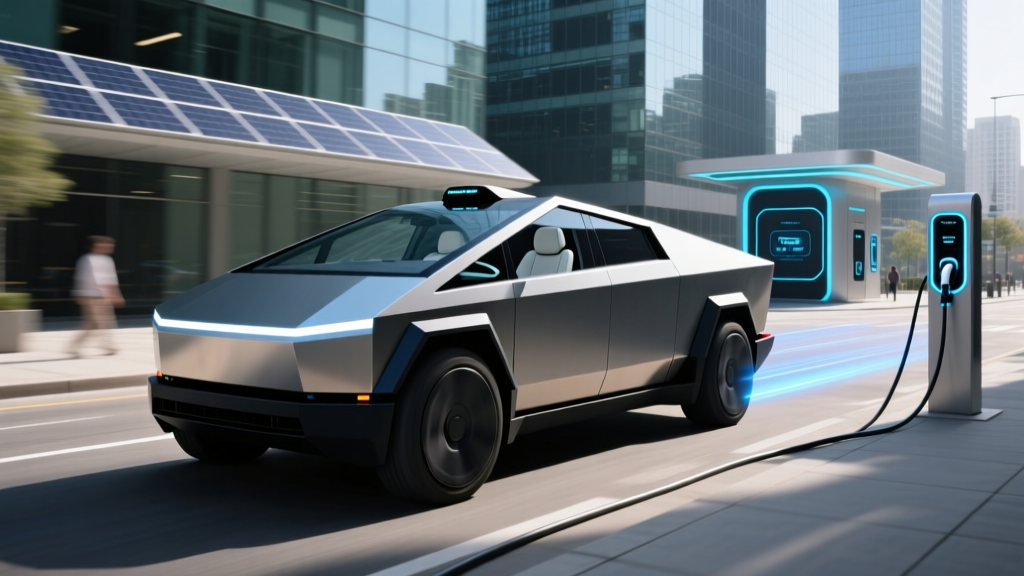
Tesla's marketing around the Cybertruck and Full Self-Driving (FSD) has generated enormous attention — and confusion. Promotional campaigns suggest a vehicle that can drive itself, but the reality on the road in 2026 is far more nuanced. If you've searched for information on the Tesla Cybertruck Full Self-Driving promotion, you're likely trying to answer a fundamental question: Can this truck actually drive itself, or is this still a driver-assist system that demands your full attention?
The short answer: Tesla's FSD (Supervised) remains an SAE Level 2 driver-assistance system. It is not a robotaxi. You are the driver, you are liable, and you must remain engaged at all times. Meanwhile, true Level 4 robotaxi services from Waymo and others operate in limited cities without any driver behind the wheel. Understanding the gap between Tesla's promotional language and the engineering reality is critical before you spend $8,000 on the FSD package or factor autonomous capability into your Cybertruck purchase decision.
What the Tesla Cybertruck FSD Promotion Actually Includes
As of early 2026, Tesla offers FSD (Supervised) on the Cybertruck as either a one-time purchase of $8,000 or a monthly subscription at $99/month. The package includes:
- Navigate on Autopilot (highway on-ramp to off-ramp guidance)
- Auto Lane Change (with driver confirmation or automatic, depending on settings)
- Autopark and Smart Summon
- Traffic Light and Stop Sign Control
- City street driving with intersection handling
Tesla has occasionally bundled FSD trials or promotional transfers with Cybertruck deliveries to boost adoption rates. These promotions typically offer a 30-day free trial of FSD capabilities, after which the system reverts to basic Autopilot unless you purchase or subscribe. Some limited-time promotions have included FSD transferability between vehicles — a notable perk given that FSD purchases have historically been locked to the original VIN.
However, the word "Full Self-Driving" in the product name is a marketing term, not a technical classification. Here's what the SAE automation levels actually mean:
SAE Automation Levels: Where Tesla FSD Sits
| Level | Name | Who Drives | Example |
|---|---|---|---|
| Level 0 | No Automation | Human | Basic cruise control |
| Level 1 | Driver Assistance | Human (system assists steering OR speed) | Adaptive cruise, lane-keeping |
| Level 2 | Partial Automation | Human (system assists steering AND speed simultaneously) | Tesla Autopilot, FSD Supervised, BlueCruise, Super Cruise |
| Level 3 | Conditional Automation | System (human must take over on request) | Mercedes Drive Pilot (limited markets, <40 mph) |
| Level 4 | High Automation | System (no human needed in geofenced area) | Waymo One, Zoox |
| Level 5 | Full Automation | System (everywhere, all conditions) | Does not exist commercially |
Tesla FSD (Supervised) is Level 2. The driver must monitor the road, keep hands available, and intervene at any moment. Tesla's own owner's manual and on-screen warnings state this explicitly.
Cybertruck FSD vs. True Robotaxis: The Technology Gap
The reason Tesla's FSD cannot be classified above Level 2 comes down to its technology stack and design philosophy. Here's how it compares to actual Level 4 robotaxi systems:
Tesla FSD (Supervised) — Camera-Only Approach
- Sensors: 8 cameras (Cybertruck), no lidar, no radar (removed in 2023+ vehicles)
- Processing: Tesla HW4 (AI4) computer, ~300 TOPS inference capability
- Mapping: Vision-based lane/road detection, no HD pre-mapped routes required
- Geofencing: None — designed to operate on any road
- Driver monitoring: Cabin camera for attention; no steering-wheel torque sensor on Cybertruck
Waymo Level 4 Robotaxi — Multi-Sensor Redundancy
- Sensors: Custom lidar array, radar units, multiple cameras, audio sensors
- Processing: Custom compute platform with redundant systems
- Mapping: Centimeter-precision HD maps of every operational road
- Geofencing: Strictly limited to pre-mapped, approved operational zones
- Driver monitoring: None required — no driver present
The trade-off is fundamental. Tesla's camera-only, no-geofence approach offers broader geographic coverage — you can engage FSD on a rural road in Montana — but cannot guarantee the system handles every edge case. Waymo's lidar-plus-HD-maps approach is far more reliable within its zone but cannot simply be deployed to a new city overnight. As of 2026, neither approach has achieved Level 5 (drive anywhere, any condition, no human).
Where Can You Actually Use Robotaxi Services Right Now?
If you're looking for a vehicle that genuinely drives itself — no driver attention required — your options in 2026 are limited to specific cities with approved Level 4 operations:
| Service | Operational Cities (2026) | Hours | Vehicle | SAE Level |
|---|---|---|---|---|
| Waymo One | Phoenix, San Francisco, Los Angeles, Austin (limited rollout) | 24/7 in Phoenix/SF; limited hours in LA/Austin | Jaguar I-PACE, Hyundai Ioniq 5 (newer fleet) | Level 4 |
| Zoox | Las Vegas (limited public), Foster City (testing) | Limited hours | Zoox purpose-built vehicle | Level 4 |
| Cruise | Operations suspended since late 2023; limited supervised testing in Phoenix/Dallas as of 2025 | N/A for public | Chevrolet Bolt EV / Origin | Level 4 (suspended) |
Tesla does not operate a robotaxi service. Despite repeated announcements of a "Tesla Robotaxi" launch (most recently teased for 2025–2026), no Tesla vehicle can be summoned driverless in any city as of this writing. The Cybertruck with FSD remains a personally owned, personally supervised vehicle.
According to the National Highway Traffic Safety Administration (NHTSA), any Level 4 deployment on public roads requires state-level approval and, in some cases, federal exemptions. California's DMV and CPUC jointly regulate robotaxi operations, while Arizona has taken a more permissive approach. Texas and Nevada have their own frameworks. Tesla has not applied for or received Level 4 operating permits in any jurisdiction.
Safety Data: FSD Supervised vs. Level 4 Robotaxis
Safety is the most contested topic in autonomous driving. Here's what the data actually shows:
Tesla FSD (Supervised) Safety Context
- Tesla's quarterly safety reports claim approximately 1 crash per 4–5 million miles driven with Autopilot/FSD engaged, compared to the US average of ~1 crash per 670,000 miles (per NHTSA data).
- However, these figures are self-reported by Tesla and not independently verified. They primarily reflect highway driving, where crash rates are already lower.
- NHTSA's Standing General Order (SGO) data, which mandates crash reporting for ADAS-equipped vehicles, has logged hundreds of incidents involving Tesla Autopilot/FSD. As of 2024, NHTSA had opened multiple investigations into Autopilot-related crashes, particularly involving stationary emergency vehicles.
- The Insurance Institute for Highway Safety (IIHS) has repeatedly flagged concerns about driver monitoring adequacy in Tesla's system, rating Tesla vehicles lower on their partial-automation safeguards compared to systems like GM's Super Cruise and Ford's BlueCruise.
Waymo Level 4 Safety Data
- Waymo has published peer-reviewed data showing 85% fewer police-reported crashes and 57% fewer injury-causing crashes per million miles compared to human benchmarks in the same operating areas.
- As of early 2026, Waymo has completed over 40 million fully driverless miles across its operational cities.
- Incidents do occur — minor collisions with cones, chain-reaction scenarios, and rare pedestrian near-misses have been documented — but no fatalities have been attributed to Waymo's driverless operations.
The critical distinction: when a Waymo robotaxi encounters a scenario it cannot handle, it performs a minimal-risk maneuver (pulling over safely). When Tesla FSD encounters an edge case, the driver must intervene — and the system's warnings may give only seconds to react.
Pricing: Cybertruck FSD vs. Robotaxi vs. Rideshare
If your interest in the Cybertruck FSD promotion stems from a desire to reduce transportation costs, here's how the economics compare:
| Option | Cost Structure | Per-Mile Cost (Est.) | Driver Required? |
|---|---|---|---|
| Cybertruck + FSD Purchase | $8,000 one-time + vehicle cost ($79,990+ AWD MSRP) | ~$0.12–0.15/mi (electricity + depreciation) | Yes — you drive/supervise |
| Cybertruck + FSD Subscription | $99/month + vehicle cost | ~$0.12–0.15/mi + $99/mo | Yes — you drive/supervise |
| Waymo One (Phoenix/SF) | Per-ride pricing, similar to Uber/Lyft | ~$1.00–2.50/mi depending on demand | No — fully driverless |
| Uber/Lyft (national avg.) | Per-ride pricing | ~$1.50–3.00/mi depending on city/demand | Human driver |
The Cybertruck FSD package does not eliminate your role as driver — it assists you while you drive. You cannot send your Cybertruck to pick up a friend while you stay home, and you cannot sleep during a highway trip. The value proposition is reduced driving fatigue, not eliminated driving responsibility.
For context, the Cybertruck AWD starts at $79,990 MSRP in 2026, with the Cyberbeast at $99,990. Neither qualifies for the §30D federal EV tax credit due to the IRS MSRP cap of $80,000 for trucks — the AWD barely qualifies at base price, but any options or destination charges push it over. The Cyberbeast is ineligible. Always verify current-year eligibility with a tax professional.
Current Limitations of Tesla FSD on Cybertruck
Even as a Level 2 system, FSD on the Cybertruck has well-documented limitations that every owner and prospective buyer should understand:
Conditions Where FSD Requires Heightened Driver Vigilance
- Heavy rain, fog, or snow: Camera-only systems degrade significantly in low-visibility conditions. The system may disengage unexpectedly.
- Construction zones: Temporary lane markings, shifted lanes, and cones remain challenging. FSD may follow outdated lane lines.
- Unprotected left turns: Complex intersections with oncoming traffic and no dedicated signal remain a known weakness.
- Rural and unmapped roads: While FSD doesn't require HD maps, performance degrades on roads with poor or absent lane markings.
- Emergency vehicles: NHTSA investigations have specifically targeted Tesla's historical difficulty detecting stopped emergency vehicles with flashing lights.
- Phantom braking: The system occasionally brakes hard for nonexistent obstacles, particularly on highways with overpasses or shadows.
- Cybertruck-specific: The truck's large dimensions (231.7" long, 95" wide including mirrors) mean FSD lane-centering must account for significant width — tight construction zones and narrow urban lanes require extra vigilance.
What Tesla FSD (Supervised) Does NOT Do
FSD will not drive you home while intoxicated. It will not let you nap on the highway. It will not navigate without a licensed, attentive driver in the seat. It does not make the Cybertruck autonomous. You remain legally responsible for every action the vehicle takes while FSD is engaged. Treat it as an advanced co-pilot, not a replacement driver.
The Regulatory Landscape for Autonomous Vehicles in 2026
Understanding who governs what helps clarify why the Cybertruck FSD promotion can claim "Full Self-Driving" while remaining Level 2:
- NHTSA (federal): Sets vehicle safety standards and investigates crashes. Does not currently "approve" ADAS systems before sale — Tesla ships FSD as an over-the-air update under existing self-certification rules.
- State DMVs and PUCs: Regulate driver licensing and commercial transport. Level 4 robotaxi operations require explicit state approval (e.g., California CPUC permits for Waymo).
- FTC: Has scrutinized Tesla's "Full Self-Driving" naming as potentially misleading, though no formal action has forced a name change as of 2026.
- International: The EU and China have different regulatory frameworks. Tesla's FSD has faced delays in European approval due to UN Regulation 79 limitations on steering-system automation.
The regulatory gap is this: Tesla can sell a Level 2 system called "Full Self-Driving" because there is no federal law prohibiting the name. Meanwhile, actual Level 4 robotaxi operators face months or years of permitting before carrying a single paying passenger. This asymmetry is a source of ongoing debate among safety advocates and competitors.
Cybertruck FSD: Frequently Asked Questions
Is the Tesla Cybertruck Full Self-Driving promotion worth it?
It depends on your expectations. If you want an advanced highway and city driving assistant that reduces fatigue on long trips, FSD can be valuable — especially at $99/month, which lets you try it risk-free. If you expect the Cybertruck to drive itself while you disengage, you will be disappointed and potentially endangered. The $8,000 purchase price is difficult to justify unless you drive high miles in FSD-friendly conditions regularly.
Can the Cybertruck drive itself without me paying attention?
No. Tesla's cabin camera monitors driver attention, and the system will issue escalating warnings — visual, audible, and eventually a forced pullover — if it detects inattention. FSD (Supervised) is designed for continuous driver oversight.
Will Tesla ever launch a true robotaxi service with the Cybertruck?
Tesla has announced plans for an unsupervised FSD mode and a dedicated robotaxi (the smaller, purpose-built "Cybercab" concept unveiled in late 2024). As of 2026, unsupervised FSD has not been launched in any market, and regulatory approval for driverless operation has not been obtained. Timelines have repeatedly shifted — Elon Musk originally promised a coast-to-coast autonomous drive in 2017. Treat future autonomy claims with appropriate skepticism.
How does FSD on the Cybertruck compare to FSD on the Model Y or Model 3?
The underlying software is the same (Tesla's FSD v12.x neural-net-based stack as of 2025–2026), but the Cybertruck's larger dimensions, higher center of gravity, and different steering ratio (rear-wheel steering assist) mean the driving behavior feels slightly different. Lane centering accounts for the truck's width, and parking maneuvers require more space. The HW4 (AI4) computer is standard on all current Cybertrucks.
Does FSD improve the Cybertruck's range or efficiency?
Marginally, in some scenarios. FSD's smoother acceleration and braking patterns can yield slightly better efficiency than an aggressive human driver — typically a 2–5% improvement on highway routes. The Cybertruck AWD's EPA range is 340 miles (with the standard battery pack); real-world highway range at 75 mph is closer to 280–300 miles, and cold weather can reduce that further. FSD won't meaningfully change these figures.
What happens if I crash while FSD is engaged?
You are liable. Tesla's terms of service and owner's manual make clear that the driver is responsible for the vehicle at all times. Insurance companies treat FSD-engaged crashes the same as any other at-fault accident. Tesla's vehicle data logs will show whether FSD was active, whether warnings were issued, and whether the driver intervened — this data has been used in both civil litigation and NHTSA investigations.
The Bottom Line: Promotion vs. Reality
The Tesla Cybertruck Full Self-Driving promotion markets a compelling vision — a truck that handles the driving for you. The 2026 reality is a capable but imperfect Level 2 driver-assist system that demands your constant attention and legal responsibility. It's among the most advanced consumer ADAS packages available, particularly for highway driving and navigating complex urban streets. But it is not autonomous, it is not a robotaxi, and no promotion changes that engineering and regulatory reality.
If you're buying a Cybertruck and want reduced driving fatigue on commutes and road trips, the $99/month FSD subscription is a low-risk way to experience the technology. If you're buying specifically because you believe the truck will soon drive itself, you're betting against the current regulatory framework, the limitations of camera-only perception, and a track record of delayed autonomy timelines. For true driverless rides today, Waymo One in Phoenix, San Francisco, and Los Angeles remains the only scaled, proven option — and it doesn't come in a Cybertruck.