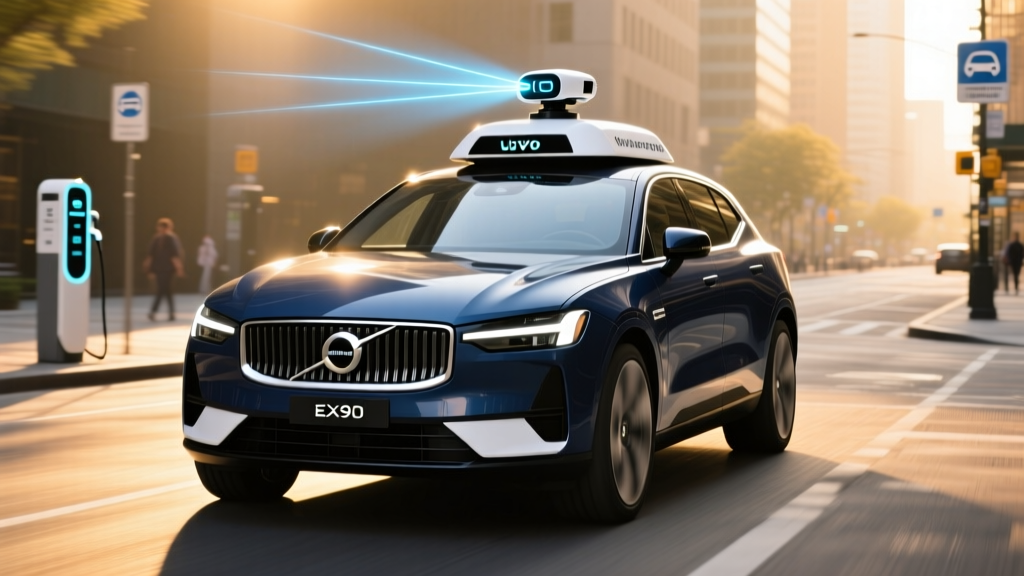
The Volvo EX90 is the first mainstream luxury SUV to ship with a roof-mounted lidar sensor as standard hardware. That 1550-nanometer Luminar Iris unit sits above the windshield, scanning up to 250 meters ahead to build a 3D point cloud of the road. It's an impressive piece of engineering — and it's also the source of significant confusion about what the EX90 can and cannot do on its own.
After spending time with the EX90's Pilot Assist system on highway and suburban routes, here's the reality: the lidar gives Volvo's driver-assistance suite a sensing advantage that cameras and radar alone can't match, but this remains a Level 2 system. You are the driver. The car is not.
How the Volvo EX90 Lidar and Sensor Suite Works
The EX90 doesn't rely on lidar alone. Volvo calls its full hardware stack the "sensor shield," and it combines multiple sensing modalities to create redundancy — the idea being that if one sensor type struggles (camera in glare, radar in heavy rain), another picks up the slack.
| Sensor Type | Quantity | Function | Range |
|---|---|---|---|
| Lidar (Luminar Iris) | 1 (roof-mounted) | 3D point-cloud mapping of objects, pedestrians, debris | Up to 250 m (vehicles), 120 m (small objects) |
| Cameras | 8 (surround-view + forward) | Lane detection, traffic sign recognition, object classification | ~200 m (forward telephoto) |
| Radars | 5 (1 front long-range, 4 corner) | Velocity/distance measurement, blind-spot, cross-traffic | ~200 m (front), ~80 m (corner) |
| Ultrasonic sensors | 12 | Low-speed parking, near-field obstacle detection | ~5 m |
The lidar unit itself uses a 1550 nm wavelength laser, which is eye-safe at higher power levels than the more common 905 nm wavelength. That allows Luminar's sensor to push farther down the road with higher resolution. In practical terms, the EX90 can detect a dark tire tread lying in the highway at night from over 100 meters away — something a camera-based system like Tesla's vision-only Autopilot would struggle to identify with the same confidence.
All sensor data feeds into Volvo's core computing architecture, which uses NVIDIA DRIVE Orin chips to process perception, prediction, and planning in real time. The EX90 launched with Qualcomm Snapdragon Cockpit Platforms handling infotainment and the interior driver-monitoring camera.
What Pilot Assist Actually Does on the Road
Volvo's Pilot Assist is the brand name for its highway driving-assistance feature. It combines adaptive cruise control with lane-centering steering, and in the EX90 it benefits from the full lidar-enhanced sensor stack.
The Volvo EX90's Pilot Assist is an SAE Level 2 driver-assistance system. This means the vehicle can simultaneously control steering and acceleration/braking under certain conditions, but the driver must remain fully engaged — eyes on the road, hands on or near the wheel, and ready to take over instantly. It is not autonomous or self-driving. Only Level 4 systems (like Waymo's robotaxi service) operate without a human driver in the loop.
On a divided highway at 65-75 mph, Pilot Assist holds the EX90 centered in its lane with noticeably smooth steering inputs. The lidar contributes most in scenarios where traditional systems get confused: construction-zone cone lines that shift lanes, a partially obscured lane marking under bridge shadows, or a stopped vehicle around a gentle curve that radar alone might detect late.
Volvo has also rolled out Pilot Assist with Park Assist Pilot for low-speed automated parking maneuvers, and an interior driver-understanding system that uses two infrared cameras and a capacitive steering wheel to monitor whether you're actually paying attention. If the cabin cameras detect prolonged gaze-away or hands-off behavior, the system escalates warnings and will eventually bring the vehicle to a controlled stop with hazard lights activated.
Real-World Capabilities and Honest Limitations
- Drive itself without supervision — this is not a robotaxi
- Navigate highway exits or interchanges autonomously (no lane-change-on-ramp feature at launch)
- Handle unmapped rural roads, unpaved surfaces, or missing lane markings reliably
- Operate in heavy snow accumulation on the lidar housing or camera lenses (the system will alert you and disengage)
- Replace attentive driving in construction zones with temporary signage and shifting lanes
- Function as a hands-off system — the capacitive wheel requires contact
The lidar's real-world advantage shows up in edge cases. During testing on a foggy morning with visibility around 200 meters, the EX90's system maintained confident following distance and lane position where a camera-reliant system would have degraded. Similarly, at dusk with direct sun washing out the forward camera, the lidar and radar continued to track vehicles ahead without hesitation.
But lidar isn't magic. In heavy wet snow, slush buildup on the roof-mounted sensor housing can block the laser, triggering a "sensor blocked" warning. Volvo engineered the housing with a heated cleaning system, but in sustained winter storms, you'll still need to pull over and wipe it manually. The same applies to the cameras and corner radars — ice and road grime degrade the entire sensor shield.
Urban driving presents its own limits. Pilot Assist handles stop-and-go traffic competently, but complex multi-lane intersections with unprotected left turns, pedestrians crossing mid-block, and cyclists filtering through lanes are beyond the system's design intent. You're on your own in downtown traffic.
| Scenario | System Capability | Driver Required? |
|---|---|---|
| Highway cruising (divided, clear markings) | Excellent — smooth lane centering, adaptive speed | Yes, hands on wheel |
| Highway construction zones | Good — lidar helps detect cones early, but lane shifts may confuse | Yes, heightened attention |
| Night driving, unlit roads | Strong — lidar detects objects beyond headlight range | Yes |
| Fog / reduced visibility | Better than camera-only systems; lidar penetrates fog | Yes |
| Heavy snow / ice on sensors | Degraded — system may disengage with warning | Full manual control |
| Urban intersections | Limited — not designed for complex traffic scenarios | Full manual control |
| Automated lane change (highway) | Available via turn-signal activation on updated software | Yes, must confirm |
| Hands-off / eyes-off driving | Not supported — Level 2 requires engagement | N/A |
EX90 Trim Availability and What's Standard
Volvo made the right call here: the lidar hardware is standard on every EX90, regardless of trim. You don't need to option up to get it. However, the software features that leverage the full sensor stack vary.
For the 2025-2026 model years, the EX90 is offered in two main configurations:
- EX90 Twin Motor Performance Ultra (~$81,550 MSRP): 496 hp, 111 kWh battery (NMC chemistry, ~107 kWh usable), EPA-estimated 310 miles of range, includes Pilot Assist with full lidar-enhanced features
- EX90 Twin Motor Ultra (~$78,150 MSRP): 402 hp, same battery, EPA-estimated 300 miles, same ADAS hardware and software
Pilot Assist is included at no additional cost — there is no monthly subscription for the base driving-assistance features. This is a meaningful differentiator from competitors like Tesla (which charges $8,000 for FSD or $99/month) and GM's Super Cruise (which transitioned to a subscription model after the initial included period).
Volvo has indicated that future advanced features — potentially including unsupervised autonomous driving for specific highway corridors — could be delivered via over-the-air updates and may carry a subscription fee. As of early 2026, no such feature has been activated or priced.
How the EX90 Lidar Compares to Competing ADAS Systems
The luxury-SUV ADAS landscape is crowded. Here's how the EX90 stacks up against the systems buyers actually cross-shop:
| Feature | Volvo EX90 (Pilot Assist) | Tesla Model X (FSD Supervised) | BMW iX (Driving Assistant Pro) | Mercedes EQS SUV (Drive Pilot) |
|---|---|---|---|---|
| Lidar | Yes (Luminar, roof) | No (vision-only) | No (radar + camera) | Yes (Luminar, for Level 3 in limited markets) |
| SAE Level | Level 2 | Level 2 | Level 2 | Level 2 (Level 3 on specific German autobahn sections only) |
| Hands-off allowed? | No | No | No (hands-off at ≤40 mph in EU, not US) | Level 3: yes, ≤40 mph, approved roads only (not available in US as of 2026) |
| Cost to buyer | Included standard | $8,000 or $99/mo | Included on higher trims | Included (Level 3 not US-available) |
| Sensor count | 1 lidar, 8 cam, 5 radar, 12 ultrasonic | 8 cameras, 0 radar, 0 lidar | 0 lidar, 8+ cam, 5 radar | 1 lidar, 10+ cam, 5+ radar |
| Night/fog advantage | Strong (lidar) | Limited (camera-dependent) | Moderate (radar helps) | Strong (lidar) |
The key takeaway: Volvo and Mercedes are the only mainstream luxury brands putting lidar on US-market consumer vehicles. Tesla's pure-vision approach is lower cost but sacrifices the depth-sensing redundancy that lidar provides. BMW relies on high-resolution radar and cameras, which is effective but doesn't match lidar's object-classification confidence at range.
Mercedes' Drive Pilot deserves a specific callout: it's the only SAE Level 3 system certified for consumer use, but only on specific German autobahn sections at speeds under 40 mph. It is not available in the United States, and even in Germany, the driver can legally disengage only under strict conditions. The Volvo EX90's hardware is technically capable of supporting higher automation levels pending regulatory approval and software validation, but Volvo has been explicit that no Level 3 or Level 4 feature is currently active.
Safety Context: What the Data Says
Volvo's safety reputation is well-earned, and the EX90's sensor suite is designed around the company's stated goal of zero fatalities in its new vehicles. The lidar specifically addresses a class of crashes that cameras and radar miss: stationary objects at highway speed, pedestrians at night beyond headlight range, and debris in the travel lane.
Volvo cites internal research suggesting the EX90's sensor shield could reduce severe crashes by up to 20% compared to vehicles without lidar, though independent real-world validation from IIHS and NHTSA will take years of fleet data to confirm. The EX90 earned IIHS Top Safety Pick+ status for its crashworthiness, though ADAS-specific ratings are still being evaluated.
The driver-monitoring system is equally important. Volvo's cabin cameras track eye gaze direction and blink patterns, while the capacitive steering wheel confirms hand presence. This dual-verification approach is more robust than torque-sensing wheels alone (which can be fooled by a weighted object on the rim) and is closer to what the NHTSA has recommended for Level 2 systems.
Frequently Asked Questions
Is the Volvo EX90 self-driving?
No. The EX90's Pilot Assist is an SAE Level 2 driver-assistance system. The vehicle can steer, accelerate, and brake under highway conditions, but the driver must remain fully attentive with eyes on the road and hands on the steering wheel. It cannot navigate without human supervision.
How much does the EX90's ADAS cost?
Pilot Assist and the full lidar sensor suite are included in the EX90's base price — no subscription, no add-on package. The EX90 Twin Motor Ultra starts around $78,150, and the Twin Motor Performance Ultra starts around $81,550. Future over-the-air feature upgrades may carry additional fees, but none have been announced or priced as of early 2026.
Does the lidar work in bad weather?
Partially. The 1550 nm Luminar lidar penetrates fog and light rain better than cameras, giving the EX90 an advantage in reduced-visibility conditions. However, heavy snow accumulation or ice on the roof-mounted sensor housing will degrade or block the lidar, and the system will alert you to clean it. The housing includes a heating element to mitigate icing.
Can the EX90 change lanes on its own?
With updated software, the EX90 supports lane-change assist: you activate the turn signal, the system checks surrounding traffic using the corner radars and cameras, and if clear, executes the lane change. The driver must initiate and confirm — it does not change lanes autonomously.
Which trims include the lidar?
All of them. The Luminar lidar sensor is standard hardware on every 2025 and 2026 Volvo EX90, regardless of trim level. You do not need to select a specific package to get it.
How does the EX90's system compare to Tesla FSD?
Both are Level 2 systems requiring driver supervision. The EX90 uses lidar plus cameras and radar for sensor redundancy; Tesla's FSD Supervised relies solely on cameras (no lidar, no radar). The lidar gives the EX90 a measurable advantage in depth perception at range, night driving, and fog. Tesla's FSD has broader feature ambition (city-street navigation) but has faced greater regulatory scrutiny. Tesla charges $8,000 or $99/month for FSD; Volvo includes Pilot Assist at no extra cost.
Will Volvo enable Level 3 autonomous driving on the EX90?
Volvo has stated the EX90's hardware is "prepared" for higher automation levels, but no Level 3 feature is currently active or announced for the US market. Regulatory approval, software validation, and liability frameworks must be in place before any hands-off, eyes-off driving capability is activated. Expect this to be a multi-year timeline.
The Volvo EX90's lidar is genuine hardware differentiation in a market where most ADAS systems rely on cameras and radar alone. It provides real, measurable sensing advantages in the edge cases where crashes happen — nighttime, fog, debris, and construction zones. But it's a tool for a better-informed driver, not a replacement for one. If you're buying the EX90 expecting autonomy, recalibrate. If you're buying it for the most robust Level 2 sensor suite available in a three-row electric SUV at no subscription cost, that's exactly what you're getting.