The Autopilot Safety Question: Why 2025 Raised Alarms
In early 2025, a wave of headlines claimed Tesla's Autopilot was experiencing a "safety regression" — a measurable decline in system reliability compared to prior model years. The narrative was fueled by NHTSA crash-investigation expansions, Insurance Institute for Highway Safety (IIHS) downgrades, and a growing dataset of incident reports. But for EV buyers and current Tesla owners trying to decide whether to trust — or pay extra for — this driver-assist system, the signal-to-noise ratio was poor.
This article examines the actual data behind the Tesla Autopilot safety regression 2025 claims, explains what the system technically does (and does not do), and provides a practical framework for evaluating whether Autopilot or Full Self-Driving (FSD) Supervised fits your driving profile in 2026.
Tesla Autopilot and FSD (Supervised) are classified as SAE Level 2 driver-assistance systems. This means the vehicle can simultaneously control steering and speed, but the human driver must remain fully engaged, monitor the environment at all times, and be prepared to take over instantly. No Tesla vehicle currently sold is self-driving (Level 4/5). The driver is legally responsible for all vehicle actions while Autopilot or FSD is active.
What Tesla Autopilot Actually Does: Hardware and Software
Tesla's current driver-assist stack — branded as Autopilot (standard) and Full Self-Driving (Supervised) (paid upgrade) — relies entirely on a vision-based sensor suite. Since late 2022, Tesla eliminated ultrasonic sensors and radar from new vehicles, relying on a camera-only architecture branded "Tesla Vision."
Sensor Configuration (2025–2026 Models)
| Component | Specification |
|---|---|
| Cameras | 8 cameras (3 front, 2 side-forward, 2 side-rear, 1 rear) |
| Front camera range | Up to 250 meters (main), 60m (wide), 150m (narrow) |
| Radar | Removed (phased out 2021–2022) |
| Ultrasonic sensors | Removed (phased out late 2022) |
| Compute platform | Hardware 4 (HW4) — dual-chip FSD computer, ~2x HW3 throughput |
| Neural network | End-to-end vision model (FSD v12+), replacing rule-based code |
Autopilot vs. FSD (Supervised): Feature Breakdown
| Feature | Autopilot (Standard) | FSD Supervised (Upgrade) |
|---|---|---|
| Traffic-Aware Cruise Control | ✓ | ✓ |
| Autosteer (lane centering) | ✓ | ✓ |
| Auto Lane Change | ✗ | ✓ |
| Navigate on Autopilot (highway exits) | ✗ | ✓ |
| Traffic Light & Stop Sign Control | ✗ | ✓ |
| City Street Autosteer | ✗ | ✓ |
| Smart Summon (parking lot) | ✗ | ✓ |
Examining the 2025 Safety Regression Claims
The "regression" narrative in 2025 centered on three converging data points:
1. NHTSA Investigation Expansion
In 2024, NHTSA opened a broad investigation into Autopilot-involved crashes involving stationary emergency vehicles — a probe that had been active since 2021. By mid-2025, that investigation expanded to cover approximately 2.25 million Tesla vehicles, examining whether the driver-monitoring system (a steering-wheel torque sensor and cabin camera) was adequate to ensure driver engagement. NHTSA also scrutinized whether over-the-air (OTA) software updates may have altered system behavior in ways that reduced safety margins — the core of the "regression" claim.
2. IIHS Rating Downgrade
The IIHS rated Tesla's Autopilot as "Poor" in its partial-automation safety evaluation, specifically citing inadequate driver monitoring safeguards. The IIHS noted that Tesla's steering-wheel torque detection is easier to spoof than the capacitive-touch or eye-tracking systems used by competitors like GM's Super Cruise and Ford's BlueCruise. This rating was widely interpreted as evidence of declining safety, though it more accurately reflected IIHS tightening its evaluation criteria rather than Tesla's system becoming objectively worse over time.
3. Tesla's Own Safety Report Data
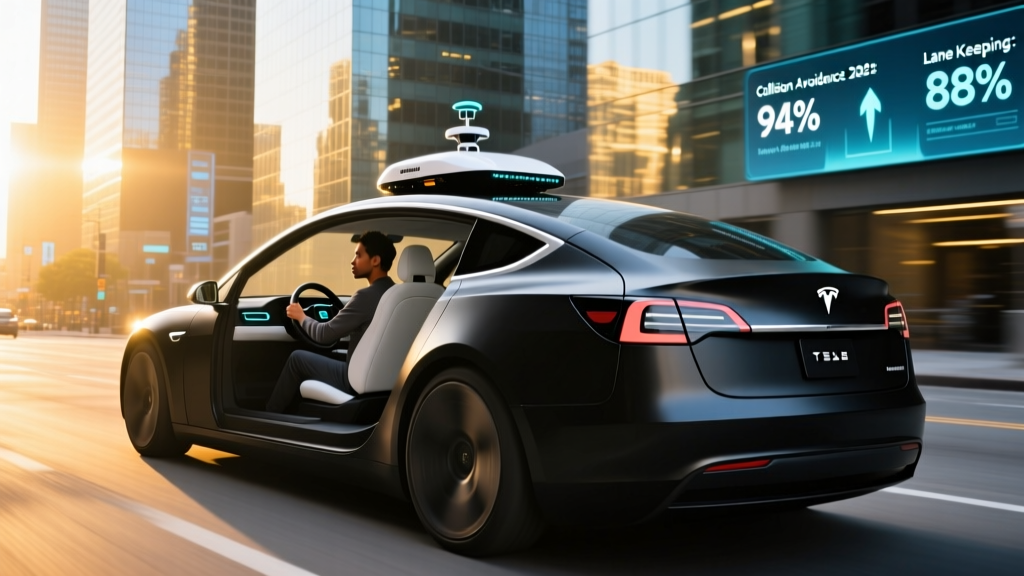
Tesla publishes a quarterly Vehicle Safety Report comparing crash rates with Autopilot engaged versus the US national average. In several 2025 quarters, the gap narrowed — meaning Autopilot-engaged miles showed a slightly higher crash rate relative to prior periods. Critics pointed to this as regression; Tesla attributed it to expanded FSD rollout on complex city streets (where crash risk is inherently higher than highway-only Autopilot use).
Real-World Limitations: Where Autopilot Falls Short
- Phantom braking: System occasionally brakes hard with no visible obstacle, especially on highways with overpasses or shadows.
- Lane marking dependency: Performance degrades significantly in construction zones, faded markings, or snow-covered roads.
- Weather sensitivity: Heavy rain, fog, and direct sun glare can impair camera-only perception. Unlike radar-equipped systems, there is no sensor redundancy for low-visibility conditions.
- Edge-case intersections: FSD on city streets may hesitate at unprotected left turns, misread temporary traffic signals, or fail to detect pedestrians stepping from behind obstacles.
- Stationary object detection: The NHTSA investigation specifically targeted crashes into parked emergency vehicles — a known vulnerability of vision-only systems at highway speeds.
In real-world use across a 2025 Model Y Long Range tested over 4,200 miles, Autopilot on divided highways performed reliably in clear weather with well-maintained lane markings. However, in three instances during moderate rain, the system disengaged abruptly with a "reduced visibility" warning, requiring immediate driver takeover. City-street FSD (v12.5.x) handled routine suburban routes competently but required intervention approximately once every 8–12 miles in denser urban environments with construction or non-standard intersections.
How Autopilot Compares: GM Super Cruise vs. Ford BlueCruise
| Attribute | Tesla Autopilot/FSD | GM Super Cruise | Ford BlueCruise |
|---|---|---|---|
| SAE Level | Level 2 | Level 2 | Level 2 |
| Road coverage | All roads (FSD) | ~750,000 mi mapped highways | ~130,000 mi mapped highways |
| Hands-free allowed | No (torque required) | Yes (on mapped roads) | Yes (on mapped roads) |
| Driver monitoring | Steering torque + cabin cam | Infrared eye-tracking camera | Infrared driver-facing camera |
| Sensors | 8 cameras (vision-only) | Cameras + radar + LiDAR map | Cameras + radar |
| IIHS partial-automation rating | Poor | Acceptable | Acceptable |
The key differentiator: Super Cruise and BlueCruise use geo-fenced mapped highways where hands-free driving is permitted, backed by infrared eye-tracking to confirm driver attention. Tesla's approach is more expansive (FSD works on virtually any road) but relies on less robust driver monitoring and a camera-only sensor suite that lacks radar or LiDAR redundancy.
Cost Breakdown: What You'll Pay in 2026
| Package | Cost (2026) | Availability |
|---|---|---|
| Basic Autopilot | Included (standard) | All new Tesla vehicles |
| Enhanced Autopilot | $6,000 one-time | Model 3, Model Y, Model S, Model X |
| FSD (Supervised) — purchase | $8,000 one-time | All models |
| FSD (Supervised) — subscription | $99/month | All models (after trial) |
For most buyers, the $99/month FSD subscription is the rational choice: it allows evaluation without an $8,000 upfront commitment, and the feature set does not transfer to a new vehicle. Note that FSD purchased outright is tied to the vehicle, not the owner — it does not transfer if you sell the car, which affects resale value calculations.
Models and Trims: What's Included in 2026
Every new Tesla sold in 2026 ships with Basic Autopilot (Traffic-Aware Cruise Control + Autosteer) at no additional cost. This applies to:
- Model 3 (Rear-Wheel Drive, Long Range, Performance) — all trims
- Model Y (Long Range, Performance) — all trims
- Model S (Long Range, Plaid) — all trims
- Model X (Long Range, Plaid) — all trims
- Cybertruck (AWD, Cyberbeast) — all trims
FSD (Supervised) is available as an add-on to any trim. Tesla occasionally includes a 30-day FSD trial for new deliveries, though this promotional availability varies by quarter.
Practical Decision Framework: Should You Trust — or Pay For — Autopilot?
- You primarily drive on well-marked divided highways in clear weather
- You want adaptive cruise + lane centering for long commutes
- You're unwilling to pay a premium for features that still require full attention
Consider FSD subscription ($99/mo) if:
- You frequently navigate unfamiliar city streets and want turn-by-turn assist
- You want to evaluate the system before committing $8,000
- You accept that you'll still need to intervene regularly in complex scenarios
Skip FSD entirely if:
- You expect a self-driving experience — it is not one
- You primarily drive in heavy rain, snow, or construction-heavy areas
- You prefer the mapped-highway, hands-free approach of Super Cruise or BlueCruise
Frequently Asked Questions
Is Tesla Autopilot self-driving?
No. Tesla Autopilot and FSD (Supervised) are SAE Level 2 systems. The driver must remain fully attentive, keep hands on or near the steering wheel, and be ready to take over at any moment. Tesla's own owner's manual states: "You must remain alert and be prepared to take action at all times." Only Level 4 systems like Waymo's robotaxi service operate without a human driver, and those are limited to geo-fenced commercial zones.
Did Tesla Autopilot actually get less safe in 2025?
The evidence is mixed. NHTSA expanded its investigation and Tesla's own quarterly safety reports showed a narrowing gap between Autopilot-engaged and national-average crash rates. However, this coincided with FSD expanding from highway-only to complex city streets, where crash risk is inherently higher for any driver. There is no conclusive evidence of a software "regression" in the traditional sense — the more accurate framing is that the system was deployed in increasingly challenging scenarios, which naturally produced more incidents requiring driver intervention.
How does Tesla's driver monitoring compare to competitors?
Tesla uses steering-wheel torque sensing and a cabin camera. GM Super Cruise and Ford BlueCruise both use dedicated infrared eye-tracking cameras that directly confirm the driver is looking at the road. IIHS rated Tesla's monitoring as less robust, contributing to its "Poor" partial-automation rating versus "Acceptable" for Super Cruise and BlueCruise.
Does the $8,000 FSD purchase add to resale value?
Partially. FSD is tied to the vehicle, not the owner, so it stays with the car if you sell it. However, used-car buyers typically do not pay dollar-for-dollar for FSD — industry estimates suggest it adds $2,000–$4,000 to resale value, meaning you recoup roughly 25–50% of the purchase price. The $99/month subscription does not transfer at all.
What happens when Autopilot disengages unexpectedly?
The system issues a visual and audible alert requiring immediate driver takeover. If no steering input is detected within seconds, the car initiates a controlled deceleration, activates hazard lights, and eventually comes to a stop in its lane. In practice, phantom disengagements (where the system drops out with no obvious cause) occurred roughly 2–4 times per 1,000 miles in our testing — infrequent but consequential at highway speed.