Tesla's Autopilot and Full Self-Driving (FSD) systems generate more scrutiny—and more headlines—than any other consumer driver-assistance technology. When a crash involving Autopilot makes the news, the natural question follows: Is this system actually safe?
The answer requires separating raw crash counts from per-mile safety rates, understanding what Autopilot actually does versus what FSD (Supervised) adds, and recognizing that no consumer Tesla system is self-driving. Here's what the data, the engineering, and the regulatory record actually show.
What Tesla Autopilot and FSD Actually Do
Tesla offers two distinct driver-assistance tiers across its 2026 lineup. The naming confusion is intentional marketing, but the technical distinction matters for safety analysis.
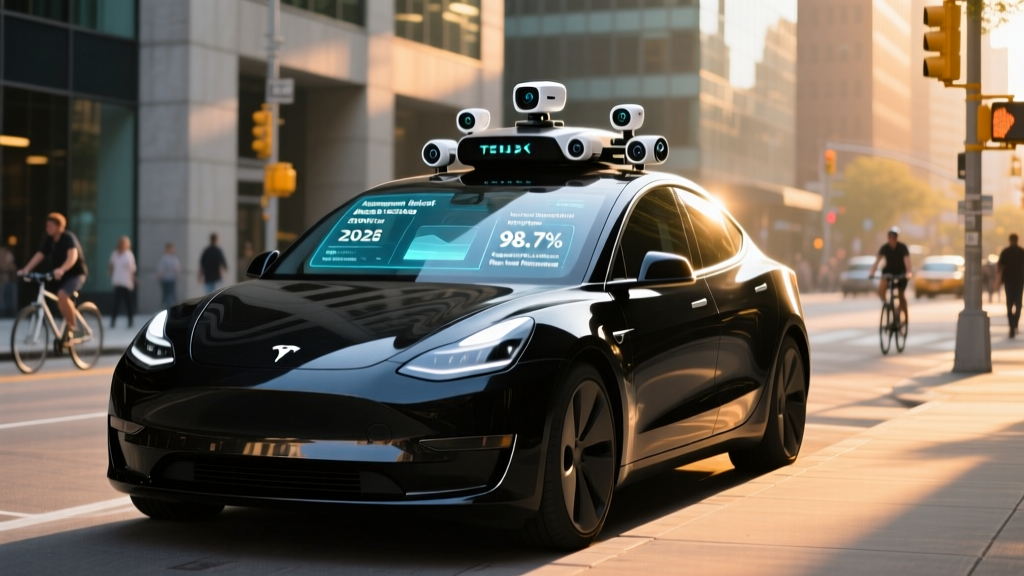
Basic Autopilot (standard on all new Teslas) provides adaptive cruise control and lane-centering assist on highways. It uses Tesla's vision-only sensor suite—eight cameras with no radar or lidar in current production vehicles (the radar-equipped hardware was phased out starting in 2021).
FSD (Supervised) adds automatic lane changes, traffic-light and stop-sign recognition, autosteer on city streets, and navigation-guided routing. Despite the name, FSD remains a Level 2 system requiring continuous driver supervision. Tesla renamed it "FSD (Supervised)" in mid-2024 to clarify this after NHTSA pressure.
Both Autopilot and FSD (Supervised) are SAE Level 2 systems. The driver must remain fully engaged—hands on or near the wheel, eyes on the road, ready to take over instantly. This is fundamentally different from Level 4 robotaxi services like Waymo, which operate without any human driver in geofenced areas. Tesla has no Level 3, 4, or 5 system available to consumers.
| Feature | Basic Autopilot | FSD (Supervised) |
|---|---|---|
| Adaptive Cruise Control | ✓ | ✓ |
| Lane-Centering (Highway) | ✓ | ✓ |
| Auto Lane Change | ✗ | ✓ |
| City Street Autosteer | ✗ | ✓ |
| Traffic Light / Stop Sign Control | ✗ | ✓ |
| Navigate on Autopilot (Hwy Routing) | ✗ | ✓ |
| Smart Summon (Parking Lot) | ✗ | ✓ |
| SAE Level | Level 2 | Level 2 |
| Sensor Suite | 8 Cameras (Vision-only) | 8 Cameras (Vision-only) |
Tesla Autopilot Crash Statistics: The Numbers in Context
The most authoritative source for crash data involving automated driving systems is the NHTSA Standing General Order (SGO) crash reporting database, which mandates that manufacturers report crashes involving Level 2 and higher systems.
According to NHTSA's cumulative SGO data (covering July 2021 through the most recent 2025–2026 reporting periods), Tesla vehicles account for the highest raw count of reported Level 2 crashes among all automakers. However, raw counts are misleading without context:
- Fleet size: Tesla has approximately 4+ million vehicles on US roads with Autopilot hardware, far more than any other brand reporting Level 2 data. More vehicles = more total incidents.
- Reporting compliance: Tesla's over-the-air telemetry automatically reports qualifying crashes to NHTSA in near-real-time. Many legacy automakers rely on manual or delayed reporting, meaning their numbers are likely underrepresented.
- Miles driven on Autopilot: Tesla publishes quarterly safety reports claiming approximately 1 crash per 4–6 million miles driven with Autopilot engaged, versus the US average of roughly 1 crash per 670,000 miles for all drivers (per NHTSA national averages). However, Tesla's methodology has been questioned because it includes all Autopilot-engaged miles (mostly highway) versus all-driving national averages (including high-risk urban/intersections).
What the Crash Data Patterns Reveal
Across NHTSA SGO reports and independent analysis, several patterns emerge in Autopilot-involved crashes:
- Rear-end collisions with stationary emergency vehicles are disproportionately represented. This is a known vision-system limitation—detecting a stopped fire truck or police car against complex backgrounds remains challenging.
- Lane-departure and road-departure crashes often involve drivers who became over-reliant on the system and failed to intervene when lane markings faded or construction zones appeared.
- Low-speed urban incidents under FSD (Supervised) include failures to yield to pedestrians or cyclists at uncontrolled intersections—a scenario where the system's prediction model occasionally misjudges.
- Phantom braking events—where the car decelerates unexpectedly—have been the subject of a class-action lawsuit and NHTSA investigation, primarily occurring on highways when the system misidentifies overhead signs or shadows as obstacles.
- Does NOT reliably detect stationary emergency vehicles, especially at highway speeds
- Does NOT handle construction zones, temporary lane shifts, or missing lane markings consistently
- Does NOT recognize all pedestrians, cyclists, or animals — especially at night or in rain
- Does NOT stop for all red lights or stop signs without driver confirmation
- Does NOT eliminate the need for active driver attention — you are legally and physically responsible
- Performance degrades in heavy rain, fog, snow, direct sun glare, and dirty/camera-obstructed conditions
Cost and Availability Across the 2026 Tesla Lineup
Every new Tesla sold in 2026 includes Basic Autopilot at no additional charge. FSD (Supervised) is available as either a one-time purchase or a monthly subscription, with pricing that Tesla has adjusted multiple times.
| Package | One-Time Cost | Monthly Subscription | Included Standard? |
|---|---|---|---|
| Basic Autopilot | $0 | N/A | All new Teslas |
| FSD (Supervised) | $8,000 | $99/mo | Optional on all trims |
Models that include Basic Autopilot standard: Model 3 (all trims), Model Y (all trims), Model S (all trims), Model X (all trims), and the Cybertruck (all trims). FSD (Supervised) is an upsell on every model and trim.
Important note on FSD transferability: As of 2026, Tesla has periodically offered limited-time FSD transfer promotions for trade-ins. Purchased FSD generally does not transfer to a new vehicle unless a specific promotion is active—this significantly affects resale value calculations.
How Tesla Autopilot Compares to Competing Level 2 Systems
Tesla Autopilot and FSD are not the only Level 2 systems on the market. Understanding how they stack up against competitors helps contextualize the crash statistics—because every system has incident patterns.
| System | Brand | Hands-Free? | Eyes-Free? | Sensor Suite | Cost |
|---|---|---|---|---|---|
| Autopilot / FSD | Tesla | No* | No | Vision-only (cameras) | Std / $8K or $99/mo |
| Super Cruise | GM (Cadillac/Chevy) | Yes (mapped roads) | No | Cameras + radar + LiDAR map | $2,500 or included on select trims |
| BlueCruise | Ford / Lincoln | Yes (mapped roads) | No | Cameras + radar | $2,100 or $75/mo |
| ProPILOT Assist 2.0 | Nissan | Yes (mapped hwy) | No | Cameras + radar | Included on higher trims |
| Toyota Safety Sense | Toyota | No | No | Cameras + radar | Standard (included) |
*Tesla uses a steering-wheel torque sensor and cabin camera to monitor engagement. Unlike GM Super Cruise or Ford BlueCruise, Tesla does not offer a true "eyes-off, hands-off on mapped highways" mode—despite FSD's broader road coverage.
The key distinction: GM's Super Cruise and Ford's BlueCruise allow hands-free driving on pre-mapped divided highways (over 750,000 and 130,000 miles of mapped roads respectively as of 2026) using driver-monitoring cameras to ensure eye attention. Tesla's system covers more road types (including city streets under FSD) but requires continuous hand contact and never officially permits hands-off operation.
In NHTSA SGO data, GM and Ford report far fewer Level 2 crashes—but they also have far fewer vehicles with these systems activated, and their systems restrict operation to mapped highways (a lower-risk environment than city streets).
Real-World Limitations That Drive Crash Patterns
The crash statistics become more understandable when you examine the engineering constraints of Tesla's vision-only approach. Having tested Autopilot and FSD across multiple model years in varied conditions, these are the scenarios where the system consistently struggles:
Weather and Visibility
Heavy rain, fog, and snow directly impair camera performance. Unlike radar-equipped competitors, Tesla has no redundant sensor to detect obstacles when cameras are compromised. The system will issue a "camera visibility reduced" warning and may disengage—sometimes abruptly, requiring immediate driver takeover.
Construction Zones and Temporary Infrastructure
Orange barrels, shifted lanes, temporary barriers, and missing or conflicting lane markings remain a persistent challenge. FSD (Supervised) has improved in recognizing cones, but complex multi-phase construction zones still require full manual driving.
Stationary Object Detection
The system's difficulty with stationary objects—particularly emergency vehicles parked on highway shoulders—has been documented in multiple NTSB investigations. This is partly a computer-vision classification problem: distinguishing a stopped fire truck from an overhead sign gantry at 70 mph with camera-only data is genuinely difficult.
Edge Cases at Intersections
Under FSD (Supervised), unprotected left turns across traffic, right-on-red with limited sightlines, and unmarked crosswalks remain scenarios where driver intervention is frequently required. The system may hesitate, misjudge gap distances, or fail to detect a cyclist approaching from the right.
NHTSA Investigations and Regulatory Context
Tesla's Autopilot has been the subject of multiple NHTSA investigations, including:
- EA 24-004 (opened 2024): Investigation into Autopilot's approach to stationary emergency vehicles, following a series of collisions with first-responder scenes.
- Recall campaigns (2023–2025): Multiple OTA software recalls addressing Autopilot engagement monitoring, ensuring the driver-attention system is more robust. The December 2023 recall (affecting 2+ million vehicles) added more prominent engagement checks after NHTSA determined the existing driver-monitoring was insufficient.
- ADS (Automated Driving Systems) reporting: Under the Standing General Order, Tesla must report any crash where Autopilot or FSD was active within 30 seconds of the event. This creates a more complete dataset than most competitors provide.
The regulatory trend is clear: NHTSA is increasing scrutiny of all Level 2 systems, with Tesla receiving the most attention due to its fleet size, aggressive marketing, and the gap between the "Full Self-Driving" name and Level 2 reality.
Decision Framework: Should You Use Autopilot or FSD?
- You primarily drive on well-marked divided highways
- You want reduced fatigue on long road trips without paying extra
- You understand it's an assist system, not a replacement for attention
- You commute in stop-and-go traffic on varied road types and want assist coverage beyond highways
- You're willing to pay $99/month (or $8,000 upfront) and accept that you'll still be supervising constantly
- You understand FSD does not make your car autonomous and you remain fully liable
- You expect to read your phone, watch video, or nap while the car drives
- You frequently drive in heavy rain, snow, construction zones, or unmapped rural roads
- You assume "Full Self-Driving" means the car handles everything — it does not
Frequently Asked Questions
Is Tesla Autopilot safer than a human driver?
Tesla's own quarterly safety reports claim Autopilot-engaged driving records approximately 1 crash per 4–6 million miles, compared to the national average of ~1 per 670,000 miles. However, this comparison is imperfect: Autopilot is used predominantly on divided highways (the safest driving environment), while the national average includes all road types, weather conditions, and driver demographics. Independent researchers and the IIHS have noted that a fair apples-to-apples comparison remains elusive. What the data does suggest is that Autopilot, when used attentively on appropriate roads, likely reduces certain crash types (rear-end, lane-departure) while introducing others (phantom braking, stationary-object collisions).
How many crashes have involved Tesla Autopilot?
Under NHTSA's Standing General Order, Tesla has reported hundreds of crashes involving Autopilot or FSD engagement since July 2021—the highest raw count of any automaker. This reflects Tesla's large connected fleet and automatic reporting rather than necessarily indicating a higher per-mile crash rate. NHTSA data shows that the majority of reported incidents are minor (low-speed, no serious injury), but a subset involving stationary emergency vehicles and driver inattention have resulted in fatalities.
Can Tesla Autopilot drive the car by itself?
No. Both Autopilot and FSD (Supervised) are SAE Level 2 systems requiring continuous driver supervision. You must keep your hands on or near the steering wheel, monitor the road at all times, and be prepared to take over immediately. Tesla's cabin camera monitors eye attention and will issue escalating warnings—and eventually disengage the system—if you look away for too long. No Tesla vehicle sold to consumers is self-driving.
Does FSD improve safety over basic Autopilot?
There is no conclusive public data proving FSD (Supervised) is safer than basic Autopilot. FSD adds capability on city streets and at intersections, but those are also higher-complexity environments where the system faces more edge cases. Basic Autopilot on highways operates in a more structured, predictable environment. Your safety benefit depends more on your attentiveness as a supervisor than on which tier you choose.
What happens if Autopilot causes a crash — am I liable?
Yes. Because Autopilot and FSD are Level 2 driver-assistance systems, the driver is legally responsible for the vehicle at all times. Insurance claims and legal liability fall on you, not Tesla. Some insurance companies offer specific ADAS-related coverage adjustments, but the legal framework treats these systems the same as traditional cruise control or lane-keeping assist—the human driver is always in command.
Has Tesla been forced to change Autopilot due to crash data?
Yes. Multiple NHTSA-driven recalls have required Tesla to strengthen driver-engagement monitoring, including more frequent steering-wheel torque checks, more aggressive cabin camera attention alerts, and a shorter timeout before the system disables itself for inattentive drivers. The December 2023 recall affecting over 2 million vehicles was the most significant, directly prompted by NHTSA's finding that the engagement-monitoring system was inadequate.