Can You Actually Take a Waymo to or From SFO in 2026?
San Francisco International Airport handles over 50 million passengers annually, and for EV-curious travelers, the question is increasingly practical: can a driverless Waymo One robotaxi pick you up curbside at SFO, or drop you off for a flight? The short answer is yes — but with significant caveats around pickup zones, surge pricing, and geofence boundaries that determine whether your specific destination is reachable.
Waymo, the Alphabet-owned autonomous vehicle company, operates the largest commercial Level 4 robotaxi fleet in the United States. Unlike Tesla's Full Self-Driving (Supervised) or GM's Super Cruise — which are Level 2 driver-assist systems requiring constant human supervision — Waymo's 6th-generation vehicles operate with no one behind the wheel. This distinction matters enormously for liability, safety regulation, and your experience as a rider.
Waymo One robotaxis operate at SAE Level 4 (High Automation) within their approved Operational Design Domain (ODD). This means the vehicle handles all driving tasks — steering, braking, navigation, hazard response — without human intervention, but only within mapped, geofenced areas under defined conditions. Outside that zone, the vehicle will pull over safely rather than hand control to a passenger. This is fundamentally different from Level 2 systems (Tesla Autopilot, Ford BlueCruise, GM Super Cruise) where the human driver remains legally responsible at all times.
Where Can You Use Waymo Right Now?
As of early 2026, Waymo One operates commercial paid rides in the following metro areas, each with distinct geofence boundaries that expand periodically:
| Metro Area | Status | Coverage Notes | Approx. Service Area |
|---|---|---|---|
| San Francisco Bay Area | Fully commercial | SF proper, parts of Daly City, South SF, SFO airport zone | ~80+ sq mi |
| Los Angeles | Fully commercial | Downtown LA, Hollywood, West LA, Santa Monica, LAX zone | ~80+ sq mi |
| Phoenix (East Valley) | Fully commercial (longest-running) | Chandler, Tempe, Mesa, Phoenix proper, Sky Harbor airport | ~225+ sq mi |
| Austin, TX | Commercial (expanding) | Central Austin, South Austin, select suburban corridors | ~45+ sq mi |
| Atlanta, GA | Commercial launch (2025-2026 rollout) | Midtown, Buckhead, initial corridors | Expanding |
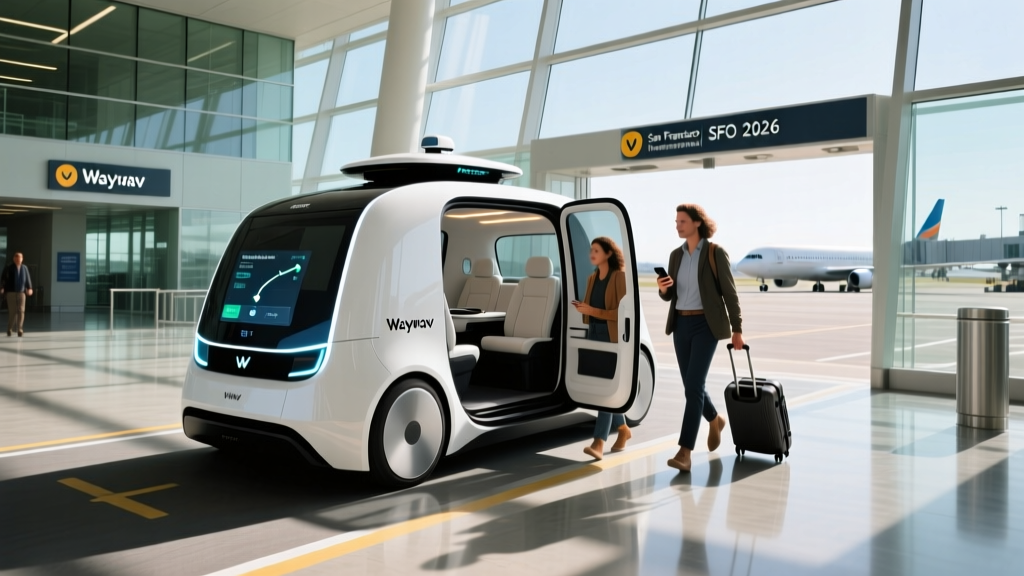
For SFO Waymo riders specifically: Waymo One serves designated pickup and dropoff zones at San Francisco International Airport. However, the airport geofence is more restrictive than city-street coverage — you cannot hail a Waymo from every curb. Riders must follow the Waymo app's pin to the authorized autonomous-vehicle pickup area, typically in the Ride App / App-Based pickup zone on the Departures/Ticketing level or designated garage area, depending on the terminal. Always confirm in-app before walking.
How SFO Waymo Pricing Compares to Uber and Lyft
Waymo uses dynamic pricing that factors distance, estimated time, demand, and operational costs. In the Bay Area, riders consistently report Waymo fares that are competitive with UberX and Lyft standard tiers, though the calculus shifts during surge periods.
| Route | Waymo One (est.) | UberX (est.) | Lyft Standard (est.) | Notes |
|---|---|---|---|---|
| SFO → Union Square, SF | $35–$55 | $30–$65 | $28–$60 | ~15 mi, 25-45 min |
| SFO → Palo Alto | $55–$85 | $50–$95 | $45–$90 | ~22 mi, 30-50 min |
| SFO → Oakland (downtown) | Likely unavailable* | $45–$80 | $40–$75 | *Outside geofence |
| Mission District → SFO | $32–$50 | $28–$55 | $25–$50 | ~14 mi |
Note: Fares are approximate ranges based on reported rider data and typical non-surge conditions. Airport fees, tolls (Bay Bridge, etc.), and tip are additional. Waymo does not currently accept tips in-app since there is no driver.
Key pricing insight: During heavy Uber/Lyft surge events (concerts letting out, holiday travel, SFO peak arrival banks), Waymo's algorithmic pricing has often remained more stable than human-driver surge multipliers — but Waymo's smaller fleet means availability becomes the constraint rather than price. Expect longer wait times (10-20+ minutes) at SFO during peak hours versus 3-7 minutes for Uber/Lyft.
How Safe Are Waymo Robotaxis? The Real Data
Safety is the most legitimate question for any first-time robotaxi rider. Waymo publishes periodic safety reports and has submitted data to NHTSA. Here is what the numbers actually show:
- Cumulative fully-autonomous miles driven: 30+ million driverless miles across Phoenix, SF, LA
- Injury-causing crash rate vs. human benchmark: Waymo reports approximately 85% fewer injury-causing crashes per million miles compared to human drivers in comparable geographies (based on Waymo's published safety case studies and NHTSA-reported benchmarks)
- Police-reported crash rate: Significantly below human baseline; most reported incidents involve Waymo vehicles being rear-ended at low speed or struck by human-driven vehicles running red lights
- At-fault incidents: Very low rate; NHTSA Standing General Order data shows Waymo incidents are predominantly minor contact events, not high-severity collisions
Sources: Waymo Safety Reports, NHTSA Standing General Order crash data, IIHS analyses.
Context that matters: Waymo's fleet operates in dense urban environments where low-speed collisions are more common but less severe. The relevant comparison is not highway fatality rates but urban injury-crash rates, and on that metric Waymo's data is compelling. However, the fleet has not yet accumulated billions of miles — the statistical confidence intervals are still widening as the fleet scales. A single high-profile incident can shift public perception faster than aggregate data shifts policy.
Notable incidents in the Bay Area have included Waymo vehicles making contact with towed trailers, low-speed collisions with cyclists in complex intersections, and a small number of events where vehicles entered active rail crossings (prompting a voluntary software recall and fix). None of these resulted in serious injuries, but they illustrate that Level 4 autonomy in 2026 is very good, not flawless.
Waymo's Technology Stack: Lidar, Cameras, and HD Maps
Waymo's approach to autonomy is sensor-fusion-heavy — the polar opposite of Tesla's camera-only FSD strategy. The current 6th-generation Waymo Driver hardware suite includes:
- Custom-built lidar units — multiple roof-mounted and body-integrated sensors providing 360° 3D point-cloud perception out to 500+ meters. Lidar is independent of ambient light, giving Waymo a significant night-driving and glare-resistance advantage.
- High-resolution camera array — overlapping fields of view for object classification, traffic-light state detection, signage reading, and lane-marking interpretation.
- Radar sensors — for velocity detection of moving objects and redundancy in adverse conditions (fog, rain) where camera and lidar performance degrades.
- HD maps + geofencing — Waymo pre-maps every inch of its service area at centimeter precision. The vehicle localizes itself against this map in real time. This is why Waymo cannot simply "drive anywhere" — it requires a mapped, approved ODD.
- Custom AI compute platform — onboard inference hardware running Waymo's perception, prediction, and planning models, with remote-assist capability for edge cases where the vehicle requests human guidance (not remote driving, but high-level route confirmation).
The vehicle platform itself is currently the Zeekr RT (a Geely-built electric minivan designed from the ground up for autonomous operation) for newer fleet additions, alongside the legacy Jaguar I-PACE EVs from earlier fleet generations. Both are fully electric, contributing to Waymo's per-ride emissions profile being tied to the regional grid mix — in California's increasingly renewable-heavy grid, that means relatively low upstream carbon intensity.
Regulatory Landscape: Who Approves Waymo at SFO?
Operating a driverless commercial robotaxi in California requires approval from multiple regulatory bodies, and understanding this stack explains why expansion is slower than the technology might suggest:
- California DMV — issues the Autonomous Vehicle Testing and Deployment permits. Waymo holds a full Deployment Permit (not just testing), allowing commercial driverless operation.
- California Public Utilities Commission (CPUC) — regulates commercial passenger service. Waymo received its TCP (Transportation Charter-Party Carrier) permit authorizing paid rides.
- NHTSA (federal) — sets vehicle safety standards (FMVSS). Robotaxis must either comply with existing standards or receive exemptions. NHTSA also mandates crash reporting via the Standing General Order.
- SFO Airport Commission / San Francisco Mayor's Office — airport-specific access requires separate agreements for curbside pickup zones, staging areas, and per-ride fees.
- Local municipalities — each city within the Bay Area geofence (Daly City, South San Francisco, etc.) has input on operational boundaries.
This layered regulatory environment is why Waymo's expansion to new cities takes 12-24+ months of mapping, testing, permitting, and community engagement — not because the vehicles cannot physically drive there, but because the legal and political infrastructure must be built city by city.
Current Limitations: What SFO Waymo Cannot Do
- Geofence boundaries are strict. If your destination is outside the mapped ODD — say, Oakland, Berkeley, Marin County, or most of the East Bay — Waymo will not offer the ride. Check the app before committing.
- Heavy weather restrictions. While Waymo handles light rain and fog, dense fog (common at SFO in winter), heavy downpours, or any scenario where sensor performance degrades below safety thresholds will trigger service pauses or ride cancellations.
- Construction zones and unmapped changes. If a road has been significantly reconfigured since the last map update, the vehicle may take a conservative route, pull over, or request remote assist — adding time to your trip.
- No child seats or unaccompanied minors. Waymo's terms require all riders to be 18+. You cannot install your own car seat, and the vehicles do not provide them.
- Luggage limitations. The Zeekr RT offers generous cargo space, but oversized items (skis, large surfboards, multiple oversized suitcases for a family of 5) may not fit. Plan accordingly for airport runs.
- No highway driving to distant cities. Waymo uses highways within its ODD (e.g., US-101 between SF and SFO), but will not take you to San Jose, Sacramento, or Napa.
- Wait times at SFO can be long during peak. Fleet density at the airport is lower than in central SF. Budget 15-25 minutes for pickup during arrival rushes.
- Accessibility: Waymo has been deploying wheelchair-accessible vehicles in select markets, but availability at SFO is limited — confirm in-app or contact Waymo support ahead of travel.
How to Actually Use Waymo One at SFO
- Download the Waymo One app (iOS/Android) and create an account with payment method before arriving at SFO.
- Enter your destination — the app will immediately confirm whether it's within the service area and provide an upfront price.
- Walk to the designated pickup zone — follow SFO signage for "Ride App" or "App-Based Rides" pickup areas. The app pin will guide you to the exact curb or garage spot.
- Confirm the vehicle — the app shows the car's license plate, model (Zeekr RT or Jaguar I-PACE), and a photo. Verify before entering.
- Unlock via app — tap "Start Ride" when you're at the vehicle. The doors unlock automatically.
- Buckle up and confirm — the in-cabin screen prompts all passengers to fasten seatbelts before the vehicle begins moving.
- Ride and monitor — screens show the vehicle's perception view (what it "sees" — pedestrians, cars, cyclists rendered in 3D). You can play music, adjust climate, or request a pull-over via the screen.
- Exit at destination — the vehicle will pull to a safe stop. Check for belongings, then exit. Payment is automatic.
Frequently Asked Questions
Is Waymo at SFO truly self-driving, or is there a hidden driver?
There is no human driver in the vehicle — no one in the front seat, no remote operator controlling the steering wheel. Waymo One at SFO is SAE Level 4: fully driverless within its geofenced service area. Remote assist personnel can provide high-level guidance (e.g., confirming a route around construction) but do not drive the vehicle in real time.
How much does a Waymo from SFO to downtown San Francisco cost?
Typically $35–$55 for a ride from SFO to Union Square, Nob Hill, or the Financial District, depending on time of day and demand. This is in line with UberX/Lyft non-surge pricing. Tolls and airport fees are included in the upfront quote.
Can Waymo take me from SFO to Oakland or Berkeley?
No. As of 2026, Waymo's Bay Area geofence does not extend across the Bay Bridge to the East Bay. Oakland, Berkeley, Alameda, and points east are outside the Operational Design Domain. You'll need Uber, Lyft, BART, or a traditional taxi for East Bay destinations.
Is Waymo safer than a human Uber driver?
Waymo's published data shows significantly lower injury-causing crash rates per million miles compared to human driver benchmarks in comparable urban environments. The fleet has driven 30+ million fully autonomous miles with no fatalities attributed to the autonomous system. However, the statistical sample is still growing, and urban low-speed incidents do occur. For the cautious traveler: Waymo's safety record is strong, but "safer than humans" is a claim best evaluated on the specific metric (injury crashes per million urban miles) rather than as an absolute.
What happens if the Waymo vehicle gets confused or encounters an emergency?
The vehicle is designed to execute a "minimal risk condition" — meaning it will signal, slow down, and pull to a safe stop (shoulder, parking lane, or low-traffic side street). It will not continue driving in an uncertain state. Remote assist may be engaged to help the vehicle resolve the situation, or roadside assistance is dispatched. In-cabin screens and speakers allow you to contact support at any time.
Can I use Waymo at SFO at 2 AM?
Waymo One in the Bay Area operates 24/7, including late-night airport runs. However, fleet density is lower overnight, so expect longer wait times. The service area may also be slightly reduced during overnight hours for operational reasons — confirm in-app.
Does Waymo work in heavy rain or fog at SFO?
Light rain and typical SFO fog are within the operational envelope. Dense fog (visibility under ~50 meters), heavy rain, or any condition that significantly degrades lidar and camera performance may trigger service restrictions or ride cancellations. Waymo errs on the side of caution — if the system isn't confident, it won't drive.
What electric vehicle does Waymo use?
Waymo's current fleet includes the Jaguar I-PACE (90 kWh NMC battery, EPA range ~234 mi) from earlier fleet builds and the newer Zeekr RT — a purpose-built electric autonomous vehicle from Geely's Zeekr brand with a larger battery and sensor-integrated design. Both are zero tailpipe-emission BEVs.
The Bottom Line for SFO Travelers
Waymo One at SFO in 2026 is a genuinely functional, commercially mature Level 4 robotaxi service — not a pilot, not a demo, not a "coming soon." For trips within San Francisco proper, the Peninsula, and select South Bay corridors, it offers pricing competitive with Uber/Lyft, a compelling safety record backed by tens of millions of driverless miles, and an experience that is genuinely novel the first time you watch a steering wheel turn itself through a four-way stop in the Mission.
The limitations are real and worth planning around: no East Bay, no Marin, no distant suburbs, weather-dependent availability, and potentially long waits at the airport during peak hours. If your destination is within the geofence and you're not on a razor-thin schedule, Waymo is a legitimate — and arguably safer — alternative to a human-driven rideshare. If you need to get to Berkeley at 5 PM on a Friday in the fog, book the Uber.