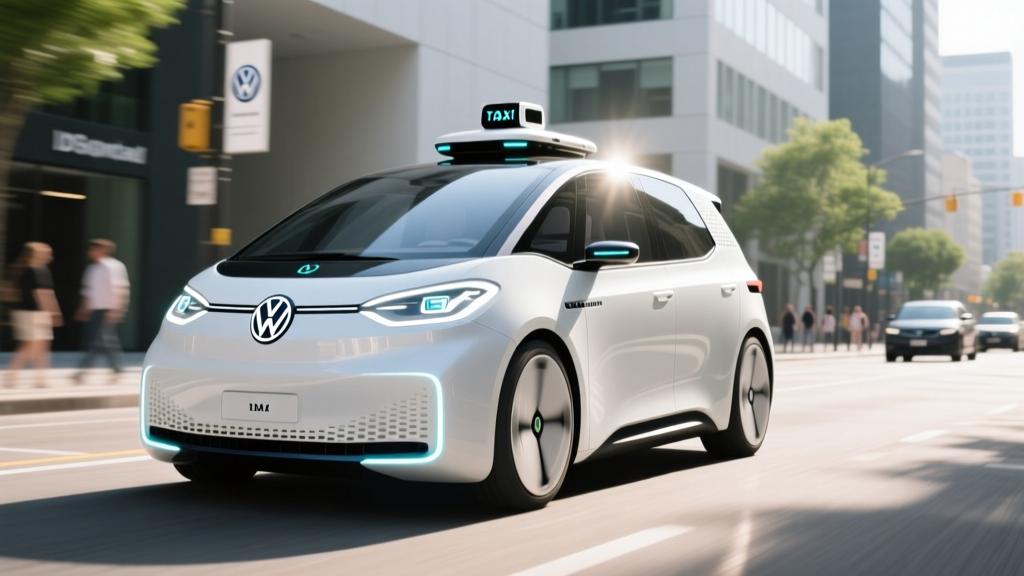
When enthusiasts search for "self-driving VW," they are typically envisioning a fully autonomous Volkswagen you can buy and sleep in while it drives you across the country. The reality in 2026 is more nuanced—and more interesting. Volkswagen Group, through its autonomous driving subsidiary Motional (a joint venture with Hyundai Motor Group) and its commercial vehicle arm, has been developing the ID. Buzz AD, a purpose-built autonomous electric van aimed at robotaxi and autonomous ride-hailing fleets. But where does this technology actually stand today, and when might you be able to hail one?
This guide cuts through the marketing to deliver the hard data on VW's autonomous driving efforts: SAE automation levels, actual service availability, safety records, technology stack, pricing, and the limitations that still define the robotaxi space.
SAE Automation Levels: Where VW's Self-Driving Tech Actually Sits
The single most important distinction in autonomous driving is the SAE Level. Consumer vehicles with "driver-assist" features (VW's Travel Assist, Tesla Autopilot, Ford BlueCruise) operate at SAE Level 2—the driver must remain engaged and supervise at all times. Robotaxis like Waymo's Jaguar I-PACE fleet and the targeted VW ID. Buzz AD aim for SAE Level 4—fully driverless operation within a defined operational design domain (ODD), meaning specific geofenced areas under specific conditions.
| SAE Level | Definition | VW Product | Driver Required? |
|---|---|---|---|
| Level 2 | Partial automation—steering + acceleration assisted | ID.4, ID.7, ID. Buzz (consumer) with Travel Assist | Yes, always |
| Level 2+ | Enhanced L2 with lane changes, hands-off (eyes-on) | Upcoming VW models with Travel Assist High Speed | Yes, always |
| Level 4 | Full driverless within geofenced ODD | ID. Buzz AD (robotaxi/fleet only) | No (within ODD) |
The consumer ID. Buzz you can buy today is a Level 2 vehicle. It is not self-driving. The ID. Buzz AD robotaxi variant—equipped with a significantly more complex sensor suite—is a Level 4 vehicle, but it is not available for purchase. It is designed exclusively for fleet operators offering autonomous ride-hailing services.
Where Can You Actually Use VW's Robotaxi Service?
This is where expectations meet reality. As of early 2026, VW's autonomous driving efforts are channeled primarily through Motional, which operates and tests Level 4 robotaxi services. VW's ID. Buzz AD has been in testing phases with select partners, but widespread commercial deployment remains limited.
| City / Region | Status | Vehicle Platform | Access |
|---|---|---|---|
| Las Vegas, NV | Testing / limited pilot | Hyundai Ioniq 5 (Motional fleet) | Invite-only via Lyft |
| Boston, MA | Testing / mapping | Hyundai Ioniq 5 | Closed testing |
| Munich, Germany | ID. Buzz AD pilot testing | VW ID. Buzz AD | Closed / regulatory pilot |
| Hamburg, Germany | MOIA shuttle trials | VW ID. Buzz AD variant | Limited pilot |
For US consumers, the critical takeaway: you cannot currently hail a self-driving VW in any American city. Motional's limited US operations use Hyundai platforms, not VW-branded vehicles. The ID. Buzz AD pilots are concentrated in Germany under regulatory sandbox permits. VW has announced intentions to launch commercial robotaxi services in European cities, but no firm date for unrestricted public access has been confirmed.
If you are looking for a commercially available robotaxi in the US right now, Waymo operates Level 4 driverless rides in Phoenix, San Francisco, Los Angeles, and Austin via the Waymo One app. Cruise (GM) has been working to resume limited operations after its 2023 suspension. VW's robotaxi is not yet in this competitive set for American riders.
How Much Would VW's Robotaxi Cost vs Uber and Lyft?
Because VW's ID. Buzz AD robotaxi service is not yet commercially available at scale, definitive consumer pricing does not exist. However, we can estimate based on Motional's partnership structure and the broader robotaxi pricing landscape.
| Service | Avg. Cost (5-mile trip) | Availability | Notes |
|---|---|---|---|
| UberX (human driver) | $12–$18 | Nationwide | Surge pricing applies |
| Lyft (human driver) | $11–$17 | Nationwide | Surge pricing applies |
| Waymo One (Level 4 robotaxi) | $10–$16 | PHX, SF, LA, Austin | No surge; promotional pricing in some markets |
| VW ID. Buzz AD (projected) | Estimated $10–$15 | Not yet available | Via Lyft/Motional partnership or MOIA in EU |
The long-term thesis for robotaxi pricing is undercutting human-driven rideshare by eliminating the driver's share of the fare (typically 70–80% of what you pay goes to the driver). Industry analysts project that at scale, robotaxis could offer per-mile costs 20–40% below Uber/Lyft. VW, through its MOIA ride-pooling subsidiary in Europe, has signaled it will position the ID. Buzz AD as a shared autonomous shuttle, which could push per-rider costs even lower through multi-passenger routing.
However, early-stage robotaxi services tend to launch at or slightly above rideshare parity, subsidized by the operator to build ridership. Expect VW/Motional to follow this pattern when commercial service launches.
Safety Record: What the Data Actually Shows
Safety is the most scrutinized dimension of any robotaxi program. For VW's ID. Buzz AD specifically, public safety data is limited because the vehicle has been in controlled pilot testing rather than large-scale commercial deployment. Here is what we know:
- ID. Buzz AD test fleet miles: VW has not published cumulative autonomous test miles for the ID. Buzz AD specifically. Motional's broader fleet (Hyundai-based vehicles) has logged millions of autonomous miles across US and European test programs.
- Disengagement rates: Not publicly reported for ID. Buzz AD. For context, California DMV disengagement reports (required for all AV testers in the state) show leading operators averaging 5,000–30,000+ miles between safety-driver interventions.
- At-fault collisions: No publicly reported at-fault collisions involving the ID. Buzz AD in autonomous mode during pilot testing.
- Industry comparison: NHTSA requires Standing General Orders for crash reporting from AV operators. Waymo reports approximately 1 at-fault collision per 1.5+ million autonomous miles—a rate significantly better than the human average of roughly 1 reported crash per 500,000 miles.
The honest assessment: VW's ID. Buzz AD does not yet have the millions of commercial passenger miles that Waymo has accumulated. Safety claims at this stage should be treated as preliminary. The vehicle's sensor redundancy (see technology stack below) suggests a design philosophy prioritizing safety margins, but real-world validation at scale is still pending.
Technology Stack: Sensors, Compute, and Geofencing
The ID. Buzz AD's technology stack is substantially more complex than the consumer ID. Buzz. Where the consumer van relies on cameras, radar, and ultrasonic sensors for Level 2 Travel Assist, the AD variant adds a roof-mounted sensor array and significantly more compute power.
| Component | Consumer ID. Buzz (Level 2) | ID. Buzz AD (Level 4) |
|---|---|---|
| Cameras | Front-facing mono camera + surround-view | Multi-camera 360° array (8–12 cameras), high-resolution |
| LiDAR | None | Multiple solid-state LiDAR units (roof + corners) |
| Radar | Front + rear long-range radar | 6+ radar units (long-range + short-range surround) |
| Ultrasonic | 12 sensors (parking) | Enhanced short-range ultrasonic array |
| Compute | Standard VW ADAS ECU | High-performance redundant compute platform (Motional stack) |
| HD Maps | Not required | Centimeter-precision HD maps, pre-scanned geofence |
| Redundancy | Single-path systems | Dual-redundant steering, braking, power, compute |
The critical distinction between VW/Motional's approach and Tesla's camera-only FSD is the inclusion of LiDAR. Motional, like Waymo, uses a multi-modal sensor fusion approach combining camera, LiDAR, and radar data. This provides redundant perception—particularly important in edge cases like direct sun glare, heavy rain, or low-contrast scenarios where cameras alone can struggle.
The ID. Buzz AD operates within a geofenced operational design domain (ODD). This means the vehicle can only drive autonomously in pre-mapped areas where it has centimeter-accurate HD maps and validated routes. Outside that geofence, the vehicle cannot operate without a human driver. This is a fundamental architectural difference from Tesla's approach, which attempts generalizable driving everywhere but requires human supervision.
Current Limitations: Weather, Geofencing, and Edge Cases
Level 4 autonomy is impressive within its domain—but that domain has hard boundaries. Here are the real limitations of VW's robotaxi program:
- Geofencing: The vehicle can only operate within pre-mapped, approved zones. If your trip starts or ends outside the geofence, the service cannot fulfill it.
- Weather restrictions: Like most Level 4 systems, heavy snow, dense fog, and torrential rain can exceed sensor confidence thresholds. The vehicle may pull over safely or refuse to dispatch in severe conditions.
- Construction zones: Unmapped road changes, temporary lane closures, and novel construction configurations remain challenging. Remote human teleoperators may need to assist.
- No highway operation (currently):strong> Most Level 4 robotaxi geofences cover urban/suburban streets. Highway merging and high-speed autonomous operation are generally not yet part of the ODD for VW's pilot programs.
- Limited hours: Some pilot programs restrict operation to daylight or specific hours, even if the technology nominally supports nighttime driving.
- No consumer purchase: You cannot buy an ID. Buzz AD. It is a fleet-only vehicle. The consumer ID. Buzz remains Level 2.
Regulatory Landscape: Who Approves Robotaxi Operations?
Autonomous vehicle deployment in the United States is governed by a patchwork of state and federal regulations:
- Federal (NHTSA): Sets vehicle safety standards (FMVSS). The NHTSA requires crash reporting via Standing General Orders but does not currently "approve" AV software. Federal Motor Vehicle Safety Standards were written for human-driven vehicles, and exemptions are required for vehicles without steering wheels or pedals (not applicable to the ID. Buzz AD, which retains manual controls).
- State level: States control road-use permissions. California (DMV + CPUC), Arizona, Texas, and Nevada have the most permissive frameworks for commercial robotaxi deployment. Each state has different testing permits, insurance requirements, and reporting mandates.
- European Union: Germany passed the Autonomous Driving Act (Autonomes Fahren Gesetz) in 2021, creating a legal framework for Level 4 operations on public roads. This gives VW a clearer regulatory pathway in its home market than many competitors have in the US. The EU's broader UNECE regulations are evolving to accommodate autonomous commercial vehicles.
For VW, the German regulatory environment is arguably more favorable than the US. The ID. Buzz AD pilots in Munich and Hamburg operate under German federal permits. US deployment through Motional faces the state-by-state approval process, which is slower and more fragmented.
The Consumer VW ID. Buzz: What You CAN Buy Today
If you are interested in VW's electric van but don't want to wait for robotaxi commercialization, the consumer 2025/2026 VW ID. Buzz is available now. Here are the key specs:
| Spec | ID. Buzz (RWD) | ID. Buzz AWD (4Motion) |
|---|---|---|
| Battery | 91 kWh usable (NMC) | 91 kWh usable (NMC) |
| EPA Range | 234 miles | 231 miles |
| Real-World Range | ~190–210 mi highway; ~160–180 mi cold weather | ~185–205 mi highway; ~155–175 mi cold weather |
| DC Fast Charge (peak) | 200 kW | 200 kW |
| 10–80% DC Time | ~26 minutes | ~26 minutes |
| Horsepower | 282 hp | 335 hp |
| 0–60 mph | ~7.9 sec | ~5.9 sec |
| Base MSRP | ~$59,995 | ~$63,995 |
| ADAS | Travel Assist (Level 2) | Travel Assist (Level 2) |
| Battery Warranty | 8 years / 100,000 mi | 8 years / 100,000 mi |
The consumer ID. Buzz is a compelling electric family van with retro styling and solid practicality, but it is definitively a Level 2 driver-assist vehicle. You must keep your hands on the wheel and eyes on the road. The 234-mile EPA range is adequate for city and suburban use but requires planning for longer road trips—expect real-world highway range closer to 190–210 miles, and less in cold weather due to the van's large frontal area and cabin heating demands.
At its ~$60,000 starting MSRP, the consumer ID. Buzz exceeds the $55,000 MSRP cap for SUVs/vans under the IRS §30D federal tax credit, meaning it does not qualify for the $7,500 new EV credit. Always verify current eligibility on irs.gov, as rules and qualifying vehicle lists are updated periodically.
Frequently Asked Questions
Is VW's self-driving car actually available to the public?
No. The VW ID. Buzz AD robotaxi is in pilot testing in Germany and is not available for public ride-hailing in any city. The consumer ID. Buzz you can buy is Level 2 driver-assist, not self-driving. For commercially available robotaxis in the US, Waymo One operates in Phoenix, San Francisco, Los Angeles, and Austin.
Can I buy a self-driving VW for personal use?
Not currently, and likely not for years. The ID. Buzz AD's Level 4 system is designed for fleet operation. Consumer vehicles with Level 4 capability (fully driverless in all conditions) do not exist on the market from any manufacturer. The most advanced consumer systems (VW Travel Assist, Tesla FSD Supervised, GM Super Cruise) are Level 2—requiring driver supervision at all times.
How does VW's autonomous tech compare to Tesla FSD?
These are fundamentally different approaches. Tesla FSD (Supervised) is a Level 2 system that attempts to drive anywhere using cameras only, but requires the human driver to monitor and intervene. VW/Motional's ID. Buzz AD is a Level 4 system that uses LiDAR + cameras + radar + HD maps but only operates within pre-mapped geofences. Tesla's approach is broader in geographic scope but lower in automation level. VW/Motional's approach is higher in automation (no driver needed) but narrower in geographic scope.
When will VW robotaxis be available in the US?
There is no confirmed date. Motional (VW/Hyundai JV) has tested in Las Vegas and Boston, but commercial service timelines have been repeatedly delayed. VW's primary robotaxi focus has been European markets, particularly Germany, where the regulatory framework is more established. US deployment would require state-by-state approval and competitive positioning against Waymo, which has a multi-year head start.
How safe are robotaxis compared to human drivers?
Based on available data from leading operators, robotaxis appear to have lower at-fault collision rates than human drivers. Waymo reports roughly 1 at-fault crash per 1.5+ million autonomous miles, compared to the human average of approximately 1 reported crash per 500,000 miles (NHTSA data). However, robotaxis operate in constrained conditions (mapped urban areas, fair weather) and total industry miles are still a fraction of human-driven miles. VW's ID. Buzz AD does not yet have sufficient public safety data for direct comparison.
What happens if a VW robotaxi encounters a situation it can't handle?
Level 4 robotaxis are designed to enter a "minimal risk condition" when they encounter situations outside their capability. This typically means pulling over safely to the side of the road and requesting remote assistance. Some operators use teleoperation centers where human operators can remotely assess the situation and either guide the vehicle or dispatch a human driver. The ID. Buzz AD retains a steering wheel and pedals, so a safety operator (during testing) or future fleet attendant could take manual control if needed.