If you've searched for a robotaxi service area near you and come up empty, you're not alone. Fully driverless ride-hailing remains confined to a handful of US metro zones in 2026 — but within those zones, the service is real, priced competitively, and accumulating millions of autonomous miles. This guide maps exactly where you can hail a driverless ride today, what it costs, how safe the data says it is, and what still keeps these vehicles inside their geofences.
What Level of Autonomy Are Robotaxis, Really?
Before looking at maps, it's critical to separate consumer driver-assist systems from actual robotaxis. Tesla Autopilot, Ford BlueCruise, and GM Super Cruise are SAE Level 2 systems — the driver must remain engaged at all times. Robotaxis from Waymo, Zoox, and (historically) Cruise operate at SAE Level 4: fully driverless within a defined operational design domain (ODD), with no human behind the wheel and no expectation of intervention.
| Level | Name | Driver Required? | Example |
|---|---|---|---|
| 2 | Partial Automation | Yes — hands on or eyes on, always | Tesla FSD (Supervised), GM Super Cruise |
| 3 | Conditional Automation | No in specific conditions; must take over on request | Mercedes DRIVE PILOT (limited markets, ≤40 mph) |
| 4 | High Automation | No — within geofenced ODD | Waymo One, Zoox (commercial pilot) |
| 5 | Full Automation | No — anywhere, any condition | Does not exist commercially |
No Level 5 robotaxi exists. Every commercial service today is Level 4 — meaning driverless, but only inside a carefully mapped, geofenced zone under specific conditions. Step outside that zone, and the vehicle won't operate.
Where Can I Use a Robotaxi Right Now?
As of early 2026, three operators run or are ramping driverless commercial or pilot service in the United States. Availability is tightly controlled and often requires an invitation or waitlist.
| Operator | City / Zone | Service Type | Hours | Access |
|---|---|---|---|---|
| Waymo One | Phoenix, AZ (metro-wide including Tempe, Chandler, Mesa, Scottsdale) | Fully driverless commercial | 24/7 | Open to public via app |
| Waymo One | San Francisco, CA (most of city, SFO airport route added late 2024) | Fully driverless commercial | 24/7 | Open to public via app |
| Waymo One | Los Angeles, CA (Santa Monica, Hollywood, downtown, LAX corridor) | Fully driverless commercial | 24/7 | Open to public via app |
| Waymo One | Austin, TX (central and south Austin, expanding) | Fully driverless commercial | Limited hours, expanding | Waitlist / early access |
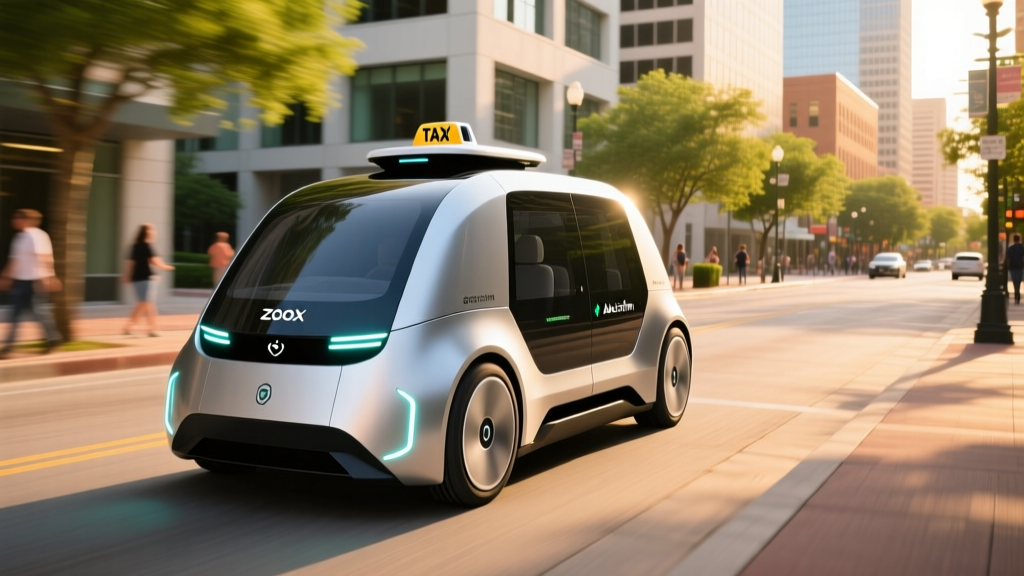
| Zoox | Foster City & San Francisco, CA (pilot zones) | Driverless pilot (no fare initially) | Limited hours | Invitation-based |
| Zoox | Las Vegas, NV (Las Vegas Blvd corridor) | Driverless pilot | Limited hours | Invitation-based |
| Cruise | — (operations suspended since late 2023; gradual re-entry testing in Phoenix and Dallas with safety drivers in 2025-2026) | Not commercially available driverless | N/A | N/A |
Key takeaway: Phoenix remains the most mature robotaxi service area in the world, with Waymo covering over 300 square miles including freeway routes. San Francisco and Los Angeles are the next largest, though dense urban environments mean more edge cases. Austin is the newest expansion market. Outside these metros, no fully driverless ride-hailing exists in the US as of this writing.
How Much Does a Robotaxi Cost vs Uber or Lyft?
Robotaxi pricing is designed to undercut or match conventional rideshare — a deliberate strategy to build ridership while operators absorb higher per-vehicle costs.
| Service | Base Fare | Per-Mile Rate | Estimated 5-Mi Trip | Surge Pricing? |
|---|---|---|---|---|
| Waymo One | ~$5.00 | ~$1.25/mi | $11–$14 | No dynamic surge |
| UberX | ~$3.50 | ~$1.50/mi | $12–$18 | Yes, can 1.5–3x |
| Lyft Standard | ~$3.50 | ~$1.45/mi | $12–$17 | Yes, variable |
Waymo's advantage isn't always the base fare — it's the absence of surge pricing. During rain, rush hour, or events in San Francisco, an UberX can surge to 2–3x, pushing that same 5-mile trip to $30+. Waymo holds steady. Wait times in mature service areas like Phoenix average 3–6 minutes; in newer markets like LA, expect 8–15 minutes as fleet density ramps.
To use Waymo One: download the app, enter your destination, and confirm pickup. The vehicle arrives without a driver. You unlock via the app, buckle up, and the ride begins. A screen inside shows the route. You can adjust music and climate. Payment is automatic — no tipping (there's no driver).
How Safe Are Robotaxis? The Real Data
This is where hype meets hard numbers. Robotaxi operators report safety data to the California DMV and NHTSA, and independent researchers have analyzed crash rates.
Waymo Safety Record (Through Late 2025)
- Total fully autonomous miles driven: Over 50 million (cumulative, all markets)
- Fatalities in driverless mode: 0
- Injury-causing crashes: Significantly fewer per million miles than human benchmarks
- Contactless at-fault incidents: Waymo's published data (peer-reviewed via the IIHS and independent studies) shows a ~85% reduction in injury-causing crash rates compared to human drivers in comparable urban environments
- Most common incident type: Low-speed contact with stationary objects or other vehicles making unexpected maneuvers — typically under 10 mph, no injuries
The critical context: robotaxi crashes make news precisely because they're rare. A minor fender-bender involving a Waymo in San Francisco generates headlines, while thousands of identical human-caused crashes go unreported daily. The data supports that Level 4 systems, within their ODD, are safer than the average urban driver on a per-mile basis.
That said, the Cruise suspension in late 2023 — triggered by a pedestrian-dragging incident in San Francisco and subsequent reporting failures — demonstrated that operational failures and regulatory trust matter as much as raw crash statistics. Cruise's gradual return in 2025-2026 has been with safety drivers, not driverless.
Under the Hood: The Technology Stack
Robotaxis don't drive themselves by magic. They rely on layered sensor suites, high-definition maps, and real-time decision-making compute. Here's how the major stacks compare:
| Component | Waymo (6th-Gen) | Zoox (Purpose-Built Vehicle) |
|---|---|---|
| LiDAR | Custom roof-mounted + corner units; 360° coverage, ~500m range | 4 corner-mounted LiDAR units, 360° coverage |
| Cameras | 8+ high-resolution cameras for object classification, traffic light reading | Multi-camera array covering full 360° |
| Radar | Multiple radar units for velocity detection, adverse weather | Multiple radar units |
| HD Maps | Pre-mapped geofence with centimeter-level detail; real-time updates | Pre-mapped operational zones |
| Compute | Custom "Driver" system with redundant compute paths | Redundant compute with fail-operational design |
| Vehicle Platform | Jaguar I-PACE (84 kWh battery, 234-mi EPA range); transitioning to Zeekr RT custom van | Purpose-built bidirectional vehicle, no steering wheel, 4 facing seats |
| Redundancy | Dual-redundant braking, steering, compute, power | Dual-redundant across all safety-critical systems |
Notice that every production robotaxi uses LiDAR. This contrasts with Tesla's camera-only approach for its Level 2 FSD system. Robotaxi engineers consider LiDAR essential for the precise distance measurement and redundancy required when no human is available to take over. The sensor fusion approach — combining LiDAR, camera, and radar — gives the system multiple independent ways to understand the environment.
The Jaguar I-PACE, Waymo's current workhorse, uses an 84 kWh (usable) NMC battery pack. EPA range is 234 miles, but real-world robotaxi usage with constant stop-start, HVAC, and compute load reduces effective range to roughly 150–170 miles before a swap or charge is needed. Waymo manages this through fleet logistics — vehicles cycle back to charging depots as batteries deplete.
The Regulatory Landscape: Who Approves Robotaxi Service Areas?
Robotaxi operations in the US are governed by a patchwork of state and local authorities — there is no single federal "robotaxi license."
- California: The California Public Utilities Commission (CPUC) and the California DMV jointly regulate. The DMV issues testing and deployment permits; the CPUC authorizes commercial fare-charging. Both can suspend operations (as happened with Cruise).
- Arizona: The most permissive regulatory environment. The state Department of Transportation and governor's office have actively encouraged robotaxi deployment with minimal restriction, which is why Phoenix became Waymo's first mature market.
- Texas: The Texas Department of Transportation and local municipalities share oversight. Austin's expansion has involved city-level coordination on pickup zones and traffic integration.
- Nevada: The Nevada DMV and state legislature have frameworks for autonomous vehicle testing and deployment, enabling Zoox's Las Vegas pilot.
- Federal (NHTSA): The National Highway Traffic Safety Administration sets vehicle safety standards and investigates incidents but does not directly approve or deny robotaxi service areas. NHTSA's Standing General Order requires operators to report crashes involving automated systems.
This state-by-state patchwork means expansion is slow: each new metro requires regulatory engagement, local government cooperation, and often public comment periods. There's no mechanism for an operator to simply "flip a switch" and launch nationwide.
Current Limitations: What Robotaxis Still Can't Do
Level 4 autonomy is impressive within its domain, but that domain has hard edges. Here are the real-world limitations riders encounter:
- Geofence boundaries: The vehicle will not drive outside its mapped service area. If your destination is 200 feet beyond the geofence, the app won't let you book the ride. Service areas expand gradually but remain finite.
- Heavy weather: Torrential rain, dense fog, snow, and ice degrade sensor performance. Waymo in Phoenix rarely faces this; Waymo in San Francisco occasionally pauses service during heavy atmospheric rivers. Snow-belt cities are not viable robotaxi markets with current sensor stacks.
- Construction zones: Unexpected lane closures, temporary barriers, and flaggers can confuse the system. Robotaxis may stop, wait, or request remote assistance — adding minutes to your trip.
- Unusual road configurations: Unmapped driveways, private roads, unpaved surfaces, and complex multi-point turns remain challenging. Pickups and drop-offs may be routed to the nearest mapped-accessible curb rather than your exact door.
- Emergency vehicles: While systems are trained to pull over for sirens and lights, edge cases remain — particularly when multiple emergency vehicles are present or when pulling over safely requires complex maneuvers.
- Freeway driving: Waymo has expanded to include some freeway segments in Phoenix and LA, but many service areas remain surface-street only. A cross-city trip that would be 10 minutes on the freeway might take 25 minutes on surface streets.
- Accessibility: Current vehicles (Jaguar I-PACE) require riders to enter a standard SUV. Wheelchair-accessible vehicles are not yet part of the fleet. Zoox's purpose-built vehicle has a low floor and wide door, but it's not yet in wide commercial service.
- No stops or multi-destination trips: You can't ask a robotaxi to stop at a drive-through or add a second pickup. It's point A to point B only.
What a robotaxi will NOT do: Drive outside its geofence, operate in severe weather, handle unmapped terrain, let you override the route, or function as a personal vehicle you own. These are ride-hail services, not autonomous cars you can buy.
Frequently Asked Questions
Where can I use a robotaxi service right now?
The largest live robotaxi service areas are Phoenix (metro-wide, 24/7), San Francisco (most of the city, 24/7), and Los Angeles (select zones, expanding). Austin is ramping. Outside these metros, no driverless ride-hailing is commercially available in the US. Zoox runs invitation-only pilots in Foster City, San Francisco, and Las Vegas.
How much does a robotaxi cost vs Uber or Lyft?
Waymo One fares are comparable to or slightly below UberX and Lyft for standard trips — roughly $11–$14 for a 5-mile ride. The real savings come during peak demand, when rideshare surges 1.5–3x and Waymo does not. There is no tipping since there is no driver.
How safe are robotaxis — is there real data?
Waymo has accumulated over 50 million fully autonomous miles with zero fatalities in driverless mode. Independent studies published through IIHS and academic institutions show an approximately 85% reduction in injury-causing crash rates compared to human benchmarks in comparable urban settings. The Cruise incident in late 2023 demonstrated that operational failures (not just crash rates) matter — and regulators will act on them.
Is a robotaxi truly self-driving, or is someone monitoring remotely?
Robotaxis are SAE Level 4 — fully driverless within their geofenced operational domain. There is no human in the vehicle. However, remote fleet operators monitor vehicles and can provide guidance in ambiguous situations (e.g., a construction zone). The vehicle makes all real-time driving decisions; remote assistance is for edge-case routing, not steering or braking.
Can I buy a robotaxi for personal use?
No. Waymo's Jaguar I-PACE vehicles and Zoox's purpose-built vehicle are not available for consumer purchase. These are fleet-operated vehicles with specialized sensor suites, compute hardware, and software that requires constant mapping, monitoring, and updates. Consumer vehicles with advanced driver-assist (Tesla FSD, GM Super Cruise) remain Level 2 — you must stay engaged.
Why isn't the robotaxi service area bigger?
Each expansion requires: (1) high-definition mapping of every road in the new zone, (2) state and local regulatory approval, (3) fleet deployment and charging infrastructure, and (4) validation testing under local conditions. This process takes 12–24 months per new metro. Weather limitations (snow, heavy rain) also exclude many cities from current sensor capabilities.
What happens if the robotaxi gets confused or breaks down?
The vehicle will pull over safely and contact remote support. If the issue is software-related, remote guidance can often resolve it within minutes. For hardware failures, Waymo dispatches a roadside-assistance team. Riders are not expected to intervene or troubleshoot. In over 50 million miles, this has resulted in occasional delays but no rider-stranded safety incidents.