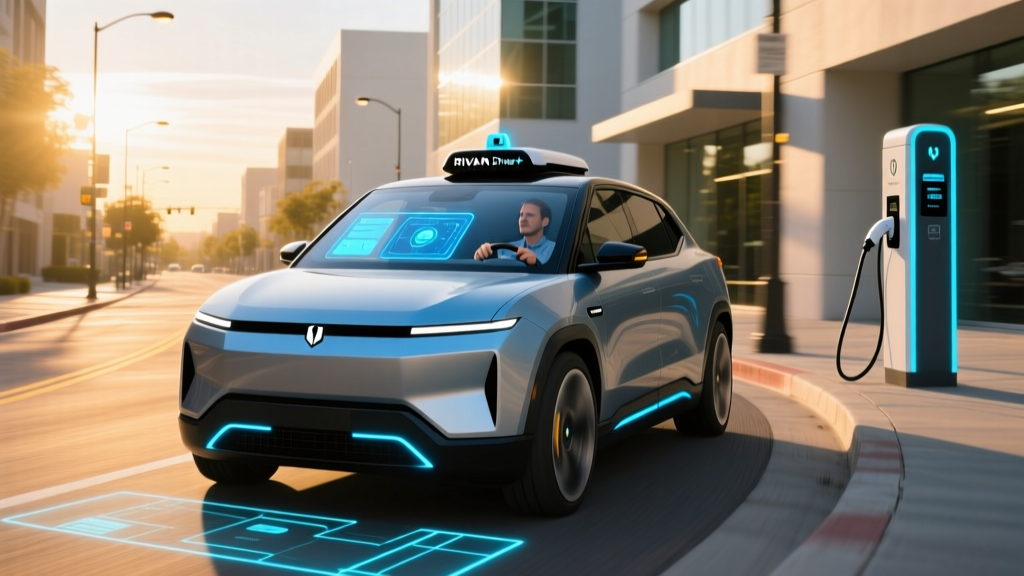
Search for "Rivian FSD" and you'll hit a wall of confusion. Rivian doesn't sell a feature called Full Self-Driving — that's Tesla's branding. What Rivian offers is Driver+, a Level 2 advanced driver-assistance system (ADAS) bundled standard on every R1T, R1S, and the new R2 lineup. It's capable, it's improving via over-the-air updates, and it has real limitations you need to understand before you trust it on a cross-country drive.
This guide cuts through the marketing fog. We'll explain exactly what Driver+ does in 2026, how its sensor stack works, where it falls short, and whether it holds up against Tesla Autopilot/FSD, GM Super Cruise, Ford BlueCruise, and the latest Hyundai/Kia Highway Driving Assist.
What Is Rivian Driver+ (And Why People Call It "Rivian FSD")
Rivian Driver+ is the company's umbrella name for its SAE Level 2 driver-assistance suite. It combines two core functions:
- Adaptive Cruise Control (ACC): Maintains a set speed and following distance using radar and cameras, including stop-and-go traffic handling down to 0 mph.
- Lane Centering Assist: Actively steers to keep the vehicle centered in its lane, using forward-facing cameras to read lane markings and, in newer software builds, the road edge.
When both are engaged simultaneously on a highway, Driver+ provides hands-on-wheel, eyes-on-road assisted driving. The system launched with the R1T and R1S in 2022 and has matured through continuous OTA updates — Software 14.x and 15.x releases through 2025 and 2026 added smoother lane-keeping, better cut-in detection, and improved merging behavior.
Rivian Driver+ is an SAE Level 2 system. Per the SAE J3016 standard, Level 2 means the vehicle can simultaneously control steering and acceleration/braking under certain conditions, but the driver must continuously supervise, keep hands on the wheel, and be prepared to take over instantly. Rivian does not offer a Level 3 (eyes-off) or Level 4 (driverless) system. No consumer EV sold in the U.S. today does — Level 4 robotaxis like Waymo operate only in geofenced commercial fleets.
Under the Hood: Rivian's Sensor Suite and How Driver+ Works
Rivian's ADAS stack is hardware-rich, which gives the software team room to improve capability over time without requiring retrofits.
| Component | Count / Spec | Role |
|---|---|---|
| Forward-facing cameras | Wide + narrow + telephoto | Lane detection, traffic sign recognition, object classification |
| Surround-view cameras | 8+ total exterior cameras | 360° awareness, blind-spot monitoring, parking assist |
| Forward radar | 1x long-range (77 GHz) | ACC target tracking, cut-in detection, adverse weather redundancy |
| Ultrasonic sensors | 12 sensors | Low-speed parking, close-proximity obstacle detection |
| Driver monitoring | Steering-wheel torque sensor + cabin camera (newer builds) | Hands-on detection, attention alerts |
| Compute | Rivian custom ADAS ECU | Sensor fusion, path planning, neural-net inference |
Rivian's approach is camera-primary with radar as a redundancy layer — similar to Tesla's vision-centric architecture but with the radar retained. This matters in practice: radar gives Driver+ an edge in heavy rain, fog, and low-contrast highway scenarios where cameras alone struggle. The cabin-facing driver-monitoring camera (added in later hardware revisions) enables more precise attention tracking than torque-based steering-wheel detection alone.
Driver+ Capabilities: What It Does Well
In real-world highway driving across the R1T and R1S, Driver+ delivers solid Level 2 performance in its intended use cases:
- Interstate cruising: Lane centering is confident on well-marked divided highways, holding the vehicle near the middle of the lane even through gentle curves.
- Stop-and-go traffic: ACC handles congested freeway conditions smoothly, resuming from a full stop without driver input (within a short timeout window).
- Speed-limit awareness: The system reads posted speed-limit signs and can prompt the driver to adjust cruise speed accordingly.
- Large-vehicle offset: Recent software updates add a slight lateral offset when passing semi-trucks, mimicking what a human driver would do for comfort and safety.
- Smooth lane changes: When the driver initiates a lane change via the turn signal (available on newer software builds), the system executes the maneuver smoothly after verifying the adjacent lane is clear.
The steering feel is notably natural for a Level 2 system — Rivian tuned the lane-keeping to avoid the "ping-pong" oscillation that plagued early ADAS implementations from other manufacturers.
Real-World Limitations: Where Driver+ Falls Short
- Drive without supervision — hands must remain on the steering wheel at all times.
- Navigate highway exits, interchanges, or toll booths autonomously (no automated ramp-to-ramp routing).
- Handle construction zones with shifted lanes, temporary barriers, or faded markings reliably.
- Operate in heavy snow, freezing rain, or dense fog that obscures cameras and reduces radar effectiveness.
- Stop at traffic lights or stop signs without driver intervention on surface streets (no city-street assist mode in 2026).
- Recognize or yield to pedestrians, cyclists, or animals as a primary braking function — that's the separate AEB system.
The most common real-world frustrations owners report:
Construction zones: Like virtually every Level 2 system, Driver+ can become confused by temporary lane markings, orange barrels, and shifted lanes. The system may attempt to follow old (crossed-out) lane lines. You must take over immediately in these areas.
Lane-marking dependency: On rural two-lane roads with faded or absent lane paint, lane centering degrades or disengages. The ACC function continues, but you're steering manually.
Cold-weather sensor obstruction: Snow and slush buildup on the forward camera housing and radar can trigger system-disable warnings. Rivian's heated camera washer helps but doesn't fully solve this in active winter storms.
No hands-free mode: Unlike GM's Super Cruise or Ford's BlueCruise on approved highways, Rivian does not currently offer a true hands-off-wheel mode. The torque sensor and/or cabin camera require periodic proof of driver engagement. This is a deliberate design choice reflecting Rivian's conservative safety posture, but it means longer drives require more active involvement than some competitors.
Cost, Availability, and Trim-Level Breakdown
One of Rivian's strongest competitive advantages is that Driver+ comes standard on every vehicle — no subscription, no premium package upsell, no per-month fee.
| Brand / System | Included Standard? | Extra Cost | Subscription Option |
|---|---|---|---|
| Rivian Driver+ | Yes — all trims | $0 | None (fully included) |
| Tesla Autopilot (basic) | Yes — all models | $0 | N/A |
| Tesla FSD (Supervised) | No | $8,000 one-time | $99/month |
| GM Super Cruise | Select trims only | $2,200–$2,500 (package) | Free 3 yrs, then ~$25/mo |
| Ford BlueCruise | Select trims only | $2,100 (package) | $75/month or $800/yr |
| Hyundai HDA2 | Yes — mid/high trims | $0 | None |
The no-subscription model is a meaningful ownership advantage. Over five years, a Tesla FSD subscriber would pay $5,940 ($99 × 60 months) for a system that remains Level 2. A Ford BlueCruise subscriber pays $4,500 over the same period after the initial package. Rivian owners pay nothing beyond the vehicle's MSRP.
Driver+ is included on every 2026 R1T, R1S, and the newly launched R2. There are no trim-gated ADAS tiers — a base R2 Standard gets the same Driver+ system as a fully loaded R1S Adventure with the Max battery pack.
Rivian Driver+ vs. the Competition
| Feature | Rivian Driver+ | Tesla FSD (Supervised) | GM Super Cruise | Ford BlueCruise |
|---|---|---|---|---|
| SAE Level | Level 2 | Level 2 | Level 2 | Level 2 |
| Hands-free (eyes-on) | No | No (hands-on) | Yes (mapped highways) | Yes (mapped highways) |
| Auto lane change | Driver-initiated (signal) | Auto + driver-initiated | Driver-initiated (signal) | Driver-initiated (signal) |
| City-street assist | No | Yes (FSD only) | No | No |
| Radar retained | Yes | No (Tesla Vision) | Yes | Yes |
| LiDAR | No | No | Yes (HD maps + LiDAR) | No |
| Ongoing cost | $0 | $8,000 or $99/mo | ~$25/mo after yr 3 | $75/mo or $800/yr |
Where Rivian wins: Zero recurring cost, no trim-level gatekeeping, and a sensor suite that includes radar for weather redundancy. For buyers who want capable highway assist without subscription lock-in, it's the strongest value proposition in the segment.
Where Rivian trails: No hands-free mode. GM Super Cruise and Ford BlueCruise both permit hands-off-wheel driving on hundreds of thousands of miles of pre-mapped divided highways (verified by GM's Super Cruise coverage map). If you prioritize hands-free comfort on long interstate hauls, those systems currently offer a tangible advantage — at a cost.
The Tesla comparison: Tesla's FSD (Supervised) offers the most ambitious feature set, including city-street traffic light and stop-sign handling. However, it remains a Level 2 system requiring full driver attention, costs $8,000 upfront or $99/month, and its real-world reliability in complex urban environments is inconsistent based on extensive owner reporting and NHTSA's ongoing ADS investigation data. Rivian's Driver+ is more conservative but more predictable in what it will and won't attempt.
Safety Context: What the Data Says
Rivian vehicles have earned strong safety ratings — the R1T received a 5-star overall rating from NHTSA, and Driver+ is designed as a safety augmentation layer, not a replacement for attentive driving.
Key safety behaviors built into the system:
- Escalating attention warnings: If the system detects no steering torque or driver-camera eye contact, it issues visual, audible, and haptic alerts in sequence before disengaging and slowing the vehicle.
- Automatic Emergency Braking (AEB): Operates independently of Driver+ and is always active, providing forward collision warning and automatic braking for detected vehicles, pedestrians, and cyclists.
- Blind-spot intervention: Can apply corrective steering if you attempt a lane change into a detected vehicle in your blind spot, even when Driver+ is not engaged.
- Rear cross-traffic alert with braking: Active in reverse, applying brakes if crossing traffic is detected.
No ADAS system eliminates crash risk. The IIHS research on partial automation consistently shows that Level 2 systems reduce — but do not eliminate — certain crash types, and driver over-reliance remains a significant risk factor. Treat Driver+ as a co-pilot, not an autopilot.
What's Next: Rivian's ADAS Roadmap
Rivian has signaled that future software updates will expand Driver+ capabilities, though the company has been careful not to announce timelines or specific features prematurely. Areas to watch:
- Hands-free highway mode: Rivian's hardware (cabin driver-monitoring camera) is capable of supporting a hands-off mode similar to Super Cruise or BlueCruise. Whether and when Rivian enables this depends on validation and regulatory comfort.
- Enhanced highway navigation: Automated on-ramp-to-off-ramp routing (similar to Tesla's Navigate on Autopilot) is a logical next step given the existing sensor suite.
- R2 platform scaling: The R2, arriving with the same ADAS hardware, will bring Driver+ to a lower price point (starting around $45,000 MSRP), making it accessible to a much broader buyer pool.
Rivian's OTA update cadence has been consistent — major software drops every 2–3 months with incremental improvements. Unlike some competitors that charge for post-purchase feature unlocks, Rivian has historically included all ADAS improvements at no additional cost.
Frequently Asked Questions
Does Rivian have a feature called "FSD"?
No. "Full Self-Driving" (FSD) is a Tesla product name. Rivian's driver-assistance system is called Driver+. It provides SAE Level 2 adaptive cruise control and lane centering. Search results and forums sometimes use "Rivian FSD" colloquially, but the correct term is Driver+.
Is Rivian Driver+ self-driving?
No. Driver+ is SAE Level 2, meaning the driver must remain fully engaged — hands on the wheel, eyes on the road — at all times. The system assists with steering and speed control but does not drive autonomously. No consumer vehicle sold in the U.S. in 2026 offers self-driving capability.
How much does Rivian Driver+ cost?
Nothing beyond the vehicle's purchase price. Driver+ is included standard on every R1T, R1S, and R2 — all trims, all model years. There is no subscription fee, no premium package requirement, and no per-month charge for current or future ADAS features.
Can Driver+ change lanes automatically?
On recent software builds, Driver+ supports driver-initiated lane changes: you activate the turn signal, the system verifies the adjacent lane is clear, and then executes the lane change. Fully automatic lane changes (without driver signal input) are not currently supported.
How does Driver+ handle bad weather?
Light rain and overcast conditions are handled well — the forward radar provides redundancy when camera visibility degrades. Heavy rain, snow, fog, or ice buildup on sensors can cause the system to limit functionality or disengage. Rivian's heated camera washer mitigates some of this, but Driver+ is not designed for use in severe weather.
Will Rivian add hands-free driving in the future?
Rivian has not announced a hands-free mode, but the hardware (cabin-facing driver monitoring camera, full sensor suite) supports it. Any future hands-free feature would arrive via OTA update at no additional cost, consistent with Rivian's approach to ADAS features. No timeline has been confirmed.
Is Driver+ better than Tesla Autopilot?
They have different strengths. Tesla Autopilot (basic, included) is comparable in highway lane-keeping and ACC performance. Tesla FSD (paid) adds city-street capability but at $8,000 or $99/month and with inconsistent real-world reliability. Rivian Driver+ is more conservative — no city-street mode — but free, predictable, and backed by radar for weather resilience. For pure highway use with zero ongoing cost, Driver+ is the stronger value.