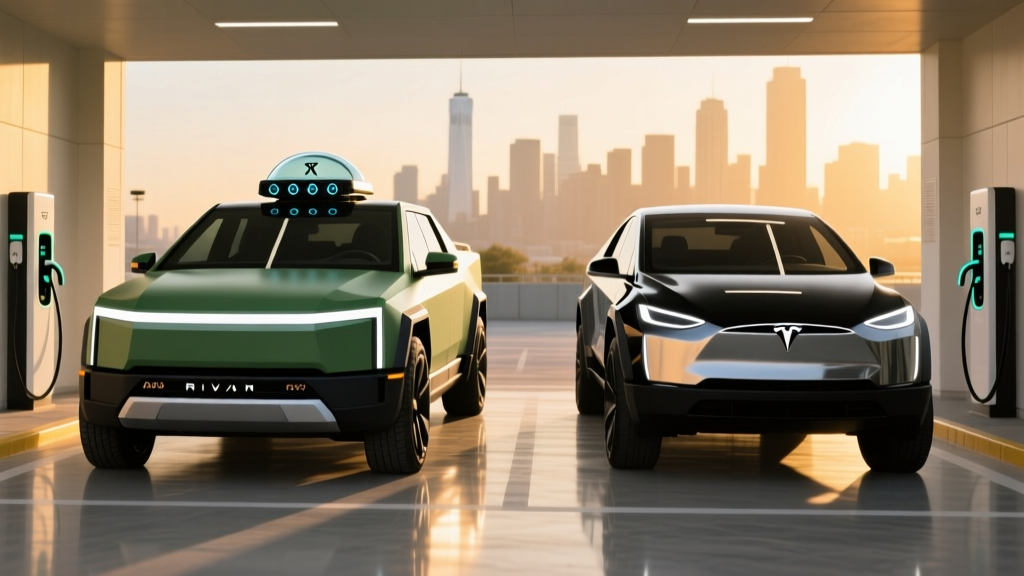
Two of the most debated driver-assistance systems in the electric-vehicle market belong to brands that approach the problem from fundamentally different philosophies. Tesla bets on a vision-only neural network trained on billions of real-world miles. Rivian layers cameras, radar, and ultrasonic sensors into a more traditional redundancy stack. If you're cross-shopping an R1S, R1T, Model Y, or Model X, the ADAS experience will shape your daily ownership more than 0-60 times ever will.
This comparison breaks down exactly what Rivian Autonomy vs Tesla FSD delivers in real-world highway and city driving, what each system costs, where they fall short, and what the SAE automation framework actually says about their capabilities.
What Each System Actually Does
Before comparing, it's essential to define the feature sets precisely, because brand naming creates more confusion than clarity in this space.
Tesla's ADAS Tiers
- Basic Autopilot (standard on all new Teslas): Traffic-Aware Cruise Control + Autosteer (lane centering on highways). Hands-on-wheel required.
- Enhanced Autopilot ($6,000 one-time, where still offered): Adds Auto Lane Change, Autopark, Summon, and Navigate on Autopilot (highway on/off-ramp routing).
- Full Self-Driving (Supervised) ($8,000 one-time or $99/month subscription in 2026): Everything above plus traffic light and stop sign recognition, autosteer on city streets, and FSD Computer v4 hardware on current-production vehicles.
Rivian's ADAS Tiers
- Driver Assistance (standard on all R1S and R1T trims): Adaptive cruise control, lane centering, highway assist, blind-spot monitoring, rear cross-traffic alert.
- Driver Assistance+ (included on Adventure and Ascend trims, available on Standard): Adds hands-free highway driving on supported divided highways, automatic lane change on highways, and enhanced parking features.
The critical takeaway: neither system drives the car for you without supervision. Both require an attentive driver prepared to take over instantly.
SAE Automation Level: Neither Is Self-Driving
Both Tesla FSD (Supervised) and Rivian Driver Assistance+ operate at SAE Level 2.
The SAE J3016 framework defines Level 2 as "partial driving automation" — the system can control steering and acceleration/braking simultaneously under certain conditions, but the human driver must continuously monitor the driving environment and be ready to intervene immediately. Level 4 (true driverless operation in a defined operational design domain) is currently only achieved by commercial robotaxi services like Waymo in geofenced urban areas. No consumer vehicle sold in the United States in 2026 is Level 3 or above.
Tesla's branding of "Full Self-Driving" has drawn scrutiny from the NHTSA and consumer-advocacy groups precisely because the name implies capability beyond Level 2. Tesla added the "(Supervised)" qualifier in 2024 to address this, but the marketing still leads some buyers to overestimate what the system does. Rivian deliberately uses conservative naming — "Driver Assistance" and "Driver Assistance+" — to set clearer expectations.
Hardware and Sensor Architecture
The sensor suites reveal each company's engineering philosophy.
| Specification | Tesla FSD (Supervised) | Rivian Driver Assistance+ |
|---|---|---|
| Cameras | 8 surround cameras (HW4/AI5: higher-res front vision) | 11 cameras (surround + cabin monitoring) |
| Radar | None (vision-only since 2022; HW4 removed radar) | 5 radar units (front + corner radars) |
| Ultrasonic Sensors | Removed (Tesla Vision replaced USS in 2022) | Ultrasonic sensors for close-range parking |
| Compute Platform | FSD Computer v4 / AI5 (dual-chip redundancy) | Rivian custom ADAS ECU + Qualcomm Snapdragon Ride |
| Driver Monitoring | Cabin camera (eye/attention tracking) | Cabin camera + capacitive steering wheel |
| Mapping | Neural-net-based lane/path inference, HD map-lite | HD mapping on supported highway corridors |
Tesla's pure-vision approach is the industry's most aggressive bet on neural networks. The system infers depth, lane geometry, and object classification entirely from camera data processed through transformer-based models. The advantage is scalability — no expensive lidar or radar hardware per vehicle — and a training dataset drawn from millions of Tesla vehicles on the road. The trade-off is vulnerability in conditions where cameras struggle: heavy rain, fog, direct sun glare, and low-contrast lane markings.
Rivian's sensor-fusion approach is more conservative but offers redundancy. Radar operates independently of visible light and sees through rain and fog better than cameras. Ultrasonic sensors handle low-speed parking maneuvers where vision systems can struggle with proximity estimation. The downside is higher hardware cost and the complexity of fusing disparate sensor data into a coherent world model.
Real-World Highway Performance
Highway driving is where both systems are most capable, and where most owners spend the majority of their ADAS-enabled miles.
Tesla FSD (Supervised) on Highways
Navigate on Autopilot handles on-ramp-to-off-ramp routing, including automatic lane changes to follow a navigation route and overtake slower traffic. In our experience across Model Y (2025 Long Range) and Model X (2025 Plaid) test vehicles, the system excels at:
- Smooth lane changes with appropriate gap selection in moderate traffic
- Consistent speed management and following distance
- Handling complex interchange geometry (stacked ramps, lane drops)
Weaknesses emerge in construction zones with shifted lane markings, faded or conflicting lane lines, and aggressive cut-in scenarios where the system can brake abruptly.
Rivian Driver Assistance+ on Highways
Rivian's hands-free highway assist operates on mapped divided highways — a growing but finite network of supported roads. On these corridors, the R1S and R1T allow true hands-off-wheel operation (eyes-on-road, monitored by cabin camera). Strengths include:
- Rock-steady lane centering, even in crosswinds and through curves
- Confident automatic lane changes when the driver confirms with a turn-signal tap
- Better performance than Tesla in moderate rain, thanks to radar redundancy
The limitation is geographic: if you leave a supported highway corridor, the system downgrades to hands-on Driver Assistance (lane centering + adaptive cruise), which is still capable but requires hands on the wheel.
City Street Capabilities and Edge Cases
This is where the gap between the two systems widens considerably.
Tesla FSD (Supervised) attempts to handle city streets — traffic lights, stop signs, unprotected left turns, pedestrian-heavy urban corridors. The ambition is enormous, and the system has improved markedly since its 2022 beta days. In 2026, FSD handles most routine urban intersections competently. But edge cases remain: unprotected left turns across multi-lane traffic, temporary construction signals, four-way stops with ambiguous right-of-way, and dense urban environments with erratic pedestrians and cyclists still require frequent driver takeovers. Expect to intervene roughly once every 5–15 miles in complex city driving, based on aggregated user-reported disengagement data.
Rivian does not currently offer city-street autosteering. Driver Assistance+ is limited to highway and divided-highway use. In urban environments, you get adaptive cruise control and lane-keeping assist, but the system does not navigate intersections, read traffic signals, or make turns. This is a deliberate choice: Rivian has prioritized doing a smaller set of things reliably over extending capability into domains where the failure modes are more numerous and more dangerous.
What Neither System Handles Reliably
- Severe weather: Heavy snow, ice-covered roads, and dense fog degrade both systems. Tesla's vision-only stack is more affected; Rivian's radar provides some redundancy but is not immune.
- Construction zones: Temporary barriers, shifted lanes, and absent or conflicting markings challenge both systems.
- Unmapped or rural roads: Rivian's system requires HD-mapped highway corridors. Tesla's system generalizes better but performs less predictably on poorly marked rural roads.
- Emergency vehicles: Both systems have been involved in incidents with stationary emergency vehicles. Neither reliably identifies and responds to parked fire trucks, ambulances, or police cars with flashing lights in all conditions. The NHTSA has investigated multiple Tesla crashes involving this exact scenario.
- Railroad crossings: Neither system is designed to autonomously negotiate railroad crossings. Always take over.
Pricing and Availability Breakdown
| Cost Factor | Tesla FSD (Supervised) | Rivian Driver Assistance+ |
|---|---|---|
| One-Time Purchase | $8,000 | $0 (included on Adventure & Ascend trims) |
| Monthly Subscription | $99/month | N/A (no subscription tier) |
| Standard ADAS Included | Basic Autopilot (all trims) | Driver Assistance (all trims) |
| Available On | All current Tesla models (Model 3, Y, S, X, Cybertruck) | R1S, R1T (Adventure, Ascend trims; optional on Standard) |
| Hardware Requirement | HW4 or AI5 (2023+ production) | Gen 2 platform (2025+ R1S/R1T) or updated Gen 1 via OTA |
| Feature Expansion Model | OTA updates to FSD neural network | OTA updates; highway map expansion over time |
Tesla's pricing model gives you the option to subscribe without committing $8,000 upfront — a practical choice for buyers who want to evaluate FSD before purchasing. However, FSD does not transfer between vehicles if you sell your Tesla, which effectively makes it a sunk cost.
Rivian bundles its highest-level driver assistance into higher trims at no additional per-feature cost. If you're buying an Adventure or Ascend edition R1S or R1T, Driver Assistance+ is already included in the MSRP. Standard trim buyers can add it as a package. There is no subscription and no separate $8,000 line item, which simplifies the purchase decision but means you're paying for it whether you want it or not on higher trims.
Safety Data and Regulatory Context
Tesla's FSD has been the subject of multiple NHTSA investigations, particularly regarding crashes involving stationary emergency vehicles and the adequacy of Tesla's driver-monitoring system. In 2024, Tesla implemented stricter attention-monitoring requirements for FSD (Supervised) users, including more frequent cabin-camera gaze checks and faster disengagement warnings.
Rivian's more conservative approach — limiting hands-free operation to mapped divided highways and requiring hands-on engagement everywhere else — has resulted in fewer high-profile incidents. However, Rivian's smaller fleet size means less real-world exposure data is publicly available for statistical comparison.
Neither system has received a Top Safety Pick+ designation from the IIHS specifically for their ADAS performance, as IIHS evaluates crashworthiness and crash-avoidance features (AEB, headlight performance) separately from Level 2 highway-assist quality. Both vehicles perform well in IIHS crash tests — the Model Y and R1S have earned Top Safety Pick+ in their respective evaluation years.
Which System Should You Choose?
Choose Tesla FSD (Supervised) If:
- You want the most expansive feature set, including city-street autosteer, even with its current limitations.
- You drive a Tesla daily and want to evaluate FSD via the $99/month subscription before committing to a purchase.
- You value a system trained on the largest real-world driving dataset in the industry.
- You accept that the system's ambition sometimes outpaces its reliability in edge cases.
Choose Rivian Driver Assistance+ If:
- Your ADAS use is primarily highway commuting and road trips on divided highways.
- You prefer sensor redundancy (radar + cameras) over a pure-vision approach.
- You want hands-free highway driving without a subscription or $8,000 add-on (on Adventure/Ascend trims).
- You value conservative, predictable system behavior over cutting-edge capability in complex urban scenarios.
Frequently Asked Questions
Is Tesla FSD actually self-driving?
No. Tesla Full Self-Driving (Supervised) is an SAE Level 2 driver-assistance system. The driver must remain attentive, monitor the road, and be prepared to take over at any moment. The "(Supervised)" qualifier in Tesla's current branding reflects this reality. True self-driving (Level 4) is currently only available through commercial robotaxi services like Waymo in limited geofenced areas.
Does Rivian plan to add city-street self-driving?
Rivian has indicated it is developing more advanced ADAS capabilities through its partnership with Volkswagen's software division and continued in-house development. However, as of 2026, Rivian has not announced a city-street autosteer feature comparable to Tesla's FSD. The company has focused on making its highway system reliable and expanding its mapped-highway network.
Can I use Tesla FSD on a monthly basis without buying it?
Yes. Tesla offers FSD (Supervised) as a $99/month subscription in the United States. You can subscribe, evaluate the system, and cancel at any time. This is a practical option for buyers unsure whether the feature justifies the $8,000 one-time purchase price.
Which system works better in rain and bad weather?
Rivian's sensor-fusion approach (cameras + radar) generally maintains better performance in moderate rain and fog than Tesla's pure-vision system. Radar can penetrate precipitation that degrades camera visibility. However, neither system should be relied upon in severe weather — heavy snow, ice, or dense fog. Both require the driver to take full control in those conditions.
Does FSD or Driver Assistance+ affect my insurance premium?
Insurance treatment of ADAS features varies by carrier and state. Some insurers offer modest discounts for vehicles equipped with automatic emergency braking and lane-keeping assist. Tesla has its own insurance product in many states that uses real-time driving data (including FSD engagement) to calculate premiums. Check with your insurer directly — there is no universal rule, and premiums for both Tesla and Rivian vehicles tend to be higher than average for their respective vehicle classes regardless of ADAS features.
Which Rivian trims include Driver Assistance+?
Driver Assistance+ is standard on Adventure and Ascend trim levels for both the R1S and R1T. On the Standard trim, it is available as an add-on package. All trims include the baseline Driver Assistance suite (adaptive cruise, lane centering, blind-spot monitoring) at no extra cost.