Rivian Autonomous Driving: The Quick Verdict
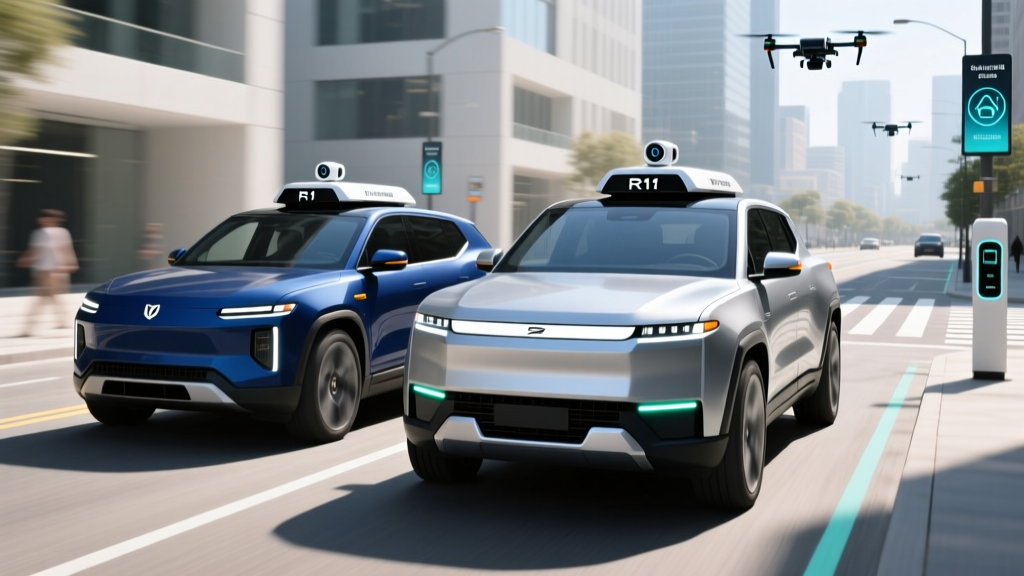
Rivian's autonomous driving technology is not a robotaxi system — it's a sophisticated Level 2 driver-assistance suite. The R1T pickup and R1S SUV come equipped with Rivian's Driver+ system, which pairs adaptive cruise control with lane-centering on highways. For 2025 and 2026 model-year vehicles, Rivian has continued to refine this system through over-the-air updates, but it remains firmly in the driver-supervision-required category. If you're researching Rivian autonomous driving to understand what the R1T and R1S can actually do on their own, this guide breaks down the real capabilities, the hardware stack, and how Rivian's approach compares to both Level 4 robotaxi services and competitor driver-assist systems.
Rivian Driver+ is an SAE Level 2 system. The driver must remain attentive, keep hands on or near the steering wheel, and be prepared to take over at any moment. This is not a self-driving vehicle. Level 4 robotaxi services (Waymo, Zoox) operate without a driver — Rivian does not offer this capability.
The Rivian Driver+ Technology Stack Explained
Rivian uses a multi-sensor approach for its Driver+ system, combining cameras, radar, and ultrasonic sensors. This differs from Tesla's camera-only (Tesla Vision) approach and aligns more closely with the sensor-fusion philosophy used by Ford's BlueCruise and GM's Super Cruise.
Hardware Breakdown
| Sensor Type | Count | Function |
|---|---|---|
| Exterior Cameras | 11 | Lane detection, traffic sign recognition, object classification, surround view |
| Forward Radar | 1 (long-range) | Vehicle distance/speed measurement in low-visibility conditions |
| Corner Radars | 4 | Blind-spot monitoring, cross-traffic alert, lane-change assist |
| Ultrasonic Sensors | 12 | Low-speed proximity detection, parking assist |
| Driver Monitoring Camera | 1 (interior) | Ensures driver attention and eye-gaze direction |
Notably, Rivian does not currently use lidar in its production vehicles. The company has invested heavily in its camera and radar perception pipeline, leveraging machine learning models trained on data collected from its growing fleet. Rivian's in-house developed autonomy software runs on a custom compute platform, giving the company tight control over its perception and planning stack — similar to Tesla's vertical integration but with the added redundancy of radar.
What Driver+ Actually Does
Rivian's Driver+ system provides two primary highway-assistance features:
- Adaptive Cruise Control (ACC): Maintains a set speed and following distance from the vehicle ahead, including stop-and-go traffic handling down to 0 mph.
- Lane Centering Assist: Actively steers to keep the vehicle centered in its lane on divided highways with clear lane markings.
Combined, these features reduce fatigue on long highway drives — a meaningful consideration for R1T and R1S owners who regularly cover 200+ miles. However, the system does not navigate highway interchanges autonomously, does not stop at red lights or stop signs without driver input, and does not handle complex urban driving scenarios.
Rivian Driver+ vs. Competitor Level 2 Systems
How does Rivian's autonomous driving stack up against other Level 2 systems available in 2026? Here's a feature-level comparison:
| Feature | Rivian Driver+ | Tesla Autopilot | Ford BlueCruise | GM Super Cruise |
|---|---|---|---|---|
| SAE Level | Level 2 | Level 2 | Level 2 | Level 2 |
| Hands-Off Highway Driving | No (hands-on required) | No (hands-on required) | Yes (mapped roads, eyes monitored) | Yes (mapped roads, eyes monitored) |
| Auto Lane Change | Driver-initiated with confirmation | Available with FSD (Supervised) | Available on select models | Available |
| Sensor Suite | Cameras + radar | Cameras only | Cameras + radar | Cameras + radar + lidar (Ultra Cruise) |
| Driver Monitoring | Camera-based | Steering wheel torque | Camera-based | Camera-based |
| Mapped Road Requirement | No (works on most highways) | No | Yes (~130,000+ miles mapped) | Yes (~750,000+ miles mapped) |
| Included in Vehicle Price | Yes | Basic Autopilot yes; FSD extra ($8,000) | Trial included; subscription after | Trial included; subscription after |
Rivian's approach prioritizes broad usability over hands-off operation. Because Driver+ doesn't require pre-mapped roads, it functions on virtually any divided highway with visible lane markings — an advantage over BlueCruise and Super Cruise in rural areas. The tradeoff is that Rivian still requires hands on the steering wheel, which some drivers find less convenient on long trips.
Rivian's Autonomous Driving Roadmap: What's Next?
Rivian has been relatively measured in its public statements about advancing beyond Level 2. CEO RJ Scaringe has emphasized a pragmatic approach to autonomy, focusing on incremental safety improvements rather than aggressive timelines toward full self-driving. As of 2026, Rivian has not announced a Level 3 or Level 4 system for consumer vehicles.
Key developments to watch:
- R2 Platform (expected 2026 production): Rivian's next-generation, more affordable SUV is expected to carry an updated sensor suite with enhanced compute capacity, potentially enabling more advanced driver-assist features.
- Over-the-Air Updates: Rivian regularly ships software updates that improve Driver+ performance, including better lane-keeping stability, smoother acceleration/braking profiles, and improved object detection.
- Commercial Fleet Potential: Rivian's partnership with Amazon for its EDV (Electric Delivery Van) fleet involves autonomous-driving-adjacent technology, though the delivery vans currently operate with human drivers.
Rivian Driver+ vs. Level 4 Robotaxi Services: A Reality Check
Some buyers research "Rivian autonomous driving" hoping the R1T or R1S can function like a Waymo or Cruise robotaxi. This is a fundamental misunderstanding of the technology tiers. Here's how they compare:
| Capability | Rivian Driver+ (Level 2) | Waymo One (Level 4) |
|---|---|---|
| Driver Required | Yes — always | No — fully driverless |
| Operational Area | Any highway with lane markings | Geofenced zones in Phoenix, San Francisco, Los Angeles, Austin |
| Urban Street Navigation | No | Yes (within geofence) |
| Highway Driving | Yes (with supervision) | Limited (surface streets primarily) |
| Available to Consumers | Yes (buy an R1T/R1S) | Yes (ride-hail only, not for purchase) |
| Sensor Suite | Cameras + radar | Lidar + cameras + radar (custom-built) |
| Cost to User | Included with ~$75,000+ vehicle | Per-ride pricing (comparable to Uber/Lyft) |
The takeaway: Rivian offers a driver-assist system that reduces fatigue and enhances safety on highways. Robotaxi services offer fully autonomous point-to-point transportation in limited urban areas. These serve entirely different use cases, and Rivian does not compete in the robotaxi space.
Safety Data: What We Know About Rivian Driver+ Performance
Rivian has not published granular disengagement or intervention-rate data comparable to what California DMV requires from autonomous vehicle testing companies. However, we can contextualize Rivian's safety position through available data:
Rivian's decision to require hands-on-wheel engagement, rather than allowing hands-off operation like BlueCruise or Super Cruise, is a deliberate safety philosophy. While less convenient, it keeps the driver in the loop and reduces the risk of attention-related incidents. Research from the Insurance Institute for Highway Safety has consistently shown that driver monitoring is a critical factor in Level 2 system safety.
Real-World Ownership: Using Driver+ Daily
For R1T and R1S owners, Driver+ is most valuable in these scenarios:
- Highway commuting: On a 60-mile round-trip commute with 45+ miles of freeway, Driver+ significantly reduces mental and physical fatigue. The lane-centering is stable, and the adaptive cruise handles traffic speed changes smoothly.
- Road trips: On long drives (300+ miles), engaging Driver+ on interstate stretches helps maintain alertness by reducing micro-corrections and constant speed adjustments.
- Stop-and-go traffic: ACC handles creeping traffic competently, reducing the tedium of repeated braking and acceleration.
Where Driver+ falls short:
- Construction zones: The system may not correctly interpret shifted lanes or temporary barriers. Take over immediately.
- Faded lane markings: On older rural roads, lane-centering can become unreliable or disengage with a warning.
- Heavy rain or snow: Camera and radar performance degrades in severe weather. The system may limit functionality or request driver takeover.
- Complex interchanges: Driver+ does not navigate merges, exits, or lane splits autonomously — you must steer through these.
Pricing and Availability: What Does Rivian Driver+ Cost?
Unlike Tesla's Full Self-Driving (Supervised) package at $8,000 or GM and Ford's subscription-based models, Rivian includes Driver+ at no additional cost with every R1T and R1S. There is no monthly subscription fee and no premium tier to unlock.
| System | Upfront Cost | Subscription | Included Features |
|---|---|---|---|
| Rivian Driver+ | $0 (included) | None | ACC, lane centering, auto emergency braking, blind-spot assist |
| Tesla FSD (Supervised) | $8,000 | Or $99/mo | Navigate on Autopilot, auto lane change, Smart Summon, traffic light/stop sign control |
| Ford BlueCruise | $0 (trial) | ~$75/year after trial | Hands-free highway driving on mapped roads |
| GM Super Cruise | $0 (trial) | ~$25/month after trial | Hands-free highway driving on mapped roads, auto lane change |
For 2026 model-year R1T and R1S pricing, the R1T starts at approximately $69,900 (Dual-Motor Standard) and the R1S at approximately $75,900. Driver+ is standard across all trims.
Frequently Asked Questions About Rivian Autonomous Driving
Is Rivian's Driver+ system self-driving?
No. Rivian Driver+ is an SAE Level 2 driver-assistance system. The driver must remain fully engaged, keep hands on the steering wheel, and monitor the road at all times. It assists with steering and speed control on highways but does not drive the vehicle independently.
Does Rivian use lidar in its vehicles?
No. As of the 2026 model year, Rivian does not include lidar sensors in the R1T or R1S. The company relies on a camera-and-radar sensor fusion approach with machine-learning-based perception.
Can I use Driver+ on any road?
Driver+ lane centering works best on divided highways with clear lane markings. Adaptive cruise control functions on any road. The system may disengage or perform poorly on winding rural roads, in construction zones, or when lane markings are faded or obscured by weather.
Will Rivian add more autonomous features in the future?
Rivian delivers regular over-the-air updates that incrementally improve Driver+ performance. The company has not announced a Level 3 or Level 4 system for consumer vehicles. The upcoming R2 platform may carry enhanced hardware capable of supporting more advanced features, but specifics remain unannounced.
How does Rivian's system compare to Tesla's Autopilot or FSD?
Rivian Driver+ is most comparable to Tesla's basic Autopilot (included standard) — both provide adaptive cruise and lane centering with hands-on-wheel requirements. Tesla's optional FSD (Supervised) adds features like auto lane change and traffic-light recognition, but remains Level 2 and requires constant driver supervision. Rivian's approach is more conservative, with fewer advanced features but no additional cost.
Is Rivian planning a robotaxi service?
No. Rivian has not announced any plans to develop a robotaxi or ride-hail autonomous service. The company's focus remains on personal-vehicle driver-assistance technology and its commercial electric van business with Amazon.