If you have been searching for a ride in a vehicle with no steering wheel on the Las Vegas Strip, you have likely asked: is Zoox still free in Vegas? The short answer is no — Zoox ended its completely free promotional ride period in late 2024 and now charges fares comparable to standard rideshare services. But the full picture is more nuanced, and understanding what Zoox offers today requires a closer look at its service area, pricing structure, safety record, and the technology powering its purpose-built robotaxi.
This guide covers everything you need to know about riding Zoox in Las Vegas in 2026, including where the service operates, what a ride actually costs, how safe these driverless vehicles are, and what limitations you should expect before summoning one.
Where Can I Ride Zoox Right Now?
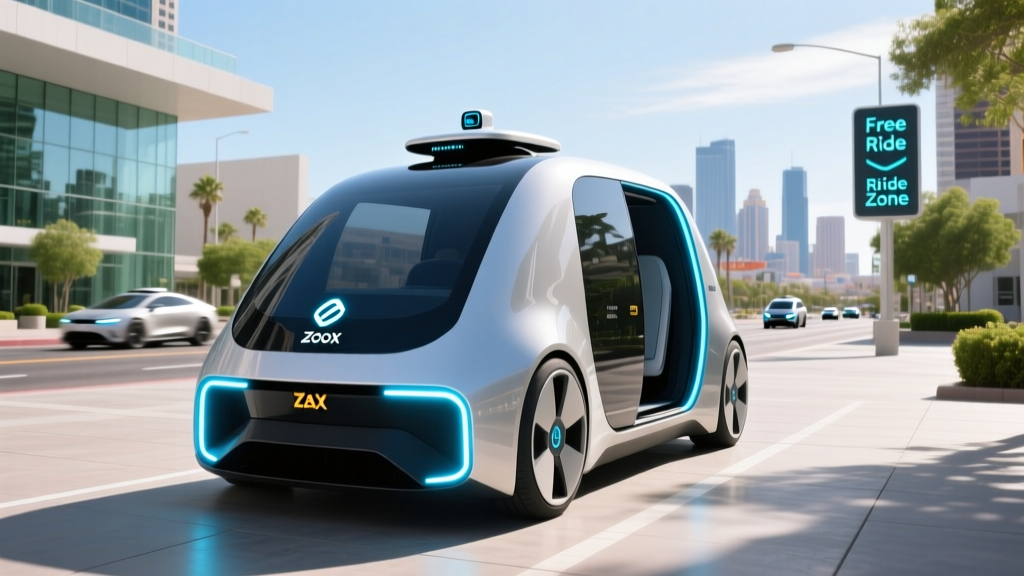
Zoox, the autonomous vehicle subsidiary of Amazon, operates its purpose-built robotaxi — a bidirectional, carriage-style vehicle with no steering wheel or pedals — in a limited number of US cities. As of early 2026, confirmed commercial service areas include:
| City | Status | Service Area Notes |
|---|---|---|
| Las Vegas, NV | Commercial rides live | Las Vegas Strip corridor, parts of downtown, select resort pickups |
| San Francisco, CA | Commercial rides live | Geofenced zones covering much of the city core; expanded since 2024 |
| Foster City, CA | Testing / limited access | Early testing zone near Zoox HQ; not full commercial service |
| Austin, TX | Announced expansion | Mapping and testing underway; commercial launch pending regulatory approval |
In Las Vegas, Zoox operates primarily along the Strip and adjacent corridors. The service does not cover the entire metro area — you cannot hail a Zoox to Henderson or the airport (Harry Reid International) at this time. Pickup and drop-off are restricted to approved locations within the geofenced zone, which Zoox defines based on its mapping coverage and operational design domain (ODD).
To check whether a specific pickup point is within the service area, open the Zoox app and enter your destination. The app will confirm availability or suggest an alternative nearby location.
How Much Does Zoox Cost vs. Uber and Lyft?
Zoox initially offered free rides during its promotional launch phase in Las Vegas and San Francisco to build ridership and gather operational data. That period has ended. As of 2026, Zoox charges per-ride fares that are broadly competitive with UberX and Lyft standard rides in the same markets.
| Service | Base Fare | Per-Mile Rate | Per-Minute Rate | Typical 3-Mile Ride |
|---|---|---|---|---|
| Zoox | ~$2.50 | ~$1.25/mi | ~$0.35/min | $8–$12 |
| UberX | ~$2.80 | ~$1.30/mi | ~$0.38/min | $9–$14 |
| Lyft Standard | ~$2.60 | ~$1.28/mi | ~$0.36/min | $9–$13 |
| Waymo (where available) | ~$2.40 | ~$1.20/mi | ~$0.33/min | $8–$11 |
Key pricing notes:
- Surge pricing: Zoox does not currently implement dynamic surge pricing the way Uber and Lyft do, though wait times may increase during peak demand rather than fares spiking.
- Tipping: There is no driver to tip. The app does not prompt for gratuity.
- Promotional credits: Zoox periodically offers new-rider credits (typically $5–$10 off your first few rides). Check the app for current promotions.
- No shared rides: Every Zoox ride is private — you will not be pooled with strangers.
For a typical Strip-to-downtown trip of 3–5 miles, expect to pay between $8 and $15 depending on traffic conditions and exact distance. This puts Zoox squarely in the same cost bracket as a standard UberX or Lyft ride — not cheaper, but not more expensive either.
How to Use the Zoox Robotaxi Service
Riding Zoox is straightforward once you understand the process:
- Download the Zoox app (available on iOS and Android) and create an account.
- Enter your pickup and drop-off locations. The app will confirm whether both points are within the current service zone.
- Walk to the designated pickup spot. Zoox uses specific curbside locations rather than pulling up to any arbitrary address. The app provides walking directions if needed.
- Board when the vehicle arrives. The Zoox robotaxi seats up to four passengers in a face-to-face configuration. There is no driver, no steering wheel, and no pedals. Doors open automatically when the vehicle is confirmed stopped.
- Confirm your ride on the in-cabin screen and the vehicle departs.
- Monitor your trip via the cabin display, which shows the vehicle's route, detected objects, and estimated arrival time. You can also stop the ride at any time using the in-cabin stop button or the app.
The experience is notably different from a traditional rideshare. The carriage-style seating, absence of a driver, and large interior screens create a distinctly new category of urban transport. Rides feel smooth — the vehicle accelerates and brakes conservatively, prioritizing passenger comfort over speed.
Is Zoox Truly Self-Driving? Understanding SAE Automation Levels
SAE Level 4 — High Automation (Geofenced Driverless)
Zoox operates at SAE Level 4 autonomy within its defined operational design domain (ODD). This means the vehicle handles all driving tasks — steering, acceleration, braking, route navigation, and hazard response — without any human driver present. There is no steering wheel, no pedals, and no expectation that a passenger will intervene.
This is fundamentally different from SAE Level 2 systems like Tesla Autopilot, Ford BlueCruise, or GM Super Cruise, which require an attentive human driver behind the wheel at all times. Level 2 is driver-assist; Level 4 (within its geofence) is driverless.
| Level | Name | Driver Required? | Examples |
|---|---|---|---|
| Level 0 | No Automation | Yes — full time | Basic cruise control |
| Level 1 | Driver Assistance | Yes — full time | Adaptive cruise OR lane-keeping |
| Level 2 | Partial Automation | Yes — must supervise | Tesla Autopilot, BlueCruise, Super Cruise |
| Level 3 | Conditional Automation | Yes — on standby | Mercedes Drive Pilot (limited conditions) |
| Level 4 | High Automation | No — within geofence | Zoox, Waymo, Cruise (pre-suspension) |
| Level 5 | Full Automation | No — anywhere | Does not exist commercially |
Zoox's Level 4 designation means it is genuinely driverless — but only within its mapped, approved service area. If the vehicle encounters a situation it cannot handle (e.g., a road closure outside its ODD), it will pull over safely and contact a remote assistance operator rather than asking a passenger to take over.
Zoox Technology Stack: Sensors, Compute, and the Purpose-Built Vehicle
Unlike Waymo, which retrofits existing vehicles (currently the Jaguar I-PACE and Zeekr RT), Zoox designed its robotaxi from the ground up as a fully autonomous vehicle. This purpose-built approach eliminates the need for a driver's position entirely and shapes the sensor and compute architecture.
Zoox Robotaxi Tech Stack Overview
- LiDAR: Multiple solid-state and spinning LiDAR units providing 360° 3D point-cloud mapping of the environment out to ~150+ meters.
- Cameras: A surround-camera array (multiple high-resolution units) for object classification, traffic signal recognition, and lane detection.
- Radar: Multiple radar units for velocity detection and performance in low-visibility conditions where cameras and LiDAR degrade.
- Compute: Custom onboard AI processing hardware running Zoox's proprietary perception, prediction, and planning stack.
- HD Maps: Centimeter-accurate pre-mapped routes within the geofenced service area, continuously updated.
- Vehicle: Purpose-built, bidirectional (can drive equally well in either direction), four-wheel steering, battery-electric with ~80 kWh estimated battery capacity.
- Top speed: Governed to approximately 75 mph (120 km/h).
- Seating: 4 passengers, face-to-face, no driver controls.
The sensor-fusion approach — combining LiDAR, cameras, and radar — differs significantly from Tesla's camera-only FSD strategy. Zoox, like Waymo, relies on LiDAR as a core sensor for depth perception and redundancy. This is the prevailing approach for Level 4 robotaxi operators, where sensor redundancy is critical because there is no human backup driver.
The vehicle's bidirectional capability is a practical advantage in tight urban environments: the robotaxi can reverse out of a dead-end or perform a three-point turn with equal competence in either direction, something conventional vehicles cannot do.
Safety Record: What the Data Shows
Safety Data Context
As of early 2026, Zoox has accumulated millions of autonomous miles across its testing and commercial operations in Las Vegas, San Francisco, and Foster City. The company reports a disengagement (human safety operator takeover) rate during testing that is competitive with other leading AV operators, though Zoox publishes fewer granular disengagement metrics than California DMV-mandated reports from competitors like Waymo.
During its commercial (driverless) phase in Las Vegas and San Francisco, Zoox has not reported any at-fault collisions resulting in serious passenger injury. Minor incidents — such as low-speed contact with stationary objects or other vehicles in complex urban scenarios — have been reported to NHTSA as required under the agency's Standing General Order for autonomous vehicle incident reporting.
For context on the broader robotaxi safety landscape:
- Waymo has published peer-reviewed research showing its driverless vehicles are involved in approximately 85% fewer injury-causing crashes per million miles compared to human-driven benchmarks, based on over 25 million driverless miles in Phoenix, San Francisco, and Los Angeles.
- Cruise (GM's robotaxi unit) suspended operations in late 2023 following a serious incident in San Francisco where a pedestrian was dragged by a Cruise vehicle. Cruise has since resumed limited testing with safety drivers in select cities under heightened regulatory scrutiny.
- Zoox has maintained a relatively low incident profile, partly because its service area and fleet size are smaller than Waymo's. The company emphasizes conservative driving behavior — the vehicle tends to yield aggressively and avoid complex unprotected left turns when possible.
The NHTSA Standing General Order requires all AV operators to report crashes involving Level 2–5 systems. This is the most reliable public source for incident data, though reports can lag by several months.
Current Limitations: What Zoox Cannot Do
Level 4 autonomy is impressive within its geofence, but it is not universal capability. Here are the concrete limitations you will encounter with Zoox in 2026:
- Geofenced service area only: Zoox cannot drive outside its pre-mapped zone. If your destination falls outside the ODD, the app will not let you book the ride.
- Weather constraints: Heavy rain, fog, or dust storms can degrade LiDAR and camera performance. Zoox may suspend service or reduce its operational area during severe weather. Las Vegas's typically dry climate is an advantage here, but monsoon-season thunderstorms (July–September) can trigger temporary service pauses.
- No highway driving: Zoox operates on surface streets within its geofence. It does not merge onto freeways or handle high-speed highway driving.
- Construction zones: While Zoox can navigate some construction areas using real-time perception, major road reconfigurations or unmapped detours can cause the vehicle to stop and request remote assistance, adding delay to your trip.
- Limited pickup/drop-off points: You cannot hail a Zoox to any arbitrary address. The app directs you to approved curbside locations.
- No airport service: As of 2026, Zoox does not serve Harry Reid International Airport in Las Vegas.
- Wait times: With a smaller fleet than Uber or Lyft, wait times can be 10–20 minutes during peak hours, compared to 3–7 minutes for conventional rideshare.
- Accessibility: The Zoox vehicle is designed to accommodate wheelchair users, but availability of accessible vehicles may be limited. Confirm in the app before relying on this feature.
Regulatory Landscape: Who Approves Robotaxi Operations?
Robotaxi operations in the United States are governed by a patchwork of state and local regulations. There is no single federal license for autonomous vehicle deployment.
In Nevada, the Department of Motor Vehicles (DMV) issues permits for autonomous vehicle testing and commercial operation under NRS 482A. Zoox holds a commercial deployment permit that allows it to operate driverless vehicles for paid rides in Las Vegas. The Nevada DMV can suspend or modify permits based on safety performance.
In California, the DMV issues testing permits (with safety drivers) and driverless testing permits, while the California Public Utilities Commission (CPUC) issues permits for commercial passenger service. Zoox holds both testing and commercial permits in California.
At the federal level, NHTSA regulates vehicle safety standards. Zoox received a notable exemption from NHTSA in 2024 for its purpose-built vehicle, which does not meet certain Federal Motor Vehicle Safety Standards (FMVSS) designed for human-driven cars — such as the requirement for a steering wheel, mirrors, and a traditional windshield. This exemption was a critical regulatory milestone, as it formally recognized the Zoox vehicle as a road-legal passenger vehicle despite its unconventional design.
Frequently Asked Questions
Is Zoox still free in Las Vegas in 2026?
No. Zoox ended its free-ride promotional period in late 2024. Rides now cost approximately $8–$15 for typical trips along the Las Vegas Strip, comparable to UberX and Lyft standard fares. New riders may still find promotional credits in the app.
How do I download and use the Zoox app?
The Zoox app is available on iOS and Android. After creating an account, enter your pickup and drop-off locations. If both are within the service zone, you can request a ride. The vehicle will arrive at a designated curbside pickup point, and you board when the doors open — no driver interaction needed.
Can Zoox drive me to the Las Vegas airport?
Not currently. Harry Reid International Airport is outside Zoox's geofenced service area in Las Vegas. You will need to use Uber, Lyft, a taxi, or a shuttle for airport trips.
Is the Zoox vehicle electric?
Yes. The Zoox robotaxi is a fully battery-electric vehicle with an estimated ~80 kWh battery pack. It produces zero tailpipe emissions and is charged at Zoox's dedicated fleet depots between rides.
How is Zoox different from Waymo?
The primary difference is the vehicle. Waymo uses retrofitted production vehicles (Jaguar I-PACE, Zeekr RT) with sensor arrays bolted on. Zoox built its vehicle from scratch as a robotaxi — no steering wheel, no pedals, bidirectional driving, carriage-style seating. Both operate at SAE Level 4. Waymo has a larger fleet and operates in more cities (Phoenix, San Francisco, Los Angeles, Austin). Zoox's footprint is smaller but its vehicle design is more purpose-built for the task.
What happens if the Zoox vehicle encounters a problem during my ride?
If the vehicle encounters a scenario it cannot resolve autonomously, it will pull over safely and connect to a remote assistance operator. You can also stop the ride at any time using the in-cabin stop button or the app. There is no expectation for passengers to take control of the vehicle.
Is riding in a Zoox robotaxi safe?
Zoox has not reported any at-fault serious injury collisions during its commercial driverless operations. The vehicle drives conservatively — yielding aggressively, obeying speed limits well below its 75 mph governed maximum, and avoiding complex maneuvers when simpler alternatives exist. However, as with any vehicle on public roads, risk is not zero. NHTSA requires all AV operators to report incidents under its Standing General Order, and this data is publicly searchable.