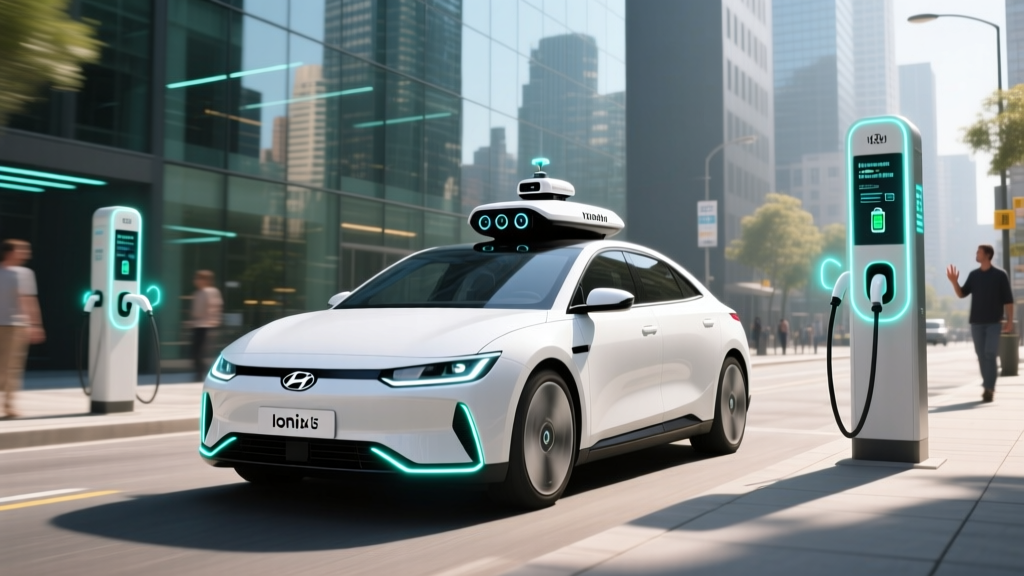
If you've searched for "Ioniq 5 self driving" you've likely seen a tangle of headlines about Hyundai's robotaxi ambitions, its partnership with Waymo, and the Ioniq 5's own Highway Driving Assist 2 system. The reality is more nuanced: the production Ioniq 5 you can buy at a dealership is not a self-driving car. It's a Level 2 driver-assist vehicle that requires your full attention. But the Ioniq 5 platform has become the backbone of Hyundai's Level 4 robotaxi testing, and as of 2026, purpose-built Ioniq 5 robotaxis are operating in limited commercial service.
Here's what you actually need to know about the Ioniq 5's autonomous capabilities, where the technology stands, and what's available today.
The SAE Autonomy Levels: Why the Ioniq 5 You Can Buy Is Not Self-Driving
Before we get into robotaxi specifics, it's essential to separate the Ioniq 5 you can purchase from the driverless vehicles Hyundai and its partners are testing. The Society of Automotive Engineers (SAE) defines six levels of driving automation, and the distinction between Level 2 and Level 4 is the single most important one for consumers.
| Level | Name | Who Drives? | Example |
|---|---|---|---|
| 0 | No Automation | Human | Basic cruise control |
| 1 | Driver Assistance | Human (system assists steering OR speed) | Adaptive cruise control |
| 2 | Partial Automation | Human (system assists steering AND speed simultaneously) | Hyundai HDA2, Tesla Autopilot, GM Super Cruise |
| 3 | Conditional Automation | System (in limited conditions; human must take over when asked) | Mercedes Drive Pilot (limited markets) |
| 4 | High Automation | System (no human needed within operational design domain) | Waymo, Zoox, Motional Ioniq 5 robotaxi |
| 5 | Full Automation | System (everywhere, all conditions) | Does not yet exist |
The 2026 Hyundai Ioniq 5 available at dealerships comes equipped with Highway Driving Assist 2 (HDA2), which is a Level 2 system. It handles lane centering and adaptive cruise control simultaneously on divided highways, and it can perform lane changes when you activate the turn signal. But your hands must remain on or near the wheel, your eyes must stay on the road, and you are legally the driver at all times. The National Highway Traffic Safety Administration (NHTSA) is clear: Level 2 systems require continuous human supervision.
The robotaxi Ioniq 5 vehicles operating in commercial service are a completely different proposition. These are heavily modified vehicles equipped with redundant sensor suites, computing platforms, and mapping systems that enable Level 4 operation — no driver in the front seat — within defined geographic areas.
Hyundai, Motional, and Waymo: The Robotaxi Ioniq 5 Story
Hyundai's path to robotaxi deployment has involved two major partnerships, and understanding both is key to knowing what's actually on the road.
Motional: Hyundai's Own Robotaxi Joint Venture
Motional is a joint venture between Hyundai Motor Group and Aptiv, established in 2020 to develop Level 4 autonomous driving technology. Motional used the Ioniq 5 as its primary robotaxi platform, beginning testing in 2022 and expanding through Las Vegas and other cities. Motional partnered with Lyft to offer driverless rides to the public in Las Vegas starting in late 2023, initially with safety drivers and later transitioning to fully driverless operations in designated zones.
However, the Motional story has had setbacks. In mid-2024, Hyundai restructured the partnership, reducing Aptiv's involvement and taking greater control of the robotaxi program. As of early 2026, Motional's commercial operations have been scaled back, with Hyundai redirecting resources toward its own internal autonomous driving division while maintaining limited testing programs.
Waymo: The Dominant Robotaxi Player Using the Ioniq 5
In 2024, Hyundai and Waymo announced a multi-year partnership to integrate Waymo's 6th-generation autonomous driving system into the Ioniq 5. This deal made the Ioniq 5 one of Waymo's vehicle platforms alongside the Zeekr RT and the Jaguar I-PACE. By late 2025, Waymo began deploying Ioniq 5-based robotaxis in select service areas, supplementing its existing fleet.
As of 2026, the Waymo-Ioniq 5 vehicles are part of Waymo One, the company's commercial ride-hailing service. This is where you'll actually find Ioniq 5 robotaxis available for public use today.
Where Can I Use an Ioniq 5 Robotaxi Right Now?
Robotaxi service is not nationwide. It's tightly geofenced — vehicles operate only within approved zones that have been extensively mapped and validated. Here's where Ioniq 5-based robotaxi services are currently available:
| Service | City / Region | Status | Access |
|---|---|---|---|
| Waymo One (Ioniq 5 fleet) | Phoenix metro (East Valley, Chandler, Tempe, Scottsdale) | Fully operational, driverless | Open to public via Waymo app |
| Waymo One (Ioniq 5 fleet) | San Francisco (most of city) | Fully operational, driverless | Open to public via Waymo app |
| Waymo One (Ioniq 5 fleet) | Los Angeles (downtown, Santa Monica, Westside) | Operational, expanding zones | Open to public via Waymo app |
| Waymo One (Ioniq 5 fleet) | Austin, TX (central zones) | Operational | Open to public via Waymo app |
| Motional / Hyundai test fleet | Las Vegas (Strip corridor, limited) | Limited testing, reduced from 2024 levels | Invite-only / Lyft waitlist |
If you're outside these metro areas, you cannot hail an Ioniq 5 robotaxi. The geofence boundaries are strict — the vehicle will not operate outside its validated operational design domain (ODD), and the app won't let you request a ride that crosses those boundaries.
How to Ride and What It Costs vs. Uber and Lyft
Using a Waymo One Ioniq 5 robotaxi is straightforward if you're in a service area:
- Download the Waymo One app (available on iOS and Android).
- Create an account and add a payment method.
- Enter your pickup and drop-off locations — the app confirms whether both are within the service zone.
- Confirm your ride. The vehicle arrives autonomously; you unlock it through the app.
- Tap "Start Ride" on the in-seatback screen. There's no driver to interact with.
Pricing: Robotaxi vs. Traditional Rideshare
One of the most common questions is whether robotaxi rides are cheaper than Uber or Lyft. The answer in 2026: it depends on the route and time of day, but robotaxi pricing is generally competitive with — not dramatically cheaper than — standard rideshare.
| Service | Typical Fare | Surge Pricing? | Tips? |
|---|---|---|---|
| Waymo One (Ioniq 5) | $11 – $16 | Rare; demand-based pricing but less volatile | No (no driver to tip) |
| UberX | $12 – $20 | Yes, frequent during peak hours | Expected ($2 – $5) |
| Lyft Standard | $11 – $19 | Yes | Expected ($2 – $5) |
Waymo's pricing advantage comes primarily from the absence of tips (typically 15-20% on rideshare) and less aggressive surge pricing. On a $15 ride, the all-in cost with Waymo is often $3-$5 less than a comparable Uber or Lyft once you factor in the tip. However, Waymo does not offer shared/pool rides, so for budget-conscious riders who normally use Uber Pool or Lyft Shared, the robotaxi can be more expensive per trip.
Safety Record: What the Data Actually Shows
Safety is the most scrutinized aspect of robotaxi operations, and rightly so. Here's what we know from reported data as of early 2026:
- Total autonomous miles driven (all vehicles, all cities): Over 50 million fully driverless miles as of Q1 2026, per NHTSA standing general orders and Waymo's published safety reports.
- Injury-causing crash rate: Waymo reports its driverless vehicles are involved in injury-causing crashes at approximately 85% lower rate than human benchmark drivers in comparable urban environments (per Waymo's 2024 peer-reviewed safety study published in collaboration with Swiss Re).
- Contactless disengagements: Waymo's Ioniq 5 fleet reports fewer remote-assistance interventions per 10,000 miles compared to its older Jaguar I-PACE fleet, attributed to the 6th-generation sensor suite's improved perception range.
- NHTSA incident reports: Like all ADS operators, Waymo is required to file crash reports under NHTSA's Standing General Order. These reports are publicly accessible and include minor low-speed contacts that would not typically make police reports for human drivers.
It's important to contextualize these numbers. Robotaxis operate primarily in dense urban environments at moderate speeds — conditions where human crash rates are already relatively high. The comparison benchmarks matter. Waymo's Swiss Re study used insurance claim data as a baseline, which is more rigorous than simple per-mile fatality comparisons that conflate highway and urban driving.
That said, robotaxis have been involved in notable incidents. In San Francisco, Waymo vehicles have occasionally made contact with towed trailers, construction-zone barriers, and other edge-case obstacles. These incidents are investigated by both the company and regulators. No fatalities have been attributed to Waymo's driverless operations as of early 2026.
Technology Stack: Lidar, Cameras, and the Ioniq 5 Robotaxi Sensor Suite
The Ioniq 5 robotaxi's ability to operate without a driver comes from a fundamentally different sensor and computing architecture than the production Ioniq 5's HDA2 system.
Production Ioniq 5 (HDA2) — What You Can Buy
- 1 forward-facing radar (front bumper)
- 1 front camera (behind windshield, top center)
- 4 surround-view cameras (for parking/360° view)
- 12 ultrasonic sensors (close-range parking)
- Processing: Hyundai's ADAS ECU — capable of Level 2 functions only
Waymo Ioniq 5 Robotaxi (6th-Gen System)
- Lidar: Multiple solid-state and spinning lidar units providing 360° 3D point clouds with range exceeding 500 meters. Lidar is the core perception sensor and is the primary differentiator from Tesla's camera-only approach.
- Cameras: 29+ high-resolution cameras covering 360° with overlapping fields of view for redundancy.
- Radars: 6 automotive-grade radar units for velocity detection and all-weather perception.
- External audio receivers: Microphones to detect sirens from emergency vehicles.
- Compute: Custom Waymo-designed autonomous driving computer with redundant processing paths.
- HD Maps: Centimeter-precision pre-mapped routes within the geofence, updated continuously.
The lidar-versus-camera debate is one of the defining splits in autonomous vehicle development. Waymo (and by extension the Ioniq 5 robotaxi) relies heavily on lidar for depth perception that cameras alone cannot match with the same reliability — particularly in low-light conditions, direct sun glare, and complex urban geometry. Tesla's FSD system uses cameras only, but Tesla's system remains Level 2 (driver supervision required), while Waymo's lidar-equipped vehicles operate at Level 4 without a driver.
Regulatory Landscape: Who Approves Robotaxi Operations?
Robotaxi deployment in the United States is governed by a patchwork of state and local regulations. There is no single federal license to operate a driverless taxi service.
- California (CPUC + DMV): The California Public Utilities Commission issues permits for commercial passenger service, while the DMV issues testing and deployment permits. Waymo holds both. San Francisco and Los Angeles operations required separate municipal coordination.
- Arizona: Among the most permissive states for autonomous vehicles. No specific state permit is required for driverless testing or deployment, which is why Phoenix was Waymo's first commercial market. The Arizona Governor's Office has issued executive orders supporting AV operations.
- Texas: Austin has welcomed robotaxi testing with relatively light regulation. State-level legislation provides a framework for AV deployment without requiring a human safety operator.
- Nevada: Nevada's DMV issues autonomous vehicle testing licenses. Motional's Las Vegas operations were authorized under this framework.
- Federal (NHTSA): NHTSA does not "approve" robotaxi services, but it sets Federal Motor Vehicle Safety Standards (FMVSS) and requires crash reporting through Standing General Orders. NHTSA can open defect investigations that affect robotaxi operations.
The regulatory environment is actively evolving. Several states have introduced or are considering legislation that would either expand or restrict driverless vehicle operations, often in response to high-profile incidents in other cities.
Current Limitations: What Ioniq 5 Robotaxis Cannot Do
Even at Level 4, the Ioniq 5 robotaxi has significant operational constraints. Understanding these limitations is essential for setting realistic expectations.
- Geofencing: The vehicle will not operate outside its pre-mapped, regulator-approved service area. If your destination is across the geofence boundary, the app simply won't let you book the ride.
- Weather degradation: Heavy rain, dense fog, and snow reduce sensor effectiveness. Waymo vehicles may decline rides, pull over safely, or operate at reduced speeds in adverse conditions. Phoenix's dry climate is a major reason it was the first deployment city.
- Construction zones: While the system handles many construction scenarios, complex or rapidly changing work zones may trigger a remote-assistance intervention or a safe pullover.
- No highway operation (in most markets): Most current robotaxi geofences cover urban and suburban surface streets, not freeways. Highway-speed autonomous operation in mixed traffic remains an active development area.
- Pickup/drop-off precision: The vehicle may not pull up to your exact front door. It uses designated or validated stop points, which can mean a short walk from your actual origin or destination.
- No trunk access for riders: In most Waymo One Ioniq 5 vehicles, the trunk is reserved for sensor/compute equipment or is simply not accessible to passengers. Cargo capacity is limited to what you can hold in the cabin.
- Accessibility: The Ioniq 5 robotaxi is not wheelchair-accessible. Waymo offers accessible vehicle options in some markets, but availability is limited.
The Production Ioniq 5's HDA2: What You Actually Get When You Buy One
If you're shopping for a 2026 Hyundai Ioniq 5 and want the most advanced driver-assist features available, here's what comes on the car and what it costs:
| Specification | Detail |
|---|---|
| EPA Range | 318 miles (SEL/Limited RWD, 84.0 kWh battery) — expect ~270-290 mi highway, ~240-260 mi in cold weather |
| Battery | 84.0 kWh usable, NMC chemistry (Long Range); 58.0 kWh (Standard Range, 240 mi EPA) |
| DC Fast Charging | Peak 240 kW (10-80% in ~18 min on a 350 kW charger; tapers significantly above 80%) |
| Level 2 Charging | 10.9 kW onboard charger (~8.5 hours 0-100% on a 48A Level 2 circuit) |
| 0-60 mph | 7.2 sec (RWD Long Range); 5.0 sec (AWD Long Range); 3.4 sec (Ioniq 5 N) |
| Horsepower | 225 hp (RWD); 320 hp (AWD); 640 hp (N) |
| HDA2 Availability | Standard on SEL trim and above; includes lane centering, adaptive cruise, lane-change assist |
| Base MSRP | ~$42,600 (SE Standard Range); ~$47,850 (SEL Long Range); ~$53,400 (Limited) |
| Federal Tax Credit (§30D) | Up to $7,500 if eligible — subject to MSRP cap ($55,000 for SUVs), buyer income limits, and battery-sourcing requirements. Check IRS.gov for current eligibility. Point-of-sale transfer available. |
| Battery Warranty | 10 years / 100,000 miles (retains ≥70% capacity) |
HDA2 is a genuinely useful highway companion, particularly on long interstate drives where it reduces fatigue. But it will not drive you to work while you read email. It will not navigate city streets autonomously. And if you take your hands off the wheel for more than about 30 seconds, it will issue escalating warnings and eventually bring the vehicle to a controlled stop.
Frequently Asked Questions
Is the Ioniq 5 truly self-driving or is it driver-assist?
The Ioniq 5 you can buy at a Hyundai dealership is a Level 2 driver-assist vehicle. Its HDA2 system requires your full attention, hands on the wheel, and you remain the legal driver. The Ioniq 5 robotaxi used by Waymo and Motional is a Level 4 vehicle — fully driverless — but it is a heavily modified platform not available for consumer purchase, and it operates only within geofenced service areas in a handful of cities.
Can I buy a self-driving Ioniq 5 for personal use?
No. There is no consumer-purchasable Ioniq 5 that operates at Level 3 or above. Hyundai has not announced plans to sell a Level 3+ Ioniq 5 to individual owners. The closest you can get is the HDA2-equipped production model, which is Level 2.
How much does a Waymo Ioniq 5 robotaxi ride cost?
For a typical 5-mile urban trip, expect $11-$16. This is comparable to UberX or Lyft Standard before tips, and often $3-$5 cheaper all-in since there's no driver to tip. Waymo uses demand-based pricing but with less volatility than traditional rideshare surge.
How safe are Ioniq 5 robotaxis compared to human drivers?
Waymo's published data (validated through a Swiss Re partnership) shows its driverless fleet is involved in injury-causing crashes at approximately 85% lower rates than human benchmarks in comparable urban conditions. Over 50 million driverless miles have been logged across Waymo's fleet. No fatalities have been attributed to Waymo's driverless operations as of early 2026. However, robotaxis have been involved in low-speed contact incidents, particularly in complex construction zones.
What cities have Ioniq 5 robotaxi service in 2026?
Waymo operates Ioniq 5 robotaxis in Phoenix, San Francisco, Los Angeles, and Austin through the Waymo One app. Motional's Las Vegas operations have been scaled back to limited testing. Service areas within these cities are geofenced — you must be within the approved zone to request a ride.
Does the Ioniq 5 robotaxi work in rain or snow?
Light rain is generally handled without issue. Heavy rain, dense fog, and snow can degrade lidar and camera performance, leading the system to reduce speed, request remote assistance, or decline the ride entirely. This is one reason robotaxi deployment has concentrated in Phoenix and Southern California, where adverse weather is rare.
Will Hyundai eventually sell a self-driving Ioniq 5 to consumers?
Hyundai has signaled long-term interest in offering Level 3 autonomous features on future production vehicles, potentially beginning with highway-only conditional automation. However, no specific model, timeline, or pricing has been announced for a consumer Level 3+ Ioniq 5. Any such system would still require the driver to take over when prompted — true Level 4 consumer vehicles remain years away at minimum.