Honda has spent the last decade refining its Honda Sensing suite, but Honda Sensing 360 marks a fundamental shift. Moving from a forward-facing camera-and-radar setup to an omnidirectional sensor array, this system brings 360-degree environmental awareness to Honda's mainstream lineup. For buyers evaluating ADAS (Advanced Driver Assistance Systems) in 2026, understanding exactly what Honda Sensing 360 can and cannot do — and how it stacks up against Toyota Safety Sense, Tesla Autopilot, and Ford BlueCruise — is essential before signing a purchase agreement.
This guide breaks down the sensor hardware, real-world capabilities, hard limitations, model availability, and cost structure of Honda Sensing 360, with the technical precision EV and hybrid buyers need to make an informed decision.
What Honda Sensing 360 Actually Does: The Sensor Hardware
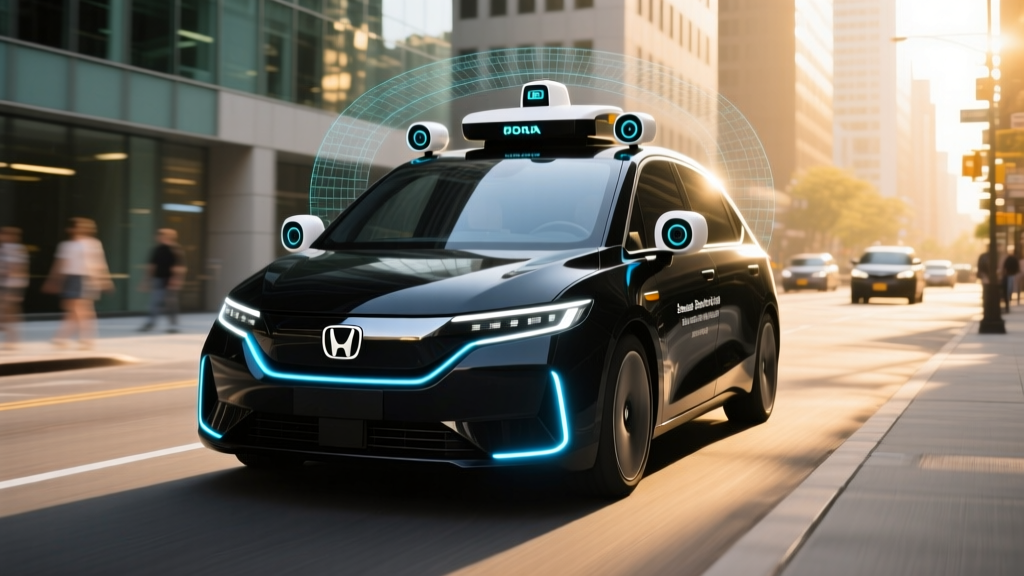
Honda Sensing 360 replaces the legacy front-camera-and-single-radar architecture with a multi-sensor omnidirectional array. The system fuses input from several hardware components to build a real-time 3D model of the vehicle's surroundings:
- Front-facing camera (windshield-mounted, behind the rearview mirror) — lane-line detection, traffic-sign recognition, pedestrian/cyclist classification
- Front millimeter-wave radar (behind the grille) — long-range object detection up to ~200 meters, adaptive cruise control target tracking
- Four corner radars (one per fender/bumper corner) — blind-spot monitoring, cross-traffic alert, lane-change assist, rear-collision warning
- Ultrasonic sensors (front and rear bumpers) — low-speed proximity detection for parking assist
The key upgrade over the prior-generation Honda Sensing is the addition of those four corner radars. Legacy Honda Sensing relied on a single front radar and a camera, meaning the vehicle was effectively blind to its sides and rear at speed. Honda Sensing 360 closes that gap, enabling features like Active Lane Change Assist and Cross-Traffic Collision Mitigation that require lateral and rearward awareness.
Sensor fusion — the software process of combining camera, radar, and ultrasonic data into a single coherent environmental model — runs on Honda's updated ADAS processor. This is computationally lighter than Tesla's vision-only neural network approach or Mobileye's EyeQ6-based systems, but it is purpose-built for the specific feature set Honda offers.
Honda Sensing 360 is a Level 2 system per the SAE J3016 standard. This means the system can simultaneously control steering and acceleration/braking under certain conditions — but the driver must remain fully engaged, with hands on the wheel and eyes on the road, at all times. It is not self-driving. It does not absolve the driver of responsibility. Honda Sensing 360+ (with hands-off capability in specific conditions, available in Japan) approaches Level 3 in limited operational design domains, but the version sold in the U.S. market is firmly Level 2.
Feature-by-Feature Capability Breakdown
Honda Sensing 360 bundles several driver-assist functions under one umbrella. Here is what each feature does, the conditions under which it activates, and its operational boundaries:
| Feature | What It Does | Activation Conditions | Key Limitation |
|---|---|---|---|
| Adaptive Cruise Control (ACC) with Low-Speed Follow | Maintains set speed and following distance; stops and resumes in traffic | 0–90+ mph, marked or unmarked roads | May not detect stationary objects at high speed; requires driver resume after extended stop |
| Lane Keeping Assist System (LKAS) | Provides steering torque to center vehicle in detected lane | 45–90 mph, clearly marked lanes | Disengages when lane markings are faded, snow-covered, or absent |
| Road Departure Mitigation (RDM) | Steers and brakes if vehicle is about to leave the roadway | 45–90 mph | Relies on detecting road edge; unreliable on unpaved or unmarked rural roads |
| Collision Mitigation Braking System (CMBS) | Warns and auto-brakes for detected frontal collisions (vehicles, pedestrians, cyclists) | 3–62 mph (pedestrians), 3–100+ mph (vehicles) | May not detect small or partially obscured objects; performance reduced in heavy rain/fog |
| Active Lane Change Assist | Initiates lane change when driver signals, if corner radars confirm the adjacent lane is clear | 45–80 mph, turn signal engaged, LKAS active | Will not change lanes if a vehicle is detected in the blind zone; aborts if conditions change mid-maneuver |
| Cross-Traffic Collision Mitigation | Detects approaching cross-traffic at intersections and warns/brakes | Low speed (under 15 mph), pulling through intersections | Limited by corner-radar field of view; obstructed views (large vehicles, walls) reduce effectiveness |
| Blind Spot Information (BSI) with Rear Cross Traffic | Visual/audible alert for vehicles in blind zones; auto-brakes when reversing into cross-traffic path | BSI: above 20 mph; RCT: reverse gear, under 5 mph | Motorcycles and bicycles may not be reliably detected by corner radars |
Honda Sensing 360 vs. the Competition
Most mainstream ADAS suites in 2026 operate at SAE Level 2, but their feature depth, sensor hardware, and real-world reliability vary significantly. Here is how Honda Sensing 360 compares to the systems buyers are most likely to cross-shop:
| System | SAE Level | Sensor Suite | Hands-Off Highway? | Active Lane Change? | Cost Structure |
|---|---|---|---|---|---|
| Honda Sensing 360 | Level 2 | Camera + front radar + 4 corner radars + ultrasonic | No (U.S.) | Yes (signal-initiated) | Standard on equipped trims, no subscription |
| Toyota Safety Sense 3.0 | Level 2 | Camera + front radar (no corner radars on most models) | No | No | Standard, no subscription |
| Tesla Autopilot | Level 2 | Vision-only (cameras, no radar on current HW4) | No | Yes (with FSD package) | Autopilot included; FSD $8,000 one-time or $99/mo |
| Ford BlueCruise | Level 2 | Cameras + radars + driver-facing camera | Yes (pre-mapped divided highways) | Yes (on select models) | Included trial, then ~$75/mo or $800/yr subscription |
| GM Super Cruise | Level 2 | Cameras + radars + LiDAR map + driver camera | Yes (400,000+ mi of pre-mapped roads) | Yes | 3-year trial, then ~$25/mo subscription |
| Hyundai/Kia Highway Driving Assist 2 | Level 2 | Camera + front radar + corner radars | No | Yes (signal-initiated) | Standard on equipped trims, no subscription |
The key takeaway: Honda Sensing 360 matches Hyundai/Kia's HDA 2 in sensor architecture and feature set (both offer signal-initiated lane changes via corner radars), and it exceeds Toyota Safety Sense in omnidirectional awareness. However, it does not offer the hands-off-highway capability of Ford BlueCruise or GM Super Cruise. If hands-free driving on mapped highways is a priority, Honda Sensing 360 is not the right system for you.
Real-World Limitations: What Honda Sensing 360 Cannot Do
- Honda Sensing 360 is not autonomous. The driver is legally and operationally responsible for the vehicle at all times.
- The system does not navigate intersections autonomously — it will not make turns, obey traffic signals, or handle roundabouts without driver input.
- Hands must remain on the steering wheel. The system uses torque-based steering detection (not capacitive), meaning you must apply slight steering input periodically or the system will issue escalating warnings and eventually disengage.
- Performance degrades in heavy rain, snow, fog, direct sun glare, and when sensors are obstructed by dirt, ice, or debris.
- Lane-keeping is unreliable on roads with faded, conflicting, or temporary lane markings (construction zones are a common failure point).
- The system may phantom-brake — applying brakes for non-existent obstacles — particularly on curved roads with roadside guardrails or overpasses that the radar misinterprets as stationary vehicles.
- Active Lane Change Assist requires a clear adjacent lane and will not change lanes in dense or fast-converging traffic. It is an assist, not an autonomous lane-change system.
Cold-weather and environmental considerations for EV/PHEV owners: If you drive a Honda electrified vehicle (such as the Prologue EV or a future Honda EV built on the e:Architecture), sensor performance in winter conditions is a practical concern. Ice accumulation on the front grille radar or corner radar housings can disable ACC, CMBS, and lane-change assist entirely. Honda's sensor housings are not heated (unlike some Tesla and Mercedes implementations), so manual clearing of ice and snow from sensor areas is required before the system will function. Plan for this if you live in a region with sustained freezing temperatures.
Model Availability: Which Hondas Get Sensing 360?
As of the 2026 model year, Honda Sensing 360 is available on the following models. Note that availability varies by trim — base trims on some models may still carry the legacy Honda Sensing suite:
- Honda Prologue (EV) — Standard on all trims (EX, Touring, Elite). As Honda's sole battery-electric vehicle in the U.S. market, the Prologue receives the full Sensing 360 suite with no additional cost.
- Honda Accord (Hybrid) — Standard on Sport-L, EX-L, and Sport Touring trims for 2026. The base LX and mid-tier Sport trims retain the prior Honda Sensing system with front camera and single radar.
- Honda CR-V (Hybrid/PHEV) — Standard on Sport Touring Hybrid trim; available as a package on Sport Hybrid.
- Honda Pilot — Standard on TrailSport, Touring, and Elite trims.
- Acura variants — Acura's equivalent system (branded with Acura-specific naming) is available on the ZDX (EV), MDX, and RDX in higher trims. Acura adds a driver-facing camera for attention monitoring, which Honda-branded vehicles do not include in the U.S. market.
Honda has stated that Sensing 360 will expand to the Civic lineup and additional models through the 2027 model year, but specific trim-level availability has not been confirmed as of this writing. Check the official Honda Automobiles site for the latest model-year specifications.
Cost: No Subscription, No Add-On — But Trim-Gated
Unlike Tesla's FSD ($8,000 one-time or $99/month) or Ford BlueCruise (subscription-based after an initial trial), Honda Sensing 360 carries no separate purchase price and no ongoing subscription fee. It is included in the vehicle's MSRP on the trims where it is standard.
| Cost Factor | Honda Sensing 360 | Tesla FSD (Supervised) | Ford BlueCruise | GM Super Cruise |
|---|---|---|---|---|
| Upfront cost | $0 (included in trim MSRP) | $8,000 one-time | $0 (included trial period) | $0 (3-year trial) |
| Subscription | None | $99/mo (alternative to purchase) | ~$75/mo or $800/yr after trial | ~$25/mo after trial |
| 5-year ADAS cost | $0 | $5,940–$8,000 | ~$3,200–$4,000 | ~$600–$1,500 |
| Hands-off highway? | No | No | Yes (mapped roads) | Yes (mapped roads) |
The trade-off is clear: Honda Sensing 360 costs nothing extra, but it also does less than BlueCruise or Super Cruise on the highway. Buyers who want a no-subscription, no-surprise-cost ADAS experience will appreciate Honda's approach. Buyers who want hands-off driving on long highway commutes will need to look elsewhere — or budget for a subscription-based system on a competing vehicle.
Insurance note: According to IIHS research, vehicles equipped with automatic emergency braking and lane-keeping systems show reduced collision rates, but insurers have been slow to offer consistent discounts for ADAS features. Check with your provider — some offer a 5–10% discount for vehicles with AEB, but Honda Sensing 360 as a complete suite does not currently qualify for a specific insurance discount category at most major carriers.
Safety Context: What the Data Says
Honda's ADAS systems have historically performed well in NHTSA and IIHS evaluations, with most Honda models earning top marks in crash-prevention tests when equipped with Honda Sensing. The addition of corner radars in Sensing 360 specifically improves performance in IIHS's vehicle-to-vehicle and vehicle-to-pedestrian AEB evaluations, particularly for crossing-path scenarios that a front-only radar cannot detect.
However, it is important to understand what ADAS safety data actually measures. NHTSA and IIHS test collision avoidance — can the system detect and brake for a specific obstacle at a specific speed in controlled conditions? They do not test the full operational design domain of the system in unstructured real-world driving. A vehicle with a strong IIHS crash-prevention rating can still exhibit phantom braking, lane-keeping failures, or driver-monitoring gaps in daily use.
Honda Sensing 360 does not include a driver-facing attention-monitoring camera in U.S.-spec vehicles (Acura variants do). This means the system relies on steering-torque detection to confirm driver engagement — a less robust method than eye-tracking. Systems like GM Super Cruise and Ford BlueCruise use infrared cameras to verify the driver's gaze direction, providing a stronger safeguard against driver inattention. This is a meaningful safety distinction for buyers who prioritize engagement monitoring.
Frequently Asked Questions
Is Honda Sensing 360 self-driving?
No. Honda Sensing 360 is an SAE Level 2 driver-assist system. It can simultaneously manage steering and speed under specific conditions, but the driver must remain fully engaged — hands on the wheel, eyes on the road — at all times. The system will not navigate turns, handle complex intersections, or drive autonomously in any scenario. The driver is legally responsible for the vehicle's operation.
Does Honda Sensing 360 work in snow and heavy rain?
Performance degrades significantly in adverse weather. Heavy rain can obscure the front camera and cause radar scattering. Snow and ice accumulation on sensor housings (particularly the front grille radar and corner radars) will cause the system to disable affected features entirely. Honda's sensor housings are not heated, so you must manually clear ice and packed snow from sensor areas before the system will reactivate.
Can I add Honda Sensing 360 to a Honda that didn't come with it?
No. Honda Sensing 360 requires specific hardware (four corner radars, updated ADAS processor, wiring harnesses) that is installed at the factory. It cannot be retrofitted to a vehicle that was not built with it. If Sensing 360 is a priority, you must select a trim that includes it at the time of purchase.
How does Honda Sensing 360 compare to Tesla Autopilot?
They serve different purposes. Tesla Autopilot (and FSD Supervised) offers more aggressive lane-management and navigation features, including automatic highway on/off-ramp handling, but requires a $8,000 purchase or $99/month subscription for FSD. Honda Sensing 360 is included at no extra cost, uses radar+camera fusion (more reliable in poor visibility than Tesla's vision-only approach), but offers fewer automated features. Neither system is self-driving — both are Level 2 and require full driver supervision.
Will Honda Sensing 360 phantom brake?
Like all radar-based ACC and AEB systems, Honda Sensing 360 can occasionally phantom brake — applying deceleration when no actual obstacle is present. This most commonly occurs on curved roads with metal guardrails, under highway overpasses, or when the radar reflects off roadside infrastructure. It is less frequent than in prior-generation Honda Sensing systems (the corner radars help disambiguate stationary objects), but it is not eliminated. Stay prepared to override braking at any time.
Does Honda Sensing 360 affect the federal EV tax credit?
No. ADAS features do not factor into IRS §30D clean vehicle credit eligibility. The credit is determined by battery sourcing, critical-mineral content, MSRP caps, and buyer income limits. However, the trim-level requirement for Sensing 360 may push a vehicle's MSRP closer to or above the §30D cap ($55,000 for sedans, $80,000 for SUVs/trucks/vans), so factor that into your purchase planning.
Sources: SAE International J3016 (automation levels), IIHS (crash-prevention ratings), NHTSA (safety data), Honda Automobiles (model specifications). Specifications reflect 2026 model-year information available at time of publication. Always verify current trim availability and feature content with your local Honda dealer.