How to Put Tesla in Autopilot: What Happens When You Pull That Lever
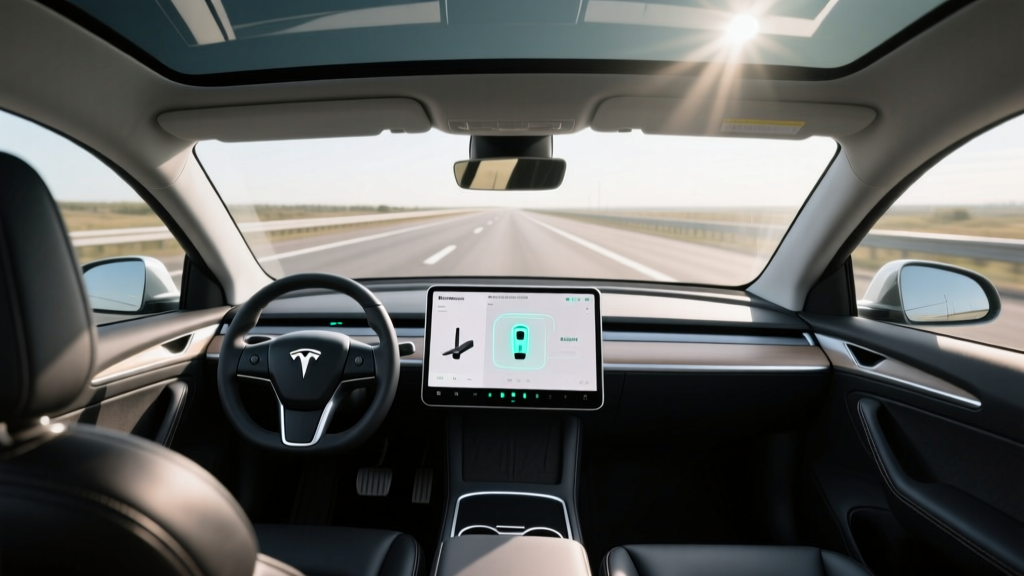
Activating Tesla's Autopilot is one of the simplest gestures in modern driving: pull the right stalk on the steering column down twice in quick succession (on 2025+ Model 3 Highland and refreshed Model Y, tap the right scroll wheel button instead, since Tesla deleted the stalks). A blue steering-wheel icon appears on the instrument screen, and the car assumes steering, acceleration, and braking within its lane. Deactivate it with a tap of the brake pedal, a firm turn of the wheel, or a push up on the stalk/button.
That two-second action is where most confusion begins. "Autopilot" in Tesla's vocabulary is not one feature — it's a tiered stack that includes basic Autopilot (standard on every new Tesla), Enhanced Autopilot (a $6,000 one-time add-on), and Full Self-Driving Capability, or FSD (a $8,000 purchase or $99/month subscription as of the 2026 model year). Each tier adds functions; none of them remove you from the driver's seat.
SAE Level 2 — Not Self-Driving
Tesla Autopilot and FSD (Supervised) are classified as SAE Level 2 driver-assistance systems per the SAE J3016 standard. That means the system can simultaneously control steering and speed, but the human driver must continuously supervise, keep hands available, and be ready to take over at any moment. True "self-driving" — where you can nap, text, or sit in the back seat — is SAE Level 4 and currently exists only in geofenced robotaxi services like Waymo and Zoox. If a Tesla marketing slide or social post implies otherwise, the SAE classification has not changed.
What Tesla Autopilot Actually Does (and Doesn't)
Basic Autopilot, included on every 2026 Model 3, Model Y, Model S, Model X, and Cybertruck, bundles two functions:
- Traffic-Aware Cruise Control (TACC): Maintains a set speed and adjusts for vehicles ahead, down to a full stop.
- Autosteer: Keeps the car centered in a clearly marked lane at up to 90 mph (or the posted limit + offset you configure).
That's it. Basic Autopilot will not change lanes, navigate off-ramps, stop at red lights without driver input, or recognize stop signs without confirmation. Those functions live in the higher tiers.
| Function | Basic Autopilot (Std.) | Enhanced ($6,000) | FSD Supervised ($8,000 / $99 mo.) |
|---|---|---|---|
| Traffic-Aware Cruise Control | ✓ | ✓ | ✓ |
| Autosteer (lane centering) | ✓ | ✓ | ✓ |
| Auto Lane Change | — | ✓ | ✓ |
| Navigate on Autopilot (highway exits) | — | ✓ | ✓ |
| Autopark / Smart Summon | — | ✓ | ✓ |
| Traffic Light & Stop Sign Control | — | — | ✓ |
| City Street Autosteer | — | — | ✓ |
FSD (Supervised) is the headline feature. On supported city streets, it will initiate turns, yield to pedestrians, and handle unprotected lefts — with you watching every move. As of early 2026, Tesla has renamed the consumer product "FSD (Supervised)" to distinguish it from the unsupervised robotaxi service Tesla launched in limited Austin geofencing in late 2025, which operates under separate regulatory approval and is not available to private owners.
The Hardware Behind the Wheel: Tesla Vision, No Radar
Since mid-2022, every Tesla shipped in the U.S. relies exclusively on Tesla Vision — a camera-only perception stack with no radar or ultrasonic sensors. A typical 2026 Model Y uses eight cameras (front narrow/wide, left/right repeaters, left/right pillars, rear) feeding a dual-chip HW4 (or HW5 on newer builds) computer capable of roughly 300+ trillion operations per second.
The vision-only approach is Tesla's most debated engineering bet. Neural networks infer depth and velocity from image sequences rather than measuring them directly with lidar or radar. In clear daylight with fresh lane markings, the system is remarkably confident. In heavy rain, snow occlusion, direct sun glare, or construction zones with conflicting cones and faded paint, confidence drops — and the system will either disengage with an audible warning or, worse, make a decision you must override in under a second.
When Autopilot Will Fail You
- Faded or missing lane markings — rural roads, freshly repaved highways, temporary construction zones.
- Standing water, heavy snow, or fog — cameras cannot see through occlusion the way radar can.
- Phantom braking — NHTSA opened investigation PE 22-019 into unexpected deceleration events; the issue persists intermittently on HW3/HW4 vehicles, especially under overpasses and with oncoming headlights.
- Stationary emergency vehicles — the system has a documented history of failing to detect parked fire trucks and police cars with lights active.
- Sun glare at dawn/dusk — direct low-angle sun can blind the forward camera array.
If any of these conditions exist, treat Autopilot as unavailable, regardless of what the touchscreen says.
Cost Breakdown: Buy, Subscribe, or Skip?
Tesla's pricing structure changed several times between 2023 and 2026, but the current tiers are stable as of the 2026 model year:
| Tier | One-Time Purchase | Monthly Subscription | Included Standard? |
|---|---|---|---|
| Basic Autopilot (TACC + Autosteer) | — | — | Yes, all vehicles |
| Enhanced Autopilot | $6,000 | Not offered | No |
| FSD (Supervised) | $8,000 | $99/month | No |
A few realities the configurator won't emphasize:
- FSD does not transfer on resale. Tesla has occasionally run limited-time transfer promotions, but the default rule is that FSD is tied to the original purchase and does not follow the car to a second owner — which is why used-Tesla listings with "FSD included" command a premium.
- Subscription FSD cancels when you sell. The $99/month tier is tied to your Tesla account, not the VIN, and ends when you transfer ownership.
- Federal §30D tax credit does not apply to software. The IRS clean-vehicle credit covers the vehicle and qualifying battery components, not post-purchase software add-ons. FSD purchased at delivery can sometimes be bundled into the vehicle's MSRP for credit-cap calculations, but consult a tax professional — the rules are narrow.
The pragmatic math: if you plan to keep the car for more than six years and drive 15,000+ miles annually in highway-heavy commutes, the $8,000 purchase amortizes reasonably. If you're testing the feature or plan to trade in within three years, the $99 monthly subscription is the rational choice. For most buyers, basic Autopilot is sufficient and the $6,000–$8,000 is better spent on home Level 2 charging infrastructure.
Step-by-Step: How to Put Tesla in Autopilot (All Current Models)
Before first use, the car requires you to complete an in-app tutorial and acknowledge a supervision agreement. After that, activation is model-dependent:
Model S / Model X (2026, with stalk)
- Ensure the car is moving above ~5 mph and lane markings are visible.
- Pull the right stalk down twice quickly. You'll hear a chime and see the blue steering-wheel icon.
- Apply light torque to the wheel periodically; the cabin camera monitors eye direction as a secondary check.
- Disengage with brake tap, upward stalk push, or firm steering input.
Model 3 Highland / Refreshed Model Y (stalkless)
- Confirm lane markings are detected (gray lane lines on the display turn blue when ready).
- Press and hold the right scroll-wheel button on the steering wheel for ~0.5 seconds.
- Same supervision and disengagement rules apply — brake, button press, or wheel torque.
Cybertruck
Cybertruck uses a dedicated Autopilot button on the yoke-style wheel, functionally identical to the scroll-wheel press on the refreshed Model 3.
How Tesla Autopilot Compares to Competing ADAS
Tesla's system is the most data-rich, but not universally the best-performing in third-party evaluations. Here's how the main Level 2 competitors stack up against FSD (Supervised) in real-world highway and city use:
| System | Brand | Hands-Free Highway? | City Streets? | Cost | Driver Monitoring |
|---|---|---|---|---|---|
| FSD (Supervised) | Tesla | Yes (hands-on required) | Yes (supervised) | $8,000 / $99 mo. | Cabin camera + torque |
| Super Cruise | GM (Cadillac/Chev/GMC) | Yes, true hands-free | No (limited hands-free corridors only) | ~$2,200 + $25/mo after 3 yrs | Infrared eye-tracking |
| BlueCruise | Ford / Lincoln | Yes, true hands-free | No | $2,100 / $75 mo. | Driver-facing camera |
| ProPILOT Assist 2.0 | Nissan | Yes, hands-free on mapped highways | No | Included on upper trims | Steering touch + camera |
| Toyota Safety Sense 3.0 | Toyota | No (hands-on always) | No | Standard on all trims | Steering torque |
The honest verdict: GM's Super Cruise and Ford's BlueCruise are more permissive on mapped divided highways — you can genuinely remove your hands, and the eye-tracking enforcement is stricter but the system is more relaxed to use. Tesla's FSD covers more roads (including unmapped city streets) but demands more active supervision and produces more frequent phantom-braking events, per NHTSA's ongoing PE 22-019 investigation and IIHS insurance-loss data. Choose based on where you drive, not which marketing video is more compelling.
Safety Data: What NHTSA and IIHS Actually Show
Tesla publishes a quarterly "Vehicle Safety Report" claiming roughly one crash per 4–5 million miles driven on Autopilot versus ~1.5 million miles off Autopilot. Treat these figures skeptically: Tesla's methodology counts any Autopilot engagement within five seconds of a crash as "on Autopilot," and the comparison baseline mixes urban, rural, and impaired-driving crashes. Independent analysis by the IIHS and academic researchers has found that Autopilot-equipped Teslas show higher rates of certain collision types (notably rear-ending stationary emergency vehicles) compared to non-engaged driving in similar conditions.
As of early 2026, NHTSA's Standing General Order requires all manufacturers to report crashes involving Level 2+ systems within 24 hours. Tesla's reported incident count is the highest of any OEM in absolute terms — partly because Tesla has the largest Level 2 fleet, and partly because the system's city-street ambitions create more edge-case exposure than BlueCruise or Super Cruise, which are confined to divided highways.
Frequently Asked Questions
Can I install Autopilot on an older Tesla that didn't come with it?
Every Tesla built since April 2019 has HW3 or later and is Autopilot-capable. Teslas built between late 2016 and April 2019 with HW2/2.5 can run basic Autopilot but are not eligible for current FSD (Supervised) without a $1,500–$2,000 hardware retrofit. Teslas built before October 2016 with HW1 cannot run modern Autopilot at all.
Does Autopilot work in the rain or snow?
Light rain, yes — the system degrades gracefully. Moderate to heavy rain, fog, or snow that obscures camera lenses will trigger a "Camera Visibility Limited" warning and disable Autosteer within seconds. Keep the camera housings (above the windshield, on the fenders, and at the rear) clean; a quick wipe at every charging stop is good practice.
Will using Autopilot lower my insurance premium?
Generally no. Most insurers — including Tesla's own insurance product in eligible states — do not offer a discount for Autopilot use, and some actuaries view the feature as a mild risk factor due to attention-decay and phantom-braking exposure. Check your specific carrier; don't assume a credit.
What happens if I ignore the "hands on wheel" warnings?
Tesla's escalation sequence is: visual warning → audible chime → gradual speed reduction → Autosteer lockout for the remainder of the trip. Repeated lockouts trigger a "strike" system; accumulate enough strikes and Tesla can suspend FSD access remotely, even on purchased licenses. This policy has been in place since late 2024.
Is FSD (Supervised) worth $8,000 in 2026?
For most buyers, no — not yet. The feature is impressive on a demo drive but still requires the same attention as manual driving, and its resale-value retention is poor. The $99/month subscription is the lower-risk way to evaluate it on a long road trip or a demanding commute before committing. Basic Autopilot handles 80% of highway driving needs at zero extra cost.