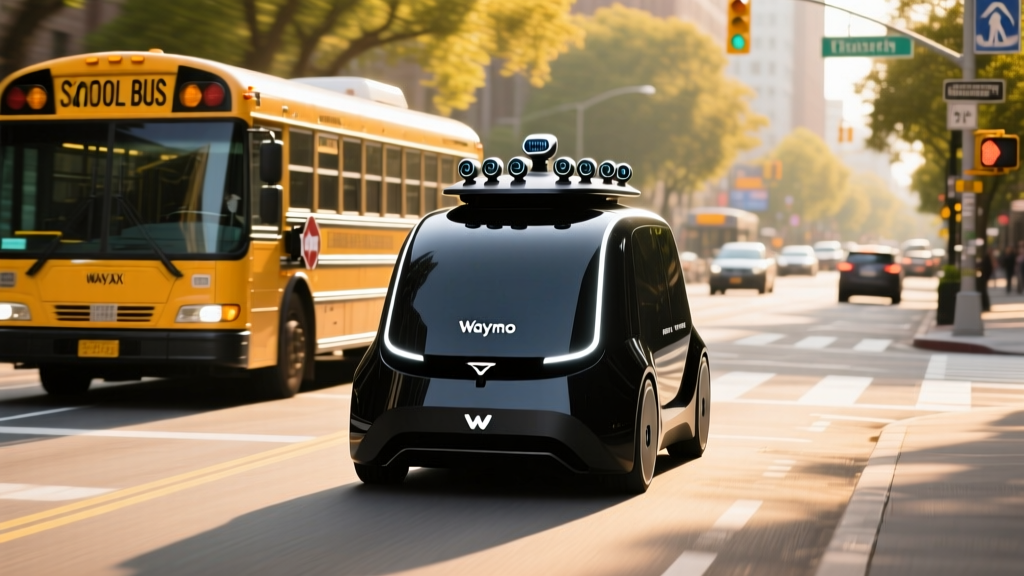
The phrase "waymo passes school bus" has become a flashpoint in the autonomous vehicle debate. It sits at the intersection of traffic law, sensor capability, and public trust — and it reveals more about the state of Level 4 robotaxis than almost any other edge case. Below, we unpack exactly what happens when a Waymo vehicle encounters a stopped school bus, how the technology and regulations handle it, and what that means for anyone considering a robotaxi ride in 2026.
SAE Automation Levels: Where Robotaxis Actually Sit
Before examining the school bus scenario, the automation level must be precise. Consumer vehicles with Tesla Autopilot, Ford BlueCruise, or GM Super Cruise are SAE Level 2 — the driver must remain engaged at all times. Robotaxis like Waymo operate at SAE Level 4, meaning they drive without any human intervention, but only within a defined operational design domain (ODD): specific geofenced areas, weather conditions, and road types.
| Level | Who Drives | Example | Supervision Required |
|---|---|---|---|
| Level 2 | System steers/accelerates; driver monitors | Tesla Autopilot, FSD Supervised, BlueCruise | Yes — full-time |
| Level 3 | System drives in narrow conditions; driver on standby | Mercedes Drive Pilot (limited markets) | Yes — on demand |
| Level 4 | System drives fully within ODD; no driver needed | Waymo One, Zoox | No — within geofence |
| Level 5 | System drives everywhere, all conditions | None currently deployed | No |
What Happens When a Waymo Approaches a Stopped School Bus
Every U.S. state requires vehicles to stop when a school bus has its red stop arm extended and lights flashing. Waymo's sixth-generation driver system — deployed across its commercial fleet as of 2025 — uses a sensor fusion stack to detect this scenario:
- LiDAR (light detection and ranging) maps the bus's 3D shape and the extended stop arm at up to 500 meters.
- Camera arrays classify the flashing red lights and the stop-arm sign via computer vision trained on millions of labeled frames.
- Radar confirms the bus's stationary position and detects any moving pedestrians near the curb.
When the system identifies an active school bus stop, the Waymo vehicle is programmed to come to a full stop at a safe distance — typically 20 feet or more behind the bus, consistent with state law — and remain stopped until the stop arm retracts and lights cease. The vehicle will not attempt to pass.
This matters because early-generation AVs (circa 2019–2021) occasionally struggled with school bus edge cases: buses partially obscured by parked cars, stop arms that deployed after the AV had already committed to a lane change, or buses stopped in travel lanes rather than at curbs. Waymo's safety reports indicate these scenarios have been systematically addressed through expanded training data and conservative fallback behavior — if the system is uncertain, it stops and waits rather than proceeding.
Where You Can Actually Ride a Waymo in 2026
Waymo One — the company's commercial ride-hailing service — is not available everywhere. Operations are tightly geofenced and approved by state regulators on a city-by-city basis.
| Metro Area | Status | Approx. Geofence Size | Hours |
|---|---|---|---|
| Phoenix, AZ (East Valley + Downtown) | Fully commercial | ~225 sq mi | 24/7 |
| San Francisco, CA | Fully commercial | ~47 sq mi (city limits) | 24/7 |
| Los Angeles, CA | Commercial (expanding) | ~80+ sq mi | 24/7 |
| Austin, TX | Commercial launch phase | ~35 sq mi initial | Limited hours initially |
| Atlanta, GA | Testing / pre-commercial | TBD | N/A |
Outside these geofences, the service is simply unavailable — the app will not let you hail a ride. This is a hard constraint, not a preference.
How to Use Waymo One — and What It Costs vs. Uber/Lyft
Riding in a Waymo is straightforward but requires the Waymo One app (iOS/Android). After creating an account, you enter a pickup and drop-off within the service area, confirm the fare, and the nearest Waymo vehicle drives to you. There is no driver to tip, no surge pricing in the traditional sense, and the vehicle's interior is monitored by cabin cameras.
| Service | Base Fare Range | Surge Pricing | Tip Expected |
|---|---|---|---|
| Waymo One | $12 – $18 | Rare (demand-based caps) | No (no driver) |
| UberX | $14 – $24 | Yes — can 1.5x–3x | 15–20% typical |
| Lyft | $13 – $22 | Yes | 15–20% typical |
On a per-mile basis, Waymo is generally competitive with UberX and slightly cheaper than Lyft once you remove the tip. The gap widens during surge events, where Waymo's pricing tends to stay more stable. However, Waymo's availability is far more limited geographically, so for most U.S. riders it remains a novelty rather than a daily commute option.
Safety Record: What the Data Actually Shows
Waymo has accumulated over 30 million fully driverless miles as of early 2026, with the majority in Phoenix and San Francisco. The company publishes periodic safety data, and independent analyses by the National Highway Traffic Safety Administration (NHTSA) and academic researchers provide additional context.
Waymo Safety Data Highlights
- Driverless miles driven: 30+ million (cumulative through early 2026)
- Police-reported crash rate: Approximately 85% lower than human benchmarks for comparable urban driving, per Waymo's published analysis of property-damage-only and injury crashes.
- NHTSA Standing General Order incidents: Waymo has reported dozens of minor-contact incidents as required under NHTSA's standing order for ADS-equipped vehicles. The vast majority involve low-speed contacts with other human-driven vehicles, not at-fault events.
- School bus violations: No publicly reported instances of a driverless Waymo illegally passing a stopped school bus with an active stop arm.
- Disengagement rate: Not directly comparable to Level 2 systems; Waymo's remote-assistance interventions occur roughly once every 5,000–8,000 miles in complex urban environments, per industry estimates. These are remote guidance events, not emergency takeovers.
For context, human drivers in the U.S. experience roughly 5.4 police-reported crashes per million vehicle miles (IIHS data). Waymo's rate is materially lower, though direct comparison is imperfect: Waymo operates in geofenced, mapped areas and avoids highways and extreme weather by design.
Technology Stack: Sensors, Mapping, and the Geofence
Waymo's sixth-generation "Waymo Driver" hardware, introduced in 2023 and now standard across the fleet, includes:
- Custom LiDAR: 360-degree perception out to 500+ meters, capable of detecting small objects (curbs, debris, pedestrians) in direct sunlight — a historical weakness of LiDAR.
- Camera system: High-resolution cameras covering all directions, optimized for reading traffic signals, signs (including stop-arm signs), and lane markings.
- Radar: Multiple units for velocity detection of moving objects and redundancy in rain/fog.
- HD maps: Centimeter-accurate maps of every operational street, updated continuously. The vehicle localizes itself against these maps in real time.
- Compute: Custom-designed inference hardware processing sensor data at high frame rates.
This sensor-rich approach contrasts with Tesla's camera-only ("Tesla Vision") strategy for its FSD Supervised system. Waymo's redundancy across LiDAR, camera, and radar is one reason the system can operate without a human driver — the failure of any single sensor type does not blind the vehicle. The trade-off is cost: each Waymo vehicle's sensor suite is estimated at $100,000+, making the robotaxi model dependent on high utilization to recoup hardware costs.
The geofence is equally critical. Waymo vehicles will not operate outside their approved area, in heavy snow, or on unmapped roads. This is a deliberate safety boundary, not a software limitation waiting to be unlocked.
Regulatory Landscape: Who Approves Robotaxi Operations
Robotaxi deployment in the U.S. is governed by a patchwork of state and federal rules:
- Federal (NHTSA): Sets vehicle safety standards (FMVSS) and requires crash reporting via Standing General Order. NHTSA does not currently "approve" ADS software but can investigate and order recalls.
- California (CPUC + DMV): The California Public Utilities Commission issues commercial passenger service permits; the DMV issues testing and deployment permits. San Francisco and LA operations required approval from both, plus local coordination.
- Arizona: Among the most permissive states. Waymo has operated commercially in Phoenix since 2020 under a relatively light-touch regulatory framework.
- Texas (Austin): Regulated at the state level; local coordination with the city required for commercial launch.
- Other states: Most states lack specific robotaxi legislation, meaning Waymo cannot legally operate commercially there even if it wanted to.
The school bus scenario specifically falls under state traffic codes. Waymo's programming must comply with the traffic laws of every jurisdiction in which it operates — and because school bus stop-arm laws are uniform across all 50 states (stop when red lights flash / arm extended), the behavioral rule is consistent nationwide even as geofences expand.
Current Limitations — What Robotaxis Still Cannot Do
- Weather: Waymo vehicles do not operate in heavy snow, ice, or dense fog. Light rain is handled; downpours that degrade LiDAR returns trigger a conservative pull-over or trip cancellation.
- Highway driving: Most Waymo geofences exclude high-speed freeways. Trips that would require freeway segments are routed on surface streets or declined.
- Construction zones: Unmapped lane closures and temporary barriers remain challenging. The vehicle will slow, stop, or request remote guidance rather than navigate blindly.
- Edge cases: Unusual road configurations, unpaved roads, private property (parking garages, driveways), and areas with no HD map coverage are out of bounds.
- Accessibility: Current Waymo vehicles (Jaguar I-PACE based) require riders to enter and exit independently. Wheelchair-accessible vehicles have been announced for future deployment but are not yet widely available.
- Rider behavior: Cabin cameras monitor for vandalism, smoking, or refusal to wear seatbelts. The vehicle can pull over and end the trip if safety rules are violated.
These limitations are not bugs — they are the boundaries of the Level 4 operational design domain. Waymo's safety case rests on knowing what it cannot handle and refusing to operate in those conditions, rather than attempting to handle every scenario a human driver would.
Frequently Asked Questions
Can a Waymo legally pass a stopped school bus?
No. Waymo's system is programmed to detect school bus stop arms and flashing red lights using LiDAR and camera fusion, and to come to a full stop at a safe distance until the bus resumes motion or the stop signal retracts. There are no publicly documented instances of a driverless Waymo illegally passing an active school bus stop.
Where can I use Waymo One right now?
Fully commercial Waymo One service is available in Phoenix (East Valley and Downtown), San Francisco, and Los Angeles, with Austin in early commercial launch. Atlanta and other cities are in testing phases. Service is geofenced — you cannot hail a ride outside the approved area.
How much does a Waymo ride cost compared to Uber?
For a typical 5-mile urban trip, Waymo One fares range from $12–$18, compared to $14–$24 for UberX (before tip). Waymo does not surge as aggressively and does not require tipping, making it cheaper during peak demand. Pricing varies by city and trip length.
Is Waymo truly self-driving, or is someone monitoring?
Waymo operates at SAE Level 4 — there is no human driver in the vehicle. However, a remote operations team monitors the fleet and can provide guidance (not direct steering/braking control) when the vehicle encounters an unfamiliar situation. This is fundamentally different from Level 2 systems like Tesla Autopilot, where a human driver must remain engaged at all times.
How safe are robotaxis compared to human drivers?
Waymo reports a police-reported crash rate approximately 85% lower than human benchmarks for comparable urban driving, across 30+ million driverless miles. However, direct comparison is imperfect: Waymo avoids highways, extreme weather, and unmapped areas by design. Independent analyses from NHTSA and academic institutions generally support the conclusion that Waymo's safety record is strong within its operational domain.
What happens if a Waymo encounters a situation it can't handle?
The vehicle will slow down, stop in a safe location, and either wait for the situation to resolve or request remote guidance from Waymo's operations team. It will not attempt to navigate a scenario it cannot confidently handle — this conservative behavior is a core part of the safety case for Level 4 autonomy.