Quick Verdict: Zoox Is Free in Las Vegas — Here's How to Get a Ride
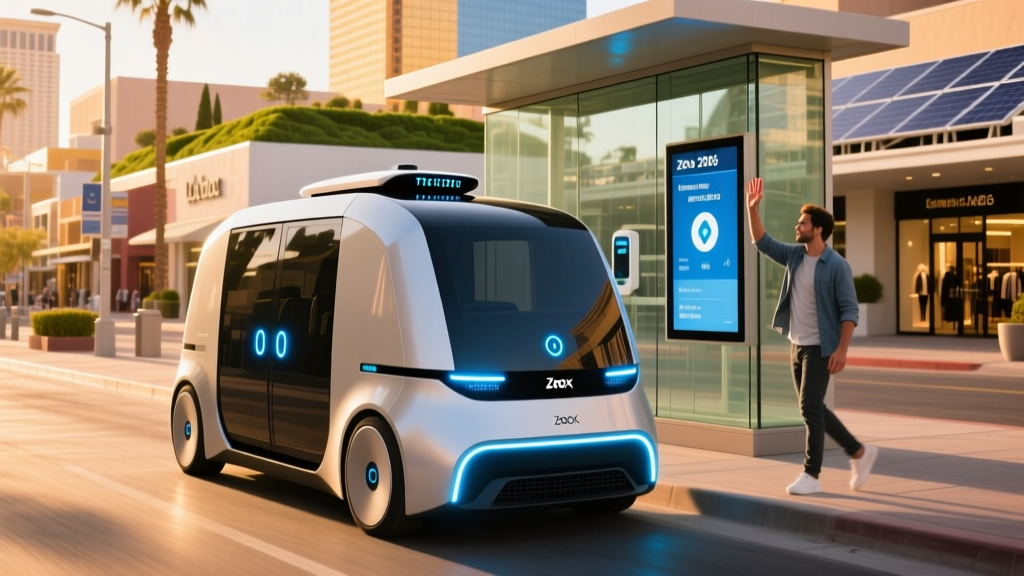
Zoox, Amazon's purpose-built robotaxi subsidiary, operates a free rider program in Las Vegas as of early 2026. Unlike conventional rideshare vehicles retrofitted with sensors, Zoox deploys a custom-designed, bidirectional carriage-style vehicle with no steering wheel or pedals — a true SAE Level 4 autonomous platform. If you've been searching for how to order Zoox in Las Vegas, the process is straightforward: download the Zoox app, request a ride within the geofenced service area, and a driverless vehicle arrives within minutes. The catch? The service is still invitation-based and geographically limited to a defined corridor on and around the Las Vegas Strip.
This guide covers exactly how to access the service, what the ride experience is like, Zoox's safety record with real data, the technology powering the vehicle, and the regulatory framework that allows it to operate. Whether you're an EV enthusiast planning a Vegas trip or a rideshare driver tracking the competitive landscape, here's everything you need to know.
How to Order Zoox in Las Vegas: Step-by-Step
Ordering a Zoox robotaxi in Las Vegas requires the official Zoox rider app, available on iOS and Android. Here's the current process as of 2026:
- Download the Zoox app from the Apple App Store or Google Play Store. Search "Zoox" — the developer is listed as Zoox, Inc.
- Sign up and request access. Zoox's Las Vegas service has operated on a waitlist and invitation basis since its public launch. Create an account with your phone number and email. If the waitlist is open, you'll receive an invitation code or automatic approval within days.
- Verify your location. Open the app while physically inside the Las Vegas service area. The map will show the active geofence boundary — currently covering a corridor along and adjacent to the Las Vegas Strip, including major hotel-casino pickup zones.
- Set your pickup and drop-off. Both points must fall within the geofenced zone. The app suggests designated pickup spots near hotel entrances and major intersections for easier vehicle access.
- Confirm your ride. A Zoox vehicle — the distinctive boxy, symmetrical carriage — is dispatched. Expect wait times of 3–8 minutes depending on demand and your location within the zone.
- Board and ride. The vehicle arrives, doors unlock automatically via the app, and you select your seat. The interior features two forward-facing and two rear-facing seats. There is no driver, no steering wheel, and no pedals. The ride begins autonomously.
Zoox operates as an SAE Level 4 robotaxi within its geofenced service area. This means the system performs all driving tasks — steering, acceleration, braking, and navigation — without any human intervention or supervision within its operational design domain (ODD). This is fundamentally different from Level 2 driver-assist systems like Tesla Autopilot, GM Super Cruise, or Ford BlueCruise, which require continuous driver attention and are not self-driving. In a Zoox vehicle, there is no driver seat because no driver is needed inside the geofence.
Where Can I Use Zoox Right Now? Service Area Breakdown
Zoox's commercial rider service is limited to specific cities and tightly defined geofences within those cities. As of early 2026, here is the current operational footprint:
| City | Status | Service Area | Access |
|---|---|---|---|
| Las Vegas, NV | Live — rider service active | Las Vegas Strip corridor and adjacent areas (~10 sq mi geofence) | App + waitlist/invitation |
| San Francisco, CA | Live — testing and limited riders | Select neighborhoods (SoMa, Mission Bay corridor) | Employee and invited riders |
| Foster City, CA | Testing operations | Local road network around Zoox HQ | Employees only |
| Austin, TX | Announced — expansion planned | TBD | Not yet available |
Las Vegas remains the primary city where the general public can realistically access a Zoox ride. The Las Vegas Strip geofence covers the densest tourist corridor, meaning most major hotels — from Mandalay Bay in the south to the Wynn/Encore in the north — fall within or near the service boundary. However, rides to McCarran International Airport (Harry Reid) or suburban Henderson are not currently supported.
Zoox has indicated plans to expand to additional cities, but announced expansion should not be confused with live service. Always check the Zoox app map for the real-time geofence boundary before planning a trip.
Zoox Pricing vs. Uber and Lyft: What Does a Ride Cost?
One of the most compelling aspects of Zoox's Las Vegas service is the pricing structure — or rather, the lack of one.
| Service | Base Fare | Per-Mile Rate | Typical Strip Ride (2 mi) | Surge Pricing |
|---|---|---|---|---|
| Zoox | $0.00 | $0.00 | $0.00 (free) | None |
| UberX | ~$2.50 | ~$1.50/mi | ~$8–$14 | Yes (1.5x–3x common) |
| Lyft Standard | ~$2.50 | ~$1.40/mi | ~$7–$13 | Yes (Prime Time surges) |
| Waymo One (Phoenix/SF) | ~$2.00 | ~$1.30/mi | ~$7–$12 | Limited surge |
As of early 2026, Zoox charges nothing for rides in Las Vegas. This is a deliberate strategy: Amazon is subsidizing the service to accumulate real-world passenger miles, refine the rider experience, and build public familiarity with driverless vehicles. There is no tipping mechanism in the app because there is no driver to tip.
This free-ride model will not last indefinitely. Zoox has not announced a paid pricing structure, but industry analysts project that once the service scales, pricing will be competitive with or slightly below Uber/Lyft — potentially $0.70–$1.00 per mile — since the economics of removing the driver (who typically earns 60–75% of a rideshare fare) dramatically reduce operating costs. For now, if you can get access, every Zoox ride in Las Vegas is effectively a zero-cost trip.
Zoox Safety Record: Real Data, Not Marketing Claims
Safety is the single most scrutinized aspect of any robotaxi operation. Zoox has accumulated millions of autonomous miles, though it publishes less granular public safety data than Waymo. Here is what is known from regulatory filings and company disclosures:
- Autonomous miles driven: 2+ million miles across all test and service operations (combined Las Vegas, San Francisco, Foster City)
- Driverless miles: Zoox began fully driverless operations (no safety operator in the vehicle) on public roads in late 2023, accumulating driverless miles in Las Vegas and select California zones
- Reported collisions: Zoox files collision reports with the California DMV and Nevada authorities as required. The company has reported a small number of minor-contact incidents, predominantly low-speed events where other human-driven vehicles struck the Zoox vehicle — consistent with the broader robotaxi industry pattern where AVs are rear-ended or side-swiped at intersections
- Disengagement rate: During testing phases with safety drivers, Zoox reported disengagement rates (human takeover events) that improved significantly year-over-year, though exact per-1,000-mile figures have not been consistently published in the same format as Waymo's California DMV reports
- No reported serious injuries: As of early 2026, Zoox has not publicly disclosed any rider or pedestrian fatality or serious injury attributable to its autonomous system
Sources: California DMV Disengagement Reports, Zoox company disclosures, Nevada DMV AV program filings.
For context, the broader robotaxi safety picture is instructive. Waymo, the most data-transparent operator, has published peer-reviewed research showing its vehicles are involved in injury-causing crashes at a rate roughly 85% lower than human benchmarks in comparable urban driving. Zoox has not yet published equivalent peer-reviewed studies, which is a notable gap in public transparency. However, the absence of serious incident reports across millions of miles is a positive signal.
The National Highway Traffic Safety Administration (NHTSA) requires all automated driving system operators to report crashes under Standing General Order 2021-01. Zoox complies with this reporting mandate. Riders should understand that robotaxi safety is a statistical advantage in aggregate but not an absolute guarantee — edge cases remain, and the system operates within a defined operational design domain.
The Zoox Vehicle and Technology Stack: Purpose-Built for Autonomy
Zoox's most distinctive advantage is that it did not retrofit an existing car. The Zoox vehicle is engineered from the ground up as a Level 4 robotaxi, which has significant implications for both safety and rider experience.
Vehicle Architecture
- Form factor: Symmetrical, carriage-style body — identical front and rear, enabling bidirectional travel without turning around
- Seating: Four passengers in a face-to-face configuration (two forward, two rear-facing); no driver seat
- Dimensions: Compact footprint (~167 inches long), designed for dense urban navigation and tight pickup zones
- Powertrain: Fully electric, dual-motor all-wheel drive; battery capacity estimated at ~75 kWh (NMC chemistry)
- Top speed: 75 mph (geared for urban operation, typically operates at or below posted speed limits of 25–45 mph in service areas)
Sensor Suite (Redundant, Multi-Modal)
- LiDAR: Multiple solid-state and spinning LiDAR units providing 360° 3D point-cloud mapping at up to 200+ meters range
- Cameras: High-resolution camera array covering all directions, enabling traffic-sign recognition, signal detection, and semantic scene understanding
- Radar: Millimeter-wave radar for velocity detection and operation in degraded visibility (rain, fog, dust)
- Ultrasonic: Short-range proximity sensors for low-speed maneuvering and pickup-zone precision
Computing and Software
- Onboard compute: Custom high-performance computing platform running Zoox's proprietary perception, prediction, and planning stack
- HD maps: Pre-mapped, centimeter-accurate 3D maps of the entire geofenced service area, updated regularly
- Remote assistance: Fleet operations center can provide high-level guidance (not remote driving) when the vehicle encounters an ambiguous scenario — the vehicle will safely stop and request clarification rather than guess
The multi-sensor approach — LiDAR plus cameras plus radar — stands in contrast to Tesla's camera-only FSD strategy. Zoox's position, shared by Waymo and Cruise, is that sensor redundancy is essential for Level 4 operation: if one sensor modality is degraded (e.g., cameras blinded by direct sun glare), LiDAR and radar maintain perception capability. This redundancy comes at higher hardware cost but provides a wider safety margin for driverless operation.
The geofenced operational design domain (ODD) means Zoox vehicles only operate in areas that have been exhaustively pre-mapped and validated. The vehicle "knows" every lane, intersection, crosswalk, and speed zone within the Las Vegas service area before it ever drives there autonomously. This is why Zoox cannot simply expand to a new neighborhood overnight — each new zone requires mapping, validation, and regulatory approval.
Regulatory Landscape: Who Approves Zoox Operations?
Robotaxi operations in the United States are governed by a patchwork of state and local regulations. Zoox must satisfy requirements at multiple levels to operate legally in Las Vegas:
- Federal (NHTSA): The National Highway Traffic Safety Administration sets vehicle safety standards (FMVSS). Zoox received a notable exemption from NHTSA in 2024 to deploy its purpose-built vehicle, which lacks traditional controls (steering wheel, pedals, mirrors) that FMVSS historically required. This exemption was a critical regulatory milestone, as it formally recognized a vehicle designed exclusively for autonomous operation.
- State of Nevada: Nevada was one of the first states to pass autonomous vehicle legislation (AB 511 in 2011, updated subsequently). The Nevada DMV issues autonomous vehicle testing and deployment permits. Zoox holds a valid Nevada deployment permit allowing driverless commercial operations within the approved geofence.
- State of California: The California DMV issues testing permits and requires annual disengagement reports. The California Public Utilities Commission (CPUC) governs commercial passenger service permits. Zoox holds testing permits in California but has been more limited in commercial deployment compared to Waymo.
- Local jurisdictions: City and county authorities (Clark County, City of Las Vegas, City of Paradise) coordinate on pickup/drop-off zones, traffic management integration, and emergency response protocols.
The regulatory environment is evolving. The NHTSA continues to develop framework rules for vehicles without manual controls, and state legislatures are actively debating insurance requirements, data-sharing mandates, and operational boundaries. For riders, this means the regulatory framework permitting your Zoox ride is real and enforceable — but it's also newer and less established than the century of regulation governing conventional taxis and rideshare.
Current Limitations: What Zoox Cannot Do
Understanding the boundaries of Zoox's capabilities is as important as understanding what it can do. Every Level 4 robotaxi has an operational design domain — a set of conditions under which it is designed to function. Outside that domain, the vehicle will not operate.
- Geofence restriction: The vehicle will not travel outside the pre-mapped Las Vegas service corridor. You cannot request a ride to the airport, to suburban areas, or to neighboring cities. Both pickup and drop-off must be inside the geofence.
- Weather constraints: While Zoox's multi-sensor stack handles light rain and overcast conditions, heavy rain, flooding, dust storms (relevant in the Las Vegas desert), or other severe weather events may trigger service suspension. The vehicle may pull over safely and wait for conditions to improve.
- Construction zones: Major, unmapped road construction within the geofence can cause the vehicle to stop and request remote assistance or reroute. Temporary lane closures and detours that aren't reflected in HD maps are a known edge case for all Level 4 systems.
- Complex edge cases: Unusual scenarios — emergency vehicles with non-standard approaches, police officers directing traffic with hand signals, fallen debris blocking a lane — may require the vehicle to stop safely and request guidance from the remote operations center. This can add minutes to your trip.
- No highway driving: Zoox currently operates on surface streets within its urban geofence. Highway merging and high-speed autonomous driving are not part of the current Las Vegas service profile.
- Limited hours: Service may not be available 24/7. Check the app for current operating hours, which have expanded over time but may still have late-night or early-morning gaps.
- Capacity: Maximum four passengers per vehicle. No car seats, no large luggage, no pets (service animals excepted per ADA requirements).
- Accessibility: Zoox has stated its vehicle is designed to accommodate wheelchair users, but real-world accessibility may vary by pickup location and curb infrastructure. The company is working on ADA compliance across its fleet.
These limitations are not unique to Zoox — Waymo and every other Level 4 operator faces similar ODD constraints. The key takeaway: Zoox is excellent for short, predictable trips within the Las Vegas Strip corridor during normal conditions. It is not a replacement for a rental car, an airport shuttle, or a trip to Red Rock Canyon.
Zoox vs. Waymo: The Two Level 4 Robotaxi Approaches
Zoox and Waymo (Alphabet's autonomous driving division) are the two most prominent Level 4 robotaxi operators in the United States, but they take fundamentally different approaches:
| Feature | Zoox | Waymo One |
|---|---|---|
| Parent company | Amazon | Alphabet (Google) |
| Vehicle | Purpose-built (no steering wheel) | Jaguar I-PACE retrofitted (6th-gen hardware); custom vehicle in development |
| SAE Level | Level 4 | Level 4 |
| Live cities (2026) | Las Vegas (public); SF (limited) | Phoenix, San Francisco, Los Angeles, Austin |
| Pricing | Free (promotional) | Paid (competitive with Uber/Lyft) |
| Sensor approach | LiDAR + cameras + radar | LiDAR + cameras + radar |
| Public safety data | Limited public disclosure | Peer-reviewed studies published |
| Cumulative autonomous miles | ~2M+ | 50M+ (driverless) |
Waymo has a substantial lead in operational scale, city count, and cumulative miles. Zoox's advantage lies in its purpose-built vehicle design, which eliminates the cost and complexity of retrofitting and offers a unique rider experience. Both approaches are valid; the market will determine which model scales more efficiently.
Frequently Asked Questions
Is Zoox truly self-driving, or is there a remote driver?
Zoox is genuinely self-driving within its geofenced service area — there is no human driver in the vehicle, no remote joystick operator, and no safety driver behind a hidden wheel. The vehicle operates at SAE Level 4. A remote operations center can provide high-level guidance (e.g., confirming it's safe to proceed past an unusual obstruction), but they do not steer or control the vehicle in real time. The onboard AI handles all driving tasks.
How much does a Zoox ride cost compared to Uber or Lyft?
As of early 2026, Zoox rides in Las Vegas are completely free — $0 base fare, $0 per mile, no surge pricing, no tipping. A comparable 2-mile UberX or Lyft ride on the Las Vegas Strip typically costs $8–$14, more during peak hours. Zoox's free pricing is a promotional strategy to build ridership and accumulate operational data. Paid pricing has not been announced but is expected to be competitive with or below rideshare rates once implemented.
Where exactly can I use Zoox in Las Vegas?
The service area covers a geofenced corridor along and near the Las Vegas Strip, roughly from Mandalay Bay in the south to the Wynn/Encore properties in the north, including adjacent east-west streets. The exact boundary is visible in the Zoox app map. Rides outside this zone — including to Harry Reid International Airport, downtown Fremont Street, or suburban areas — are not available.
How safe are robotaxis compared to human drivers?
Waymo's peer-reviewed research (the most comprehensive public data available) shows its robotaxis are involved in injury-causing crashes at approximately 85% lower rates than human benchmarks in comparable urban driving environments. Zoox has not published equivalent peer-reviewed data, but has reported no serious injuries or fatalities across its operational history. The NHTSA requires all AV operators to report crashes under a standing general order. Robotaxis are programmed to follow speed limits, never drive impaired, and maintain 360° sensor awareness — advantages over human drivers. However, they can struggle with edge cases like construction zones, unusual traffic-control scenarios, and severe weather.
What happens if the Zoox vehicle encounters something it can't handle?
The vehicle is programmed to stop safely — it will pull to the side of the road or stop in its lane with hazard signals — and contact the remote operations center for guidance. A remote operator can assess the situation via the vehicle's cameras and sensors and provide a high-level resolution (e.g., confirming a safe path around an obstacle). The vehicle will not proceed if it lacks confidence in a safe path. This can add a few minutes to your trip but prioritizes safety over speed.
Can I ride Zoox if I use a wheelchair?
Zoox has designed its vehicle with accessibility in mind, including a wide door opening and level floor. The company has stated ADA compliance is a priority. However, real-world accessibility may depend on the specific pickup location and curb infrastructure. Contact Zoox support through the app for specific accessibility accommodations before your ride.
Will Zoox expand beyond Las Vegas?
Zoox has announced plans to expand to additional cities, with Austin, TX among the reported targets. San Francisco has limited operations. However, each new city requires extensive HD mapping, regulatory approval, and fleet deployment — expansion is measured in years, not months. Check the Zoox app or official announcements for the latest service area updates.
This article reflects information available as of early 2026. Robotaxi service areas, pricing, and regulations change frequently. Always verify current availability and terms through the official Zoox app and applicable state regulatory agencies before planning a trip.