Honda's Autonomous Driving Strategy: Two Parallel Paths
Honda's approach to autonomous driving splits into two distinct tracks: a production Level 3 system available in Japan since 2021, and a Level 4 robotaxi partnership through its investment in GM's Cruise. Understanding which is which — and what you can actually use today — requires separating Honda's consumer vehicle technology from its ride-hailing ambitions.
This guide covers both paths with real data on service availability, safety records, regulatory status, and the hard limitations that define where Honda driverless cars stand in 2026.
SAE Automation Levels: Where Honda Systems Actually Land
The most common confusion in autonomous vehicle discussions is conflating driver-assist features with true self-driving capability. Here's exactly where Honda's systems sit on the SAE International automation scale:
| SAE Level | Definition | Honda Equivalent | Driver Role |
|---|---|---|---|
| Level 0 | No automation | — | Full control |
| Level 1 | Driver assistance (steering OR speed) | Honda Sensing (ACC or LKA) | Full control, hands on wheel |
| Level 2 | Partial automation (steering AND speed) | Honda Sensing Elite (with Traffic Jam Pilot) | Supervision required, hands may leave wheel in limited conditions |
| Level 3 | Conditional automation — system drives in defined scenarios | Legend with Traffic Jam Pilot (Japan only) | Can disengage in traffic jams under 19 mph; must be ready to resume |
| Level 4 | High automation — no driver needed in operational domain | Cruise Origin (GM/Honda partnership) | No driver; geofenced service areas only |
| Level 5 | Full automation — anywhere, any condition | Does not exist in production | — |
The critical distinction: Honda Sensing and Sensing Elite are Level 2 driver-assist systems. The driver remains legally responsible. Only the Japan-market Legend with Traffic Jam Pilot reaches Level 3, and only under narrow conditions. Honda's robotaxi ambitions target Level 4 through Cruise.
Honda Legend Level 3: The Production System in Japan
In March 2021, Honda launched the Legend Hybrid EX in Japan — the world's first production vehicle with certified Level 3 autonomous capability. The system, called Traffic Jam Pilot, allows the driver to legally take their eyes off the road and hands off the wheel under specific conditions:
- Vehicle speed below 30 km/h (19 mph)
- On divided highways (expressways with physical barriers)
- Heavy traffic conditions (stop-and-go congestion)
- Clear weather, good visibility
- GPS signal available and HD map coverage confirmed
When these conditions are met, the system assumes full driving responsibility. The driver can watch a video or use a smartphone — but must be prepared to resume control within approximately 10 seconds when the system requests it (typically when traffic clears and speeds exceed 30 km/h).
Technical Specifications
The Legend's Level 3 system uses a sensor suite of:
- 1 lidar sensor (roof-mounted, for 3D environmental mapping)
- 5 radar units (front, rear corners)
- Multiple cameras (forward, surround-view)
- Ultrasonic sensors (close-range obstacle detection)
- GNSS + HD map integration (centimeter-level positioning)
- Driver monitoring camera (infrared, tracks eye/head position)
The vehicle was limited to 100 units in its initial release, priced at approximately ¥11,000,000 (roughly $71,000 USD at 2021 exchange rates). Honda has not announced plans to export the Level 3 Legend to the United States or European markets, primarily due to differing regulatory frameworks.
Cruise Partnership: Honda's Level 4 Robotaxi Play
Honda's path to fully driverless ride-hailing runs through its investment in GM Cruise. In 2018, Honda committed $2.75 billion to Cruise over 12 years, with the explicit goal of developing a purpose-built robotaxi — the Cruise Origin.
The Cruise Origin Vehicle
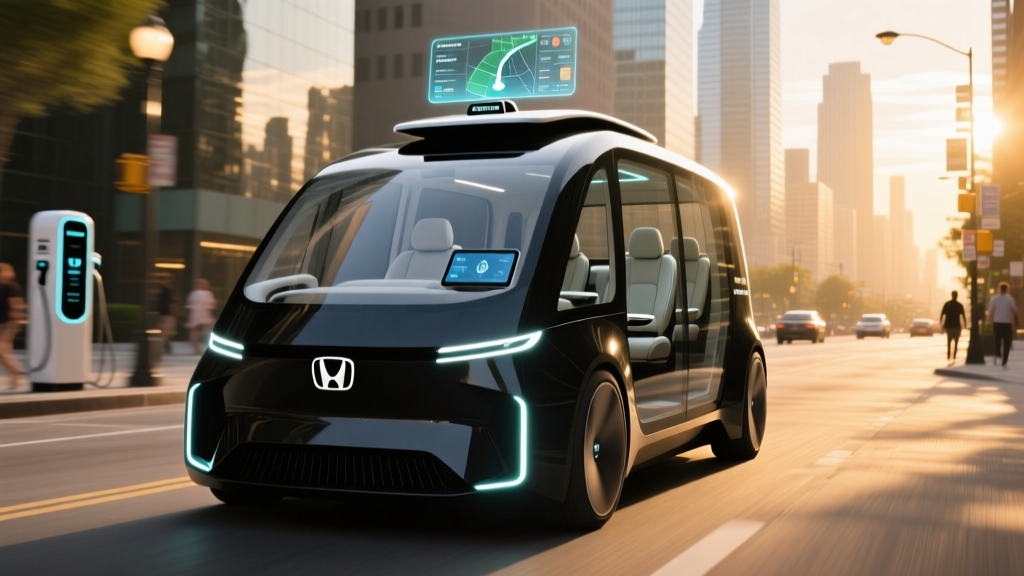
The Cruise Origin is a Level 4 autonomous shuttle designed without a steering wheel or pedals. Key specifications:
- Battery electric platform (GM Ultium architecture)
- Estimated range: 250+ miles (EPA, preliminary)
- Seating: 6 passengers, face-to-face configuration
- Sensor suite: lidar, radar, cameras, ultrasonic (redundant systems)
- Top speed: limited to approximately 75 mph
- No driver controls — fully autonomous operation
However, Cruise's operational setbacks in late 2023 — including a serious incident in San Francisco where a pedestrian was dragged by a robotaxi — led to a suspension of operations and a significant restructuring. As of 2026, Cruise has resumed limited testing in Phoenix and Dallas, but the timeline for Origin deployment and Honda-branded robotaxi services remains uncertain.
Service Availability: Where Can You Ride a Honda-Connected Robotaxi?
| Service | City/Region | Status (2026) | Access |
|---|---|---|---|
| Honda Legend Level 3 | Japan (nationwide, on qualifying expressways) | Production vehicle, available for purchase (limited units) | Private ownership; Japan market only |
| Cruise (GM/Honda) | Phoenix, AZ | Limited testing with safety drivers (2026) | Not open to public riders |
| Cruise (GM/Honda) | Dallas, TX | Limited testing with safety drivers (2026) | Not open to public riders |
| Waymo (comparison) | Phoenix, San Francisco, Los Angeles | Commercial service, fully driverless | Open to public via Waymo app |
The reality for most readers: there is currently no publicly accessible robotaxi service using Honda technology in the United States. The Legend's Level 3 system is available only as a purchased vehicle in Japan. Cruise's Level 4 operations have not yet returned to commercial, driverless service as of early 2026.
Safety Data: What the Numbers Show
Autonomous vehicle safety claims require scrutiny. Here's what's documented:
Since its March 2021 launch, there have been no publicly reported collisions attributed to the Traffic Jam Pilot system. However, the deployment is extremely limited (approximately 100 vehicles), and the operational design domain (low-speed, divided highway, clear weather) minimizes exposure to complex scenarios. The National Highway Traffic Safety Administration (NHTSA) does not track Japan-market incidents.
Cruise Safety Incidents (2023)
Cruise's 2023 suspension followed a October 2023 incident in San Francisco where a pedestrian, already struck by a human-driven vehicle, was run over and dragged approximately 20 feet by a Cruise robotaxi. The vehicle's system detected the initial impact but did not recognize the pedestrian's position beneath it. California's DMV suspended Cruise's deployment permit, citing failures in post-collision behavior and transparency with regulators.
Prior to suspension, Cruise had accumulated over 2.5 million driverless miles in San Francisco, Phoenix, and Austin. The company reported a collision rate of approximately 5.3 reportable incidents per million miles — compared to the U.S. average of approximately 1.9 police-reported crashes per million miles for human drivers (though underreporting in human crash data complicates direct comparison).
Industry Context
Waymo, the current leader in commercial robotaxi service, published data in 2024 showing a 85% reduction in injury-causing crashes compared to human benchmarks in Phoenix and San Francisco, across 7+ million driverless miles. This data, reviewed by IIHS researchers, represents the most comprehensive real-world safety analysis available for Level 4 systems.
Technology Stack: Lidar vs. Camera-Only Approaches
Honda's two autonomous systems use fundamentally different sensor philosophies:
| System | Primary Sensors | Mapping | Redundancy |
|---|---|---|---|
| Legend Level 3 | Lidar (1 roof unit) + radar (5 units) + cameras + ultrasonic | HD maps + GNSS (centimeter-level) | Driver as fallback; system requests takeover |
| Cruise Origin (Level 4) | Lidar (multiple units, 360°) + radar + cameras + ultrasonic | HD maps + real-time SLAM + GNSS | Full system redundancy; no driver fallback |
| Tesla FSD (comparison) | Camera-only (8 cameras), no lidar | Neural network inference, no HD maps | Driver as fallback (Level 2) |
Honda and Cruise both use lidar — light detection and ranging sensors that create precise 3D point clouds of the environment. This contrasts with Tesla's camera-only approach, which relies entirely on machine vision neural networks. The lidar-vs-camera debate remains active in the industry, but every commercially deployed Level 4 robotaxi (Waymo, Cruise, Zoox, Baidu Apollo) currently uses lidar as a core sensor.
Geofencing and Operational Design Domains (ODDs)
Both Honda's Level 3 system and Cruise's Level 4 robotaxi operate within geofenced areas. For the Legend, this means pre-mapped expressways with HD map coverage. For Cruise, it means specific city zones (initially downtown Phoenix and San Francisco) where the system has been validated. Outside these zones, the systems will not engage — or will request the driver to take over (Level 3) or refuse the trip (Level 4).
Pricing: Robotaxi Costs vs. Rideshare
Since Honda's Level 3 Legend is a purchased vehicle (not a ride service), pricing comparisons focus on the Cruise robotaxi model vs. Uber/Lyft:
| Service | Base Fare | Per-Mile Rate | Per-Minute Rate | Typical 5-Mile Trip |
|---|---|---|---|---|
| Cruise (2023, pre-suspension) | $1.50 | $0.90 | $0.25 | $7.25 - $9.00 |
| Waymo (Phoenix, 2026) | $2.00 | $1.10 | $0.30 | $9.00 - $12.00 |
| UberX (Phoenix avg, 2026) | $2.50 | $1.25 | $0.35 | $10.50 - $14.00 |
| Lyft (Phoenix avg, 2026) | $2.25 | $1.20 | $0.32 | $10.00 - $13.00 |
Robotaxi services have historically priced rides at or slightly below Uber/Lyft to build market share. Cruise's pre-suspension pricing in San Francisco averaged 10-20% below comparable UberX rides. However, with Cruise not currently operating commercial service, there is no Honda-connected robotaxi pricing available in 2026.
Regulatory Landscape: Who Approves Autonomous Operations?
Autonomous vehicle regulation in the United States operates on two levels:
Federal (NHTSA)
The National Highway Traffic Safety Administration sets vehicle safety standards but does not currently have a comprehensive federal framework for Level 4 robotaxi deployment. NHTSA has issued standing general orders requiring crash reporting for vehicles with Level 2+ and above systems, and has opened investigations into Tesla Autopilot, Cruise, and Waymo incidents.
State Level
Deployment authority largely falls to state regulators:
- California (DMV + CPUC): Requires testing permits, driverless deployment permits, and commercial service permits. Suspended Cruise's permit in October 2023.
- Arizona: Permissive regulatory environment; no specific permit required for testing or deployment. Cruise and Waymo both operate in Phoenix.
- Texas: Allows autonomous vehicle operation; Cruise has testing authorization in Dallas.
- Japan (for Honda Legend): Japan's Ministry of Land, Infrastructure, Transport and Tourism (MLIT) certified the Legend's Level 3 system under revised Road Traffic Act provisions effective April 2020.
For Honda specifically, the Legend's Level 3 system is approved only under Japanese regulations. There is no pathway to sell or operate the Level 3 Legend in the U.S. without NHTSA rulemaking or a specific exemption — neither of which is pending as of 2026.
Current Limitations: What Honda Driverless Systems Cannot Do
- Operates only below 19 mph (30 km/h) — disengages when traffic clears
- Requires divided expressway with HD map coverage
- Cannot operate in rain, snow, fog, or reduced visibility
- Cannot navigate construction zones or temporary lane shifts
- Driver must remain seated, belted, and sober — system monitors via interior camera
- Not available outside Japan
- Not in commercial service as of early 2026 (testing only with safety drivers)
- Geofenced to specific zones within Phoenix and Dallas
- Cannot operate in heavy rain, flooding, or snow
- May refuse trips to unmapped or low-confidence areas
- Cannot accommodate child seats or wheelchair accessibility (Origin design)
- No Honda branding or consumer purchase option — ride service only
Is This Truly Self-Driving or Driver-Assist?
The answer depends entirely on which Honda system:
Honda Sensing / Sensing Elite (U.S. market, all current models): Level 2 driver-assist. The driver must remain engaged, hands on or near the wheel, eyes on the road. This is not self-driving. The system assists with lane centering and adaptive cruise control, but the driver is legally and operationally responsible.
Honda Legend with Traffic Jam Pilot (Japan only): Level 3 conditional automation. In very specific conditions (low-speed, divided highway, clear weather), the system drives and the driver can disengage. This is the closest Honda offers to "self-driving," but it's extremely limited in scope and geography.
Cruise Origin (GM/Honda partnership): Level 4 high automation. No driver, no steering wheel. This is genuinely self-driving — but only within geofenced service areas, and it's not currently in commercial operation.
FAQ: Honda Driverless Cars
Can I buy a Honda with self-driving capability in the United States?
No. The only Honda with Level 3 capability is the Legend, sold exclusively in Japan. All U.S.-market Honda vehicles (Civic, Accord, CR-V, Prologue, etc.) offer Level 2 Honda Sensing driver-assist, which requires active driver supervision.
When will Honda robotaxis be available to the public?
There is no confirmed timeline. Cruise resumed limited testing with safety drivers in Phoenix and Dallas in 2024-2025, but has not announced a date for returning to fully driverless commercial service. The Cruise Origin vehicle has been delayed, and Honda has not announced an alternative robotaxi program.
How does Honda's Level 3 compare to Tesla's Full Self-Driving?
They occupy different SAE levels. Honda's Traffic Jam Pilot is certified Level 3 in Japan — the system assumes legal driving responsibility under specific conditions. Tesla FSD (Supervised) remains Level 2 — the driver is always legally responsible, even when the system is steering and accelerating. Honda's system is more limited in scope (low-speed traffic only) but shifts liability; Tesla's system operates in more scenarios but does not shift liability.
What sensors does Honda use for autonomous driving?
The Legend Level 3 uses 1 lidar, 5 radar units, multiple cameras, ultrasonic sensors, and HD map integration with GNSS positioning. This multi-sensor approach (lidar + radar + camera) is standard for Level 3/4 systems, contrasting with Tesla's camera-only approach.
Is Honda still investing in Cruise?
Honda's original $2.75 billion commitment to Cruise was announced in 2018. Following Cruise's operational suspension in late 2023 and GM's subsequent restructuring of the division (reducing Cruise's budget and headcount significantly), Honda has not publicly confirmed whether its full investment commitment remains active. The partnership's future direction remains unclear as of 2026.