If you search for companies with driverless cars, you will find dozens of names — but only a handful actually let you hail a vehicle with nobody in the driver's seat. The gap between marketing promises and operational reality in autonomous vehicles remains wide. This guide cuts through the hype with concrete data on which robotaxi services you can ride today, what they cost, how safe they are, and where the technology still falls short.
What "Driverless" Actually Means: SAE Automation Levels Explained
Before evaluating any company, you need to understand the SAE International automation scale. Most consumer vehicles — including Teslas running FSD Supervised, GM's Super Cruise, and Ford's BlueCruise — operate at SAE Level 2. The driver must remain attentive and is legally responsible for the vehicle at all times.
True robotaxis operate at SAE Level 4: high automation within a defined operational design domain (ODD). There is no driver, no steering wheel intervention expected, and the system handles all driving tasks within its geofenced area. No production vehicle currently operates at Level 5 (full automation everywhere, in all conditions).
| Level | Name | Who Drives? | Examples |
|---|---|---|---|
| 0 | No Automation | Human, always | Legacy vehicles |
| 1 | Driver Assistance | Human (system assists steering OR speed) | Adaptive cruise control, lane-keep |
| 2 | Partial Automation | Human (system assists steering AND speed) | Tesla Autopilot, FSD Supervised, BlueCruise, Super Cruise |
| 3 | Conditional Automation | System (human must take over on request) | Mercedes DRIVE PILOT (limited, Germany/CA/NV) |
| 4 | High Automation | System (within geofenced ODD, no human needed) | Waymo, Zoox, Cruise (paused) |
| 5 | Full Automation | System (everywhere, all conditions) | None commercially available |
Companies With Driverless Cars: Who's Operating Public Services Now
As of early 2026, the list of companies offering fare-charging, fully driverless (no safety operator) rides to the public is remarkably short. Here is who is actually running commercial Level 4 robotaxi operations and where.
| Company | Parent/Backer | Live Driverless Cities | Service Hours | Vehicle |
|---|---|---|---|---|
| Waymo One | Alphabet (Google) | Phoenix, San Francisco, Los Angeles, Austin (expanding) | 24/7 in most markets | Jaguar I-PACE (custom outfitted), Zeekr (incoming) |
| Zoox | Amazon | Limited Las Vegas, Foster City (employee/testing phases); public launch announced | Limited hours | Zoox purpose-built carriage (no steering wheel) |
| Baidu Apollo Go | Baidu | Wuhan, Beijing, Chongqing, Shenzhen (China) | Extended hours, some 24/7 | Various, including Apollo RT6 |
| WeRide | Independent (Nissan/Renault backed) | Guangzhou, Beijing (China); Abu Dhabi pilot | Daytime/extended | Various + purpose-built GAC collaboration |
Where Can I Use a Robotaxi Service Right Now?
In the United States, Waymo One is the only company offering a scaled, commercial, fully driverless service that any member of the public can hail. Here is the city-by-city breakdown:
- Phoenix metro: The longest-running market. Covers roughly 225+ square miles including Chandler, Tempe, Mesa, Scottsdale, and parts of downtown Phoenix. Waymo has operated driverless here since 2020.
- San Francisco: Full commercial service across most of the city. Waymo received its CPUC (California Public Utilities Commission) permit for paid driverless rides in August 2023.
- Los Angeles: Service area covers central LA, Hollywood, Santa Monica, and expanding zones. Commercial operations launched in 2024.
- Austin, Texas: Announced and in early operations as of late 2025/early 2026, with geographic rollout phased in.
Outside the US, Baidu Apollo Go operates the world's largest robotaxi fleet by ride volume, concentrated in Chinese cities — particularly Wuhan, where it has run hundreds of thousands of fully driverless rides. However, these services are not accessible to most US-based readers in their home markets.
How to Hail a Driverless Ride and What It Costs
Using Waymo One is similar to Uber or Lyft: download the app, enter your pickup and destination, and a vehicle arrives. The difference is that no one is in the driver's seat. You can request a ride, track the vehicle's approach, and unlock the doors from the app.
| Service | Typical Fare | Surge Pricing? | Tips? |
|---|---|---|---|
| Waymo One | $12–$18 | Yes (dynamic pricing in high demand) | No (in-app tip optional, rarely expected) |
| Uber (UberX) | $10–$16 | Yes | Yes (customary 15–20%) |
| Lyft (standard) | $10–$15 | Yes | Yes (customary 15–20%) |
Waymo's pricing is generally in the same range as UberX or Lyft before tip, though surge pricing during peak hours can push fares higher. The value proposition is consistency — no driver variability, no conversation, and a vehicle that follows traffic laws precisely. For airport runs in Phoenix (PHX Sky Harbor service launched in 2024), fares from the airport to nearby areas typically run $15–$25 depending on destination.
How Safe Are Robotaxis? Real Data, Not Marketing
Safety is the most contentious question around companies with driverless cars. Here is what the data actually shows, sourced from company disclosures, NHTSA, and state regulatory filings.
- ~85% reduction in injury-causing crash rates compared to human baseline (per mile)
- ~57% reduction in any police-reported crash vs. human drivers
- Most collisions involving Waymo vehicles are low-speed, at-fault-by-other-party incidents (rear-ended at stoplights, sideswiped in parking areas)
However, the data is not uniformly positive across all operators:
- Cruise (pre-suspension, 2022–2023): California DMV records showed Cruise vehicles were involved in multiple minor collisions per 10,000 miles — a higher rate than Waymo. The October 2023 San Francisco incident, where a Cruise vehicle dragged a pedestrian who had been struck by a human-driven car, led to the company's permit revocation and operational shutdown.
- Edge-case concerns: Robotaxis have struggled with construction zones, temporary lane closures, unusual road configurations, and interactions with emergency vehicles. California DMV disengagement reports and collision filings document these scenarios.
- Pedestrian and cyclist interactions: While robotaxis generally obey speed limits and stop at crosswalks, there have been documented instances of vehicles stopping unexpectedly in travel lanes or failing to proceed when safe — causing traffic disruption rather than danger.
The honest assessment: Level 4 robotaxis from established operators like Waymo appear to be at least as safe as attentive human drivers in their approved operating areas, and likely safer in terms of injury-causing crashes. But they are not infallible, and their safety record is built on constrained geofenced operation — not universal driving competence.
Technology Stack: How Robotaxis Actually See the Road
Companies with driverless cars take different sensor approaches. Understanding these helps explain why some systems work only in specific conditions.
| Company | Primary Sensors | HD Mapping | Compute Platform |
|---|---|---|---|
| Waymo (6th-gen) | LiDAR (multiple, 360°), radar, cameras (8+), audio detection | Yes — centimeter-precise HD maps, continuously updated | Custom Waymo Driver platform |
| Zoox | LiDAR, radar, cameras (redundant arrays on all four corners) | Yes — HD maps | Custom Zoox compute |
| Baidu Apollo | LiDAR, radar, cameras | Yes — HD maps | Apollo computing unit |
| Tesla (FSD — Level 2, not robotaxi) | Cameras only (Tesla Vision, no LiDAR/radar) | No — real-time perception only | Custom FSD chip (HW3/HW4) |
The dominant approach among actual Level 4 operators is sensor fusion: combining LiDAR (light detection and ranging — precise 3D distance measurement), radar (velocity and object detection in poor visibility), and cameras (lane markings, signs, classification). This redundancy is why Waymo can operate at night and in light rain.
Tesla's camera-only approach is the outlier. While Tesla has demonstrated impressive vision-based perception, FSD remains a Level 2 system requiring driver supervision. No Tesla vehicle operates as a driverless robotaxi commercially as of 2026, despite years of announced timelines. The camera-only approach faces inherent challenges in heavy rain, fog, direct sun glare, and low-light scenarios that LiDAR-equipped vehicles handle more robustly.
Geofencing is the other critical technology component. Every current Level 4 robotaxi operates within a pre-mapped area. The vehicle's software knows every lane, intersection, speed limit, and construction-zone update within its territory. Drive outside that boundary, and the system cannot operate. This is why "Level 4" does not mean "drives anywhere."
Current Limitations: Where Robotaxis Cannot Go (Yet)
If you are evaluating companies with driverless cars, you need to understand the operational constraints that define what these services cannot do today:
- Geographic boundaries: Waymo in Phoenix covers ~225 square miles — a fraction of the metro area. You cannot take a robotaxi from downtown Phoenix to Sedona, the Grand Canyon, or even many suburbs outside the mapped zone.
- Weather restrictions: Heavy rain, snow, ice, and dense fog degrade sensor performance. Most operators reduce service areas or suspend operations entirely during severe weather. Waymo in Phoenix largely avoids this issue due to climate, but San Francisco fog and LA rain have caused service interruptions.
- Highway driving: Most robotaxi services avoid high-speed freeways or limit their use. Waymo has begun highway-capable operations on select routes, but the majority of rides are surface-street trips under 45 mph.
- Construction zones and detours: While improving, robotaxis can struggle with temporary lane shifts, flaggers, and unmapped road changes. In some cases, the vehicle will pull over safely and request remote assistance rather than navigate an unfamiliar configuration.
- No spontaneous stops: You cannot ask a robotaxi to "pull over at that store for a minute" or make an unplanned stop mid-route. Pickup and dropoff happen at designated or approved locations within the geofence.
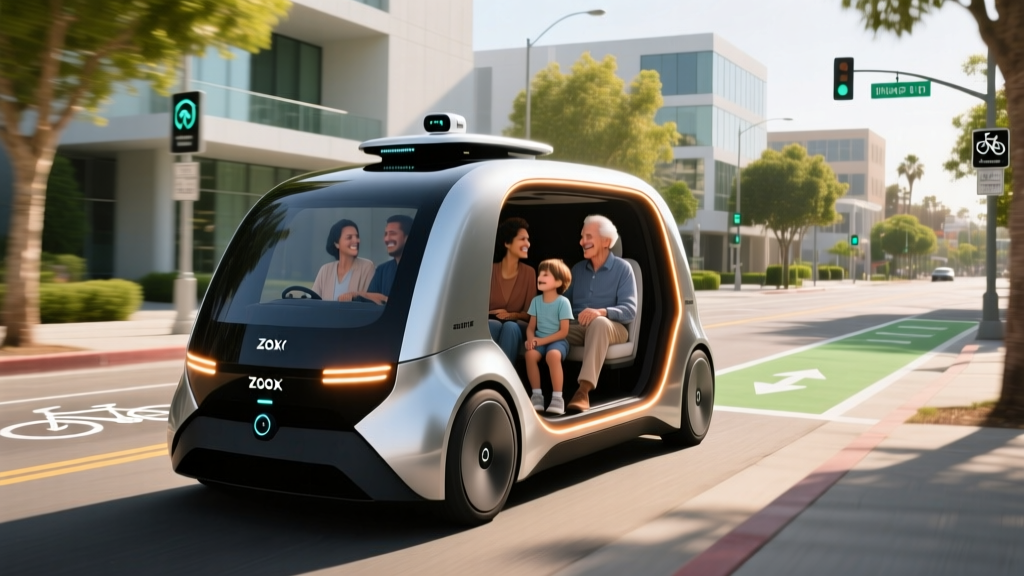
- Accessibility gaps: Current robotaxi fleets (Jaguar I-PACE conversions, for instance) may not accommodate all wheelchair configurations or mobility devices. Purpose-built vehicles like the Zoox carriage aim to address this but are not yet widely deployed.
- Emergency situations: There is no driver to assist with a medical emergency, a child seat issue, or a vehicle malfunction. Remote support can dispatch help, but response times are not equivalent to having a human present.
Regulatory Landscape: Who Approves Driverless Operations
Robotaxi deployment in the US requires navigating a patchwork of state and federal regulations:
- State level (primary authority): Each state determines whether driverless testing and commercial operations are legal. California requires permits from both the DMV (for testing) and the CPUC (for commercial passenger service). Arizona takes a permissive approach with minimal permitting — which is why Waymo scaled in Phoenix first. Texas passed legislation in 2023 enabling autonomous vehicle operations.
- Federal level (NHTSA): The National Highway Traffic Safety Administration sets vehicle safety standards but has not issued comprehensive federal regulations for Level 4 operations. NHTSA's Standing General Order requires crash reporting from ADS-equipped vehicles, which provides transparency into incident data.
- Local/municipal: Cities can impose additional requirements — first-responder interaction protocols, parking/stopping rules, and community engagement mandates. San Francisco's Board of Supervisors has repeatedly pushed back on robotaxi expansion, demonstrating that local political approval is not guaranteed.
The result is a fragmented landscape where a company may be approved in one city but unable to operate in the next. There is no single "federal robotaxi license" that grants nationwide deployment authority.
Frequently Asked Questions
Is Tesla's FSD a robotaxi service?
No. Tesla Full Self-Driving (Supervised) is an SAE Level 2 driver-assist system. The driver must remain attentive, keep hands available, and is legally responsible for the vehicle. As of 2026, Tesla does not operate a commercial driverless ride-hailing service. Tesla has discussed a future robotaxi platform, but no Level 4 service is live.
How much does a Waymo ride cost compared to Uber?
Typical Waymo One fares for a 5-mile urban trip range from $12–$18, comparable to UberX before tip. Waymo does not require tipping (though in-app tipping is available). During surge periods, Waymo's dynamic pricing can push fares higher, similar to rideshare surge.
Can I use a robotaxi at the airport?
Waymo One offers service to and from Phoenix Sky Harbor International Airport (PHX) as of 2024, making it one of the first airport robotaxi services in the US. San Francisco International (SFO) and Los Angeles International (LAX) service availability depends on current geofence boundaries and airport authority agreements — check the app for current coverage.
What happens if a robotaxi gets into an accident?
Waymo and other operators carry commercial insurance policies covering passenger liability. In a collision, the vehicle's systems document the event in detail (sensor data, video, vehicle state). Passengers can contact remote support immediately via an in-vehicle button. The operating company assumes liability for at-fault incidents, though the legal framework for autonomous vehicle liability is still evolving.
Will robotaxis replace Uber and Lyft drivers?
Not in the near term. Current robotaxi services operate in limited geofenced areas in a handful of cities. Waymo completes tens of thousands of paid rides per week across all markets — a fraction of the millions of daily rideshare trips nationwide. Robotaxis will likely complement rather than replace human-driven rideshare for years, particularly in suburban, rural, and highway scenarios.
Which companies with driverless cars should I watch?
Beyond Waymo (the current US leader), watch Zoox (Amazon-backed, purpose-built vehicle, early public operations), Baidu Apollo Go (largest fleet by ride volume, China-focused), and Aurora (trucking-focused autonomous technology that may expand to passenger service). Companies like Cruise have demonstrated that setbacks can be severe — so track operational status, not just announcements.