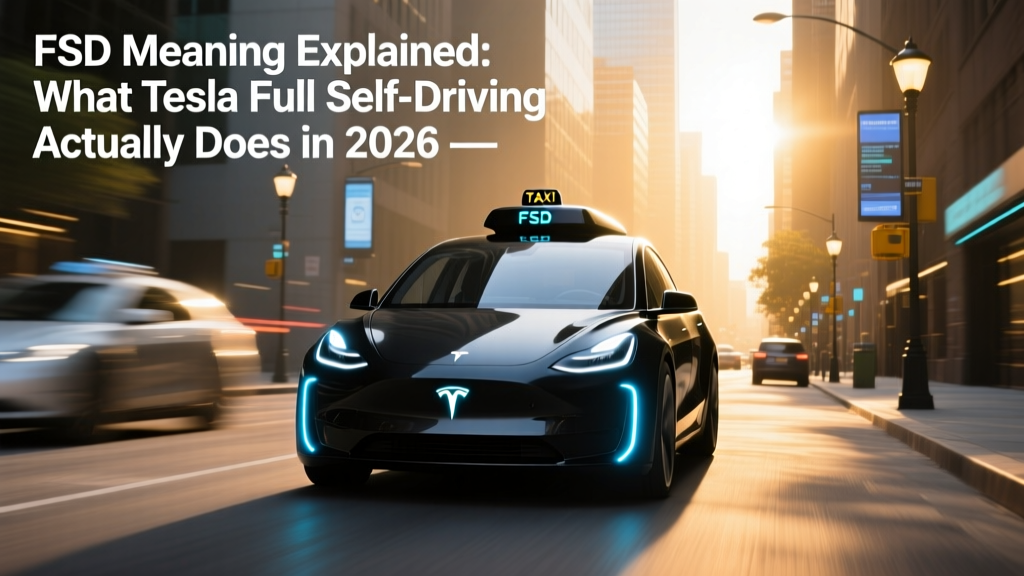
If you have browsed Tesla's configurator or watched a YouTube demo, you have likely encountered the acronym FSD and wondered what it actually delivers. The FSD meaning is both simpler and more nuanced than the name implies: it is an advanced Level 2 driver-assistance suite that handles steering, acceleration, braking, and navigation on highways and city streets — but it still requires your full attention at all times.
This guide unpacks what Tesla Full Self-Driving (Supervised) does in 2026, how its hardware and neural-network software work, what it costs, and where it falls short compared to competing systems from GM, Ford, and Hyundai. If you are deciding whether to add FSD to your next Tesla order or subscribe monthly, the numbers and real-world caveats below will help you make that call.
What FSD Means: Feature Definition and How It Works
FSD stands for Full Self-Driving, Tesla's premium driver-assistance package that sits above the standard Autopilot system included with every new Tesla. As of 2026, Tesla officially labels the consumer product FSD (Supervised) — a deliberate naming update that reflects the system's actual operational requirement: a licensed driver must remain in the driver's seat, monitor the road, and be ready to take over instantly.
Technically, FSD relies on Tesla's Hardware 4 (HW4) sensor suite, which includes:
- 8 cameras providing 360-degree vision (forward-facing narrow and wide lenses, repeaters, rear-view)
- 12 ultrasonic sensors (phased out on newer builds in favor of Tesla Vision camera-only perception)
- Onboard neural-network processing via dual custom FSD chips running at ~300 TOPS combined
Unlike competitors that fuse cameras with radar or lidar, Tesla has committed to a camera-only (Tesla Vision) approach since 2022. The system processes real-time video through deep neural networks trained on billions of miles of fleet driving data to identify lanes, traffic signals, pedestrians, obstacles, and road geometry.
FSD (Supervised) Feature Breakdown
| Feature | What It Does | Environment |
|---|---|---|
| Traffic-Aware Cruise Control | Maintains set speed and following distance | Highway and city |
| Autosteer | Centers vehicle in lane, handles curves | Marked highways |
| Auto Lane Change | Executes lane changes when turn signal activated or automatically | Highway |
| Navigate on Autopilot | Takes on/off-ramps, adjusts speed for interchanges | Highway navigation |
| City Streets (FSD) | Handles intersections, traffic lights, stop signs, turns | Urban/suburban roads |
| Smart Summon | Drives to your location in a parking lot via app | Parking lots (private property) |
| Autopark | Parallel or perpendicular self-parking | Parking spaces |
SAE Automation Level: Why FSD Is Not Self-Driving
SAE Level 2 — Driver Assistance, Not Autonomous Driving
Tesla FSD (Supervised) is classified as SAE Level 2 automation per the SAE J3016 standard. This means the system can simultaneously control steering and acceleration/braking, but the human driver must continuously supervise and intervene when the system encounters situations it cannot handle. True "self-driving" — where you can read a book or nap — begins at SAE Level 4, which currently only applies to geofenced commercial services like Waymo and Zoox, not any consumer vehicle you can buy.
Tesla's own Autopilot disclaimer page states: "The currently enabled features require active driver supervision and do not make the vehicle autonomous." This is not legal boilerplate — it is an operational reality. During city-street driving, FSD may hesitate at unprotected left turns, misread temporary construction zones, or fail to yield to emergency vehicles. You are the fallback system.
FSD Cost in 2026: Purchase vs. Subscription
Tesla offers FSD (Supervised) through two payment models:
Tesla FSD Pricing — 2026
| Option | Price | Notes |
|---|---|---|
| One-Time Purchase | $8,000 | Transfers to the vehicle (not the owner); adds to resale value marginally |
| Monthly Subscription | $99/month | Cancel anytime; no long-term commitment; good for trying the feature |
| Standard Autopilot | Included | Traffic-aware cruise + Autosteer on highways; no city-street capability |
The breakeven math: At $99/month, you would need to subscribe for roughly 81 months (6.75 years) to equal the $8,000 outright purchase. If you plan to keep your Tesla for 3–4 years and use FSD regularly, the one-time purchase makes financial sense. If you are unsure whether you will rely on it, the subscription lets you activate FSD for a road trip and cancel when you no longer need it.
One important caveat: FSD purchases are tied to the vehicle, not the owner. If you sell your Tesla, the FSD purchase transfers to the new owner. Tesla has occasionally offered FSD transfer promotions for repeat buyers, but these are limited-time and not guaranteed.
Which Tesla Models and Trims Include FSD?
FSD (Supervised) is available as an add-on across Tesla's entire 2026 lineup:
FSD Availability by Model
| Model | HW4 Equipped | FSD Eligible | Standard Autopilot |
|---|---|---|---|
| Model 3 (Highland/Refresh) | Yes (all trims) | Add-on ($8,000 or $99/mo) | Included |
| Model Y (Juniper) | Yes (all trims) | Add-on ($8,000 or $99/mo) | Included |
| Model S | Yes | Add-on ($8,000 or $99/mo) | Included |
| Model X | Yes | Add-on ($8,000 or $99/mo) | Included |
| Cybertruck | Yes | Add-on ($8,000 or $99/mo) | Included |
No Tesla model ships with FSD as standard equipment. The base Autopilot suite — traffic-aware cruise control and basic Autosteer — is included on every new Tesla. FSD is always an upsell, either at the time of order or activated later via the Tesla app on any HW4-equipped vehicle.
Pre-2019 vehicles with Hardware 2.0 or 2.5 are not eligible for current FSD. Owners of older Teslas with HW3 (introduced April 2019) may need a hardware upgrade to access the latest FSD builds; Tesla has offered free HW3-to-HW4 upgrades for some FSD-purchased vehicles, but confirm eligibility with Tesla directly.
Real-World Capabilities and Limitations
FSD (Supervised) has improved substantially since its 2022 beta launch, but real-world performance varies enormously by scenario. Here is what to expect based on extensive testing and owner reports:
Where FSD Performs Well
- Divided highways with clear lane markings: Smooth lane-keeping, confident on-ramp to off-ramp navigation, reliable speed adjustment for curves and traffic
- Suburban arterial roads: Handles traffic lights, stop signs, and gentle turns with minimal intervention in good weather
- Low-speed urban driving: Generally competent at navigating gridlock, right turns on red, and marked crosswalks
Where FSD Struggles
- Construction zones: Temporary lane shifts, cones, and flaggers frequently confuse the system — expect to take over
- Unprotected left turns: The system may hesitate or abort turns across oncoming traffic, especially at complex intersections
- Heavy rain, snow, or fog: Camera-only perception degrades significantly in low-visibility conditions; FSD may disengage unexpectedly
- Faded or missing lane markings: Rural roads and poorly maintained urban streets can cause wandering or disengagement
- Unusual road geometry: Roundabouts, five-way intersections, and non-standard signage remain edge cases
⚠️ Critical FSD Limitations
FSD (Supervised) does NOT:
- Drive you to a destination without supervision — you must remain alert with hands near the wheel
- Function reliably in heavy rain, snow, or dense fog
- Obey all traffic signals — verify green lights and stop signs yourself
- Detect all pedestrians, cyclists, or debris — especially at night or in high-contrast glare
- Replace an attentive driver — NHTSA has opened multiple investigations into Autopilot/FSD-involved crashes where driver inattention was a factor
Tesla monitors engagement through a cabin camera. Repeated warnings for inattention can result in temporary FSD suspension ("FSD strike" system).
FSD vs. Competing ADAS: How It Compares
Tesla FSD is the most feature-rich consumer Level 2 system, but it is not the only option — and depending on your driving patterns, a competitor may suit you better.
| Feature | Tesla FSD (Supervised) | GM Super Cruise | Ford BlueCruise | Hyundai/Kia HDA2 |
|---|---|---|---|---|
| SAE Level | Level 2 | Level 2 | Level 2 | Level 2 |
| Hands-Free Highway | Yes (with eye monitoring) | Yes (on ~750,000 mi mapped roads) | Yes (on ~130,000 mi pre-mapped roads) | No (hands-on required) |
| City Street Driving | Yes (nationwide) | No | No | No |
| Automatic Lane Change | Yes | Yes | Yes | Yes |
| Sensor Suite | Camera only | Camera + lidar + radar | Camera + radar | Camera + radar |
| Cost | $8,000 or $99/mo | ~$2,200 (included on some trims) | ~$2,100 or $75/mo | Included on higher trims |
| Driver Monitoring | Cabin camera | Infrared eye-tracking camera | Infrared camera | Steering-wheel torque |
Key takeaway: If your priority is hands-free highway cruising on major interstates, GM Super Cruise offers a smoother, more confident experience thanks to lidar-backed precision mapping — and it costs significantly less. FSD's advantage is its city-street capability, which no competitor offers at the consumer level. If you regularly navigate complex urban environments and want the most ambitious ADAS available, FSD is the only option. If you mostly drive highways, Super Cruise or BlueCruise may deliver a more polished experience for less money.
Is FSD Worth It? A Decision Framework
Buy FSD If:
- You drive in varied urban/suburban environments frequently and want the broadest ADAS coverage available
- You plan to keep your Tesla for 5+ years (breakeven on the $8,000 purchase vs. subscription)
- You are comfortable serving as the attentive safety fallback and understand the system's limitations
- You value being on the cutting edge of neural-network driving technology and can tolerate occasional edge-case behavior
Skip FSD If:
- You primarily drive on well-marked highways — standard Autopilot (included) handles this well
- You expect a truly autonomous experience — no consumer vehicle offers this in 2026
- You frequently drive in heavy rain or snow where camera-based systems degrade
- You are budget-conscious and your commute is predictable — save the $8,000 or $99/month
Frequently Asked Questions
What does FSD stand for?
FSD stands for Full Self-Driving. Despite the name, it is a Level 2 driver-assistance system that requires continuous driver supervision. Tesla officially brands it as "FSD (Supervised)" to reflect this requirement.
Is Tesla FSD actually self-driving?
No. Tesla FSD is SAE Level 2, meaning it controls steering and speed simultaneously but requires a fully attentive human driver ready to intervene at any moment. True self-driving (SAE Level 4) is currently limited to geofenced commercial robotaxi services like Waymo, not any consumer vehicle.
How much does Tesla FSD cost in 2026?
FSD costs $8,000 as a one-time purchase or $99 per month as a subscription. Standard Autopilot (highway cruise control and lane centering) is included with every new Tesla at no extra cost.
Can I add FSD to my Tesla after delivery?
Yes. Any Tesla equipped with Hardware 3 or Hardware 4 can have FSD activated remotely via the Tesla app after purchase. You can subscribe monthly or buy outright at any time.
Does FSD work in bad weather?
FSD performance degrades in heavy rain, snow, and fog because it relies solely on cameras. In reduced-visibility conditions, the system may issue warnings or disengage entirely. Always be prepared to take full control in adverse weather.
What happens if I don't pay attention while using FSD?
Tesla's cabin camera monitors driver attention. If you repeatedly ignore warnings to keep your eyes on the road, Tesla will issue escalating "strikes" that can temporarily suspend FSD access. Continued misuse can result in longer suspensions.
Does FSD transfer if I sell my Tesla?
Yes. The FSD purchase is tied to the vehicle, not the owner. When you sell the car, FSD transfers to the new owner. This can slightly boost resale value, though the used-market premium for FSD is typically far less than the $8,000 original cost.