Ford and Self-Driving: Separating Marketing From Reality
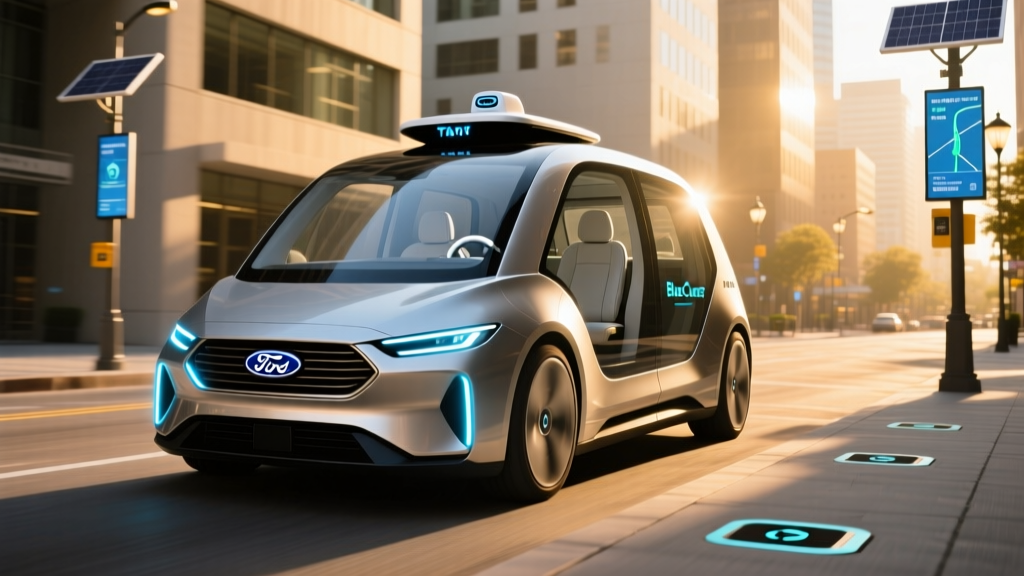
When shoppers search for information to evaluate the automotive manufacturing company Ford on self-driving, they encounter a tangle of press releases, YouTube demos, and branding that blurs the line between driver-assist and true autonomy. Ford's consumer-facing system, BlueCruise, is a hands-free highway driving assistant — not a robotaxi. Ford once pursued Level 4 autonomy through its Argo AI partnership, but shut that program down in late 2022 and pivoted to advanced driver-assistance and commercial fleet automation. As of 2026, Ford does not operate a public robotaxi service in any city.
This guide cuts through the noise with exact specifications, SAE level definitions, real safety data, and a clear-eyed assessment of where Ford's self-driving technology stands today — and where it realistically goes from here.
BlueCruise: Ford's Actual Self-Driving Product
BlueCruise is the only "self-driving" technology Ford currently sells to consumers. It launched on the 2021 Ford F-150 Lightning and Mustang Mach-E and has expanded across the lineup. Here is what it actually does and what it costs.
How BlueCruise Works
BlueCruise combines adaptive cruise control, lane-centering, and a driver-facing infrared camera that monitors eye gaze. On pre-mapped divided highways (Ford calls these "Hands-Free Blue Zones"), the system allows the driver to remove hands from the steering wheel. The camera ensures your eyes remain on the road — look away for more than a few seconds and the system escalates warnings, eventually bringing the vehicle to a controlled stop.
As of the 2026 model year, BlueCruise 1.4 (the latest iteration) adds:
- Lane Change Assist: The vehicle can initiate and complete lane changes on highways with driver confirmation via turn signal stalk.
- Predictive Speed Assist: Automatically adjusts speed for upcoming curves based on map data.
- Hands-Free Zone Coverage: Over 130,000 miles of divided highways across the U.S. and Canada, up from ~100,000 miles at launch.
BlueCruise Pricing and Availability
| Item | Cost | Notes |
|---|---|---|
| BlueCruise (hardware + 1-year subscription) | Included on select trims (Lariat, Platinum, GT) | Varies by model; standard on Mach-E GT, F-150 Lightning Platinum |
| Annual subscription renewal | $75/year or $210 for 3 years | Required after initial period expires |
| BlueCruise 1.4 upgrade (2026) | OTA update; no additional charge for equipped vehicles | Requires compatible hardware (2023+ models) |
| BlueCruise on base trims | Not available | Hardware not included on Select/base trims |
The subscription model has drawn criticism from owners who expected a one-time purchase. Ford's position is that ongoing map updates, cloud connectivity, and software improvements justify the recurring fee. Whether you agree or not, factor this into your total cost of ownership.
SAE Levels Explained: Where Ford Sits on the Autonomy Spectrum
Understanding Ford's self-driving position requires clarity on SAE International's six levels of driving automation. This framework is the industry standard, and conflating levels is the single most common source of consumer confusion.
| SAE Level | Name | Who Drives? | Ford Example | Industry Example |
|---|---|---|---|---|
| Level 0 | No Automation | Human | Base-model F-150 (no ADAS) | — |
| Level 1 | Driver Assistance | Human (system assists one function) | Adaptive cruise OR lane-keeping alone | Most modern cars |
| Level 2 | Partial Automation | Human (system assists steering + speed simultaneously) | BlueCruise, Co-Pilot360 Assist+ | Tesla Autopilot, GM Super Cruise |
| Level 3 | Conditional Automation | System (human must take over on request) | Not offered by Ford | Mercedes Drive Pilot (limited markets) |
| Level 4 | High Automation | System (no human needed in defined conditions) | Not offered by Ford | Waymo One, Zoox |
| Level 5 | Full Automation | System (all conditions, everywhere) | Does not exist anywhere | Theoretical |
Ford's decision to remain at Level 2 for consumer vehicles is deliberate. Level 3 shifts legal liability to the automaker when the system is engaged, and Level 4 requires massive sensor suites, HD mapping, and geofencing that make consumer deployment economically impractical at scale. Ford chose to invest in making Level 2 excellent rather than chasing Level 4 without a viable business model.
The Argo AI Chapter: Why Ford Exited Robotaxis
From 2017 to 2022, Ford invested heavily in Level 4 autonomy through Argo AI, a Pittsburgh-based self-driving startup co-funded with Volkswagen. Argo operated test fleets of Ford Fusion Hybrid and later Ford Escape Hybrid vehicles equipped with lidar, radar, and camera arrays in six cities: Pittsburgh, Miami, Washington D.C., Austin, Palo Alto, and Detroit.
In October 2022, Ford and VW jointly shut down Argo AI. Ford CEO Jim Farley stated that "profitable, fully autonomous vehicles at scale are a long way off" and that the company would redirect investment toward Level 2+ and Level 3 driver-assist technologies. Ford took a $2.7 billion write-down on the Argo investment.
The strategic pivot was pragmatic. Argo's Level 4 technology required:
- Sensor costs: Each vehicle carried $100,000+ in lidar, radar, and compute hardware.
- HD mapping: Every operational zone required centimeter-accurate 3D maps, updated constantly.
- Safety drivers: Despite "driverless" goals, Argo still employed remote operators and in-car safety drivers during testing.
- No revenue path: Six years and billions in spending produced no commercial service generating meaningful income.
Ford redirected those resources into BlueCruise development and Latitude AI, a subsidiary formed from former Argo engineers focused on Level 2+ and Level 3 highway automation for consumer vehicles.
Ford's Technology Stack: Camera, Radar, and Lidar
BlueCruise uses a sensor fusion approach — multiple sensor types working together — rather than the camera-only strategy Tesla pursues with FSD. Here is the hardware stack on a 2026 model-year vehicle equipped with BlueCruise 1.4:
| Sensor Type | Quantity | Function | Range |
|---|---|---|---|
| Forward-facing camera | 1 | Lane detection, traffic sign recognition, vehicle/pedestrian detection | ~200 meters |
| Surround-view cameras | 4 | 360° situational awareness, lane-change assist | ~50 meters each |
| Driver-monitoring IR camera | 1 (mounted on instrument cluster) | Eye-gaze tracking, attention verification | Cabin only |
| Forward radar (long-range) | 1 | Adaptive cruise, emergency braking, vehicle distance | ~200 meters |
| Corner radars (short/mid-range) | 4 | Blind-spot detection, cross-traffic alert, lane-change safety | ~60 meters |
| Ultrasonic sensors | 12 | Low-speed parking assist, near-field obstacle detection | ~5 meters |
Notably, BlueCruise does not use lidar. The Argo AI robotaxi program relied on Velodyne and custom lidar units, but Ford determined that lidar's cost and packaging requirements were unnecessary for a Level 2 system where the human driver serves as the ultimate redundancy layer. This is a key distinction from Waymo's Level 4 stack, which requires lidar as a primary sensor because there is no human fallback.
Ford's approach prioritizes reliability in common highway scenarios over the extreme edge-case handling that Level 4 demands. The trade-off is that BlueCruise simply disengages and hands control back to the driver when conditions exceed its capabilities — which is the correct behavior for Level 2.
Safety Record: What the Data Shows
Ford has published limited but concrete data on BlueCruise safety performance. As of early 2026:
- Cumulative hands-free miles driven: Over 80 million miles (Ford-reported, as of Q4 2025)
- Hands-free zone coverage: 130,000+ miles of divided highways (U.S. and Canada)
- Driver disengagement rate: Ford has not published a standardized interventions-per-1,000-miles metric comparable to California DMV reports filed by Waymo and Cruise
- NHTSA investigations: As of 2026, NHTSA has not opened a standalone defect investigation into BlueCruise specifically, though Ford's Co-Pilot360 systems are included in broader ADAS data-collection orders
Source: NHTSA, Ford Motor Company press releases
For context, Waymo's Level 4 robotaxi fleet has logged over 30 million fully driverless miles and publishes detailed safety reports peer-reviewed by third parties. Ford's 80 million BlueCruise miles are supervised Level 2 miles — the driver is always present and ultimately responsible. These are not directly comparable datasets, and it is important not to conflate them.
The Insurance Institute for Highway Safety (IIHS) has noted that partial-automation systems like BlueCruise can create complacency risk: drivers over-trust the system and respond more slowly when intervention is needed. Ford's driver-monitoring camera is specifically designed to mitigate this, and early data suggests it is more effective than steering-wheel torque sensors (used by some competitors) at maintaining driver engagement.
Where BlueCruise Works — and Where It Doesn't
BlueCruise is not a go-anywhere system. It operates only in Ford-mapped "Hands-Free Blue Zones," which are limited to divided highways with physical barriers or medians. Here is a realistic picture of coverage and limitations.
Current Operational Coverage
- Interstate highways: Most major interstates (I-95, I-5, I-80, I-10, I-70, etc.) are mapped, but not every mile. Rural stretches and recently constructed segments may be excluded.
- U.S. coverage: All 48 contiguous states have at least partial Blue Zone coverage; Alaska and Hawaii have minimal or no coverage.
- Canada: Major trans-Canada highway corridors are included.
- Non-highway roads: BlueCruise hands-free mode does not activate on surface streets, city roads, or undivided two-lane highways, even if the vehicle is otherwise capable of adaptive cruise and lane-keeping on those roads.
Current Limitations
- Weather: Heavy rain, snow, fog, or ice can obscure cameras and radar, causing the system to disengage. BlueCruise will alert the driver and require hands-on-wheel operation.
- Construction zones: Temporary lane shifts, missing lane markings, and altered traffic patterns frequently exceed the system's capabilities. Ford's map data may not reflect real-time construction.
- Night driving: While functional at night, camera performance degrades in low-light conditions, and the system may disengage more frequently on poorly lit highway stretches.
- Complex interchanges: Multi-lane merges, collector-distributor roads, and toll plazas often require manual driving even within Blue Zones.
- No autonomous parking or summon: BlueCruise does not include self-parking or remote vehicle summon capabilities comparable to Tesla's Smart Summon.
- Geofence rigidity: The system will not engage outside pre-mapped zones, even if the road appears identical to a mapped highway. Map updates are pushed OTA but are not real-time.
BlueCruise vs. Competitors: Level 2 Showdown
Ford does not compete in the Level 4 robotaxi space, but BlueCruise faces direct competition from other Level 2+ systems. Here is how it stacks up against the most relevant alternatives in 2026:
| Feature | Ford BlueCruise 1.4 | GM Super Cruise | Tesla Autopilot / FSD Supervised | Hyundai/Kia HDA2 |
|---|---|---|---|---|
| SAE Level | Level 2 | Level 2 | Level 2 | Level 2 |
| Hands-free highway | Yes (Blue Zones) | Yes (mapped highways) | No (hands-on required) | No (hands-on required) |
| Eyes-off allowed | No (IR camera monitors gaze) | No (camera monitors gaze) | No | No |
| Auto lane change | Yes (driver confirms via stalk) | Yes (auto + confirm) | Yes (FSD only) | No |
| Driver monitoring | IR camera | IR camera | Steering wheel torque + camera | Steering wheel torque |
| Surface street operation | No (hands-free mode) | No (hands-free mode) | Yes (FSD, supervised) | No |
| Subscription cost | $75/year after Year 1 | $25/month or included 3 yrs | $199/month (FSD) or $8,000 upfront | No subscription |
| Mapped highway coverage | 130,000+ miles | 750,000+ miles | N/A (no geofence) | N/A |
GM's Super Cruise offers significantly more mapped highway coverage, while Tesla's FSD operates on any road but requires hands on the wheel and has drawn NHTSA scrutiny for its marketing. Ford's BlueCruise occupies a middle ground: robust hands-free capability on major highways, with stricter geofencing that limits use to well-mapped corridors.
The Robotaxi Question: Will Ford Re-Enter Level 4?
Ford has not announced any plan to launch a Level 4 robotaxi service. The company's public statements through 2026 emphasize:
- Latitude AI: Ford's autonomous driving subsidiary (staffed by former Argo AI engineers) is developing Level 2+ and Level 3 technology for consumer vehicles, not robotaxis.
- Commercial fleet focus: Ford Pro, the company's commercial division, is exploring limited Level 4 applications for controlled environments (warehouse campuses, port logistics) but has not announced a public service.
- Partnership strategy: Ford has not disclosed any new Level 4 partnership since the Argo AI dissolution. Industry speculation about a potential Waymo or Aurora integration remains unconfirmed.
The economics explain Ford's caution. Waymo, backed by Alphabet, has spent an estimated $30+ billion on its Level 4 program and operates only in Phoenix, San Francisco, Los Angeles, and Austin — with safety drivers still present in some markets. Cruise (GM-backed) suspended all operations in late 2023 after a serious pedestrian incident in San Francisco and has only cautiously resumed limited testing. The robotaxi business model remains unproven at scale.
For Ford, which operates on significantly thinner margins than Alphabet, the risk-reward calculation favors selling millions of BlueCruise-equipped vehicles at a $75/year subscription over burning billions on a Level 4 moonshot with no guaranteed payoff.
Frequently Asked Questions
Does Ford have a self-driving car I can buy today?
Ford sells vehicles with BlueCruise, a Level 2 hands-free highway driving system. It is not self-driving — you must remain attentive and ready to take over. BlueCruise is available on the F-150 Lightning, Mustang Mach-E, Explorer, and Lincoln models in select trims. Ford does not sell or operate any Level 4 self-driving vehicle.
How much does BlueCruise cost compared to Uber or Waymo?
BlueCruise is not a ride-hailing service — it is a driver-assist feature in a vehicle you own or lease. The subscription costs $75/year after the initial included period. A Waymo One ride in Phoenix or San Francisco typically costs comparable to Uber/Lyft ($1–$2/mile depending on demand), but Waymo is a point-A-to-B service, not a feature you install in your own car. These are fundamentally different products.
How safe is BlueCruise compared to a human driver?
Ford reports over 80 million cumulative hands-free miles without a publicly attributed fatality in BlueCruise mode. However, comprehensive third-party comparative data (BlueCruise vs. human-only driving) is not yet published by NHTSA or IIHS. The driver-monitoring camera reduces complacency risk compared to torque-sensor-only systems, but Level 2 systems still require active human supervision and can fail in edge cases.
Can BlueCruise drive me door-to-door without me paying attention?
No. BlueCruise operates only on pre-mapped divided highways (Blue Zones), requires your eyes on the road at all times, and disengages for surface streets, construction zones, and adverse weather. It is a highway cruising aid, not a door-to-door autonomous system.
Will Ford ever compete with Waymo in robotaxis?
As of 2026, Ford has announced no Level 4 robotaxi program. The company's Latitude AI subsidiary is developing advanced Level 2+ and Level 3 technology for consumer vehicles. Ford's post-Argo AI strategy prioritizes scalable driver-assist over capital-intensive robotaxi operations. This could change if a viable partnership or technology breakthrough emerges, but no such announcement is on the horizon.
What vehicles come with BlueCruise in 2026?
BlueCruise is available on the Ford F-150 Lightning (Lariat and above), Mustang Mach-E (Premium, GT, California Route 1), Ford Explorer (Limited, Platinum, ST), Ford Expedition (Limited, Platinum), Lincoln Corsair, Lincoln Nautilus, and Lincoln Navigator. Base trims across all models do not include BlueCruise hardware. Always verify trim-level inclusion before purchasing, as packaging changes by model year.