Ford's Autonomous Vehicle Reality Check
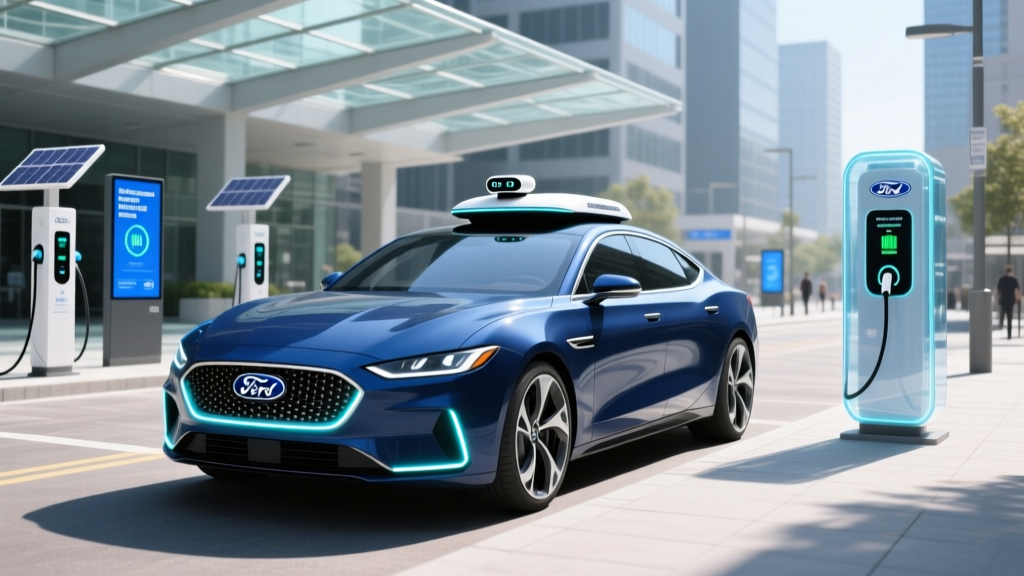
Search for "Ford autonomous vehicle" and you'll find a tangle of press releases, concept renders, and years-old robotaxi promises that never materialized. Here's the unvarnished 2026 truth: Ford does not operate a robotaxi service today, has no announced Level 4 consumer vehicle, and has deliberately pivoted away from the capital-intensive robotaxi race that consumed its Argo AI partnership through 2022. What Ford does sell is BlueCruise — a capable but firmly Level 2 driver-assistance system available on select F-150, Mustang Mach-E, and Lincoln models.
Understanding this distinction isn't semantic hair-splitting. It's the difference between a car that drives itself (it doesn't) and a car that helps you drive on approved highways while you remain legally and physically responsible (it does). Let's map exactly where Ford's autonomous ambitions stand, what BlueCruise actually delivers, and how it compares to the Level 4 robotaxi services you can actually hail today.
SAE Automation Levels: Where BlueCruise Actually Sits
The Society of Automotive Engineers defines six levels of driving automation, and conflating them is the single most common source of buyer confusion in this space. BlueCruise, despite its hands-free marketing, is Level 2 — the same category as Tesla Autopilot, GM Super Cruise, and Nissan ProPILOT. The driver must remain engaged, eyes on the road (verified by an infrared camera), and ready to take over instantly.
| Level | Name | Driver Role | Example (2026) |
|---|---|---|---|
| 0 | No Automation | Full control | Basic cruise control |
| 1 | Driver Assistance | Hands on wheel, full attention | Adaptive cruise, lane-keep |
| 2 | Partial Automation | Hands off (some systems), eyes on, full responsibility | BlueCruise, Super Cruise, FSD Supervised |
| 3 | Conditional Automation | Eyes off in specific conditions, must take over on request | Mercedes Drive Pilot (limited markets) |
| 4 | High Automation | No driver needed in geofenced area | Waymo One, Zoox (commercial robotaxi) |
| 5 | Full Automation | No driver needed anywhere | Does not exist commercially |
BlueCruise in 2026: Specs, Coverage, and Hardware
Ford's BlueCruise has evolved since its 2021 debut. The current iteration, BlueCruise 1.4 (rolled out via over-the-air updates to 2024–2026 model-year vehicles), offers hands-free driving on over 130,000 miles of pre-mapped, divided highways across the US and Canada. It handles lane centering, adaptive cruise, and automated lane changes when the driver confirms via turn signal — but it does not navigate city streets, construction zones, or unmapped roads autonomously.
Hardware Stack
BlueCruise relies on a sensor suite that includes:
- Forward-facing camera and radar (adaptive cruise, lane detection)
- Driver-facing infrared camera (attention monitoring — eyes-on enforcement)
- Ultrasonic sensors (close-range obstacle detection)
- GPS + HD map data (geofenced highway sections only)
Notably absent: lidar. Ford's consumer ADAS stack is camera-and-radar-based, similar to Tesla's vision approach but with radar retained. This is a deliberate cost and complexity trade-off — lidar adds significant per-vehicle expense, which works for fleet robotaxis (Waymo's Jaguar I-PACE vehicles carry hundreds of thousands of dollars in sensors) but not for consumer vehicles priced between $45,000 and $75,000.
BlueCruise Pricing
BlueCruise is not free. For 2026 model-year vehicles, Ford structures access as:
- Complimentary trial: 90 days on new vehicle purchase (varies by trim)
- Annual subscription: ~$75/year
- Monthly subscription: ~$15/month
- Hardware requirement: Must be factory-equipped — cannot be retrofitted to non-BlueCruise vehicles
The Argo AI Shutdown: Why Ford Abandoned the Robotaxi Race
To understand Ford's current position, you have to understand what happened in October 2022. Ford and Volkswagen jointly invested over $3.6 billion in Argo AI, a Pittsburgh-based autonomous vehicle startup developing Level 4 technology for commercial robotaxi deployment. The plan was ambitious: launch driverless ride-hail services in Miami, Austin, and Washington DC using modified Ford Fusion Hybrid test vehicles, eventually scaling to a dedicated robotaxi platform.
It didn't happen. Argo AI shut down, with Ford and VW splitting the remaining assets and engineering talent. Ford CEO Jim Farley was candid about the economics: "We came to the conclusion that the capital required to develop and deploy a Level 4 robotaxi at scale was going to be very significant, and the timeline was going to be longer than we originally thought."
The lesson was industry-wide. Between 2022 and 2025, Cruise (GM's robotaxi arm) suspended operations after a serious pedestrian incident in San Francisco, Motional (Hyundai/Aptiv JV) restructured, and Zoox pivoted to a purpose-built vehicle still in limited testing. Only Waymo — backed by Alphabet's deep pockets — maintained consistent commercial expansion.
Ford's response was strategic: redirect autonomous vehicle R&D toward advanced driver-assistance (Level 2/3) that generates revenue today, rather than burning billions on a Level 4 service with an uncertain regulatory and profitability timeline.
How BlueCruise Compares to Actual Robotaxi Services
If you're researching Ford autonomous vehicles because you want a self-driving ride, here's how BlueCruise stacks up against the Level 4 robotaxi services you can actually use in 2026:
| Attribute | Ford BlueCruise 1.4 | Waymo One | Zoox (Limited) |
|---|---|---|---|
| SAE Level | Level 2 | Level 4 | Level 4 |
| Driver Required? | Yes — eyes on, ready to take over | No | No |
| Where Available | 130,000+ mi US/Canada highways | Phoenix, SF, LA, Austin (expanding) | Limited Las Vegas, SF testing |
| How You Access It | Buy/lease equipped Ford or Lincoln | Hail via Waymo app (like Uber) | Invite-only / employee testing |
| Cost to User | $75/yr subscription + vehicle cost | Per-ride pricing (~UberX comparable) | Not commercially available |
| Sensor Stack | Camera, radar, ultrasonic, IR driver cam | LiDAR, camera, radar (custom suite) | LiDAR, camera, radar (purpose-built vehicle) |
| Operational Domain | Divided highways only | Geofenced urban/suburban zones | Geofenced urban zones |
Safety Data: What the Numbers Actually Show
Safety claims in the autonomous vehicle space are notoriously difficult to compare because manufacturers and operators use different metrics. Here's what's available with reasonable sourcing:
BlueCruise specifics: Ford reports BlueCruise has accumulated over 80 million hands-free miles as of late 2025. The system has not been implicated in any NTSB-investigated fatal collisions. However, the National Highway Traffic Safety Administration (NHTSA) has opened preliminary inquiries into hands-free driving systems across multiple manufacturers, examining whether driver monitoring systems are sufficiently robust to prevent inattention. Ford's infrared driver camera — which tracks eye position and issues escalating alerts before disengaging — is generally regarded as more conservative than camera-only attention monitoring.
Waymo comparison: Waymo's published safety data (covering over 30 million fully driverless miles through 2025) shows a 57% reduction in injury-causing crash involvement compared to human benchmark data, and an 85% reduction in police-reported crashes. This data, while compelling, covers geofenced urban operations in favorable weather — not a direct analog to BlueCruise's highway use case.
Current Limitations: What BlueCruise Cannot Do
Ford is transparent about BlueCruise's operational boundaries, but marketing materials don't always foreground them. Here's what you need to know before relying on the system:
- Geofenced only: BlueCruise activates exclusively on pre-mapped, divided highways. Surface streets, rural two-lane roads, and unmapped highway sections revert to standard adaptive cruise — you must retake the wheel.
- Eyes-on enforcement: The IR camera will disable hands-free mode if you look away from the road for more than a few seconds. You cannot read, use a phone, or nap.
- Construction zones: BlueCruise typically disengages in active construction areas with altered lane markings, requiring full manual control.
- Weather degradation: Heavy rain, fog, snow, or direct sun glare can cause sensor degradation and system disengagement. Ford explicitly states the system is designed for "clear weather conditions."
- No autonomous navigation: Unlike Tesla's FSD Supervised (which attempts point-to-point navigation including city streets), BlueCruise does not navigate exits, interchanges, or surface streets autonomously. It maintains lane and speed on the highway — that's it.
- Lane change confirmation: Automated lane changes require the driver to initiate via turn signal; the system will not change lanes proactively.
Regulatory Landscape: Who Approves What
Autonomous vehicle regulation in the US remains a patchwork. At the federal level, NHTSA sets vehicle safety standards (FMVSS) and investigates crash patterns, but has not established comprehensive regulations for Level 4 deployment. The SAE level definitions provide a framework, but enforcement and operational approval happen at the state level.
For Level 2 systems like BlueCruise, no special state approval is required — they're classified as driver-assistance features, similar to cruise control or lane-keeping assist. The driver retains full legal responsibility.
For Level 4 robotaxis, the landscape is fragmented:
- California: CPUC and DMV jointly regulate; permits required for testing and commercial deployment
- Arizona: Minimal regulation; Waymo launched commercially in Phoenix partly due to favorable regulatory environment
- Texas: Austin and Dallas have become testing grounds with relatively permissive frameworks
- Federal: No comprehensive Level 4 legislation as of 2026; NHTSA maintains authority over vehicle safety standards but not operational deployment
Ford's decision to focus on Level 2 sidesteps this regulatory complexity entirely — BlueCruise works wherever you drive an equipped vehicle on a mapped highway, with no jurisdiction-specific approval needed.
Frequently Asked Questions
Where can I use Ford's autonomous vehicle technology right now?
BlueCruise is available on over 130,000 miles of divided highways across the US and Canada in any Ford or Lincoln vehicle factory-equipped with the system (2021+ model years, varies by trim). It is not available on surface streets or unmapped roads. Ford does not operate a robotaxi service in any city.
How much does BlueCruise cost compared to Uber or Waymo?
BlueCruise is a subscription feature (~$75/year) added to a vehicle you already own or lease — it's not a per-ride service. Waymo One charges per ride, with pricing generally comparable to UberX (typically $0.90–$1.50/mile depending on city and demand). These are fundamentally different products: BlueCruise is a driving aid for your car; Waymo is a replacement for owning a car in specific cities.
Is BlueCruise actually self-driving?
No. BlueCruise is SAE Level 2 — partial automation requiring continuous driver supervision. You must keep your eyes on the road and be ready to take over at any moment. Only Level 4 services like Waymo operate without a human driver, and they are limited to specific geofenced areas in a handful of cities.
Will Ford ever launch a robotaxi service?
Ford has not announced any Level 4 robotaxi plans since shutting down Argo AI in 2022. The company has publicly stated it is focusing autonomous R&D on Level 2/3 driver-assistance features that can be deployed profitably at scale today. If Ford re-enters the Level 4 space, it would likely be through a new partnership or acquisition — but there are no confirmed plans as of 2026.
What's the safest way to use BlueCruise?
Treat it as a fatigue-reduction tool, not a replacement for driving. Keep your eyes on the road (the IR camera will enforce this anyway), stay aware of traffic around you, and be prepared to take over in construction zones, bad weather, or any situation where the system disengages. Review Ford's owner manual guidance on BlueCruise operational limits before relying on the system.
Sources: NHTSA Automated Vehicles Safety, Ford BlueCruise Official Page, Waymo Safety Data