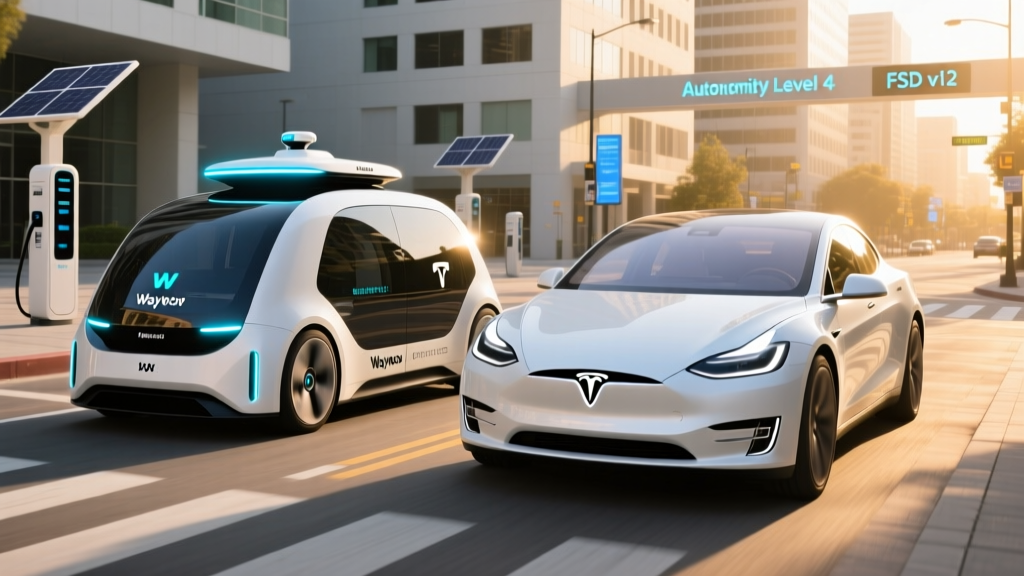
The autonomous vehicle race has split into two fundamentally different philosophies. Waymo operates a commercial driverless ride-hail service you can download and use today. Tesla sells consumer vehicles with a Level 2 driver-assistance system it calls "Full Self-Driving (Supervised)" — and has repeatedly promised, but not yet delivered, a scalable robotaxi network. Understanding the gap between these two approaches requires looking past marketing language and into SAE automation definitions, real-world safety data, sensor architectures, and regulatory approvals.
The Autonomy Gap: SAE Levels That Actually Matter
The single most important distinction in the Waymo vs Tesla debate is the SAE level of automation each system operates at. This is not a semantic detail — it defines who is legally and operationally responsible when the vehicle is in motion.
| SAE Level | Name | Who Drives? | Example |
|---|---|---|---|
| Level 2 | Driver Assistance | Human must supervise at all times | Tesla FSD (Supervised), GM Super Cruise, Ford BlueCruise |
| Level 3 | Conditional Automation | System drives in limited conditions; human must take over on request | Mercedes Drive Pilot (limited markets) |
| Level 4 | High Automation | No human driver needed within geofenced operational domain | Waymo One, Zoox |
| Level 5 | Full Automation | No human driver needed anywhere, ever | Does not exist commercially |
Waymo's robotaxi service, Waymo One, operates at SAE Level 4. There is no human in the driver's seat. The vehicle handles all driving tasks within its approved operational design domain (ODD) — a defined geographic area under specific conditions. If the system encounters a scenario it cannot handle, it executes a minimal-risk maneuver (pulling over safely) without human intervention.
Tesla's FSD (Supervised) is SAE Level 2. Despite the "Full Self-Driving" name, the driver must remain attentive, keep hands near the wheel (or demonstrate engagement via cabin monitoring), and be prepared to take over at any moment. Tesla's own owner's manual states: "You must remain attentive and be prepared to take action at all times." The system does not remove driver responsibility — it augments it.
Tesla has discussed launching a "Robotaxi" service using its vehicles, which would theoretically move toward Level 4 in limited areas. As of 2026, no such service is commercially available to the public. Tesla's Cybercab concept, unveiled in late 2024, remains in pre-production.
Where Can You Actually Use Each Service Today?
This is where the Waymo vs Tesla comparison becomes starkly practical. Waymo operates a live, bookable ride-hail service. Tesla does not operate any ride-hail or robotaxi service whatsoever.
| Factor | Waymo One | Tesla Robotaxi / FSD |
|---|---|---|
| Service Type | Commercial driverless ride-hail | No ride-hail service exists; FSD is a consumer driver-assist feature |
| Live Cities (2026) | Phoenix metro (Chandler, Tempe, Mesa, Scottsdale, parts of Phoenix proper, Gilbert), San Francisco (most of city), Los Angeles (West LA, Santa Monica, Beverly Hills, expanding), Austin (limited rollout) | N/A — FSD usable on any Tesla-equipped vehicle nationwide, but as Level 2 assist only |
| How to Access | Waymo One app (iOS/Android); request ride like Uber/Lyft | Purchase Tesla vehicle + FSD package ($8,000 one-time or $99/mo subscription) |
| Operating Hours | 24/7 in Phoenix and San Francisco; limited hours in newer markets | FSD available whenever the owner drives |
| Geofencing | Strictly geofenced per city; cannot operate outside approved zones | No geofence — works on any mapped road, but driver remains responsible |
Where can I use this robotaxi service right now? Waymo One is available to the general public in the Phoenix metropolitan area (the largest operating zone, covering over 225 square miles), San Francisco, and Los Angeles, with Austin in early limited service. You download the app, enter your destination, and a driverless Jaguar I-PACE or purpose-built Zeekr vehicle arrives. In newer cities, there may be a waitlist or restricted access zones.
Tesla owners with FSD can engage the system on virtually any road in the United States. But this is not a robotaxi — it is advanced cruise control and lane-keeping with automatic navigation assistance. You are the driver.
Safety Records: What the Data Actually Shows
Safety is the most contested and consequential dimension of the Waymo vs Tesla comparison. Both companies publish data, but the metrics, denominators, and contexts differ substantially.
Waymo Safety Data (Level 4, Driverless)
As of early 2026, Waymo has accumulated over 40 million fully driverless miles across its commercial operations. In a NHTSA-reported analysis and Waymo's own published safety case, the company has documented:
- Injury-causing crash rate: Approximately 85% lower than the human benchmark in comparable urban environments (per Waymo's peer-reviewed safety case methodology)
- Police-reported crash rate: Approximately 57% lower than human drivers in the same geographies
- Contactless incidents: Very low rate of curb or stationary-object contact, with most minor incidents occurring during low-speed maneuvering
- NHTSA Standing General Order: Waymo files crash reports as required; the vast majority are minor (other parties striking the Waymo vehicle, typically at low speed)
Tesla FSD Safety Data (Level 2, Driver Supervised)
Tesla publishes a quarterly Vehicle Safety Report. However, it has significant methodological limitations for evaluating FSD specifically:
- Reported metric: ~1 crash per 4–5 million miles driven with Autopilot/FSD engaged
- Human benchmark comparison: ~1 crash per ~670,000 miles (NHTSA national average)
- Critical caveat: Tesla's data combines Autosteer (highway lane-keeping) with FSD (city streets). Most Autopilot miles are highway driving, which is inherently safer than urban driving. The data does not isolate FSD city-street performance.
- NHTSA investigations: Tesla's Autopilot/FSD has been the subject of multiple NHTSA defect investigations related to crashes with emergency vehicles and failure to respond to road conditions. As of 2026, several remain open.
- IIHS research: Partial automation systems have not demonstrated a net safety benefit over attentive manual driving when measured across all scenarios.
How safe are robotaxis? For Level 4 robotaxis (Waymo), the available data suggests a safety performance meaningfully better than human drivers in the same urban environments, though the total mileage base is still small compared to the billions of human-driven miles nationally. For Level 2 systems (Tesla FSD), the safety picture is mixed: highway Autosteer performs well, but city-street FSD has been involved in documented incidents, and the driver-monitoring system is less robust than competitors like GM's Super Cruise.
Technology Stack: Lidar + Radar + Cameras vs. Cameras Only
The sensor architecture behind each system reveals why their capabilities and limitations diverge so sharply.
| Component | Waymo (6th-Gen Driver) | Tesla FSD (Hardware 4 / AI5) |
|---|---|---|
| Cameras | 29+ high-resolution cameras (360° coverage) | 8 cameras (HW4) or optimized camera suite (AI5); vision-only |
| Lidar | 5 custom-built lidars (360° overlapping fields) | None — Tesla removed all lidar and ultrasonic sensors |
| Radar | 6 imaging radars (long and short range) | Removed in HW4 vehicles (previously present in HW3); vision-only |
| HD Mapping | Pre-built centimeter-accurate HD maps for every operating zone | No HD maps; real-time perception only |
| Geofencing | Strictly limited to pre-mapped operational design domains | No geofencing — operates on any road |
| Compute | Custom compute platform in vehicle trunk | HW4 or AI5 chip onboard; neural networks run locally |
Why does this matter? Waymo's lidar-and-mapping approach provides redundant depth perception and a known-environment advantage. The vehicle knows exactly where every curb, lane marking, and traffic signal is before it arrives. Lidar measures distances with centimeter precision regardless of lighting. This makes the system highly reliable within its geofence but fundamentally unable to operate in unmapped areas.
Tesla's vision-only approach is designed for generality — the same hardware works on any road, in any city, without pre-mapping. The trade-off is that camera-only depth estimation is less precise than lidar, particularly in challenging lighting (direct sun glare, nighttime rain, fog). Tesla has addressed this through increasingly sophisticated neural networks trained on billions of miles of fleet data, but the absence of redundant sensors means a single point of failure in perception can cascade.
Pricing: Robotaxi vs. Rideshare vs. Owning an FSD-Equipped Tesla
How much does it cost vs Uber/Lyft? Waymo One pricing is competitive with Uber and Lyft in the same markets, often within $1–3 of a comparable UberX ride, though surge pricing dynamics differ.
| Service | Typical 5-Mile Ride (Phoenix) | Typical 8-Mile Ride (San Francisco) | Surge Pricing | Tipping |
|---|---|---|---|---|
| Waymo One | $12–$18 | $18–$28 | Rare; demand-based pricing exists but less volatile | In-app tipping available; not expected |
| UberX | $11–$20 | $16–$30 | Frequent during peak demand | Expected (15–20%) |
| Lyft | $10–$19 | $15–$28 | Frequent during peak demand | Expected (15–20%) |
| Waymo + tip | $12–$18 | $18–$28 | N/A | Optional |
Waymo does not charge a tip by default, which can make the effective cost lower than a comparable UberX or Lyft when you factor in the customary 15–20% driver tip. However, Waymo's availability is limited — in Phoenix, wait times can reach 15–25 minutes outside core zones, and in San Francisco, service may be unavailable during heavy rain or dense fog.
For Tesla owners, the economics are entirely different. FSD costs $8,000 as a one-time purchase or $99/month. You are buying a driver-assistance feature for a car you already own — not paying per ride. Tesla has suggested a future model where owners could add their vehicles to a "Tesla Network" to earn income, but this does not exist in any form as of 2026.
Regulatory Landscape: Who Approves Robotaxi Operations?
Robotaxi deployment in the United States requires approval at both the state and, in some cases, municipal level. The regulatory framework is fragmented and evolving.
- California (CPUC + DMV): The California Public Utilities Commission (CPUC) issues permits for commercial driverless passenger service. The DMV separately issues testing and deployment permits. Waymo holds both. Cruise (GM) had its CPUC permit suspended in October 2023 after a serious incident in San Francisco and has been slowly re-entering markets under tighter oversight.
- Arizona: The most permissive regulatory environment. No specific state permit is required for commercial autonomous ride-hail beyond standard business licensing. Waymo has operated commercially in Phoenix since 2020.
- Texas: Austin has welcomed Waymo with a phased rollout. The state legislature passed AV framework legislation but local coordination is required.
- Federal (NHTSA): NHTSA regulates vehicle safety standards (FMVSS) but does not currently approve or certify autonomous driving systems. It monitors through Standing General Orders requiring crash reporting and can open defect investigations. The NHTSA AV safety page maintains current guidance.
Tesla's FSD operates under a different regulatory paradigm. Because it is a Level 2 system with a human driver responsible at all times, it does not require the same permits as a driverless service. However, NHTSA has opened multiple investigations into Tesla's Autopilot/FSD behavior, including crashes involving stationary emergency vehicles and the adequacy of Tesla's driver-engagement monitoring.
Current Limitations: What Each System Cannot Do
What are the current limitations? Both systems have meaningful constraints that buyers and users should understand.
Waymo Limitations (Level 4 Robotaxi)
- Geofence: Cannot operate outside pre-mapped zones. A destination 200 feet outside the boundary is unreachable.
- Weather: Service is suspended or degraded during heavy rain, fog, or flooding. Light rain is handled, but sensor performance decreases in precipitation.
- Construction zones: Major lane reconfigurations or unmapped construction can cause the vehicle to stop and wait for remote guidance.
- Highway driving: Limited highway operation in Phoenix and Austin; most service is surface-street only.
- Wait times: Outside core demand zones, 15–30 minute waits are common. Fleet size is limited.
- No intercity trips: Airport service is available in Phoenix (PHX) and San Francisco (SFO), but you cannot take a Waymo between cities.
Tesla FSD Limitations (Level 2 Driver Assist)
- Driver required: You must remain fully attentive. This is not a hands-off, eyes-off system despite the "Full Self-Driving" branding.
- Phantom braking: Documented instances of unexpected deceleration on highways, particularly near overpasses or in shadow transitions.
- Unprotected left turns: One of the most challenging scenarios; FSD can be hesitant or make aggressive gap decisions.
- Lane markings: Performance degrades significantly with faded, absent, or contradictory lane markings.
- Inclement weather: Heavy rain, snow, and fog reduce camera effectiveness. The system may disengage and request takeover.
- Regulatory risk: NHTSA investigations could result in recalls, software restrictions, or operational limitations.
Critical distinction: Tesla FSD (Supervised) is not a robotaxi. You cannot fall asleep, read a book, or leave the driver's seat. If Tesla eventually launches a driverless service, it would require separate regulatory approvals, a fundamentally different safety case, and likely additional sensor hardware. No timeline for this has been confirmed.
Decision Framework: Who Should Care About Which?
Use Waymo One if:
- You live in or visit Phoenix, San Francisco, Los Angeles, or Austin and want a genuinely driverless ride
- You want to experience Level 4 autonomy today, commercially, without buying a vehicle
- You value the safety redundancy of lidar + HD maps in a known environment
- You are evaluating whether robotaxis can replace occasional Uber/Lyft rides
Buy a Tesla with FSD if:
- You want a driver-assistance system that works on any road, nationwide, without geofencing
- You primarily drive on well-marked highways and want reduced fatigue on long trips
- You understand you are paying $8,000 (or $99/mo) for a Level 2 assist system, not autonomy
- You accept that "Full Self-Driving" is a product name, not a capability description
Wait if:
- You are expecting a Tesla robotaxi network to generate passive income from your vehicle — this does not exist and has no confirmed timeline
- You believe FSD will reach Level 4 within your ownership cycle — this remains speculative
- You live outside Waymo's service areas and want a true robotaxi experience — availability is expanding but slowly
Frequently Asked Questions
Is Tesla FSD actually self-driving?
No. Tesla FSD (Supervised) is an SAE Level 2 driver-assistance system. The driver must remain attentive and is legally responsible for the vehicle at all times. Tesla's own documentation requires the driver to supervise. Only Waymo-style Level 4 systems operate without a human driver.
Where can I use a Waymo robotaxi right now?
Waymo One is available to the public in the Phoenix metro area (the largest zone, ~225 sq mi), San Francisco, Los Angeles (expanding zones), and Austin (limited). Download the Waymo One app to check service availability at your exact pickup and drop-off locations.
How much does Waymo cost compared to Uber?
Waymo One rides are typically within $1–3 of comparable UberX or Lyft rides in the same market. A key advantage is that tipping is optional, not expected, which can make the effective cost lower. Surge pricing is less volatile than Uber/Lyft but wait times can be longer outside core zones.
Has a Waymo robotaxi ever caused a serious crash?
Waymo has accumulated over 40 million driverless miles with no reported fatalities attributed to the Waymo vehicle being at fault. Minor contact incidents occur, typically involving other parties striking the Waymo vehicle. NHTSA Standing General Order data is publicly available. The safety record, while promising, represents a relatively small mileage sample compared to national human driving data.
Can Tesla's vision-only approach match lidar-based systems?
This is the central technical debate in autonomous driving. Tesla's neural networks have improved dramatically, and the company argues that human-level vision is achievable with cameras alone. However, lidar provides direct, physics-based distance measurement that cameras must infer. In edge cases (direct sun glare, featureless walls, unusual objects), lidar's redundancy provides a measurable advantage. Tesla's approach offers scalability (no pre-mapping needed) at the cost of reduced sensor redundancy.
Will Tesla ever launch a real robotaxi service?
Tesla has announced plans for a robotaxi platform (the Cybercab concept) and has discussed a Tesla Network where owners could monetize their vehicles. However, as of 2026, no commercial robotaxi service has launched. Achieving Level 4 autonomy at scale, securing regulatory approvals in each jurisdiction, and establishing fleet operations represent enormous challenges. Timelines remain uncertain.
Who regulates robotaxi services?
Regulation is primarily state-level. California requires CPUC and DMV permits for commercial driverless service. Arizona is more permissive. NHTSA monitors safety at the federal level through crash reporting requirements and defect investigations but does not currently pre-approve AV systems. See NHTSA's AV safety resources for current federal guidance.
The Waymo vs Tesla comparison ultimately reflects two different bets on how autonomy will scale. Waymo bets on depth — redundant sensors, HD maps, and tightly controlled operational domains that deliver genuine driverless rides today, in specific cities, right now. Tesla bets on breadth — a vision-only, no-map approach that works on any road but still requires a human driver, with the promise that neural network improvements will eventually close the gap to full autonomy. For consumers in 2026, the practical reality is straightforward: if you want a robotaxi today, Waymo is the only option. If you want the most advanced consumer driver-assist system that works nationwide, Tesla FSD leads — but you remain the driver.