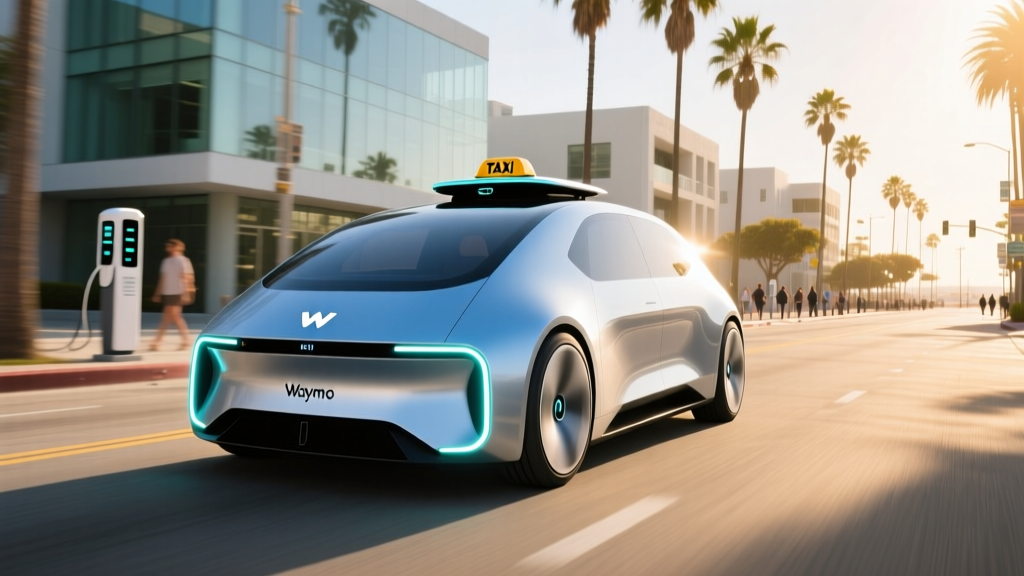
Los Angeles has become one of the most closely watched robotaxi markets in the United States, and the question many Westside residents and visitors are asking is straightforward: can you actually hail driverless taxis in Santa Monica? The short answer is that Waymo — the Alphabet-backed autonomous vehicle company — has been expanding its Waymo One service across greater Los Angeles, and the Westside corridor including Santa Monica has been part of that phased rollout. But availability, pricing, and limitations are more nuanced than a simple yes or no.
This guide breaks down exactly where robotaxis operate in the LA area as of 2026, how the service works, what it costs compared to Uber and Lyft, the safety data behind the technology, and the real-world limitations you should understand before relying on a driverless ride.
Where Can You Use Driverless Taxis in Santa Monica and LA?
Waymo One launched commercially in Los Angeles in 2024 after an extensive testing period that began in 2022. The initial service area covered a defined zone in downtown LA, Hollywood, and West Hollywood, with gradual westward expansion toward the coast. As of early 2026, Waymo's LA geofence has grown to include portions of the Westside, but coverage is not yet universal across every neighborhood in Santa Monica.
Here's a snapshot of current robotaxi availability in the greater Los Angeles area:
| Operator | Service Name | LA Areas Covered | Status | Hours |
|---|---|---|---|---|
| Waymo | Waymo One | Downtown LA, Hollywood, West Hollywood, Beverly Hills, portions of Westside/Santa Monica | Commercial (driverless) | 24/7 in core zones |
| Zoox | Zoox (Amazon) | Limited testing areas; no broad LA commercial service | Testing / limited pilot | Restricted |
| Cruise (GM) | — | LA operations suspended post-2023 incident; no 2026 commercial service | Suspended / restructured | N/A |
Key takeaway: Waymo is currently the only robotaxi operator running a commercial, fully driverless service in the Los Angeles area. If you're searching for driverless taxis in Santa Monica, Waymo One is your option — but check the app for your exact pickup and dropoff addresses, as the geofence boundary can exclude certain streets or zones on the periphery.
SAE Automation Levels: Why Robotaxis Are Not the Same as Autopilot
Before going further, it's essential to distinguish between consumer driver-assist systems and actual robotaxi services. This is one of the most common points of confusion in the EV and autonomous vehicle space.
| SAE Level | Name | Who Drives | Examples |
|---|---|---|---|
| Level 0 | No Automation | Human | Basic cruise control |
| Level 1 | Driver Assistance | Human (one feature assisted) | Adaptive cruise OR lane-keeping |
| Level 2 | Partial Automation | Human (must supervise constantly) | Tesla Autopilot, FSD Supervised, BlueCruise, Super Cruise |
| Level 3 | Conditional Automation | System (in limited conditions; human on standby) | Mercedes DRIVE PILOT (approved in select states, low-speed highway) |
| Level 4 | High Automation | System (within operational design domain; no human needed) | Waymo One, Zoox (in geofenced areas) |
| Level 5 | Full Automation | System (everywhere, all conditions) | Does not exist commercially |
How to Use Waymo One in LA: App, Pricing, and What to Expect
Using Waymo One is similar to calling an Uber or Lyft — with a few key differences that reflect the driverless model.
Step-by-Step: Hailing Your First Robotaxi
- Download the Waymo One app (iOS or Android) and create an account.
- Enter your pickup and dropoff locations. The app will confirm whether both addresses fall within the active service area. If either is outside the geofence, you'll get a notification — you cannot override this.
- Confirm your ride. Pricing is displayed upfront before you confirm, similar to Uber's upfront pricing model.
- Walk to the pickup point. Waymo vehicles pull to the curb, and you unlock the car via the app. The vehicle will not move until all doors are closed and seatbelts are fastened.
- Ride. There is a screen in the back seat showing your route, ETA, and a visualization of what the vehicle's sensors are detecting. You can adjust climate controls and select music.
- Arrive and exit. The vehicle waits until you confirm you're done, then drives off to its next ride or a staging area.
Pricing: Waymo One vs. Uber and Lyft in LA
Robotaxi pricing has been a moving target as Waymo scales operations. In early 2026, Waymo One pricing in Los Angeles is broadly competitive with UberX and Lyft standard rides, though not always cheaper.
| Service | Base Fare | Per-Mile Rate | Per-Minute Rate | Estimated 5-Mile Ride | Surge/Dynamic Pricing |
|---|---|---|---|---|---|
| Waymo One | ~$3.50 | ~$1.25 | ~$0.35 | $12–$16 | None (fixed upfront) |
| UberX | ~$2.50 | ~$1.10 | ~$0.30 | $10–$22 | Yes (can spike 1.5–3x) |
| Lyft Standard | ~$2.50 | ~$1.05 | ~$0.28 | $10–$20 | Yes (Prime Time surges) |
Waymo also offers Waymo One membership tiers and promotional credits for new riders, which can reduce effective cost per ride. Check the app for current offers in your area.
The Technology Stack: How Waymo's 6th-Generation Vehicles See the Road
Waymo's current fleet in Los Angeles uses its 6th-generation Driver system, primarily deployed on the Zeekr RT (a purpose-built electric vehicle from Geely) and the Jaguar I-PACE. The sensor suite is markedly different from camera-only approaches like Tesla's FSD.
- LiDAR: Multiple solid-state and spinning LiDAR units providing 360° 3D point-cloud mapping up to 500+ meters. LiDAR is the core sensor — it works in darkness, direct sunlight, and most weather conditions.
- Cameras: High-resolution cameras (upgraded from 5th-gen) for color information, traffic light state detection, sign reading, and object classification.
- Radar: Imaging radar units for velocity detection of moving objects, redundancy in adverse conditions.
- Audio sensors: External microphones that can detect emergency vehicle sirens and adjust behavior accordingly.
- Computing: Custom-designed Waymo compute platform processing sensor fusion in real-time.
vs. Camera-Only (Tesla FSD): Tesla relies on a vision-only stack (cameras + neural networks, no LiDAR or radar). Waymo's multi-sensor approach provides hardware redundancy — if one sensor type is degraded (e.g., camera glare from sun), LiDAR and radar continue to function. This redundancy is a key reason regulators have approved Waymo for driverless commercial service while camera-only systems remain at SAE Level 2.
Geofencing: The Invisible Boundary
Waymo's Level 4 autonomy is constrained to a high-definition mapped area. The company pre-maps every lane, curb, intersection, and traffic signal within the service zone. If you request a ride that crosses outside this geofence, the app simply won't allow it. This is not a limitation the vehicle can overcome on the fly — it's a deliberate safety and regulatory constraint.
Safety Data: What the Numbers Actually Show
Safety is the most scrutinized aspect of robotaxi operations, and rightly so. Waymo has published safety performance data and has been the subject of independent analyses. Here's what we know from available data as of early 2026:
- Total autonomous miles driven (driverless): Over 10 million fully driverless miles across Phoenix, San Francisco, and Los Angeles combined (Waymo Safety Report).
- Injury-causing crash rate: Waymo's driverless vehicles have shown an approximately 85% reduction in injury-causing crash rate compared to human-driven benchmarks in the same operating areas, per Waymo's published analysis using insurance claim data methodology.
- Contact rate: Waymo reported a roughly 57% reduction in any-contact crash rate versus human baselines.
- NHTSA Standing General Order: All Level 4 operators must report crashes to NHTSA under the Standing General Order. Waymo's reported incidents have been predominantly low-speed, minor-contact events (e.g., being rear-ended at stoplights by human-driven vehicles).
- No passenger fatalities have been reported in Waymo's commercial driverless operations as of early 2026.
For context, the Insurance Institute for Highway Safety (IIHS) and NHTSA data show that human drivers in the US experience roughly 1.14 fatalities per 100 million vehicle miles traveled. Waymo's 10+ million driverless miles without a passenger fatality is a meaningful data point, though the sample size is still far smaller than the billions of human-driven miles accumulated annually.
The honest caveat: Waymo operates in geofenced, predominantly urban environments at moderate speeds (mostly under 45 mph). This is a fundamentally different risk profile from highway driving at 70+ mph or rural roads. The safety data is strong for the operational design domain, but it should not be extrapolated to all driving scenarios.
Regulatory Landscape: Who Approves Robotaxi Operations?
Robotaxi operations in California are governed by a layered regulatory framework:
- California DMV: Issues autonomous vehicle testing permits and deployment permits. Waymo holds a deployment permit allowing commercial driverless operations. (California DMV)
- California Public Utilities Commission (CPUC): Regulates commercial passenger service. Waymo received CPUC approval for its commercial ride-hailing service in LA and San Francisco.
- NHTSA (Federal): Sets vehicle safety standards and requires crash reporting under the Standing General Order. Does not currently have a comprehensive federal framework for autonomous vehicle deployment — most regulation remains state-level.
- Local municipalities: Cities like Santa Monica and Los Angeles can influence operations through local traffic regulations, curb management policies, and public comment processes, though the CPUC and DMV hold primary authority.
This patchwork means that a robotaxi can be legal in one city but not the next, even within the same metro area. It's also why the geofence exists — Waymo must demonstrate operational safety to regulators for each specific zone.
Current Limitations: What Driverless Taxis Cannot Do
Understanding what robotaxis can't do is just as important as knowing what they can. Here are the real-world limitations as of 2026:
- Weather constraints: Heavy rain, fog, or flooding can cause Waymo to restrict service or pause operations in affected areas. LA's climate is generally favorable, but atmospheric river events or dense coastal fog can trigger service interruptions.
- Geofence boundaries: If your destination is outside the mapped service area, the ride cannot be completed. This means some trips from Santa Monica to, say, Malibu or deep into the Valley may not be possible.
- Construction zones: Unmapped road changes, temporary lane closures, and construction detours can cause the vehicle to pull over safely and request remote assistance. Expect occasional delays.
- Pickup/dropoff precision: Waymo pulls to designated or safe curbside spots, but it won't pull into a private driveway, parking garage, or alley. You may need to walk a short distance.
- No highway freeway driving (limited): Waymo's LA operations include some freeway segments, but the system is primarily optimized for surface streets. Long freeway trips may route through non-freeway paths or fall outside the geofence.
- Pets and special cargo: Service animals are accommodated, but policies on pets, large luggage, or unusual cargo may be restrictive compared to a human driver who can exercise discretion.
- Edge cases: Unusual scenarios — a police officer directing traffic with hand signals, an accident blocking all lanes, a parade route — can cause the vehicle to stop and await remote guidance. This is a safety feature, not a failure, but it can add time to your trip.
Is This Truly Self-Driving? The Honest Answer
Yes — within its operational design domain, Waymo One is genuinely driverless. There is no human in the vehicle, no safety driver, no one ready to grab the wheel. The car navigates traffic, handles intersections, responds to pedestrians, merges, and parks itself. This is SAE Level 4 autonomy in a commercial deployment.
But "self-driving" does not mean "capable of driving anywhere in any condition." The geofence, the pre-mapped routes, the weather limitations, and the remote-assistance fallback all define the boundaries of what Level 4 currently means. Level 5 — a car that can drive anywhere a human can, in any condition, without a map — remains a research goal, not a commercial reality.
If you've been conflating Tesla's Autopilot or FSD (Supervised) with what Waymo does, that's a common mistake. Tesla's system is Level 2: the driver is legally and practically responsible for the vehicle at all times. Waymo's Level 4 system assumes full driving responsibility within its zone — and is regulated accordingly.
Frequently Asked Questions
Can I get a driverless taxi from LAX to Santa Monica?
As of early 2026, Waymo has been expanding toward LAX service, but airport pickup availability depends on specific agreements with Los Angeles World Airports. Check the Waymo One app for real-time availability at LAX terminals. If LAX is not yet in the geofence, you'll need an alternative for that leg.
How much does a Waymo ride from Hollywood to Santa Monica cost?
A typical Hollywood-to-Santa-Monica ride (roughly 15 miles) on Waymo One generally costs between $22 and $32, depending on time of day and exact routing. This is typically comparable to a non-surged UberX, and can be significantly cheaper than Uber or Lyft during peak surge periods.
What happens if the Waymo vehicle encounters a problem mid-ride?
The vehicle is designed to execute a "minimal risk condition" — it will safely pull to the side of the road, activate hazard lights, and connect you with Waymo's remote support team via the in-car screen. You can also contact support through the app at any time. The vehicle will not continue driving if it detects a system fault.
Are Waymo vehicles electric?
Yes. Waymo's current LA fleet primarily uses the all-electric Jaguar I-PACE and the Zeekr RT. The Jaguar I-PACE has an EPA-estimated range of 234 miles with a 90 kWh battery pack, though Waymo manages charging operations behind the scenes — you'll never need to worry about the vehicle's charge level as a rider.
Is Waymo available 24/7 in Santa Monica?
Waymo One operates 24/7 in its core service zones. However, late-night availability in the outer edges of the geofence (including some Santa Monica areas) may be limited by vehicle supply. Expect shorter wait times during daytime and evening hours in high-demand corridors.
How do driverless taxis in Santa Monica compare to those in San Francisco?
San Francisco was Waymo's first major urban deployment and has a more mature, larger geofence. LA's service area is still expanding. The technology and pricing model are the same, but SF riders generally have broader coverage and shorter wait times due to fleet maturity. LA's coverage is expected to continue growing through 2026 and beyond.