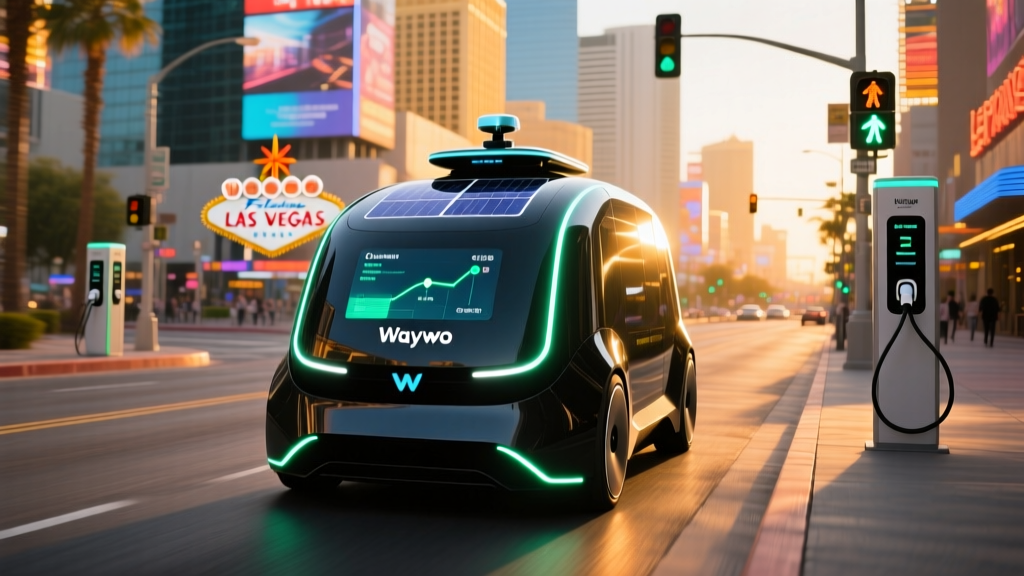
If you've visited Las Vegas in the past year, you've likely seen them: white Jaguar I-PACE SUVs gliding down the Strip with no one behind the wheel, spinning rooftop lidar arrays scanning every direction. Waymo's driverless taxi service in Vegas has become one of the most visible demonstrations of Level 4 autonomous driving in the United States. But how does it actually work, what does it cost, and how safe is it really?
This guide breaks down the current state of robotaxi service in Las Vegas — where you can ride, what to expect, and the hard data behind the technology.
What Level of Autonomy Is a Vegas Driverless Taxi?
Before hopping in, it's essential to understand what "driverless" actually means in regulatory terms. Waymo's Las Vegas operation is a SAE Level 4 autonomous service. That distinction matters enormously.
SAE Automation Levels: Where Robotaxis Sit
| Level | Name | Driver Required? | Example |
|---|---|---|---|
| Level 2 | Partial Automation | Yes — full attention | Tesla Autopilot, GM Super Cruise, Ford BlueCruise |
| Level 3 | Conditional Automation | Yes — can disengage briefly in specific conditions | Mercedes DRIVE PILOT (limited markets) |
| Level 4 | High Automation | No — within operational design domain | Waymo One (Vegas, Phoenix, SF, LA) |
| Level 5 | Full Automation | No — anywhere, any condition | Does not exist commercially |
Source: SAE International J3016
Level 4 means the vehicle handles all driving tasks — steering, braking, navigation, hazard response — without any human intervention, but only within a defined operational design domain (ODD). In Vegas, that ODD is a geofenced area covering key corridors. If conditions fall outside that domain (e.g., an unmapped construction zone or extreme weather), the vehicle is designed to pull over safely rather than hand control to a passenger.
This is fundamentally different from Tesla's FSD (Supervised), which remains a Level 2 system requiring constant driver attention despite its marketing name.
Where Can You Use a Driverless Taxi in Vegas Right Now?
Waymo launched its Las Vegas service area in phases, beginning with a limited employee-only testing period before opening to the public. As of early 2026, the operational geofence covers the following zones:
Waymo One Las Vegas: Current Service Area
| Zone | Key Destinations | Status |
|---|---|---|
| Las Vegas Strip Corridor | Major resorts from Mandalay Bay to The Strat | Live |
| Downtown / Fremont | Fremont Street Experience, Arts District | Live |
| Harry Reid Airport (LAS) | Terminal pickups and drop-offs | Live |
| Convention Center District | LVCC, Venetian Expo | Live |
| Summerlin (partial) | Select residential/commercial areas | Limited |
The geofence does not cover the entire metro area. Suburbs like Henderson, North Las Vegas, and Spring Valley remain outside the service boundary. You also cannot hail a Waymo to Red Rock Canyon or Mount Charleston — these are outside the ODD.
Competing robotaxi services have had a more turbulent presence in Vegas. Cruise (backed by GM) previously operated test vehicles in the city but suspended operations following a serious incident in San Francisco in late 2023 and has been slowly re-entering markets with safety drivers before pursuing driverless service again. Zoox (Amazon's autonomous vehicle division) has tested its purpose-built shuttle vehicle in Vegas but, as of this writing, does not offer a public ride-hail service comparable to Waymo One.
How to Hail a Driverless Taxi and What It Costs
Riding in a Waymo in Vegas works almost identically to Uber or Lyft:
- Download the Waymo One app (iOS/Android) and create an account.
- Enter your pickup and destination — both must fall within the geofence.
- Confirm your ride — the app shows the vehicle type, license plate, and ETA.
- Unlock via app — when the vehicle arrives, tap "Start Ride" to unlock the doors.
- Buckle up and go — screens inside show the route, and you can control music and climate.
There's no human driver to interact with. If you need assistance, an in-app support button connects you to a remote Waymo rider support agent via video or audio.
Pricing: Waymo vs. Uber vs. Lyft in Las Vegas
| Route (approx.) | Waymo One | UberX | Lyft |
|---|---|---|---|
| LAS Airport → Bellagio (~4 mi) | $18–$24 | $16–$28 | $15–$26 |
| Mandalay Bay → Fremont St (~7 mi) | $25–$34 | $22–$38 | $20–$35 |
| Venetian → LVCC (~1.5 mi) | $10–$14 | $9–$16 | $9–$15 |
Prices fluctuate with demand. Waymo does not currently implement surge pricing in the same way Uber/Lyft do, which can make it cheaper during peak convention or event times. Tips are not expected (there's no driver), though the app offers an optional tip feature.
Overall, Waymo pricing is competitive with standard rideshare — sometimes slightly cheaper during high-demand windows, sometimes marginally more on low-demand short trips. The novelty factor and consistency of experience are the primary differentiators for most riders.
The Technology Stack: How a Waymo Sees Vegas
Waymo's current-generation vehicle in Las Vegas is the Jaguar I-PACE equipped with the Waymo Driver sensor suite (now in its 6th generation). This is not a camera-only system — it's a multi-modal perception stack designed for redundancy.
Waymo Driver Sensor Suite (6th Gen)
| Sensor Type | Count | Purpose |
|---|---|---|
| Lidar (roof-mounted + peripheral) | 5 units | 360° 3D mapping, object detection to 500m+, works in darkness |
| Cameras (high-res, multi-focal) | 29 units | Traffic light state, sign reading, lane detection, pedestrian behavior |
| External audio microphones | Multiple | Detect emergency vehicle sirens, honking |
| IMU + GPS + HD Maps | Integrated | Centimeter-level localization, route planning |
The 6th-generation hardware improved significantly on the 5th gen in two areas critical to Vegas: thermal resilience (the desert heat previously stressed sensor cooling systems) and close-range resolution (better detection of pedestrians stepping off curbs in dense urban environments like the Strip).
Waymo relies on HD pre-mapped routes — the vehicle doesn't navigate unknown roads. Every lane, curb, traffic signal position, and speed limit within the geofence is mapped to centimeter-level accuracy. The real-time sensor data is then fused with this map to create a live understanding of the environment. This geofencing is both a strength (extremely reliable within the zone) and a limitation (the car literally cannot operate outside it without the map data).
This approach contrasts sharply with Tesla's camera-only, non-HD-map strategy for FSD — a philosophical divide in the autonomous vehicle industry that remains unresolved, though the Level 4 operational record of lidar-heavy stacks like Waymo's is currently more robust for driverless applications.
Safety Data: What the Numbers Actually Show
This is where hype often overtakes reality, so let's look at concrete figures.
Waymo Safety Record: Key Data Points
- Total driverless miles driven (all markets): Over 10 million fully autonomous miles as of late 2025, per NHTSA filings and Waymo's published safety reports.
- At-fault crash rate vs. human benchmark: Waymo's 2024 safety study (peer-reviewed and published with Swiss Re data) showed a 76% reduction in at-fault injury-causing crashes per million miles compared to human drivers in comparable urban environments.
- Contactless at-fault crash rate: 85% fewer property-damage-only at-fault crashes per million miles vs. human benchmarks.
- Las Vegas-specific incidents: Minor low-speed contact incidents have been reported (fender-benders during complex merges), with no serious injuries or fatalities attributed to Waymo driverless operations in Vegas through early 2026.
Sources: Waymo Safety Report, IIHS analysis, NHTSA Standing General Order crash data.
These numbers are significant but come with context. Waymo operates in geofenced, relatively well-mapped urban areas, primarily in fair weather. The comparison to human drivers is valid for similar environments — dense city driving — but doesn't tell us how the system would perform on rural highways or in blizzard conditions (it doesn't operate there).
For perspective, human drivers in the US experience approximately 1.5 fatal crashes and 50+ injury-causing crashes per 100 million miles driven (NHTSA). Waymo's driverless fleet has not recorded a fatal crash across any market. However, the total mileage is still small compared to the trillions of miles humans drive annually, so statistical confidence intervals remain wide for rare events like fatalities.
Regulatory Landscape: Who Approves Robotaxis in Vegas?
Nevada has been one of the most permissive states for autonomous vehicle testing and deployment, with legislation dating back to 2011 (AB 511) that established a framework for AV operations. Here's how the regulatory chain works:
- State level: The Nevada Department of Motor Vehicles (DMV) issues autonomous vehicle testing and deployment permits. Companies must demonstrate insurance coverage (minimum $5 million), submit safety self-assessments, and comply with reporting requirements.
- Federal level: NHTSA oversees vehicle safety standards and crash reporting via the Standing General Order, which requires AV companies to report crashes involving their systems within 24 hours.
- Local level: Clark County and the City of Las Vegas coordinate on road infrastructure, and the Las Vegas Convention and Visitors Authority (LVCVA) has been a partner in facilitating Strip-area operations.
Nevada does not require a safety driver in the vehicle for deployed commercial services — a critical distinction from states like California, where regulatory battles over driverless permits have been contentious (and where Cruise lost its permit in late 2023). This regulatory openness is a major reason Vegas became an early robotaxi market.
Current Limitations: What a Driverless Taxi in Vegas Cannot Do
It's important to be clear-eyed about where the technology falls short. These are not edge cases — they're real constraints that affect your ride:
Known Limitations of Waymo's Vegas Service
- Geofence boundaries: You cannot ride to Henderson, Boulder City, Red Rock Canyon, or any destination outside the mapped zone. The app will simply reject the request.
- Heavy rain and flash floods: Las Vegas monsoon-season downpours (typically July–September) can trigger service suspensions. Lidar and camera performance degrade in heavy precipitation, and the system is designed to pull over safely rather than continue blind.
- Extreme heat events: While the 6th-gen hardware improved thermal management, sustained temperatures above 115°F have occasionally caused precautionary service slowdowns.
- Unmapped construction zones: If a major road closure or construction project appears after the last map update, the vehicle may reroute significantly or stop and request remote assistance, adding time to your trip.
- Pickup/drop-off precision: In crowded areas like the Strip's hotel port-cochères, the vehicle may stop at a designated waypoint rather than pulling directly up to a specific hotel entrance. Expect a short walk in some cases.
- No highway driving to distant destinations: While Waymo vehicles use limited highway segments within the geofence, you cannot take one to Hoover Dam, the Grand Canyon, or even the outer suburbs.
- Accessibility: Current Jaguar I-PACE vehicles require passengers to enter/exit independently. Wheelchair-accessible vehicles are in testing but not yet widely deployed in Vegas.
- Wait times: During peak convention periods (CES, SEMA, March Madness), wait times can stretch to 15–20 minutes as fleet capacity is finite.
The bottom line: a driverless taxi in Vegas is excellent for point-to-point trips within the core tourist and convention corridor. It is not a replacement for a rental car if you plan to explore beyond the city, and it's not yet a universal mobility solution for all passengers.
What's Next for Vegas Robotaxis?
Waymo has signaled plans to expand its Vegas geofence further into Summerlin and potentially toward the UNLV campus area, though specific timelines remain unannounced. The company is also testing its next-generation vehicle platform — a custom-built robotaxi developed with Geely (the Zeekr RT1) — which features a lower floor, sliding doors, and no steering wheel. These vehicles are expected to begin limited deployment in select markets by late 2026, though Vegas timing is unconfirmed.
Zoox's purpose-built bidirectional shuttle continues testing in Vegas and could launch a public service if Amazon greenlights commercial operations. Cruise's timeline for returning to Vegas driverless remains unclear following its restructuring.
For now, Waymo is the only option for a truly driverless ride in Las Vegas — and it's a genuinely functional, if geographically constrained, service.
Frequently Asked Questions
Is a driverless taxi in Vegas truly self-driving, or is there a remote human controlling it?
The vehicle drives itself entirely — there is no remote joystick operator. However, Waymo employs "fleet response" specialists who can be contacted by the vehicle (or by you, via the in-app support button) if the car encounters an ambiguous situation. These specialists can provide guidance or authorize a new route, but they do not steer or brake the vehicle in real time. The driving is autonomous; the support is human.
How much does a Waymo ride cost compared to Uber in Vegas?
Waymo pricing is generally within $1–$5 of a comparable UberX or Lyft ride for the same route. During peak demand (conventions, weekends), Waymo can actually be cheaper because it doesn't apply the same surge multipliers. A typical Strip-to-airport ride runs $18–$24.
Can I take a robotaxi from the Vegas airport?
Yes. Harry Reid International Airport (LAS) is within Waymo's Vegas geofence, and the app supports terminal-area pickups and drop-offs. Follow the in-app instructions for the designated ride-hail pickup zone.
What happens if the robotaxi gets confused or stuck?
The vehicle is programmed to safely pull over, activate hazards, and contact Waymo's remote fleet response team. A specialist can assess the situation and either provide the vehicle with a new path or dispatch roadside assistance. You're never stranded without recourse — the in-app support button connects you to a human within minutes.
Are robotaxis safe at night on the Strip?
Waymo's lidar and camera systems operate identically day and night — in fact, lidar performance is unaffected by darkness. The sensor suite detects pedestrians, cyclists, and obstacles regardless of lighting. Night operations on the Strip are routine and are among the most common use cases.
Is there a person I can talk to if something goes wrong during the ride?
Yes. Every Waymo vehicle has an in-app support button and a physical help button inside the cabin. Pressing either connects you to a live Waymo rider support agent via audio or video. For emergencies, you can also call 911 directly from your phone as you would in any vehicle.
Can I bring luggage in a Waymo robotaxi?
Yes — the Jaguar I-PACE has a rear cargo area and trunk space suitable for standard luggage. There's no driver to help you load, so you'll handle bags yourself. For very large items or group travel with excessive luggage, a standard rideshare SUV option may be more practical.