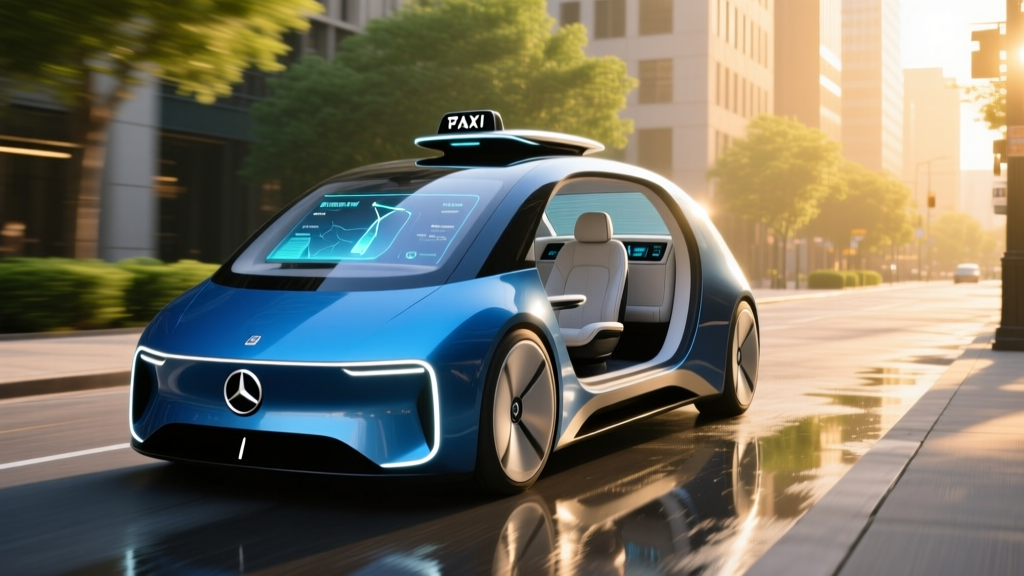
When shoppers search for a "driverless Mercedes," they're usually chasing one of two things: a car that can handle the daily commute without hands on the wheel, or a robotaxi-style experience in their own driveway. The reality in 2026 sits between those fantasies. Mercedes-Benz does not operate a driverless ride-hailing fleet like Waymo. Instead, it sells the first production vehicle in the United States with certified SAE Level 3 conditional automation: the Drive Pilot system, available on the EQS Sedan and S-Class. It's a genuine engineering milestone — and one with strict operational boundaries that buyers need to understand before writing a six-figure check.
Is This Truly Self-Driving or Driver-Assist?
Neither, exactly. Mercedes Drive Pilot occupies the narrow, legally defined lane between Level 2 driver-assist (Tesla Autopilot, GM Super Cruise, Ford BlueCruise) and Level 4 robotaxi (Waymo, Zoox). Under SAE J3016, Level 3 means the car assumes full responsibility for the dynamic driving task — steering, braking, monitoring the environment — but only within a tightly defined Operational Design Domain (ODD). When Drive Pilot is engaged, you can legally take your eyes off the road, watch a video on the MBUX screen, or answer a text. You cannot sleep, leave the driver's seat, or ignore a take-over request.
| Level | Who Drives | Who Monitors | Example |
|---|---|---|---|
| 2 | System (with supervision) | Driver, always | Tesla Autopilot, BlueCruise |
| 3 | System (conditional) | System; driver on standby | Mercedes Drive Pilot |
| 4 | System (geofenced) | System, no driver needed | Waymo One, Zoox |
| 5 | System (anywhere) | System | Does not exist in production |
The legal distinction matters. With Level 2, the driver is liable for any crash. With Drive Pilot engaged at Level 3, Mercedes-Benz has publicly stated it accepts liability for accidents caused by the system — a first among mainstream OEMs selling to US consumers.
Where Can I Use Drive Pilot Right Now?
This is where the "driverless Mercedes" dream hits a hard geofence. As of the 2026 model year, Drive Pilot is approved for use only on pre-mapped, divided highways in specific states, under specific conditions. Nevada issued the first US approval in early 2024; California followed with a deployment permit later that year. Mercedes has since expanded the operational map, but coverage remains a fraction of the interstate system.
| Region | Status (2026) | Approved Corridors |
|---|---|---|
| Nevada | Live | Select I-15, US-95 segments near Las Vegas |
| California | Live (permitted) | Portions of I-5, I-10, I-405, I-805 (mapped segments only) |
| Germany | Live since 2022 | ~8,200 miles of Autobahn (mapped, HD-mapped) |
| Other US states | Not approved | — |
Even within approved states, Drive Pilot will only engage when the vehicle's HD map confirms it is on a qualified stretch, traffic is congested at ≤ 40 mph (60 km/h), weather is clear, lane markings are visible, and a lead vehicle is present to track. Step outside any of those parameters and the system refuses activation or issues a 10-second take-over request.
Which Mercedes Models Offer Drive Pilot and at What Price?
Drive Pilot is not a software download you add to any Mercedes. It requires a dedicated sensor suite and redundant braking/steering hardware installed at the factory.
| Model | Drive Pilot Availability | System Cost | Base MSRP (2026) |
|---|---|---|---|
| EQS 450+ Sedan | Optional (Drive Pilot package) | ~$2,500 add-on | $105,550 |
| EQS 580 4MATIC | Optional | ~$2,500 add-on | $120,550 |
| S 500 4MATIC | Optional | ~$2,500 add-on | $118,300 |
| S 580 4MATIC | Optional | ~$2,500 add-on | $126,900 |
The subscription model used in Germany (roughly €5,000 / year) was replaced in the US with a one-time hardware + activation fee, though Mercedes reserves the right to require future map-data subscriptions. The EQS's EPA range of 345 miles (450+, 107.8 kWh usable NMC battery) is unrelated to Drive Pilot — the autonomy stack draws ~200W continuously, negligible against traction load.
The Technology Stack: Why Drive Pilot Is Not a Camera-Only System
Tesla's FSD (Supervised) relies on cameras and neural networks. Mercedes took the opposite approach, stacking redundant, dissimilar sensors so no single failure can blind the car. The Drive Pilot hardware includes:
- Long-range LiDAR (roof-mounted, Luminar-sourced on early prototypes; production uses Valeo Scala 3) — 3D point cloud out to ~200 m
- Rear-window LiDAR for trailing-vehicle awareness
- Millimeter-wave radar (front and corner units)
- Stereo cameras plus surround-view cameras
- Ultrasonic sensors for close-range object detection
- Redundant RTK-GPS + HD map localized to centimeter-level accuracy
- Road-moisture sensor to detect wet pavement and refuse activation
- Redundant steering and braking actuators so a single failure cannot disable control
This is why Drive Pilot costs ~$2,500 just in add-on hardware and why it cannot be retrofitted to older Mercedes. It's also why the system is so conservative about where and when it engages: every sensor must agree, the map must match the road, and the ODD must be satisfied.
Safety Record: What the Data Actually Shows
- Miles driven under Level 3 engagement (US + EU combined): estimated > 10 million miles (Mercedes has not published a precise public counter; figure derived from fleet testing + customer use since 2022 Germany launch)
- Reported at-fault collisions with Drive Pilot engaged: 0 public NHTSA incidents as of publication
- Take-over request rate: roughly 1 per 15–25 miles on approved corridors (varies with traffic density and construction activity)
- Take-over time budget: 10 seconds minimum warning before system assumes minimum-risk maneuver (controlled stop in lane)
Sources: NHTSA Standing General Order, Mercedes-Benz press disclosures, German KBA certification data.
Compare that to Level 2 systems: Tesla Autopilot-engaged crashes appear regularly in NHTSA's General Order database (hundreds of incidents, though exposure is vastly higher). Waymo's Level 4 fleet has logged over 40 million driverless miles with a lower at-fault crash rate than human benchmarks in comparable urban ODDs. Drive Pilot's record is clean but statistically small — the deployment base is a few thousand vehicles, not millions.
How Does Drive Pilot Compare to a Robotaxi on Price?
Drive Pilot is not a ride-hailing service, so the comparison is ownership vs. robotaxi subscription. Here's how the economics stack up for a commuter in Los Angeles using either a Drive Pilot-equipped EQS or Waymo One for a 30-mile round-trip commute, 240 days/year.
| Cost Category | EQS 450+ w/ Drive Pilot | Waymo One (LA) |
|---|---|---|
| Upfront / Annual Commitment | ~$108,000 MSRP + tax | $0 |
| Per-Mile Energy Cost | ~$0.05/mi (home L2 @ $0.18/kWh) | Included in fare |
| Per-Mile Operating Cost | ~$0.12/mi (energy + tires + insurance amortization) | $1.80–$2.60/mi (dynamic pricing) |
| Annual Commute Cost (7,200 mi) | ~$864 + insurance (~$3,800/yr) | ~$15,100 |
| Driver Attention Required | No (eyes off permitted) | No (no driver present) |
For pure economics, owning the EQS crushes robotaxi commuting unless your annual mileage is very low. But Waymo wins on convenience: no parking, no charging, no ownership risk. Drive Pilot wins on privacy, cargo flexibility, and the ability to leave LA for Tahoe without switching modes.
Current Limitations: What Drive Pilot Cannot Do
- Vehicle speed exceeds 40 mph (60 km/h) — the 2026 US spec cap; Mercedes has announced a 56 mph (90 km/h) update for future model years, pending regulatory approval
- Rain, snow, fog, or heavy spray is detected
- Road is not on the HD-mapped approved corridor
- Lane markings are faded, missing, or obscured
- Construction zones with temporary lane shifts
- Tunnels longer than a calibrated threshold (GPS loss)
- Night driving on poorly lit rural roads (approved highways with lighting are fine)
- No lead vehicle detected (system uses lead-vehicle tracking as a redundancy)
- Driver's eyes are closed or head is turned away for > a few seconds (interior IR camera monitors readiness)
The 40 mph cap is the most painful limitation for US buyers. Drive Pilot is a traffic-jam chauffeur, not a highway cruiser. On the 405 at 2 AM, you're driving. On the 405 at 5 PM in stop-and-go, you can watch Netflix on MBUX. That's the deal.
The Regulatory Landscape: Who Actually Approves This?
There is no single federal "self-driving license" in the United States. Drive Pilot's legality rests on a patchwork:
- Nevada (NRS 482A) — first state to certify Drive Pilot for public-road use, January 2024
- California — DMV deployment permit + CPUC passenger-service authorization (Mercedes is not operating a paid ride service, so only DMV applies)
- Federal (NHTSA) — no approval required, but subject to Standing General Order crash reporting and potential defect investigation
- Germany (KBA) — UN Regulation 157 (ALKS) type-approval, the original certification path
Other states will follow only as Mercedes submits HD maps and regulators review them. Don't expect nationwide coverage by 2027; this is a corridor-by-corridor, state-by-state rollout that will take years.
Frequently Asked Questions
Can I buy a driverless Mercedes that drives itself anywhere?
No. No production car sold in the US in 2026 is "driverless" in the Waymo sense. Drive Pilot is the most advanced consumer system available, but it is conditional Level 3 — geofenced, speed-limited, and weather-restricted.
Does Drive Pilot work at night?
Yes, on approved, well-lit divided highways within the mapped ODD. It will not engage on unlit two-lane roads.
What happens if I ignore a take-over request?
After ~10 seconds of warnings (visual, audible, haptic), Drive Pilot performs a minimum-risk maneuver: hazard lights on, controlled deceleration, stop in the current lane, unlock doors, and place an emergency call via Mercedes me connect.
Is Mercedes liable if Drive Pilot crashes?
Mercedes has publicly committed to accepting liability for accidents caused by the Drive Pilot system while properly engaged within its ODD. This is conditional — misuse, ignored take-over requests, or aftermarket modifications void the commitment.
Will the 40 mph cap be raised?
Mercedes has demonstrated a 56 mph (90 km/h) version in Germany and has announced plans to pursue US approval for higher-speed operation, but no timeline has been committed for American regulatory clearance.
Do I qualify for the §30D federal tax credit on a Drive Pilot-equipped EQS?
The EQS Sedan is assembled in Germany, which currently disqualifies it from the new-vehicle §30D credit due to final-assembly requirements. Always verify current rules at IRS.gov and consult a tax professional — sourcing rules and MSRP caps change frequently.