Las Vegas Robotaxis: What's Actually Running on the Strip and Beyond
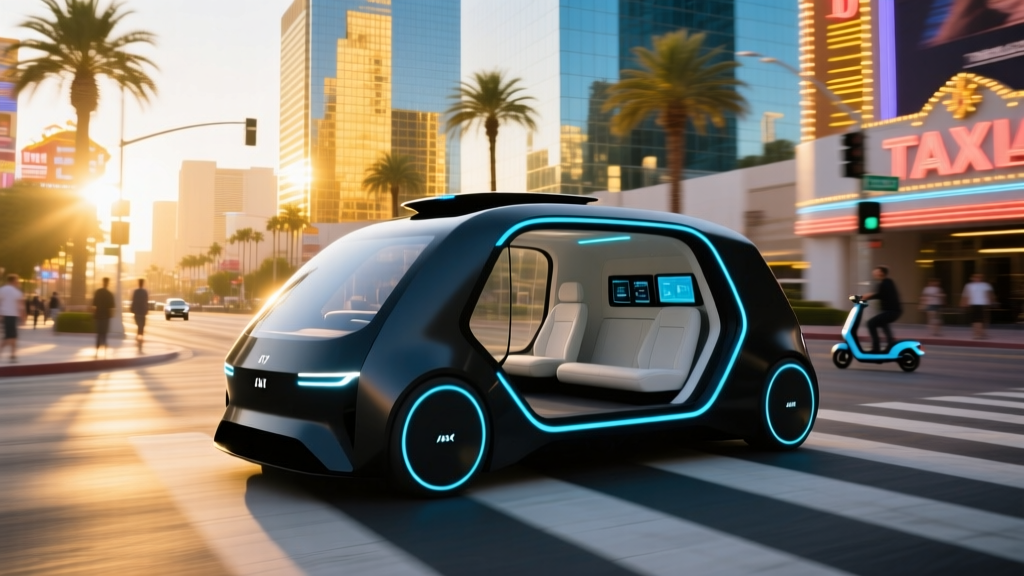
Las Vegas has quietly become one of the most active proving grounds for autonomous ride-hailing in the United States. But if you search for driverless cabs Las Vegas and expect a fleet of empty vehicles pulling up to every casino on the Strip, the reality is more nuanced. As of early 2026, fully driverless robotaxi service in the Las Vegas metro area remains in limited deployment — dominated by pilot programs and restricted geofences rather than the broad, on-demand coverage you'd find in Phoenix or San Francisco.
This guide breaks down exactly which autonomous vehicle (AV) services operate in Las Vegas right now, what the technology actually does, how pricing compares to Uber and Lyft, and what the safety data says. We'll also clarify the critical difference between consumer driver-assist systems (Level 2) and the Level 4 robotaxis that genuinely operate without a human behind the wheel.
SAE Automation Levels: Why Level 4 Matters for Robotaxis
Before evaluating any driverless cab service, you need to understand the SAE International automation levels. This is the only standardized framework that separates genuine self-driving from marketing-driven driver-assist.
| SAE Level | Name | Who Drives? | Example Systems |
|---|---|---|---|
| Level 0 | No Automation | Human (all tasks) | Basic cruise control |
| Level 1 | Driver Assistance | Human + system (one task) | Adaptive cruise OR lane-keep |
| Level 2 | Partial Automation | Human (must supervise) | Tesla Autopilot/FSD Supervised, GM Super Cruise, Ford BlueCruise |
| Level 3 | Conditional Automation | System (human on standby) | Mercedes DRIVE PILOT (limited markets, ≤40 mph) |
| Level 4 | High Automation | System (no human needed in ODD) | Waymo, Zoox, Motional/Cruise robotaxis |
| Level 5 | Full Automation | System (everywhere, all conditions) | Does not yet exist commercially |
Where Can I Use Driverless Cabs in Las Vegas Right Now?
Las Vegas sits in a tier below the primary robotaxi markets (Phoenix, San Francisco, Los Angeles) in terms of service breadth. Here's the current operational landscape as of 2026:
| Service | Operator | Type | Area | Status |
|---|---|---|---|---|
| Motional Ioniq 5 Robotaxi | Motional (Hyundai/Aptiv JV) | Level 4 robotaxi | Las Vegas Strip corridor, limited downtown | Limited public rides via Uber/Lyft integration (safety driver present in some phases) |
| Waymo | Waymo (Alphabet) | Level 4 robotaxi | Not commercially launched in LV as of 2026 | Testing/mapping — no public rides |
| Zoox | Zoox (Amazon) | Level 4 robotaxi | Limited Las Vegas testing zone | Employee/closed testing — not public |
| Beep / Navya Shuttles | Various operators | Level 4 low-speed shuttle | Downtown LV, Convention Center loops | Fixed-route, operational (15-25 mph) |
| Cruise | GM Cruise | Level 4 robotaxi | Not active in LV | Operations suspended/restructured post-2023 incident; no LV deployment |
The practical takeaway: If you want a genuine driverless ride in Las Vegas in 2026, your options are limited to low-speed autonomous shuttles on fixed downtown routes and Motional's robotaxi service — which has offered Uber/Lyft-integrated rides in the Strip corridor but often with a safety operator present during expansion phases. Waymo, the market leader, has been mapping Las Vegas roads but has not launched a commercial Waymo One service in the city as of this writing.
How to Hail a Robotaxi in Las Vegas (and What It Costs)
For the services that are accessible to the public, the hailing process mirrors standard rideshare:
- Download the operator's app (or use Uber/Lyft if the robotaxi is integrated — Motional has partnered with both platforms for select markets).
- Enter your destination. The app will confirm whether both origin and destination fall within the geofenced Operational Design Domain.
- Accept the robotaxi match. On Uber/Lyft, you may see an option to request an autonomous vehicle specifically, or the platform may assign one automatically in eligible zones.
- Ride. In a Level 4 vehicle, there is no steering wheel interaction required from you. In vehicles with safety operators, the human is present but does not drive under normal conditions.
Pricing: Robotaxi vs. Uber vs. Lyft in Las Vegas
| Service | Base Fare | Estimated 4-mi Trip | Surge Behavior | Notes |
|---|---|---|---|---|
| UberX | ~$3.50 | $14–$22 | Dynamic (1.2x–3x+) | Widely available |
| Lyft Standard | ~$3.25 | $13–$20 | Dynamic (Prime Time) | Widely available |
| Motional Robotaxi (via Uber/Lyft) | Comparable or subsidized | $10–$18 | Limited/no surge | Geofenced; promotional pricing common during expansion |
| Waymo One (where available) | ~$3.00 | $12–$19 | Limited surge | Not yet in Las Vegas |
| Low-Speed Shuttle (Beep/Navya) | Free–$2 | N/A (fixed route) | None | Downtown/convention loops |
Robotaxi operators frequently subsidize rides during market expansion to build ridership and gather data. In Phoenix, Waymo One pricing has been broadly competitive with UberX — sometimes $1–$3 cheaper per trip, sometimes $1–$2 more depending on demand. Expect similar pricing dynamics if and when a full commercial service launches in Las Vegas.
How Safe Are Robotaxis? The Real Data
Safety is the single most scrutinized question in autonomous vehicles. Here's what the data shows from operators that publish or report to regulators:
- Over 30 million fully driverless miles completed across Phoenix, San Francisco, Los Angeles, and Austin.
- Waymo's internal analysis (peer-reviewed methodology) showed a ~85% reduction in injury-causing crash rates compared to human benchmarks in comparable urban environments.
- Contact rate (any physical contact, including minor): approximately 5.3 per million miles vs. human baseline of ~14.1 per million miles in the same cities.
Motional's Las Vegas track record: Motional has logged extensive testing miles on Las Vegas roads since 2020, accumulating over 100,000 autonomous miles on the Strip corridor before opening limited public rides. Their public safety record in Las Vegas has not included any reported at-fault collisions with pedestrians or other vehicles during autonomous operation as of early 2026, though specific per-million-mile rates have not been published at the granularity Waymo provides.
The Cruise cautionary tale: In October 2023, a Cruise robotaxi in San Francisco dragged a pedestrian who had been thrown into its path by a human-driven vehicle. The incident led to California DMV suspending Cruise's deployment permit, a nationwide operational pause, and significant restructuring. This underscores that Level 4 autonomy, while statistically safer overall, still faces edge-case challenges — and that regulatory trust can be lost quickly. Cruise has not resumed Las Vegas operations.
For context on how IIHS evaluates autonomous vehicle safety, the organization emphasizes that AV crash-rate comparisons must account for differing operational conditions (geofenced urban routes vs. all human driving, which includes rural highways, impaired driving, etc.).
Under the Hood: The Robotaxi Technology Stack
Understanding what sensors and compute power enable a driverless cab helps explain both the capabilities and the limitations of these systems.
Typical Level 4 Robotaxi Sensor Suite
| Sensor Type | Function | Used By |
|---|---|---|
| LiDAR (Light Detection and Ranging) | 3D point-cloud mapping of surroundings; works in darkness; range ~200m+ | Waymo, Zoox, Motional — virtually all Level 4 operators |
| Cameras (multi-spectrum) | Traffic light/state recognition, signage reading, lane markings, object classification | All operators (redundant layer) |
| Radar (millimeter-wave) | Velocity detection of moving objects; performs well in rain/fog | All operators |
| Ultrasonic sensors | Near-field obstacle detection (parking, low-speed maneuvering) | All operators |
| HD Maps + GPS/IMU | Precise localization within centimeters; pre-mapped routes | All Level 4 operators (geofencing dependency) |
LiDAR vs. camera-only: Tesla's consumer FSD system uses a camera-only (vision-only) approach — no LiDAR. This remains a point of industry debate. Every commercial Level 4 robotaxi operator currently running driverless passenger service uses LiDAR as a core sensor, arguing that redundant depth perception is essential for safety-critical edge cases (e.g., a partially obscured pedestrian at night). The camera-only approach has not been validated at Level 4 for commercial robotaxi deployment as of 2026.
Geofencing and HD mapping: Level 4 robotaxis don't drive just anywhere. They operate within a pre-mapped Operational Design Domain (ODD) — every intersection, lane configuration, construction zone update, and speed limit is cataloged in high-definition maps before the vehicle operates autonomously there. This is why robotaxi services expand neighborhood by neighborhood rather than city-wide overnight.
Current Limitations: What Robotaxis Still Can't Do
Honest assessment of limitations is critical for anyone planning to rely on driverless cabs in Las Vegas:
- Geofence boundaries: If your destination falls outside the mapped ODD, the service simply won't accept the ride. Strip-to-suburban Henderson? Likely unavailable.
- Weather constraints: Heavy rain, dust storms (common in Vegas monsoon season — July through September), or flooding can trigger operational pauses. LiDAR and camera performance degrade in heavy particulate conditions.
- Construction zones: Las Vegas is perpetually under construction. Unmapped lane closures, temporary barriers, and flaggers can force the robotaxi to pull over and request remote assistance or a safety-operator takeover.
- High-speed highway driving: Most Level 4 robotaxi ODDs are limited to surface streets at ≤45 mph. I-15 freeway travel between the airport and the Strip is typically outside the current operational envelope.
- Pickup/dropoff precision: Crowded casino driveways, valet lanes, and double-parked vehicles create edge cases where the vehicle may stop short of your exact requested location and direct you to walk a short distance.
- No human negotiation: Robotaxis cannot make eye contact with a crossing guard, wave through a confused pedestrian, or navigate an unplanned parade route. These social-driving scenarios remain Level 4 blind spots.
Regulatory Landscape: Who Approves Robotaxis in Nevada?
Nevada was one of the first U.S. states to pass autonomous vehicle legislation (AB 511 in 2011, updated subsequently), creating a framework for AV testing and deployment. Here's how the regulatory structure works:
- Nevada Department of Motor Vehicles (DMV): Issues autonomous vehicle testing permits and deployment licenses. Operators must demonstrate minimum testing miles, insurance coverage, and safety-driver training (for testing phases).
- NHTSA (federal): Sets vehicle safety standards (FMVSS) and investigates incidents. NHTSA's Standing General Order requires AV operators to report crashes involving Level 2+ systems within 24 hours and Level 4 systems promptly.
- Local jurisdictions: The City of Las Vegas, Clark County, and the Nevada Department of Transportation (NDOT) all have input on where AVs can operate, particularly regarding road infrastructure and signal compatibility.
- Insurance requirements: Nevada requires AV operators to carry minimum $5 million in liability insurance for deployment permits — significantly higher than personal auto minimums.
The regulatory environment in Nevada is broadly AV-friendly compared to states like California (where the DMV has shown willingness to suspend permits after incidents) or New York (where testing requirements remain more restrictive). However, any serious incident in Las Vegas could trigger a regulatory pause, as seen with Cruise in California.
Frequently Asked Questions
Is a driverless cab in Las Vegas truly self-driving, or is someone still behind the wheel?
It depends on the service and its deployment phase. Motional's Las Vegas robotaxi has operated with a safety operator present during certain expansion and validation phases, meaning a human is in the driver's seat but the system handles all driving tasks under normal conditions. Low-speed shuttles (Beep/Navya) in downtown Las Vegas typically operate without a traditional driver but may have an onboard attendant. True Level 4 driverless service — no human in the vehicle at all — is available in cities like Phoenix (Waymo) but is not yet broadly deployed in Las Vegas as of 2026.
How much does a robotaxi ride cost compared to Uber or Lyft in Las Vegas?
When available, robotaxi rides are generally priced within $1–$3 of a comparable UberX or Lyft trip for the same distance. During expansion phases, operators often subsidize fares to attract riders, making robotaxi rides cheaper than traditional rideshare. Expect a 4-mile Strip corridor trip to cost approximately $10–$18 via a robotaxi-integrated platform, compared to $13–$22 for standard UberX.
Can I take a robotaxi from Harry Reid Airport to my Strip hotel?
Currently, this depends on whether the airport-to-Strip corridor is inside the operator's geofenced ODD. As of 2026, most Level 4 robotaxi services in Las Vegas have focused on surface streets along and near the Strip rather than the I-15 freeway corridor from the airport. Low-speed autonomous shuttles do not cover this route. Check the operator's app for real-time eligibility.
What happens if the robotaxi encounters a situation it can't handle?
Level 4 robotaxis are designed to execute a "minimal risk condition" — typically pulling over safely to the side of the road and stopping. The vehicle then contacts a remote operations center where a human specialist can assess the situation and either remotely guide the vehicle (teleoperations) or dispatch a support team. The vehicle will not attempt to drive through a scenario it cannot confidently navigate.
Are robotaxis available 24/7 in Las Vegas?
Not universally. Operating hours depend on the specific service and its approved ODD conditions. Some operators restrict service to daylight hours or specific time windows during initial deployment phases. Low-speed downtown shuttles typically run on fixed schedules (e.g., 7 AM–10 PM). Check the operator's app for current service hours.
Will Waymo launch in Las Vegas?
Waymo has been mapping Las Vegas roads and has signaled interest in expanding beyond its current markets (Phoenix, San Francisco, Los Angeles, Austin). However, as of early 2026, no commercial Waymo One launch date for Las Vegas has been announced. Any future launch will require Nevada DMV deployment approval and completion of extensive geofenced mapping.