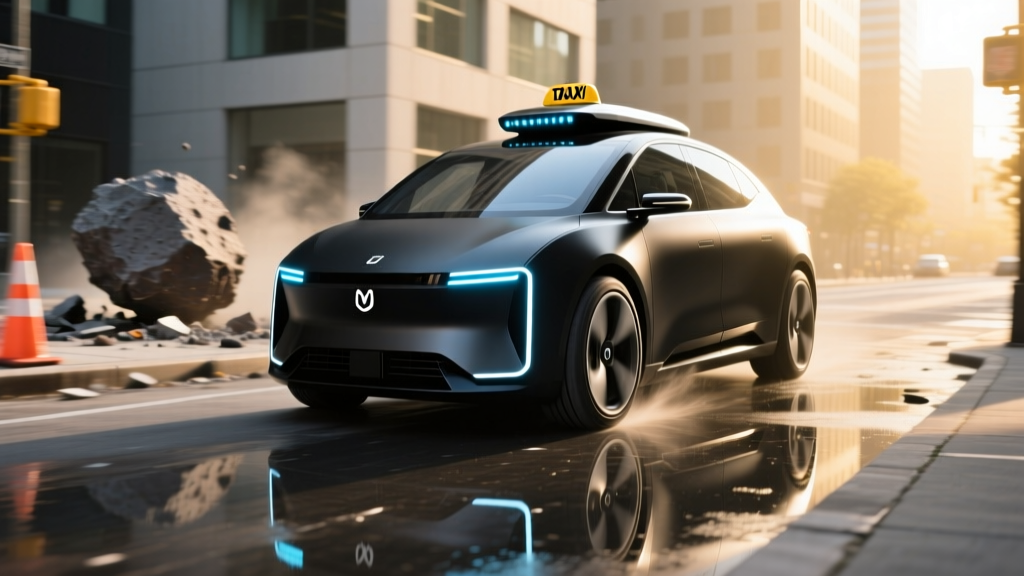
A dashcam clip circulating on EV forums and social media shows a Tesla Model Y driving with Full Self-Driving (Supervised) engaged when a small meteorite fragment — or, more likely, a piece of orbital debris or high-altitude ice — strikes the road ahead. The vehicle's response, or lack of a smooth one, has become a flashpoint for a broader conversation: what happens when Tesla's vision-only ADAS encounters something it has never been trained on?
Whether you call it the "Tesla FSD meteorite collision" or simply an extreme edge-case failure, the incident is a useful entry point for understanding what FSD actually does, where its limits are hard-coded by physics and software, and what every Tesla owner or prospective buyer needs to know before engaging the system in 2026.
What Tesla FSD (Supervised) Actually Does
Tesla's Full Self-Driving (Supervised) is the company's most advanced driver-assistance package. As of the 2026 model year, FSD (Supervised) builds on the base Autopilot system by adding:
- Navigate on Autopilot: Automatic highway on-ramp to off-ramp guidance, including lane changes and interchange navigation
- Auto Lane Change: Suggests and executes lane changes based on route and traffic conditions
- Autopark: Parallel and perpendicular parking assistance
- Summon / Smart Summon: Moves the vehicle short distances in parking lots (with the driver nearby and watching)
- Traffic Light and Stop Sign Control: Detects and responds to traffic signals and stop signs on city streets
- City Street Driving: Navigates urban intersections, turns, and complex road geometries
Technically, FSD (Supervised) relies entirely on a vision-only sensor suite. Current Tesla vehicles (Model 3 Highland, Model Y Juniper, refreshed Model S and Model X) use a camera array — typically eight cameras providing 360-degree coverage — paired with Tesla's HW4 (Hardware 4) onboard computer. Earlier vehicles with HW3 may require a hardware upgrade to access the latest FSD neural network stacks.
There is no radar. There is no lidar. Tesla removed ultrasonic sensors from production vehicles starting in late 2022, betting entirely on camera-based perception processed through neural networks. This is a fundamental architectural choice that distinguishes Tesla from competitors like GM's Super Cruise (which uses lidar mapping plus cameras and radar) and Ford's BlueCruise (cameras plus radar).
SAE Automation Level: Level 2 — Driver Supervision Required
Tesla FSD (Supervised) is classified as SAE Level 2 driver assistance. This means the system can simultaneously control steering and acceleration/braking under certain conditions, but the human driver must remain fully engaged, hands on or near the wheel, eyes on the road, and ready to take over at any moment. Tesla's own documentation states: "The driver must remain engaged and attentive at all times." This is not autonomous driving. Level 4 autonomy — true driverless operation — is currently limited to geofenced robotaxi services like Waymo in select metro areas.
The Meteorite Incident: An Edge Case That Exposes Vision-Only Limits
The reported Tesla FSD meteorite collision — in which a falling object struck the roadway or the vehicle itself while FSD was engaged — represents what ADAS engineers call an out-of-distribution event. Neural networks are trained on millions of miles of driving data. They excel at recognizing cars, pedestrians, lane markings, traffic cones, and even unusual road debris like tires or furniture. But a meteorite fragment, space debris, or even a large hailstone falling from above at high velocity is not a scenario present in meaningful quantities in any training dataset.
Here is what likely happened from a technical standpoint:
- Detection failure: The vision system either did not classify the object in time (small, fast-moving, unprecedented shape) or classified it as something non-threatening (a shadow, a road marking anomaly, or a plastic bag).
- No predictive model: Unlike a car braking ahead — which the system can predict and react to using following-distance algorithms — a vertically descending object has no precedent in the FSD motion-planning stack.
- Driver responsibility: Under SAE Level 2, the human driver was responsible for monitoring the environment and intervening. If the driver was attentive, they may have had a fraction of a second to react — likely insufficient for a high-speed falling object regardless of whether FSD was engaged.
What FSD Cannot Do
- Detect objects it has never been trained to recognize, especially small or fast-approaching ones from above
- Operate safely in heavy rain, fog, snow, or conditions that obscure camera lenses
- Navigate unmapped or severely degraded roads without clear lane markings
- React to sudden, unprecedented events faster than a human could in the same scenario
- Replace an attentive, engaged driver — the system is an assistant, not a substitute
To be fair, no consumer ADAS system — not Super Cruise, not BlueCruise, not Toyota's Safety Sense — would reliably avoid a meteorite strike. The value of examining this incident is not to single out Tesla, but to use a dramatic edge case to illustrate a universal truth about Level 2 systems: they are only as good as their training data and sensor inputs, and the driver is always the final safety net.
FSD Cost and Availability in 2026
Tesla has adjusted FSD pricing and packaging several times. As of the 2026 model year, here is the current structure:
| Option | Cost | Notes |
|---|---|---|
| FSD (Supervised) — One-Time Purchase | $8,000 | Available at vehicle purchase or added later; transfers with the vehicle, not the owner |
| FSD (Supervised) — Monthly Subscription | $99/month | Can be cancelled at any time; requires HW3 or HW4 |
| Basic Autopilot | Included (standard) | Traffic-aware cruise control + autosteer on marked highways; included on all new Teslas |
| Enhanced Autopilot | Discontinued as standalone (US) | Features folded into FSD tier in most markets |
FSD (Supervised) is available on every current-production Tesla: the Model 3 (Highland refresh), Model Y (Juniper refresh), Model S, Model X, and the Cybertruck. It requires Hardware 4 (HW4) for the latest neural network versions; owners of older HW3 vehicles may need to schedule a hardware retrofit through Tesla service.
It is important to note that FSD purchase is not eligible for the federal §30D EV tax credit, which applies to the vehicle itself (subject to MSRP caps of $55,000 for sedans and $80,000 for SUVs/trucks, plus buyer income limits and battery-sourcing requirements per IRS guidelines). FSD is classified as a software add-on, not a qualifying vehicle component.
How FSD Compares to Competing ADAS Systems
The meteorite edge case is instructive, but everyday driving scenarios are where ADAS buyers should focus their comparison shopping. Here is how Tesla FSD (Supervised) stacks up against the leading Level 2 systems in 2026:
| Feature | Tesla FSD (Supervised) | GM Super Cruise | Ford BlueCruise | Mercedes Drive Pilot (Level 3) |
|---|---|---|---|---|
| SAE Level | Level 2 | Level 2 | Level 2 | Level 3 (limited conditions) |
| Hands-Free? | No (hands-on detection) | Yes (on mapped roads, eyes monitored) | Yes (on pre-qualified highways, eyes monitored) | Yes (up to 40 mph, approved roads) |
| Sensor Suite | Cameras only (8) | Cameras + radar + lidar-mapped HD maps | Cameras + radar | Cameras + radar + lidar + HD maps |
| City Street Driving | Yes | Limited (expanding) | No (highway only) | No (highway only, low speed) |
| Cost | $8,000 or $99/mo | $2,200 (3-year trial included on select trims) | $2,100 or $75/mo | ~$2,500/year subscription (S-Class/EQS) |
| Road Coverage | Any road (in theory) | 400,000+ miles of mapped roads (US/Canada) | 130,000+ miles of pre-qualified highways | Limited approved highway segments |
Tesla's advantage is breadth: FSD attempts to work on any road, anywhere, without HD map dependency. The trade-off is that its vision-only approach can struggle in scenarios where radar or lidar would provide redundant depth perception — like a dark object against a dark road surface at night, or an unusual overhead hazard.
GM's Super Cruise and Ford's BlueCruise are more geofenced but offer genuine hands-free driving on mapped roads, with infrared cameras monitoring driver eye gaze. Mercedes-Benz's Drive Pilot is the only SAE Level 3 system available in the US (in Nevada and California), meaning the manufacturer accepts liability during system operation — but only at speeds under 40 mph in heavy traffic on approved highways.
Real-World Safety Data and NHTSA Oversight
Tesla's Autopilot and FSD systems have been under scrutiny by the National Highway Traffic Safety Administration (NHTSA) for several years. NHTSA's Standing General Order requires manufacturers to report crashes involving Level 2 and above ADAS systems. Tesla has reported hundreds of incidents, though context matters: Teslas with Autopilot/FSD represent a large and growing fleet, and the reporting requirement captures all severity levels.
Tesla publishes its own quarterly safety data, claiming that vehicles driven with Autopilot engaged record fewer accidents per million miles than the US average. However, independent researchers have noted methodological limitations — Autopilot is primarily engaged on highways (inherently safer roads), and Tesla's data does not always control for vehicle age, driver demographics, or mileage distribution.
The Insurance Institute for Highway Safety (IIHS) has repeatedly called for stronger driver-monitoring requirements in Level 2 systems, noting that "partial automation does not improve safety unless it is paired with robust driver engagement safeguards." Tesla uses a torque-based steering wheel monitor (and, in some configurations, a cabin camera) to verify driver attention — a system that has been criticized as easier to defeat than the infrared eye-tracking used by GM and Ford.
Practical Guidance: Using FSD Safely in 2026
If you own or are considering a Tesla with FSD (Supervised), here is a practical framework for safe use:
- Use it on roads you know: FSD performs best on well-marked, predictable roads. Unpaved roads, construction zones, and areas with faded lane markings degrade performance.
- Precondition your expectations in bad weather: Heavy rain, snow, and fog can blind the camera system. FSD will issue a takeover warning and may disengage — be ready.
- Stay genuinely attentive: The "supervised" in FSD (Supervised) is not marketing language — it is a legal and safety requirement. Keep your eyes on the road and hands available to steer.
- Understand the handoff: When FSD encounters an edge case — an unusual object, an ambiguous intersection, a sudden road closure — it will alert you. The handoff time can be very short. Do not rely on the system to handle every surprise.
- Keep cameras clean: Dirt, ice, or water droplets on camera lenses can degrade perception. Wipe camera housings regularly, especially in winter.
Frequently Asked Questions
Did Tesla FSD actually fail to avoid a meteorite?
Viral footage shows a Tesla encountering an unusual falling object while FSD was engaged. Whether the object was a meteorite fragment, orbital debris, or ice is difficult to verify independently. What is clear is that FSD — like all Level 2 ADAS systems — is not designed to detect and avoid unprecedented, fast-approaching objects from above. This is a limitation of the technology, not unique to Tesla.
Is Tesla FSD truly self-driving?
No. Tesla FSD (Supervised) is SAE Level 2, which requires continuous driver supervision. The driver must keep their hands available and eyes on the road at all times. Tesla's own documentation and the system's on-screen warnings reinforce this. True self-driving (Level 4) is currently limited to geofenced robotaxi services like Waymo.
How much does Tesla FSD cost in 2026?
FSD (Supervised) costs $8,000 as a one-time purchase or $99 per month as a subscription. Basic Autopilot (traffic-aware cruise control and autosteer) is included standard on all new Tesla vehicles. FSD purchase does not qualify for the federal §30D tax credit.
Which Tesla models include FSD?
FSD (Supervised) is available on all current-production Tesla vehicles: Model 3, Model Y, Model S, Model X, and Cybertruck. It requires Hardware 4 (HW4) for the latest software versions. Older vehicles with HW3 may need a hardware upgrade.
What are the biggest real-world limitations of FSD?
FSD struggles most in heavy rain, snow, and fog (camera obstruction); on poorly marked or unmapped roads; in complex construction zones; and with unusual objects not present in its training data. The vision-only system also lacks the depth-perception redundancy that radar or lidar provides for certain edge cases.
Is FSD safer than driving manually?
Tesla's own data suggests lower accident rates with Autopilot engaged, but independent researchers note that Autopilot is predominantly used on highways (safer environments), making direct comparison to all-driving averages imperfect. The safest approach is to use FSD as an assistive tool while maintaining full driver attention — not as a replacement for engaged driving.