If you've been following BYD's rapid global expansion — from the Atto 3 to the Seal to the Han EV — you've likely seen headlines about the company's advanced driver-assistance features and wondered: does BYD have self-driving technology? The short answer is no, not in the Level 4 driverless sense that Waymo or Zoox operate. What BYD does offer is a suite of SAE Level 2 driver-assistance systems under its DiPilot branding, with increasingly ambitious hardware stacks in newer models. Here's a precise breakdown of what BYD's autonomy tech can and cannot do in 2026, and how it stacks up against the industry's actual robotaxi services.
BYD's Current Autonomy Level: SAE Level 2, Not Self-Driving
BYD's DiPilot system is classified as SAE Level 2 — a partial-driving automation system. This means the vehicle can simultaneously control steering and acceleration/braking under certain conditions, but the driver must remain fully engaged, hands on or near the wheel, eyes on the road, and ready to take over instantly. This is the same classification as Tesla Autopilot, GM Super Cruise (on non-Ultra Cruise trims), and Ford BlueCruise. It is not Level 4 driverless operation.
BYD has not announced any Level 3 (conditional automation, where the driver can disengage under specific circumstances) or Level 4 (fully driverless in a defined operational domain) production vehicle for consumer sale as of early 2026. The company's public roadmap focuses on refining Level 2+ capabilities — what the industry informally calls "Level 2.5" — through hardware upgrades and over-the-air software updates.
DiPilot Hardware and Technology Stack
BYD's ADAS suite, branded DiPilot, varies significantly by model and trim. Here's what the hardware looks like across the 2026 lineup:
| Component | Entry-Level (Dolphin, Atto 3 base) | Mid-Tier (Seal, Atto 3 Premium) | Flagship (Han EV, Seal U, Denza models) |
|---|---|---|---|
| Cameras | 4–5 surround-view | 8–11 high-resolution | 11+ including forward-facing long-range |
| Millimeter-wave Radar | 1–3 units | 5 units | 5–7 units (including 4D imaging radar) |
| LiDAR | None | None (available on select markets) | 1 roof-mounted (on DiPilot 300+ trims) |
| Ultrasonic Sensors | 6–8 | 12 | 12+ |
| Compute Platform | Horizon Robotics J3 | NVIDIA Orin-N (~84 TOPS) | Dual NVIDIA Orin-X (~508 TOPS combined) |
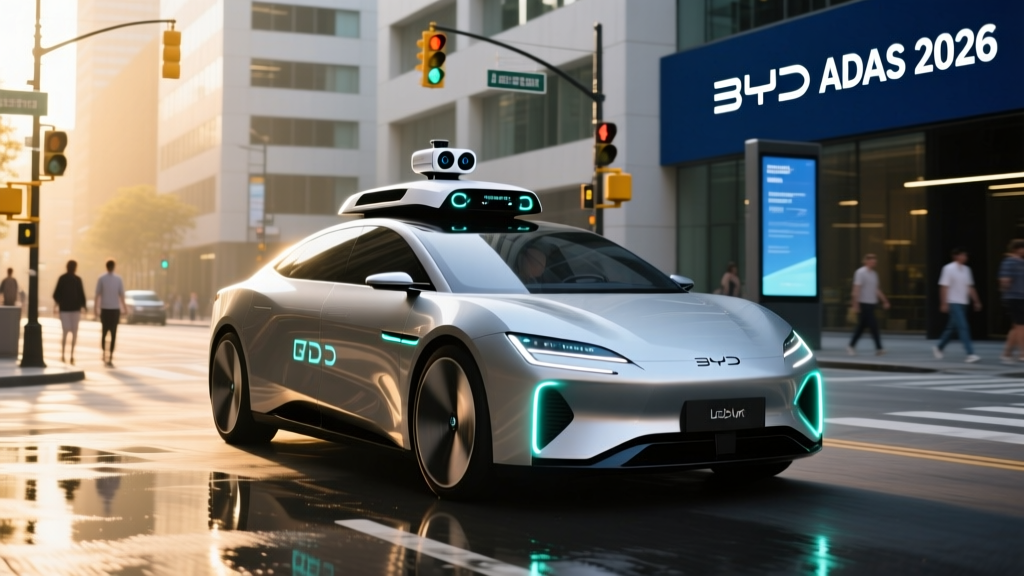
The flagship DiPilot 300 system — found on the Han EV, the Tang, and BYD's premium sub-brand Denza — uses a sensor-fusion approach combining cameras, radar, and a roof-mounted LiDAR unit. This is fundamentally different from Tesla's camera-only ("Tesla Vision") approach and more closely mirrors the hardware philosophy used by Waymo and Cruise in their robotaxi fleets, albeit applied to a Level 2 supervised system rather than Level 4 driverless operation.
BYD's decision to include LiDAR on higher trims is notable. LiDAR provides precise depth mapping independent of lighting conditions, which improves detection of stationary objects, construction zones, and edge-case obstacles — scenarios where camera-only systems have historically struggled. However, having LiDAR on a Level 2 system does not make it self-driving; it simply provides richer data for the driver-assist algorithms.
What DiPilot Can Actually Do: Feature Breakdown
BYD's DiPilot suite includes the following driver-assistance features, depending on trim and market:
- Adaptive Cruise Control (ACC) with Stop & Go: Maintains set speed and following distance in traffic, including full stops and restarts. Works from 0–150 km/h (0–93 mph).
- Lane Centering Assist (LCA): Actively steers to keep the vehicle centered in marked lanes. Requires driver hand contact on the steering wheel at regular intervals.
- Automatic Lane Change: On DiPilot 200+ trims, the system can execute lane changes on highways when the driver activates the turn signal — but only after confirming the maneuver is safe and with the driver's confirmation.
- Navigate on Pilot (Highway Assist): Available on select 2025–2026 models with DiPilot 200 or higher. Combines ACC, LCA, and automatic lane changes for semi-automated highway driving between on-ramp and off-ramp. The driver must supervise continuously.
- Automatic Emergency Braking (AEB): Detects vehicles, pedestrians, and cyclists; applies brakes if the driver doesn't respond. Effective up to 85 km/h (53 mph) for pedestrian detection, higher for vehicle-to-vehicle.
- Remote Parking Assist: Allows the driver to move the vehicle in and out of tight parking spaces via the key fob or smartphone app while standing outside the car. The vehicle moves at very low speed (~3 km/h) and stops immediately if an obstacle is detected.
None of these features constitute self-driving. The vehicle cannot operate without a licensed, attentive driver in the seat. If the driver removes their hands from the wheel or fails to respond to monitoring alerts, DiPilot will issue escalating warnings and eventually bring the vehicle to a controlled stop with hazard lights activated.
How BYD's ADAS Compares to Actual Robotaxi Services
To put BYD's Level 2 system in context, here's how it compares to the Level 4 robotaxi services currently operating in the United States and China:
| Attribute | BYD DiPilot 300 | Waymo (US) | Baidu Apollo Go (China) |
|---|---|---|---|
| SAE Level | Level 2 (driver required) | Level 4 (driverless) | Level 4 (driverless) |
| Driver Present? | Yes — must supervise | No — fully driverless | No — fully driverless |
| Operational Domain | Any road (with driver) | Geofenced metro areas | Geofenced city zones |
| LiDAR | 1 unit (flagship trims) | 5+ custom units per vehicle | Multiple units + V2X |
| Available to Consumers? | Yes — purchase vehicle | Yes — hail a ride | Yes — hail a ride |
| Weather Limitations | Reduced in heavy rain/snow (driver compensates) | Service may pause in severe weather | Service may pause in severe weather |
The critical distinction: BYD sells you a car with excellent driver-assist features that you drive. Waymo and Baidu Apollo Go sell you a ride in a vehicle that drives itself within a tightly controlled geographic and environmental domain. These are fundamentally different products.
BYD's Robotaxi Ambitions: What We Know
BYD has not launched a robotaxi service, nor has it announced a Level 4 production vehicle. However, the company's investments signal long-term interest in higher autonomy:
- Partnership with NVIDIA: BYD uses NVIDIA's DRIVE Orin platform and has committed to the next-generation DRIVE Thor chip for future models, which offers up to 2,000 TOPS of compute — enough for Level 3+ functionality.
- In-house ADAS team expansion: BYD has significantly grown its autonomous driving R&D division, recruiting engineers from Baidu, Pony.ai, and other Chinese autonomy startups.
- Testing in Shenzhen: BYD has been spotted testing prototype vehicles with extensive sensor suites (multiple LiDARs, high-res cameras) on public roads around its Shenzhen headquarters, though these appear to be research platforms rather than near-term production previews.
- No public timeline: Unlike Mercedes-Benz (which has Level 3 approval in Nevada and California for its DRIVE PILOT system at speeds up to 60 km/h), BYD has not announced any Level 3 certification pursuit in any market as of 2026.
For context, BYD's approach mirrors Toyota's cautious "guardian angel" philosophy — using advanced sensors and compute to make human drivers safer, rather than rushing to remove the driver entirely. Given BYD's mass-market positioning and price sensitivity, this is pragmatic: Level 4 hardware stacks currently add $50,000–$100,000+ per vehicle, which is incompatible with a $30,000–$50,000 consumer EV.
Safety Record and Regulatory Context
BYD's DiPilot system has not been the subject of a major NHTSA investigation as of early 2026, unlike Tesla's Autopilot/FSD (which has faced multiple NHTSA probes regarding crash-site incidents and driver-monitoring adequacy). BYD models tested by Euro NCAP — including the Atto 3 and Seal — have achieved 5-star overall safety ratings, with strong scores in the Safety Assist category that evaluates AEB, lane-keeping, and speed-assist systems. However, comprehensive real-world intervention-rate data (disengagements per 1,000 miles) for DiPilot is not publicly reported by BYD in the same way California DMV requires for autonomous vehicle testing permits.
In China, BYD vehicles with DiPilot are subject to the country's evolving ADAS regulations. China's Ministry of Industry and Information Technology (MIIT) has established a framework for Level 3 and Level 4 testing, and several cities — including Shenzhen, Beijing, and Shanghai — have passed local regulations allowing driverless testing and limited commercial robotaxi operations. BYD participates in these ecosystems as a vehicle supplier, but it is Baidu Apollo Go, Pony.ai, and AutoX that operate the actual driverless fleets.
For US buyers (should BYD eventually enter the American market, which remains uncertain due to tariff barriers), any BYD vehicle sold would need to comply with NHTSA's Federal Motor Vehicle Safety Standards and would be subject to the agency's Standing General Order requiring crash reporting for vehicles equipped with Level 2+ ADAS.
Current Limitations of BYD's DiPilot System
Like all Level 2 systems, DiPilot has well-defined operational boundaries that every owner should understand:
- Weather degradation: Heavy rain, fog, snow, or direct low-angle sunlight can impair camera and LiDAR performance. The system will issue a "sensor blocked" or "reduced functionality" warning and require the driver to assume full control.
- Lane marking dependency: Lane Centering Assist requires clearly visible lane markings. Faded, snow-covered, or construction-zone markings will cause the system to disengage or behave unpredictably.
- No traffic light/stop sign recognition (most markets): DiPilot does not automatically stop at red lights or stop signs on surface streets. The driver must manage all intersection behavior.
- Highway-focused automation: Navigate on Pilot is designed for divided highways and expressways. It does not handle urban street driving, roundabouts, or unprotected left turns.
- Driver monitoring: BYD uses a steering-wheel torque sensor and, on higher trims, a driver-facing camera. If the system detects inattention, it escalates warnings and will eventually perform an emergency stop. There is no "eyes-off" capability.
- Geofencing: Unlike Level 4 robotaxis that are geofenced to approved areas, DiPilot can technically be activated on any road — but its reliability varies enormously based on road quality, marking clarity, and traffic complexity.
Frequently Asked Questions
Does BYD have self-driving cars available to buy?
No. BYD does not sell any self-driving (Level 4 or Level 5) vehicle. All BYD models require a fully attentive, licensed driver at all times. The DiPilot system is a Level 2 driver-assistance suite — comparable to Tesla Autopilot or Ford BlueCruise — that can help with steering, acceleration, and braking on highways, but the driver remains legally and operationally responsible.
Can BYD's DiPilot drive on highways without me touching the wheel?
No. DiPilot requires continuous driver supervision. On most trims, you must maintain hand contact with the steering wheel. On trims with a driver-facing camera, brief hands-off periods may be tolerated on highways, but your eyes must remain on the road. If the system detects inattention, it will alert you and eventually disengage.
Does BYD plan to launch a robotaxi service like Waymo?
BYD has not announced any robotaxi service. The company is investing heavily in ADAS R&D and has partnerships with NVIDIA for next-generation compute platforms, but there is no public timeline for Level 3 or Level 4 production vehicles. BYD's current strategy focuses on selling consumer vehicles with advanced Level 2+ driver assistance.
How does BYD DiPilot compare to Tesla's FSD Supervised?
Both are Level 2 systems requiring driver supervision. Tesla's FSD (Supervised) attempts broader capability — including city-street navigation, traffic-light recognition, and unprotected turns — but has faced significant regulatory scrutiny and NHTSA investigations. BYD's DiPilot takes a more conservative approach, focusing primarily on highway assist and parking features, with less aggressive urban-street automation. Neither system is self-driving, and both require the driver to be fully engaged.
Is BYD's LiDAR-equipped system safer than camera-only approaches?
LiDAR provides redundant depth perception that cameras alone cannot achieve, particularly in low-light conditions, glare, or when detecting stationary objects at range. In principle, a sensor-fusion system (camera + radar + LiDAR) like BYD's DiPilot 300 has more information available than a camera-only system. However, real-world safety depends on software quality, training data, and system calibration — not just hardware count. Independent comparative safety data between DiPilot 300 and Tesla Vision in matched conditions is not currently available.
Will BYD bring DiPilot to the US market?
BYD has not announced US market entry for its passenger vehicles as of 2026. The company faces significant tariff barriers (a 100% tariff on Chinese-made EVs imposed in 2024) and has focused its international expansion on Europe, Southeast Asia, Latin America, and the Middle East. If BYD does enter the US market, its ADAS systems would need to meet NHTSA regulations and would likely be recalibrated for American road infrastructure and traffic patterns.