Chevrolet Self-Driving: Two Very Different Systems
When shoppers search for "Chevrolet self-driving," they're usually conflating two entirely separate technologies that share a corporate parent but operate under fundamentally different rules. On one hand, there's Super Cruise — General Motors' hands-free Level 2 driver-assistance system available on select Chevrolet models like the Silverado EV, Equinox EV, and Blazer EV. On the other, there's Cruise, GM's Level 4 robotaxi subsidiary that operates driverless ride-hail vehicles in limited cities.
Understanding the distinction isn't academic — it determines whether you're buying a car you must still supervise, or hailing a vehicle with no driver at all. Let's break down both systems with real data, current 2026 availability, and honest limitations.
SAE Automation Levels: Where Each System Lands
SAE Level 2 (Super Cruise): The system controls steering and acceleration/braking under specific conditions, but the driver must remain engaged and supervise at all times. You are legally responsible for the vehicle. Hands can leave the wheel; eyes cannot leave the road.
SAE Level 4 (Cruise Robotaxi): The vehicle handles all driving tasks within its operational design domain (geofenced areas, certain weather conditions) with no human driver present or required. The company, not the passenger, bears operational responsibility.
| Level | Name | Driver Required? | Example |
|---|---|---|---|
| Level 2 | Partial Automation | Yes — full supervision | Super Cruise, Autopilot, BlueCruise |
| Level 3 | Conditional Automation | Yes — can disengage briefly | Mercedes Drive Pilot (limited markets) |
| Level 4 | High Automation | No — within geofence | Waymo, Cruise (pre-suspension) |
| Level 5 | Full Automation | No — anywhere | Does not exist commercially |
This distinction matters enormously for liability, insurance, and what you're actually paying for. A 2026 Chevrolet Silverado EV with Super Cruise is not a robotaxi — it's a truck with excellent highway assistance that still needs you behind the wheel.
Super Cruise: What Chevrolet Owners Actually Get
Super Cruise is GM's premium ADAS (Advanced Driver Assistance System), and as of 2026 it covers over 750,000 miles of mapped roads across the United States and Canada — including divided highways, some state routes, and increasingly, rural corridors. It uses a combination of:
- LiDAR-mapped HD road data (pre-scanned routes stored onboard)
- Camera and radar sensor suite for real-time lane-keeping, adaptive cruise, and obstacle detection
- Driver-facing infrared camera on the steering column to monitor eye gaze and head position
- RTK-corrected GPS for lane-level positioning accuracy
When conditions are met (mapped road, clear lane markings, acceptable weather), the system illuminates a green light bar on the steering wheel. You can remove your hands entirely. The vehicle handles steering, acceleration, and braking. Lane changes can be initiated by tapping the turn signal — Super Cruise executes the maneuver after checking blind spots.
Current Chevrolet models offering Super Cruise (2026 model year):
- Silverado EV (LTZ and above trims — ~$72,000+ MSRP)
- Blazer EV (RS with Super Cruise package — ~$56,000+)
- Equinox EV (RS with package — ~$48,000+)
- Suburban/Tahoe (High Country — ~$78,000+)
Super Cruise requires a $25/month connected services subscription after the initial 3-year trial period included with new vehicles. Without it, the system reverts to standard adaptive cruise and lane-keep assist.
Cruise Robotaxi: The Driverless Side of the GM Family
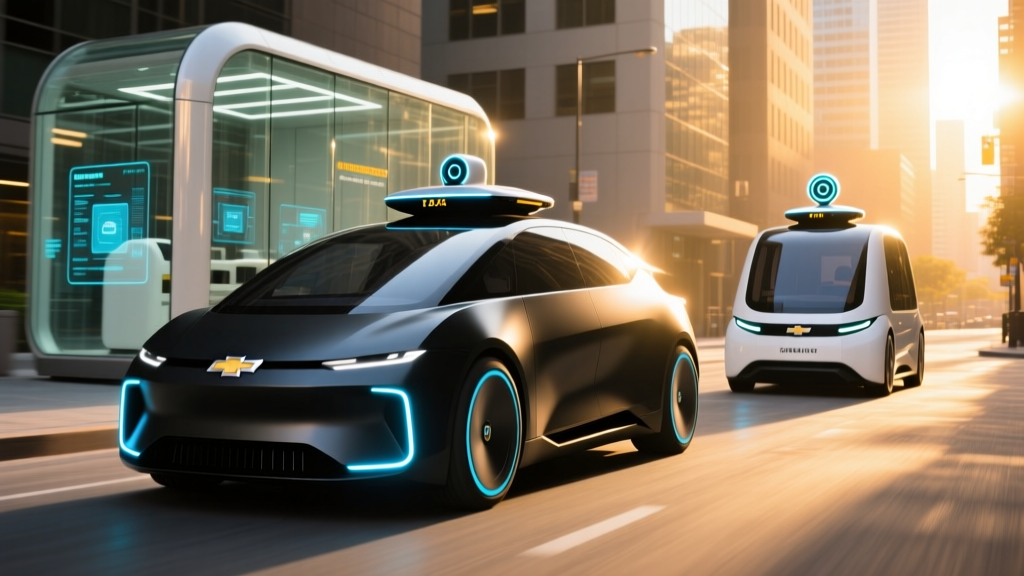
Cruise LLC, GM's majority-owned autonomous vehicle subsidiary, operates (or has operated) a fleet of purpose-built Cruise Origin vehicles — boxy, steering-wheel-free electric pods designed exclusively for ride-hail service. These are SAE Level 4: no driver, no steering wheel, no pedals accessible to passengers.
However, Cruise's operational status has been turbulent. Following a serious incident in San Francisco in October 2023 — where a Cruise vehicle dragged a pedestrian who had been thrown into its path by a human-driven car — the California DMV suspended Cruise's deployment permit. The company subsequently paused nationwide operations, conducted a comprehensive safety review, and began a phased, supervised relaunch in select cities in 2024-2025.
As of early 2026, Cruise operates with safety drivers present (effectively Level 2 with a trained operator behind the wheel) in Phoenix, Dallas, and Houston, with limited driverless testing resuming under strict regulatory oversight in Phoenix. Fully driverless commercial service has not returned to pre-suspension scale.
| City | Status | Driver Present? | Operating Hours |
|---|---|---|---|
| Phoenix, AZ | Active — limited driverless + supervised | Mixed | Select hours |
| Dallas, TX | Active — supervised only | Yes (safety driver) | Daytime hours |
| Houston, TX | Active — supervised only | Yes (safety driver) | Daytime hours |
| San Francisco, CA | Suspended — no active service | N/A | N/A |
| Austin, TX | Testing — not commercial | Yes | Limited |
For comparison, Waymo (Alphabet's robotaxi arm) operates fully driverless commercial service at scale in Phoenix, San Francisco, Los Angeles, and Austin as of 2026, with over 30 million driverless miles logged.
Safety Data: What the Numbers Actually Show
Super Cruise (Level 2): GM reports that Super Cruise has accumulated over 15 million hands-free miles as of late 2025. Because a supervising driver is always present, incident rates track closely with attentive human driving. NHTSA's Standing General Order data shows no systemic defect pattern attributable to Super Cruise specifically.
Cruise (Level 4, pre-suspension): Before its October 2023 suspension, Cruise reported approximately 3.5 million driverless miles across San Francisco, Phoenix, and Austin. The company published data claiming a 53% lower injury-causing crash rate per million miles compared to human benchmarks in San Francisco — but this figure was contested by researchers who noted the geofenced, low-speed, fair-weather operating conditions skewed comparisons.
The October 2023 incident: A pedestrian, already struck by a human-driven vehicle, was run over and then dragged ~20 feet by a Cruise robotaxi that failed to recognize the person in the roadway. Cruise initially provided incomplete video to regulators, leading to permit revocation, a $1.5 million NHTSA fine, and a company-wide operational pause. This incident remains the defining case study in robotaxi edge-case failure.
For context, the U.S. fatal crash rate is approximately 1.35 per 100 million vehicle miles (NHTSA FARS data). Robotaxi fleets have not yet accumulated enough driverless miles to reach statistical parity — 3.5 million miles is roughly 3% of the distance needed to confidently claim equivalence to human fatality rates.
How to Use Each System — and What It Costs
Super Cruise (Chevrolet owners):
- Purchase or lease a Super Cruise-equipped Chevrolet (see model list above)
- Activate the 3-year complimentary connected services trial
- On a mapped road, press the Super Cruise button on the steering wheel
- Wait for the green light bar — remove hands, keep eyes forward
- After 3 years, subscribe at $25/month or $250/year to maintain functionality
Cruise Robotaxi (ride-hail passengers):
- Download the Cruise app (available in active service cities)
- Request a ride — pricing displayed before confirmation
- Vehicle arrives; verify license plate and unlock via app
- No driver interaction; route displayed on interior screen
- Pay via app on completion
| Service | Base Fare | Per Mile | Per Minute | 5-Mile / 15-Min Ride Est. |
|---|---|---|---|---|
| Cruise (supervised, Phoenix) | $1.50 | $1.10 | $0.25 | ~$10.75 |
| UberX (Phoenix avg) | $2.50 | $1.35 | $0.35 | ~$14.50 |
| Lyft (Phoenix avg) | $2.25 | $1.30 | $0.32 | ~$13.55 |
| Waymo One (Phoenix) | $1.75 | $1.20 | $0.30 | ~$12.25 |
Robotaxi pricing is typically 15-30% below UberX/Lyft on equivalent routes, reflecting the absence of driver earnings. However, surge pricing, wait times (often 8-15 minutes outside dense zones), and geofence limitations reduce the practical advantage.
Technology Stack: Cameras, LiDAR, and Geofencing
Super Cruise sensor suite:
- 11 cameras (forward, side, rear)
- 5 radar units (long-range forward, 4 corner)
- LiDAR-derived HD maps (not real-time LiDAR — maps are pre-loaded)
- Driver-monitoring IR camera (steering column)
- RTK GPS + IMU for lane-level positioning
Cruise Origin robotaxi sensor suite:
- Real-time LiDAR arrays (roof-mounted, 360° coverage, ~200m range)
- High-resolution camera clusters (12+ units)
- Short- and long-range radar
- Ultrasonic sensors for close-proximity objects
- No driver-monitoring camera (no driver to monitor)
- Redundant compute, braking, and steering systems
The fundamental architectural difference: Super Cruise relies on pre-mapped roads and will disengage if it leaves its mapped network. Cruise uses real-time perception to navigate dynamically but within a strict geofence approved by local regulators. Neither approach works everywhere — Super Cruise won't activate on unmapped rural roads, and Cruise won't operate outside its approved city boundaries.
Regulatory Landscape: Who Approves What
Autonomous vehicle regulation in the United States is a patchwork of federal and state authority:
- Federal (NHTSA): Sets vehicle safety standards (FMVSS). Currently, FMVSS assumes a human driver — Cruise Origin required a special exemption for its steering-wheel-free design. NHTSA also mandates crash reporting via Standing General Order for all ADS-equipped vehicles.
- State DMVs: Issue deployment permits. California, Arizona, Texas, and Nevada have the most permissive frameworks. California's DMV can suspend permits immediately after safety incidents (as it did with Cruise in October 2023).
- State PUCs (Public Utilities Commissions): In California, the CPUC must separately approve commercial robotaxi fare collection. This dual-permit system (DMV for operation, CPUC for commerce) created the regulatory friction that defined Cruise's 2023 crisis.
- Local municipalities: Often control road access, curb management, and emergency response protocols. San Francisco's Board of Supervisors held multiple hearings restricting Cruise operations before the DMV suspension.
For Super Cruise, regulation is straightforward: it's classified as an ADAS feature under existing vehicle safety standards. No special permits required — GM self-certifies compliance, and NHTSA investigates only if defect patterns emerge.
Current Limitations: Where Both Systems Fall Short
Super Cruise limitations:
- Only activates on pre-mapped roads (~750,000 miles — excludes most residential streets, parking lots, unpaved roads)
- Disengages in construction zones with shifted lane markings
- Rain, snow, fog, or direct sun glare on cameras can trigger disengagement
- Driver-monitoring camera will issue escalating warnings (light bar → audible → seat vibration → system lockout) if eyes leave the road
- Not available below ~25 mph in most configurations
- Cannot navigate roundabouts, traffic circles, or complex intersections autonomously
Cruise robotaxi limitations:
- Geofenced to specific approved zones within each city
- Does not operate in heavy rain, fog, or snow
- Struggles with temporary road modifications (construction, parade routes, emergency scenes)
- Cannot make unprotected left turns across heavy traffic reliably
- Occasionally stalls in complex multi-lane merges, triggering remote assistance calls
- No highway operation (surface streets only, typically under 40 mph)
- Wait times of 10-20 minutes outside high-density zones
Neither system approaches the "drive anywhere, anytime" promise of Level 5 autonomy. Super Cruise is an excellent highway companion that reduces fatigue on long trips. Cruise is a niche urban transit option that works well within narrow parameters but cannot replace a personal vehicle or even Uber for most trips.
Frequently Asked Questions
Where can I use Chevrolet self-driving right now?
If you mean Super Cruise, you can use it on any of GM's 750,000+ mapped miles of highway across the US and Canada — provided you own or lease a Super Cruise-equipped Chevrolet. If you mean Cruise robotaxi, supervised (safety-driver) rides are available in Phoenix, Dallas, and Houston as of early 2026. Fully driverless service is limited to restricted testing in Phoenix.
How much does Cruise cost vs Uber or Lyft?
Cruise fares typically run 15-30% below UberX and Lyft on equivalent routes within its service zone. A 5-mile, 15-minute ride averages ~$10-11 on Cruise vs ~$13-15 on conventional rideshare. However, limited availability and longer wait times reduce the practical savings.
How safe are robotaxis — is there real data?
Cruise reported a 53% lower injury-crash rate per million miles vs human benchmarks before its 2023 suspension, but this data covered only ~3.5 million driverless miles — statistically insufficient for definitive comparison. Waymo has published more extensive data across 30+ million driverless miles showing favorable safety metrics. The October 2023 Cruise incident demonstrated that edge cases (a pedestrian already on the ground from a prior collision) remain unsolved challenges. Human driving causes ~1.35 fatalities per 100 million miles (NHTSA FARS); robotaxi fleets need 10-100x more data to claim statistical equivalence.
What are the current limitations I should know about?
Super Cruise requires mapped roads, won't work in bad weather or construction zones, and demands your visual attention at all times. Cruise robotaxis are geofenced, don't operate in rain/snow, can't handle highways, and may stall in complex traffic scenarios. Neither system replaces a fully attentive human driver in all conditions.
Is Chevrolet's self-driving truly self-driving or just driver-assist?
Super Cruise on Chevrolet vehicles is SAE Level 2 driver-assist — you must supervise, and you are legally responsible for the vehicle's operation. It is not self-driving. Cruise robotaxis are SAE Level 4 (driverless within their geofence), but as of 2026 most active Cruise vehicles have safety drivers present, making them functionally Level 2 in practice.
Does Super Cruise come standard on Chevrolet EVs?
No. Super Cruise is an optional package on most Chevrolet models and is typically bundled into higher trims (RS, LTZ, High Country) at a premium of $2,000-$5,000 above base MSRP. The base Equinox EV LT, for example, does not include Super Cruise — you'd need the RS with the Super Cruise package at approximately $48,000 MSRP.