What Blind Spot Assist Actually Does on the Road
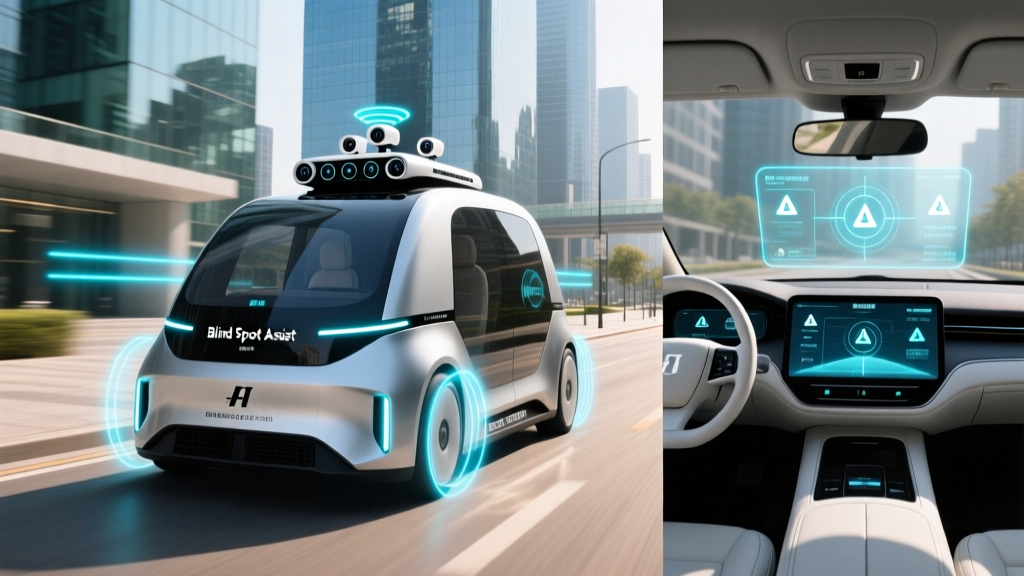
Blind spot assist is an active driver-assistance feature that goes beyond the passive warning light in your side mirror. While a basic blind spot monitor (BSM) illuminates an amber icon when a vehicle enters your rear-quarter blind zone, blind spot assist adds an intervention layer: if you activate your turn signal while a vehicle is detected in that zone, the system can apply corrective steering torque to keep you in your lane, apply gentle braking on one side, or issue an aggressive audible and haptic alert to stop the lane change.
In practical highway driving, this means the car actively resists a lane change when it detects a collision risk. On a 2026 Hyundai Ioniq 5, for example, the system can apply individual wheel braking to nudge the car back toward the center of the original lane. On a Tesla Model Y, Blind Spot Camera display pairs with an audible chime and steering resistance when turn-signal-initiated lane changes conflict with detected vehicles.
The distinction matters for buyers: passive monitoring warns you; active assist intervenes. Most EVs sold in the U.S. for 2026 include at least passive BSM as standard, but the active steering/braking intervention varies by trim, package, and manufacturer.
Blind spot assist is classified under SAE J3016 Level 2 automation at most. The system provides lateral (steering) or longitudinal (braking) support in specific scenarios, but the driver must remain fully engaged — hands on or near the wheel, eyes on the road, and ready to override at any moment. This is not self-driving. The system will disengage, beep, or escalate warnings if it detects driver inattention. No production consumer vehicle in 2026 offers Level 4 or Level 5 autonomy for blind spot scenarios.
Under the Hood: Radar, Cameras, and Ultrasonic Sensors
Blind spot assist relies on a sensor stack mounted around the vehicle's perimeter. Here's how the three primary sensor types contribute:
| Sensor Type | Typical Placement | Role in Blind Spot Assist | Detection Range |
|---|---|---|---|
| Corner radar (77 GHz mmWave) | Rear bumper corners, behind fascia | Primary: detects vehicles in adjacent lanes, measures relative speed and distance | Up to ~70 meters rearward |
| Side-rear cameras | Side mirrors, A-pillars, or rear quarter panels | Secondary/confirmation: visual classification of detected objects, lane-line context | ~30–50 meters |
| Ultrasonic sensors | Front/rear bumpers, side skirts | Low-speed supplement: parking-adjacent detection, not primary highway BSA input | ~5 meters |
The 77 GHz corner radars do the heavy lifting. They penetrate rain, fog, and darkness far better than cameras, which is why blind spot assist remains functional in conditions where camera-only systems (like some lane-keeping features) degrade. However, radar can occasionally produce false positives from guardrails, concrete barriers, or vehicles two lanes over — modern systems use filtering algorithms and camera cross-referencing to suppress these, but edge cases persist.
Tesla's current HW4 (Hardware 4) architecture on the 2026 Model Y and Model 3 relies exclusively on cameras (Tesla Vision) with no radar. This means its blind spot detection depends entirely on image recognition, which can struggle in heavy rain, direct sun glare, or when camera lenses are obscured by road grime. Competitors using radar-camera fusion (Hyundai/Kia, Ford, BMW, Mercedes-Benz) generally maintain more consistent detection in adverse weather.
Brand-by-Brand: What It's Called and Where You Get It
Every automaker brands their blind spot intervention differently, and availability varies sharply by trim. Here's a 2026 snapshot for popular EVs:
| Brand | Feature Name | Standard or Optional | Notable 2026 EV Models |
|---|---|---|---|
| Hyundai / Kia / Genesis | Blind-Spot Collision-Avoidance Assist (BCA) | Standard on most trims above SE | Ioniq 5, Ioniq 6, EV6, EV9, GV60 |
| Tesla | Blind Spot Camera + Lane Departure Avoidance | Standard on all vehicles (basic Autopilot) | Model 3, Model Y, Model S, Model X |
| Ford | BLIS (Blind Spot Information System) with Cross-Traffic Alert | Standard on most 2026 trims; active steering assist on Lariat/Platinum | Mustang Mach-E, F-150 Lightning |
| BMW | Active Blind Spot Detection | Standard on i4, iX, i7; part of Driving Assistant package on iX1 | i4, i5, iX, i7 |
| Mercedes-Benz | Active Blind Spot Assist | Standard on EQE, EQS; optional on EQA/EQB via Driver Assistance Package (~$1,950) | EQE, EQS, EQB |
| Chevrolet / GMC / Cadillac | Side Blind Zone Alert + Rear Cross Traffic Braking | Standard on most 2LT/3LT trims | Equinox EV, Blazer EV, Silverado EV, Lyriq |
| Rivian | Blind Spot Warning + Lane Keep Assist integration | Standard on all R1T and R1S (2026 software stack) | R1T, R1S |
A few observations from real-world ownership: Hyundai/Kia's BCA is among the most assertive — it will actively brake individual wheels to prevent a lane change, and the intervention feels deliberate rather than subtle. Tesla's approach is more passive: the touchscreen displays a camera feed of the blind zone and issues audio alerts, but steering resistance through Lane Departure Avoidance is gentler and can be overridden with minimal torque. Ford's BLIS with active steering assist (available on higher trims) provides a noticeable steering wheel tug that's effective but can surprise first-time users.
Cost Breakdown: Included, One-Time, or Subscription?
Unlike full-suite ADAS packages (Tesla FSD, GM Super Cruise, Ford BlueCruise) that command premium pricing, blind spot assist is typically bundled into the vehicle's base safety suite at no additional cost. Here's how pricing breaks down:
| Brand / System | Blind Spot Assist Cost | Broader ADAS Subscription? | Notes |
|---|---|---|---|
| Hyundai / Kia (BCA) | Included (no extra charge) | None — Hyundai SmartSense is standard | No subscription model for BSA features |
| Tesla (Basic Autopilot) | Included with vehicle | FSD (Supervised): $8,000 one-time or $99/month | BSA works under basic Autopilot; FSD adds auto lane change but doesn't enhance BSA itself |
| Ford (BLIS) | Included on most trims | BlueCruise: $75/month or $800/year (hands-free highway) | BLIS is independent of BlueCruise subscription |
| BMW (Active Blind Spot Detection) | Included on most trims | Driving Assistant Pro: ~$1,700 one-time (adds highway assistant) | BSA is part of standard Driving Assistant |
| Mercedes-Benz (Active BSA) | Included on EQE/EQS; ~$1,950 package on EQA/EQB | Drive Pilot (Level 3, limited): not available in U.S. as of 2026 | Active BSA bundled with Driver Assistance Package |
The bottom line: you should not have to pay extra for blind spot assist on a 2026 EV priced above $40,000. It's considered core active safety, alongside automatic emergency braking and lane-keeping assist. Subscription costs apply to higher-level features (hands-free highway driving, automated lane changes), not the blind spot intervention itself.
- Does not replace mirror checks: The system covers a defined detection zone (typically 1–3 lanes over, ~10–70 meters back). Fast-approaching motorcycles, bicycles, and narrow vehicles can fall outside radar cross-section thresholds or enter/exit the zone faster than the system can react.
- Does not steer you into a safe lane: It only prevents you from moving into an occupied lane — it does not proactively change lanes for you or suggest alternative gaps.
- Does not work reliably in all weather: Heavy snow accumulation on rear bumper corners can block radar sensors. Camera-only systems (Tesla Vision) degrade in rain, fog, and when lenses are dirty.
- Does not detect stationary objects well: Radar filtering algorithms are optimized for moving vehicles. A parked car, construction barrel, or debris in the blind zone may not trigger a warning.
- Does not eliminate the need for a shoulder check: The detection zone has physical limits. A vehicle that is immediately alongside your rear quarter-panel (less than ~3 meters back) may be in a sensor dead zone.
Real-World Performance: Where It Shines and Where It Falters
After extended highway testing across multiple 2026 EV platforms, blind spot assist proves most valuable in three scenarios:
Dense multi-lane highway traffic: When traffic is flowing at 65–80 mph across 3+ lanes, vehicles constantly drift in and out of your blind zone. The system catches lane-change conflicts that a quick mirror glance might miss, especially when you're fatigued on a long trip. Hyundai's BCA and BMW's Active BSA are particularly effective here, providing early warnings before you even reach for the turn signal.
Night driving: Dark-colored vehicles without proper lighting are notoriously hard to spot in mirrors at night. Radar-based BSA doesn't care about vehicle color or lighting — it detects the metal mass regardless. This is a genuine safety advantage over camera-only approaches.
Rain and fog: Again, 77 GHz radar penetrates precipitation that would blind a camera. On a rainy I-5 drive in a Hyundai Ioniq 6, the BCA system maintained consistent detection while the side cameras showed significant image degradation.
Where the technology falls short:
Merging from a stopped position: Most BSA systems activate above ~20 mph. Pulling out from a parking spot or a stopped side street requires traditional mirror and shoulder checks — the system won't help.
Trailer towing: If you're towing with an F-150 Lightning or Rivian R1T, the trailer extends well beyond the vehicle's rear detection zone. Ford offers a trailer-reverse guidance system, but standard BLIS does not account for the extended length, creating a dangerous gap in coverage.
Construction zones and lane shifts: When temporary lane markings conflict with permanent ones, or when lanes narrow unexpectedly, the system can become confused about which lane is "yours" and which is adjacent. False alerts spike in these environments.
Blind Spot Assist vs. Competing ADAS Features: How It Fits In
Blind spot assist is one piece of a broader ADAS ecosystem. Understanding how it relates to adjacent features helps you evaluate the full package:
| Feature | What It Does | When It Activates | Typical Sensor Input |
|---|---|---|---|
| Blind Spot Monitor (passive) | Visual/audible warning of vehicle in blind zone | Above ~20 mph, turn signal on or off | Corner radar |
| Blind Spot Assist (active) | Steering/braking intervention to prevent lane change into occupied lane | Turn signal activated + vehicle detected | Corner radar + cameras |
| Rear Cross-Traffic Alert | Warns of approaching traffic when reversing from parking | Vehicle in reverse, below ~10 mph | Corner radar |
| Lane Keeping Assist | Steers vehicle back toward lane center if drifting | Above ~40 mph, lane markings visible | Forward-facing camera |
| Auto Lane Change | Executes lane change on driver command (with turn signal) | Turn signal held, clear gap detected | Corner radar + cameras + ultrasonic |
Notably, auto lane change (offered by Tesla with FSD, Hyundai with Highway Driving Assist 2, BMW with Driving Assistant Pro) is the logical evolution of blind spot assist. Instead of only blocking an unsafe lane change, the system confirms the lane is clear and executes the change for you — but you must still initiate it via turn signal or stalk command, and you remain responsible for the maneuver. Per NHTSA guidance on ADAS, all current consumer auto lane change systems remain Level 2.
What to Look for When Shopping: A Buyer's Checklist
If blind spot assist is a priority for your next EV purchase, verify the following before signing:
- Active intervention vs. passive warning: Confirm the trim includes the active version (steering/braking), not just the mirror-icon BSM. On some base trims, only passive monitoring is included.
- Rear cross-traffic braking: Many BSA systems pair with rear cross-traffic braking (not just alert), which auto-stops the car when reversing toward approaching traffic. This is invaluable for driveway safety and worth the trim upgrade.
- Sensor type: Radar-based systems (Hyundai, Ford, BMW, Mercedes) outperform camera-only (Tesla) in adverse weather. If you live in a rainy or snowy climate, prioritize radar fusion.
- Trailer mode: If you tow, check whether the system has a trailer-length compensation mode. Most do not.
- False alert sensitivity settings: Some brands (BMW, Mercedes) let you adjust alert sensitivity in the infotainment menu. If you find the system too aggressive in urban driving, you can often dial it back.
According to IIHS ratings data, vehicles with active blind spot intervention earn higher marks in crash avoidance evaluations, and the feature is increasingly factored into Top Safety Pick criteria. For the safest 2026 EV options, cross-reference IIHS ratings with the specific trim's ADAS package.
Frequently Asked Questions
Is blind spot assist the same as self-driving?
No. Blind spot assist is an SAE Level 2 driver-assistance feature. It provides targeted steering or braking intervention in a specific scenario (lane change conflict). You must remain fully engaged — hands on or near the wheel, eyes on the road. No production consumer EV offers autonomous blind spot management.
Does blind spot assist work at low speeds or in parking lots?
Most highway-oriented BSA systems activate above 20 mph. For parking lot scenarios, rear cross-traffic alert (often bundled with BSA) covers reversing situations at low speeds. The two features complement each other but operate in different speed domains.
Can I turn off blind spot assist if I find it annoying?
Yes. Every manufacturer allows you to disable the active intervention through the vehicle settings menu, typically under "Driver Assistance" or "Safety." You can usually choose to keep passive warnings enabled while disabling the steering/braking intervention. Some systems remember your preference; others reset to default each time you start the car (a regulatory requirement in some jurisdictions).
Will blind spot assist detect motorcycles and bicycles?
It depends. Radar-based systems can detect motorcycles, but their smaller radar cross-section means detection may occur later than with a full-size vehicle. Bicycles are even more challenging. Never rely on BSA as a substitute for mirror and shoulder checks in mixed-traffic urban environments. The NHTSA ADAS overview notes that sensor limitations vary by object size and speed differential.
Do I need a subscription to keep blind spot assist working?
No. Blind spot assist is not a subscription feature on any major 2026 EV brand. It's included with the vehicle purchase. Subscriptions apply to higher-level features like hands-free highway driving (Ford BlueCruise, GM Super Cruise) or automated lane changes (Tesla FSD), but the core blind spot intervention is a one-time, permanent feature of the car.