The Illusion of Autonomy: Marketing vs. Engineering Reality
Automakers love to throw around terms like 'Autopilot,' 'ProPILOT,' and 'Full Self-Driving.' But beneath the marketing gloss lies a rigid engineering framework defined by SAE International. For consumers, tech enthusiasts, and EV buyers alike, understanding the chasm between SAE Level 2 and Level 3 advanced driver assistance systems (ADAS) is no longer optional. It is a matter of physical safety, legal compliance, and financial liability. This technology deep dive explores the sensor architectures, operational design domains (ODDs), and liability shifts that separate advanced cruise control from true conditional automation.
The Core Architecture: How Level 2 Systems Operate
SAE Level 2, officially termed 'Partial Automation,' represents the current zenith of mass-market ADAS. In a Level 2 system, the vehicle's computer can simultaneously control lateral movement (steering) and longitudinal movement (acceleration and braking). Popular implementations include Tesla Autopilot, Ford BlueCruise, GM Super Cruise, and Hyundai Highway Driving Assist.
From a hardware perspective, Level 2 systems typically rely on a sensor fusion approach utilizing forward-facing cameras (often 8-megapixel resolution), millimeter-wave radar, and ultrasonic sensors. The processing is handled by advanced system-on-chips (SoCs) like the Nvidia DRIVE Orin or Qualcomm Snapdragon Ride, which process hundreds of frames per second to identify lane lines, vehicles, and pedestrians.
However, the absolute rule of Level 2 is that the human driver remains the ultimate fallback. According to the Insurance Institute for Highway Safety (IIHS), partial automation systems require continuous driver supervision. Even if a system allows you to take your hands off the wheel (like GM Super Cruise on mapped highways), your eyes must remain on the road. If a stationary emergency vehicle is parked in the travel lane, or a plastic bag is mistaken for a rock, the Level 2 system may fail to react, and the liability for the resulting collision rests entirely on the human driver.
The Paradigm Shift: Inside Level 3 Autonomous Driving
SAE Level 3, or 'Conditional Automation,' represents a monumental leap in both engineering and legal frameworks. In Level 3, the system performs the entire dynamic driving task (DDT) within a highly specific Operational Design Domain (ODD). When the ODD conditions are met, the driver can legally disengage, take their eyes off the road, and watch a movie or read a book.
Currently, the most prominent Level 3 system available to consumers is Mercedes-Benz DRIVE PILOT, which has received regulatory approval in specific jurisdictions like Nevada and California. Honda also offers the Sensing Elite system, though it has been limited to specific lease programs in Japan.
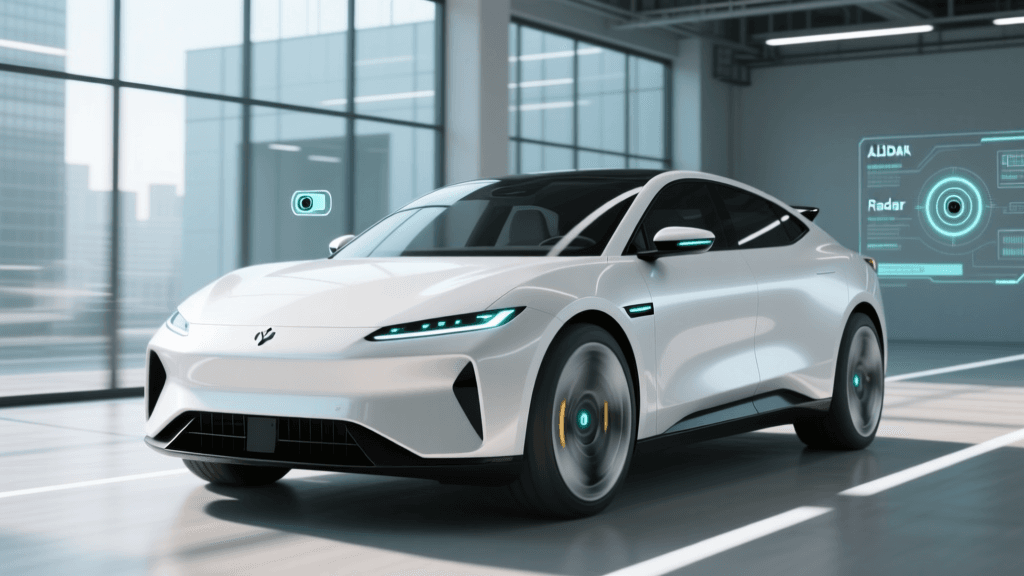
What makes Level 3 fundamentally different is the requirement for massive hardware redundancy and high-definition mapping. Mercedes-Benz DRIVE PILOT utilizes a suite including long-range LiDAR, a rear-window camera for emergency vehicle detection, high-precision GPS, and a sophisticated driver-monitoring camera. The SAE J3016 standard dictates that a Level 3 system must be able to achieve a 'minimal risk condition' (safely stopping the car) if the driver fails to take over when requested. The system will only engage under strict ODD parameters: typically on mapped, divided highways, in daylight, with clear weather, and in heavy traffic under 40 mph.
SAE Level 2 vs. Level 3: Feature & Liability Comparison
| Feature / Metric | SAE Level 2 (Advanced ADAS) | SAE Level 3 (Conditional Automation) |
|---|---|---|
| Steering & Throttle Control | System controls simultaneously | System controls simultaneously |
| Environmental Monitoring | Human driver (primarily) | Vehicle system (within ODD) |
| Fallback Readiness | Human must monitor 100% of the time | Human must be ready to take over (~10 sec warning) |
| Liability in a Crash | Human Driver | Automaker (when engaged within ODD) |
| Eye Tracking Requirement | Strict (Eyes on road at all times) | Relaxed (Eyes off road allowed, but must be awake) |
| Typical Sensor Stack | Cameras, Radar, Ultrasonics | LiDAR, HD Maps, Redundant Cameras, Precision GPS |
| Examples | Tesla Autopilot, GM Super Cruise, Ford BlueCruise | Mercedes DRIVE PILOT, Honda Sensing Elite |
The Sensor Stack Deep Dive: Vision vs. LiDAR Redundancy
The transition from Level 2 to Level 3 has sparked a fierce engineering debate regarding sensor modalities. Tesla famously relies on 'Tesla Vision,' a camera-only approach augmented by neural networks, arguing that LiDAR is a crutch and that human-like vision is the only scalable path to autonomy. However, Tesla's Full Self-Driving (FSD) capability remains legally and technically classified as a Level 2 system.
Conversely, automakers pursuing certified Level 3 autonomy, like Mercedes-Benz, deem LiDAR (Light Detection and Ranging) absolutely essential. LiDAR emits laser pulses to create a mathematically verifiable, high-resolution 3D point cloud of the environment. Unlike cameras, LiDAR is not blinded by sun glare, exiting dark tunnels, or high-contrast shadows. Unlike radar, it does not suffer from 'ghosting' (false positives from overhead signs or adjacent lane vehicles). For an automaker to assume legal liability for a vehicle's actions, the sensor data must be deterministic and redundant. If a camera fails or is obscured by mud, the 1550nm LiDAR array ensures the vehicle still 'sees' the stopped traffic ahead.
The Legal and Insurance Implications
The most profound difference between Level 2 and Level 3 is not found in the code, but in the courtroom. The National Highway Traffic Safety Administration (NHTSA) maintains strict guidelines regarding automated vehicle safety and the human driver's ultimate responsibility in partial automation scenarios.
In a Level 2 vehicle, if the adaptive cruise control fails to recognize a stationary fire truck and rear-ends it, the driver is at fault. The automaker's terms of service explicitly state the system is an assistive feature, not an autonomous pilot. Insurance companies will pursue the human driver for damages and injuries.
In a Level 3 vehicle, when the system is actively engaged within its approved ODD, the liability shifts to the manufacturer. If Mercedes-Benz DRIVE PILOT is engaged in a qualifying traffic jam and the system causes a collision due to a software or sensor failure, Mercedes-Benz assumes legal and financial responsibility. This monumental shift in liability is exactly why automakers are so cautious about rolling out Level 3 technology, restricting it to highly controlled, low-speed, geofenced environments.
Actionable Advice for EV and Smart Car Buyers
If you are in the market for a highly automated EV or luxury vehicle, you must look past the marketing brochures and evaluate the actual technology and costs.
- Verify the SAE Level: Do not be fooled by names like 'Full Self-Driving' or 'Autopilot.' Check the owner's manual or the manufacturer's technical specifications for the SAE J3016 classification. If it requires you to pay attention, it is Level 2.
- Understand the ODD Limitations: If you are buying a car with Level 3 capabilities (like the Mercedes EQS with DRIVE PILOT), understand where it actually works. It will not engage on winding country roads, in heavy rain, or at 75 mph. It is strictly a traffic-jam assistant for specific mapped highways.
- Calculate the Total Cost of Ownership: Advanced ADAS is increasingly moving to subscription models. GM Super Cruise requires a subscription of roughly $25 per month after the initial trial period expires. Tesla FSD costs $8,000 upfront or $199 per month. Mercedes-Benz DRIVE PILOT costs approximately $2,500 for an annual subscription in the US. Factor these recurring costs into your lease or finance calculations.
- Check for Hardware Upgradability: Some Level 2 systems rely on hardware that cannot be upgraded to future Level 3 standards. LiDAR and high-precision GPS antennas are expensive and difficult to retrofit. If Level 3 expansion is important to you, ensure the vehicle is equipped with the necessary redundant sensor suite from the factory.
Conclusion
The automotive industry is currently navigating the 'uncanny valley' of autonomous driving. Level 2 systems are incredibly capable, offering immense comfort on long highway journeys, but they demand unwavering human vigilance. Level 3 systems offer the first true taste of hands-off, eyes-off freedom, but they are heavily restricted by geofencing, weather, and steep subscription costs. As a buyer, understanding the deep technical and legal distinctions between these two tiers of ADAS is the key to making an informed, safe, and financially sound investment in the future of smart driving.