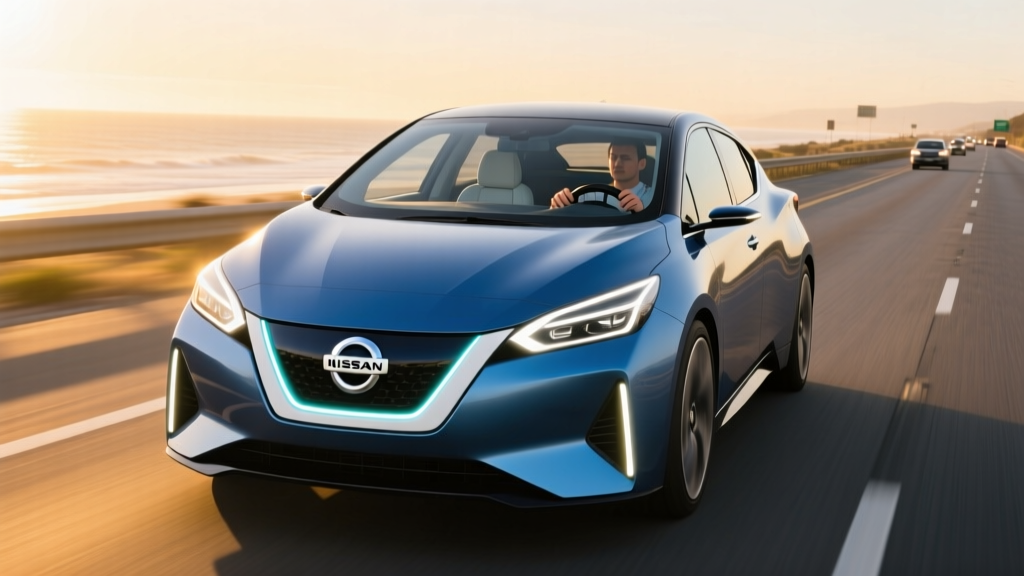
What ProPILOT Assist 2.1 Actually Does
Nissan's ProPILOT Assist 2.1 is the brand's most advanced consumer driver-assistance system, enabling hands-off, eyes-on driving on pre-mapped divided highways at speeds up to approximately 100 mph. It builds on the original ProPILOT Assist (a conventional hands-on lane-centering and adaptive cruise system) by adding high-definition 3D map data, a driver-monitoring camera, and expanded sensor processing to allow the driver to legally remove their hands from the steering wheel under specific conditions.
When conditions are met — compatible highway, clear lane markings, attentiveness confirmed by the infrared driver-monitoring camera — the system controls steering, acceleration, and braking. The driver must remain alert, eyes forward, ready to resume control within seconds when prompted. This is not a robotaxi experience; it is a supervised highway companion.
SAE Automation Level: Level 2 (Partial Driving Automation)
ProPILOT Assist 2.1 is classified as SAE Level 2 per the SAE J3016 standard. The system handles steering and speed simultaneously, but the human driver is the fallback. You must monitor the road at all times. If your gaze leaves the road for more than a few seconds, the system issues escalating alerts — audible chimes, dashboard warnings, and ultimately an emergency stop with hazard lights. Only Level 4 systems (Waymo, Zoox) operate without a human driver in the loop.
How the Sensor Suite and Mapping Work
ProPILOT Assist 2.1 relies on a layered hardware stack that Nissan has been refining since the Ariya's 2023 launch:
- Forward-facing radar (millimeter-wave, mounted behind the front grille) — tracks vehicles ahead for adaptive cruise control at distances up to ~200 meters.
- Front windshield camera — reads lane markings, speed-limit signs, and detects vehicles/pedestrians.
- Surround-view cameras (typically 4–5 units) — provide 360° awareness for lane-change context and parking.
- Ultrasonic sensors — short-range obstacle detection for low-speed maneuvers.
- Driver-monitoring camera (infrared, mounted on the instrument cluster or steering column) — verifies eye direction and head position in real time.
- HD 3D map data — centimeter-precision road-geometry and lane data for supported highway segments, delivered via Nissan's connected-services platform with periodic over-the-air updates.
The HD map data is what separates 2.1 from basic ProPILOT Assist. Without it, the system can center lanes and manage speed, but it cannot authorize hands-off operation. The maps tell the vehicle exactly how many lanes exist, the curvature of the road, and where on-ramps and interchanges occur — reducing reliance on real-time camera interpretation alone.
| Function | ProPILOT Assist 2.1 | Basic ProPILOT Assist |
|---|---|---|
| Hands-off steering (mapped highways) | Yes | No — hands-on required |
| Adaptive cruise control | Yes (full stop-and-go) | Yes |
| Lane centering | Yes | Yes |
| Active Lane Change (driver-confirmed) | Yes | No |
| Driver-monitoring camera | Yes (IR) | Torque sensor only |
| HD 3D map dependency | Yes | No |
| Highway exit/entrance assist | Limited (alerts driver) | No |
| Operational speed range | 0–~100 mph | 0–~90 mph |
Which 2026 Nissan Models Include ProPILOT Assist 2.1?
As of the 2026 model year, ProPILOT Assist 2.1 is reserved for Nissan's upper trims and electric vehicles. Availability has expanded since the Ariya's debut, but it remains a premium-tier feature:
- 2026 Nissan Ariya — Standard on Engage+, Evolve+, Empower+, and Platinum+ trims. Not available on the base Engage (which gets standard ProPILOT Assist).
- 2026 Nissan LEAF — Available on the top SL PLUS trim (SV trim retains basic ProPILOT Assist).
- 2026 Nissan Rogue — Platinum trim standard; SL trim available via the Premium Package (~$2,500 add-on).
- 2026 Nissan Pathfinder — Platinum trim standard.
- 2026 Nissan Altima — SR and Platinum trims with the Technology Package.
Nissan has not migrated ProPILOT Assist 2.1 to its entry-level models (Sentra, Versa, Kicks), which continue to offer the hands-on ProPILOT Assist or Nissan Intelligent Cruise Control. The hardware cost — particularly the driver-monitoring IR camera and HD map licensing — keeps 2.1 out of sub-$30,000 trims for now.
Pricing and Subscription Model
Unlike Ford's BlueCruise or GM's Super Cruise, which have introduced annual subscription fees after an initial trial period, Nissan currently bundles ProPILOT Assist 2.1 into the vehicle purchase with no separate recurring subscription for the core hands-off driving function. Here is how the cost structure breaks down:
| Cost Element | Details |
|---|---|
| One-time hardware cost | Included in trim/package price (no line-item add-on on qualifying trims) |
| HD map data updates | Included with NissanConnect Services trial (typically 3 years), then ~$199/year for connected-services renewal |
| Monthly subscription | None for ProPILOT Assist 2.1 function itself |
| Over-the-air updates | Delivered via NissanConnect; no separate fee |
The critical caveat: if you let your NissanConnect Services subscription lapse after the initial trial, HD map updates will stop. The system will still function with the last-downloaded map data, but newly built or reconfigured highway segments will not be recognized for hands-off operation. For most owners, renewing NissanConnect (~$199/year after year 3) is a sensible insurance policy against map staleness.
Compare this to the competitive landscape:
| System | Brand | Upfront Cost | Subscription Required? |
|---|---|---|---|
| ProPILOT Assist 2.1 | Nissan | Included in trim | No (map updates via NissanConnect) |
| BlueCruise 1.4 | Ford | ~$2,100 package or included on upper trims | Yes — ~$75/year or $750 lifetime after trial |
| Super Cruise | GM (Cadillac/Chevy) | Included on qualifying trims | Yes — ~$25/month or $2,500 lifetime after 3-year trial |
| FSD (Supervised) | Tesla | $8,000 one-time or $99/month | Subscription or one-time purchase |
| Highway Driving Assist 2 | Hyundai/Kia/Genesis | Included in trim | No (hands-on only, no hands-off mode) |
Real-World Performance and Driving Impressions
In real-world highway driving, ProPILOT Assist 2.1 delivers a confident, conservative experience. It is not trying to drive aggressively; it prioritizes smoothness and predictability. Key observations from extended use:
- Lane centering is precise on well-marked interstates. The system holds center position through gentle curves (typical highway radii) without hunting or weaving.
- Active Lane Change requires the driver to signal intent (activate the turn signal), after which the system checks blind spots and executes the lane change. It will abort if a vehicle is detected in the target lane. The maneuver feels deliberate, not sporty — expect a 3–5 second transition.
- Stop-and-go traffic is handled smoothly. The system resumes from a full stop without driver input if the pause is under ~3 seconds; longer stops require a steering-wheel tap or resume button press.
- Speed management adapts to posted limits via sign recognition and map data. Drivers can set an offset (e.g., +5 mph above posted) in the settings menu.
- Merging traffic from on-ramps is where the system shows its Level 2 limitations. ProPILOT 2.1 will adjust speed to create gaps, but it does not proactively negotiate merges the way an attentive human driver would. Expect to take over during heavy interchange congestion.
What ProPILOT Assist 2.1 Does NOT Do
- Drive on unmapped roads. Hands-off mode only activates on HD-mapped divided highways. Surface streets, rural two-lanes, and construction zones default to hands-on ProPILOT Assist.
- Handle severe weather. Heavy rain, fog, snow, or direct sun glare can blind cameras and radar, triggering immediate hands-on reversion. The system does not "see" through weather the way a human can infer context.
- Navigate highway exits or interchanges autonomously. The system alerts the driver to upcoming exits and requires manual takeover for off-ramps.
- Respond to emergency vehicles. ProPILOT 2.1 does not detect or yield to approaching ambulances, fire trucks, or police. The driver must remain responsible for situational awareness.
- Operate without driver supervision. The IR camera monitors eye direction. If you look at your phone, read a book, or close your eyes, the system escalates warnings within seconds and will bring the vehicle to a controlled stop if you do not re-engage.
Real-World Limitations You Should Expect
Every ADAS system has edge cases. Based on owner reports and testing, these are the most common ProPILOT Assist 2.1 limitations:
- Construction zones: Even on mapped highways, temporary lane shifts and barrel-line reroutes confuse the system. ProPILOT 2.1 will disengage hands-off mode and require full manual control in active work zones.
- Faded or conflicting lane markings: Older highway segments with multiple painted-over lane lines degrade camera confidence. The system may issue a "lane markings unclear" alert and revert to hands-on.
- Tunnel segments: GPS signal loss in long tunnels can interrupt HD map positioning. Some tunnels are mapped with inertial-navigation fallback; others trigger disengagement.
- Cold-weather camera obstruction: Ice or condensation on the forward camera or radar (common in sub-25°F mornings) disables the system until sensors clear. Keeping the windshield and grille area clean is essential.
- Map coverage gaps: While Nissan has expanded HD map coverage to most US Interstate highways and major expressways, some newer toll roads and recently reconfigured interchanges may not yet be mapped. Map updates occur quarterly via NissanConnect, but there is always a lag between road completion and map availability.
Safety Record and Driver Responsibility
Nissan has reported no systemic safety failures attributable to ProPILOT Assist 2.1 in its vehicles equipped with the system since its 2023 introduction on the Ariya. The driver-monitoring camera is a critical safety layer — it prevents the complacency that has contributed to incidents in systems lacking robust attention monitoring.
That said, the National Highway Traffic Safety Administration (NHTSA) continues to investigate ADAS-related incidents across all brands. The agency's Standing General Order requires manufacturers to report crashes involving Level 2 and above systems. As of 2026, Nissan's ProPILOT 2.1 incident rate appears low relative to systems with higher market penetration, but sample size remains smaller than Tesla's Autopilot/FSD fleet or GM's Super Cruise population.
The bottom line for safety: ProPILOT Assist 2.1 reduces highway fatigue and can help prevent lane-departure and rear-end collisions. It does not eliminate the need for an attentive, sober, licensed driver behind the wheel.
Frequently Asked Questions
Is ProPILOT Assist 2.1 self-driving?
No. It is an SAE Level 2 driver-assistance system. The driver must remain engaged, eyes on the road, and ready to take over at any moment. Only Level 4 services like Waymo operate without a human driver.
Can I use ProPILOT Assist 2.1 on any road?
Hands-off mode works only on pre-mapped divided highways (primarily Interstates and major expressways). On all other roads, the system defaults to hands-on ProPILOT Assist, which still provides lane centering and adaptive cruise but requires steering-wheel contact.
Does ProPILOT Assist 2.1 change lanes automatically?
It performs Active Lane Change, but only when the driver activates the turn signal. The system checks for clear space and executes the maneuver. It will not initiate a lane change on its own.
What happens if I stop paying for NissanConnect after the trial?
The system continues to function with the last-downloaded HD map data. However, you will not receive map updates, so newly built or modified highway segments will not support hands-off mode. Core ADAS features (adaptive cruise, lane centering, emergency braking) remain fully operational regardless of subscription status.
How does ProPILOT Assist 2.1 compare to Ford BlueCruise or GM Super Cruise?
All three are Level 2 hands-off highway systems with driver monitoring. Super Cruise has the largest mapped-road network (~750,000+ miles). BlueCruise covers ~130,000+ miles. Nissan's HD map coverage is competitive on major Interstates but smaller in total mileage. Nissan's advantage: no mandatory recurring subscription for the core function. Super Cruise and BlueCruise both charge annual or lifetime fees after initial trial periods.
Does the 2026 Nissan Ariya qualify for the federal EV tax credit with ProPILOT 2.1?
Tax credit eligibility under IRS §30D depends on MSRP caps ($55,000 for SUVs like the Ariya), buyer income limits ($300,000 joint / $150,000 single), and battery-component/critical-mineral sourcing requirements — which shift annually. The Ariya's eligibility has varied by model year and trim. Consult a tax professional and check the latest IRS guidance before purchasing. The credit can now be transferred at point of sale as an instant discount if all requirements are met.