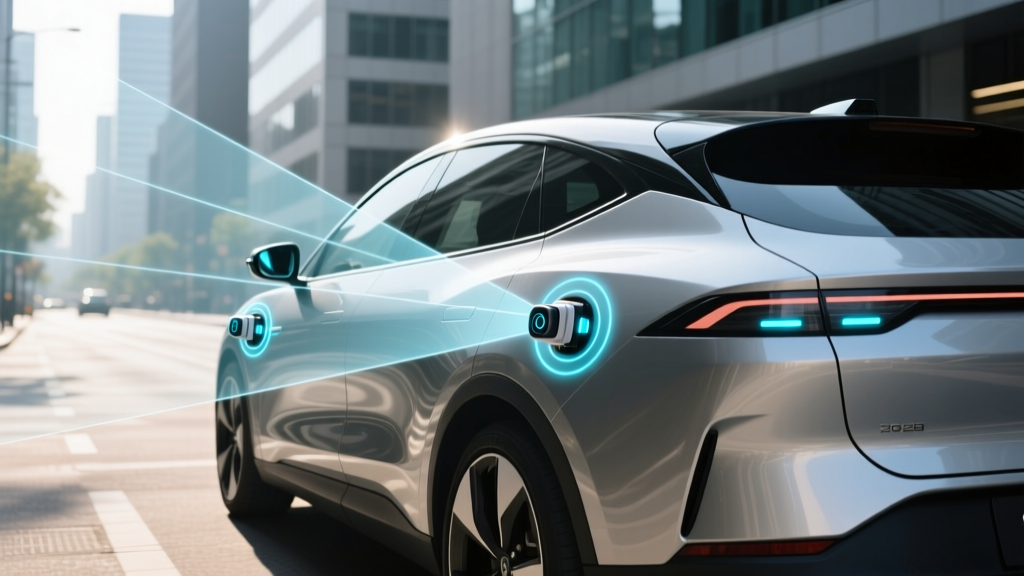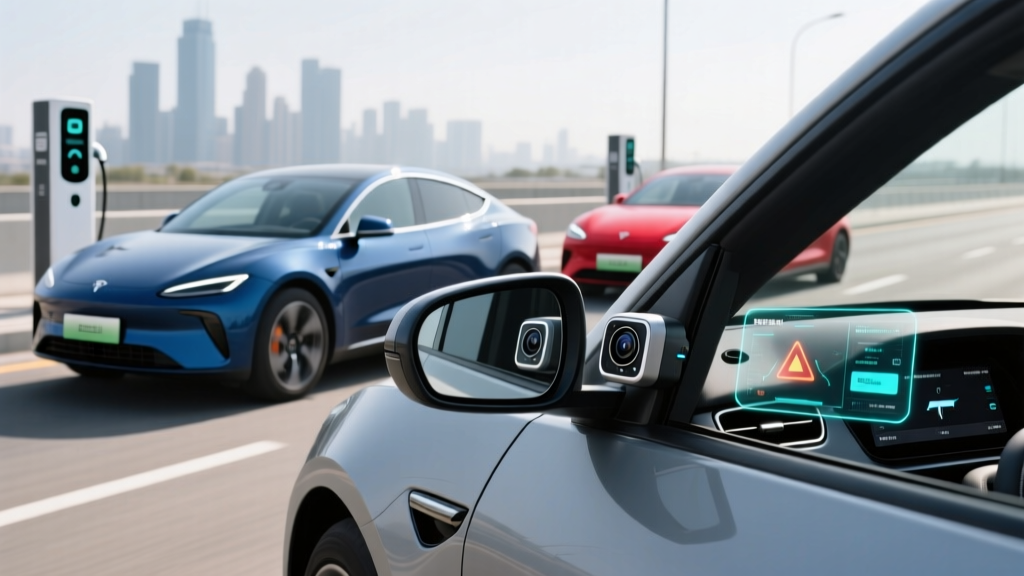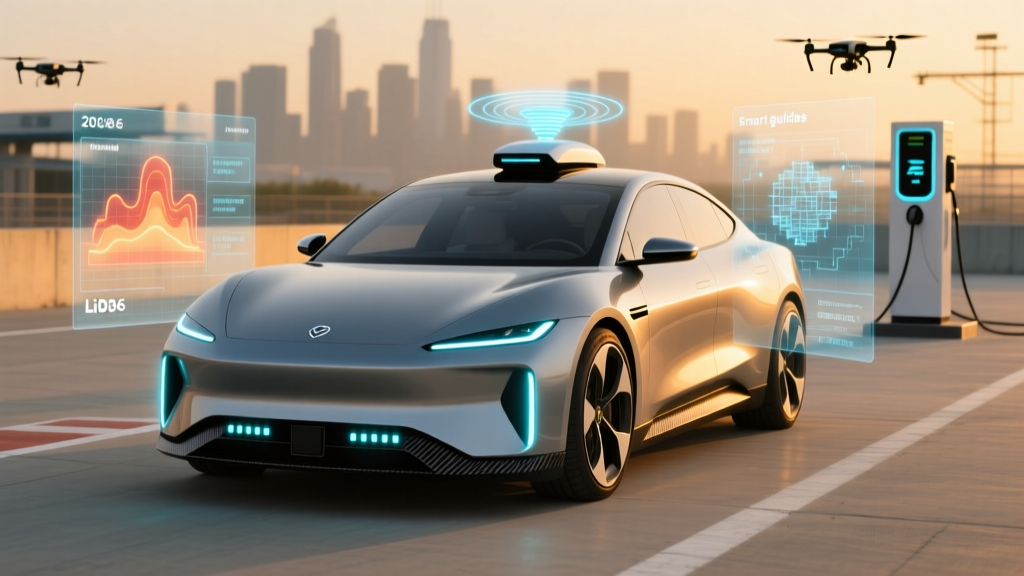
If you have ever watched a promotional video for an advanced driver-assistance system (ADAS) and seen a glowing 3D point cloud surrounding a vehicle, you might wonder: just how far does that sensor penetration go? Specifically, can LiDAR see through walls? The short answer is no — but understanding why reveals a lot about how modern EVs perceive the world, where the technology excels, and where it falls dangerously short.
This guide breaks down the physics of LiDAR, compares it to radar and camera systems used in today's EVs, and explains exactly what your car's ADAS can and cannot detect. We will also cover which 2026 models use LiDAR, what these systems cost, and the critical SAE automation levels every buyer should understand before trusting any driver-assist feature.
How LiDAR Actually Works: Light, Not X-Rays
LiDAR — Light Detection and Ranging — fires hundreds of thousands of near-infrared laser pulses per second (typically at 905 nm or 1550 nm wavelengths) and measures the time it takes for each pulse to bounce back. By calculating this time-of-flight, the sensor builds a precise 3D point cloud of the environment, often resolving objects to within centimeters at distances exceeding 200 meters.
Because LiDAR relies on reflected light, it is fundamentally a line-of-sight technology. The laser pulses cannot penetrate opaque solid objects — walls, buildings, large trucks, or dense foliage all block the beam entirely. When a pulse hits a wall, the sensor maps the wall's surface. It has zero ability to detect what lies on the other side.
This is a common misconception fueled by science-fiction depictions of "see-through" sensors. In reality:
- LiDAR cannot see through walls, buildings, or solid barriers.
- LiDAR cannot see through heavy rain, dense fog, or snow accumulation — water droplets and ice scatter the infrared pulses, degrading range and accuracy.
- LiDAR cannot see around corners. It only maps what is in its direct optical path.
- LiDAR can see in total darkness — because it provides its own illumination source, it does not rely on ambient light the way cameras do.
LiDAR vs. Radar vs. Cameras: What Each Sensor Actually Detects
Modern ADAS does not rely on a single sensor type. Automakers use sensor fusion — combining data from multiple sensor modalities to compensate for each one's weaknesses. Here is how the three primary sensor types compare in 2026 production vehicles:
| Capability | LiDAR | Radar | Cameras |
|---|---|---|---|
| See through walls/solids | ❌ No | ❌ No (but partial penetration of some non-metallic materials at specific frequencies) | ❌ No |
| Performance in darkness | ✅ Excellent (self-illuminating) | ✅ Excellent (radio waves) | ⚠️ Reduced (needs ambient light or IR assist) |
| Heavy rain/fog performance | ⚠️ Degraded (scatter) | ✅ Good (longer wavelengths penetrate better) | ⚠️ Degraded |
| 3D spatial resolution | ✅ Centimeter-level | ⚠️ Lower resolution | ✅ High (but depth estimation is computed) |
| Read traffic signs/signals | ❌ No (no color/text) | ❌ No | ✅ Yes |
| Effective range | 150–300 m | 200–300+ m | 150–250 m (varies with lens/lighting) |
| Velocity detection | ⚠️ Computed from sequential frames | ✅ Direct (Doppler effect) | ⚠️ Computed |
| Approx. unit cost (2026) | $500–$1,500+ | $50–$200 | $20–$150 per module |
The key takeaway: no sensor on any consumer vehicle can see through walls or fully occluding objects. Radar comes closest to "seeing through" certain non-metallic barriers (like plastic bumpers or thin drywall at specific GHz frequencies), but this is not a feature — radar is mounted behind the vehicle's bumper fascia by design, and its signals do not meaningfully penetrate buildings, other vehicles, or terrain.
Which 2026 EVs Actually Use LiDAR?
LiDAR adoption in consumer EVs has grown but remains far from universal. Tesla famously eschews LiDAR entirely, relying on a camera-only ("Tesla Vision") approach. Meanwhile, several competitors have embraced LiDAR as a core sensor for their ADAS stacks. Here is where LiDAR stands in the 2026 model year:
| Automaker | ADAS Brand Name | LiDAR Included? | Models/Trims (2026) | Sensor Count |
|---|---|---|---|---|
| Mercedes-Benz | Drive Pilot | ✅ Yes (Valeo SCALA 3) | S-Class, EQS (optional, specific markets) | 1 LiDAR + radar + cameras + ultrasonic |
| Volvo / Polestar | Pilot Assist / Core ADAS | ✅ Yes (Luminar Iris) | EX90, Polestar 3 (standard) | 1 LiDAR + 5 radar + 8 cameras |
| Lotus | Lotus Pilot | ✅ Yes (4× LiDAR) | Eletre, Emeya | 4 LiDAR + radar + cameras |
| XPeng | XNGP | ✅ Yes | G6, G9, P7+ (select trims) | 2 LiDAR + radar + cameras |
| BYD | DiPilot | ✅ Yes (select models) | Seal U, Han (higher trims) | 1 LiDAR + radar + cameras |
| Tesla | Autopilot / FSD (Supervised) | ❌ No (camera-only) | All models | 8 cameras (no LiDAR, no radar) |
| Ford | BlueCruise | ❌ No (camera + radar) | Mustang Mach-E, F-150 Lightning (select trims) | Radar + cameras + ultrasonic |
| GM (Chevrolet/Cadillac) | Super Cruise | ❌ No (camera + radar + HD maps) | Silverado EV, Cadillac Lyriq, Celestiq | Radar + cameras + LiDAR-mapped roads |
Notably, the Volvo EX90 made LiDAR standard equipment — a first for a mainstream luxury SUV sold in the United States — positioning the Luminar Iris unit as a safety feature rather than a premium upsell. Mercedes-Benz's Drive Pilot, meanwhile, remains the only system with conditional SAE Level 3 approval in limited U.S. jurisdictions (Nevada and California), allowing hands-off, eyes-off driving below 40 mph on mapped divided highways.
- Level 0: No automation. Warnings only (beeps, alerts).
- Level 1: Single-axis assist — either steering OR speed (adaptive cruise OR lane centering).
- Level 2: Combined steering AND speed assist. Driver must remain fully engaged and supervise at all times. This covers Tesla Autopilot/FSD (Supervised), Ford BlueCruise, GM Super Cruise, and virtually all consumer ADAS.
- Level 3: Conditional automation — the car drives itself in defined conditions, but the driver must take over when requested. (Mercedes Drive Pilot, limited markets only.)
- Level 4: High automation — no driver needed in a defined operational domain. (Waymo robotaxis in Phoenix, SF, LA. Not available in consumer vehicles.)
- Level 5: Full automation everywhere, all conditions. Does not exist in production today.
Is Any Consumer ADAS Truly Self-Driving?
No. Despite marketing language that sometimes implies otherwise, every consumer-purchasable ADAS system in 2026 — with the narrow exception of Mercedes Drive Pilot under its specific Level 3 operational design domain — requires an attentive, engaged driver at all times.
Tesla's Full Self-Driving (Supervised) is a Level 2 system. The "Supervised" parenthetical, which Tesla added to its branding following NHTSA scrutiny, is there for a reason: you must watch the road, keep your hands available, and be ready to intervene instantly. The system can navigate intersections, handle stop signs, and change lanes, but it cannot see through walls, predict a pedestrian emerging from behind a delivery truck, or reliably interpret construction-zone flaggers.
Ford's BlueCruise and GM's Super Cruise are also Level 2. BlueCruise allows hands-off driving on pre-mapped divided highways (over 130,000 miles of "Blue Zones" as of 2026), but uses a driver-facing camera to confirm your eyes remain on the road. Super Cruise operates similarly on over 750,000 miles of mapped roads, using an attention-monitoring camera on the steering column.
Neither system can operate safely without driver supervision. If you disengage — look at your phone, close your eyes, or fail to respond to takeover requests — the systems will issue escalating warnings and eventually bring the vehicle to a controlled stop with hazard lights activated.
What These Systems Cost: Purchase, Subscription, and Included Models
ADAS pricing in 2026 varies dramatically by automaker. Some include advanced features as standard equipment; others charge thousands upfront or require ongoing subscriptions. Here is a breakdown of the major systems:
| System | One-Time Purchase | Monthly Subscription | Included Standard? |
|---|---|---|---|
| Tesla FSD (Supervised) | $8,000 | $99/month | No (basic Autopilot is standard) |
| Ford BlueCruise | Included (select trims, 1–4 yr trial) | ~$75/year after trial | On Premium/Lariat+ trims only |
| GM Super Cruise | Included (3-year trial on most trims) | ~$25/month after trial | Select trims (not base) |
| Mercedes Drive Pilot | $2,500 (where available) | N/A | No (optional, S-Class/EQS only) |
| Volvo EX90 (Pilot Assist + LiDAR) | N/A | N/A | ✅ Yes (standard on all EX90 trims) |
| Toyota/Lexus (Safety Sense / Teammate) | N/A | $5–$10/month (Teammate) | Safety Sense standard; Teammate optional |
Volvo's decision to bundle LiDAR as standard on the EX90 (starting around $77,000 MSRP) is notable — it treats the sensor as core safety hardware, similar to how airbags became standard rather than optional. Tesla's approach is the opposite: FSD is a premium upsell, and the company continues to refine its camera-only neural network without adding LiDAR or radar hardware.
Real-World Limitations: Where ADAS Struggles in Daily Driving
Understanding what your ADAS cannot do is more important than knowing what it can. Here are the most common real-world failure modes and edge cases we encounter in testing:
Weather Degradation
Heavy rain, snow accumulation on sensors, and dense fog all reduce effective sensor range. LiDAR scatters in precipitation — a system rated for 250 m range in clear conditions may drop to under 80 m in moderate rain. Camera systems struggle with sun glare, heavy precipitation, and darkness on unlit roads. Radar is the most weather-resilient sensor, which is why it remains a core component even on LiDAR-equipped vehicles.
Construction Zones and Unmapped Changes
Lane shifts, temporary barriers, and missing lane markings confuse systems that rely on painted lines and HD map data. Super Cruise disengages entirely outside its mapped road network. FSD (Supervised) attempts to navigate construction zones but has been known to follow outdated lane markings or fail to recognize temporary stop signs.
Occluded Pedestrians and Cyclists
This is the scenario the "can LiDAR see through walls" question points toward. If a pedestrian is fully blocked from the sensor's line of sight — stepping out from behind a parked delivery van, emerging from a building doorway, or crossing between two large trucks — no sensor will detect them until they are physically visible. The reaction time at that point depends entirely on vehicle speed, braking system latency, and whether the driver is already prepared to intervene.
Phantom Braking
All ADAS systems occasionally brake for non-threats — shadows, overhead signs, or roadside objects the perception stack misclassifies. Tesla's camera-only system has drawn particular scrutiny for phantom braking events, though radar-equipped systems are not immune. This is annoying at best and dangerous at worst when following traffic is not expecting sudden deceleration.
Highway Merge and Exit Ramps
Short on-ramps, tight cloverleaf interchanges, and high-speed differentials remain challenging. Most Level 2 systems handle standard highway driving well but require driver takeover for complex merges, especially where lane markings are worn or absent.
Does LiDAR Make a Car Safer? The Data So Far
The honest answer: we do not yet have enough large-scale, peer-reviewed crash data to definitively prove that LiDAR-equipped consumer vehicles have lower accident rates than camera-only or radar-only vehicles. What we do know is that LiDAR provides redundant depth perception — an independent measurement of the 3D environment that does not depend on lighting conditions or neural-network inference quality.
Volvo has stated that the EX90's LiDAR system can detect a small object (like a tire tread on a dark highway) at 120 meters and a pedestrian at 250 meters, even in total darkness. These are distances at which a camera system operating at night may struggle to classify an object with high confidence. The Insurance Institute for Highway Safety (IIHS) continues to evaluate ADAS performance through its crash-avoidance testing protocols, but LiDAR-specific comparative safety data remains limited as of early 2026.
What is clear is that sensor fusion — combining LiDAR, radar, and cameras — provides more information than any single sensor modality alone. Whether that additional information translates to measurably fewer crashes depends on the quality of the software interpreting it. Hardware is necessary but not sufficient.
The Bottom Line: What EV Buyers Should Know
If you are shopping for an EV with advanced driver assistance, here is the practical framework:
- You want maximum sensor redundancy for nighttime and low-visibility driving
- You are willing to pay a premium ($70,000+) for hardware that may improve safety margins
- You value standard inclusion over subscription-based features
- You prioritize hands-off highway driving on mapped roads (Super Cruise / BlueCruise excel here)
- You want a broader model selection at lower price points
- You are comfortable with subscription costs after initial trial periods
- You are the driver. These are Level 2 assist systems (with the narrow Mercedes Level 3 exception).
- No sensor sees through walls, around corners, or behind occluding objects.
- Weather, construction zones, and unmapped changes will require your immediate intervention.
Frequently Asked Questions
Can LiDAR see through walls or buildings?
No. LiDAR uses near-infrared laser pulses that reflect off solid surfaces. It maps the surface it hits — a wall, a vehicle, a tree — but cannot detect anything behind that surface. This is a fundamental physics limitation, not a software shortcoming.
Can radar see through walls?
Automotive radar (77 GHz) can partially penetrate some non-metallic materials like plastic bumper fascia (which is why radar units are mounted behind them). However, it cannot meaningfully "see through" buildings, other vehicles, earth, or thick concrete barriers. The signal attenuates rapidly in dense materials.
Is Tesla's FSD (Supervised) self-driving?
No. Tesla FSD (Supervised) is an SAE Level 2 driver-assist system. Despite its name, it requires the driver to remain fully attentive, with hands available and eyes on the road at all times. Tesla added the "(Supervised)" qualifier to its branding to make this explicit.
Which consumer EVs have LiDAR in 2026?
The Volvo EX90 and Polestar 3 (standard), Lotus Eletre and Emeya, Mercedes S-Class/EQS (Drive Pilot option), XPeng G6/G9/P7+ (select trims), and select BYD models. Tesla, Ford, and GM do not use LiDAR in their consumer vehicles.
How much does Tesla FSD cost in 2026?
Tesla FSD (Supervised) is available as a one-time $8,000 purchase or a $99/month subscription. Basic Autopilot (adaptive cruise + lane centering) comes standard on all new Tesla vehicles.
Does LiDAR work in rain and snow?
LiDAR performance degrades in precipitation. Water droplets and snowflakes scatter the infrared laser pulses, reducing effective detection range. In moderate to heavy rain, a LiDAR system rated for 250 m may effectively see less than 80 m. This is why LiDAR-equipped vehicles also carry radar, which performs better in adverse weather.
What is the difference between Super Cruise and BlueCruise?
Both are Level 2 hands-off highway driving systems that use driver-monitoring cameras. GM's Super Cruise covers over 750,000 miles of pre-mapped roads in North America. Ford's BlueCruise covers over 130,000 miles of "Blue Zone" divided highways. Neither uses LiDAR. Both require driver attention and will stop the vehicle if the driver becomes unresponsive.