If you drive a modern electric vehicle equipped with Blind Spot Monitoring (BSM), you might wonder whether an aftermarket blind spot mirror is even necessary — and if so, where do you put a blind spot mirror without interfering with your car's built-in sensors? The short answer is that a stick-on convex mirror can still be a valuable supplement to electronic BSM, but placement matters far more than most drivers realize, especially when radar modules and camera housings occupy the same real estate on your side mirrors.
This guide breaks down the optimal placement for a blind spot mirror on EVs with factory BSM, explains how electronic and optical systems complement each other, and details exactly what modern BSM systems can and cannot do in real-world driving.
How Blind Spot Monitoring Works on Modern EVs
Blind Spot Monitoring is a driver-assistance feature that uses 24 GHz or 77 GHz radar sensors mounted behind the rear bumper fascia (and sometimes in the rear quarter panels) to detect vehicles in adjacent lanes. When a vehicle enters the detection zone — typically spanning from the B-pillar rearward to approximately 10–15 feet beyond the rear bumper — the system illuminates a warning indicator, usually an LED embedded in the side mirror housing or on the A-pillar interior.
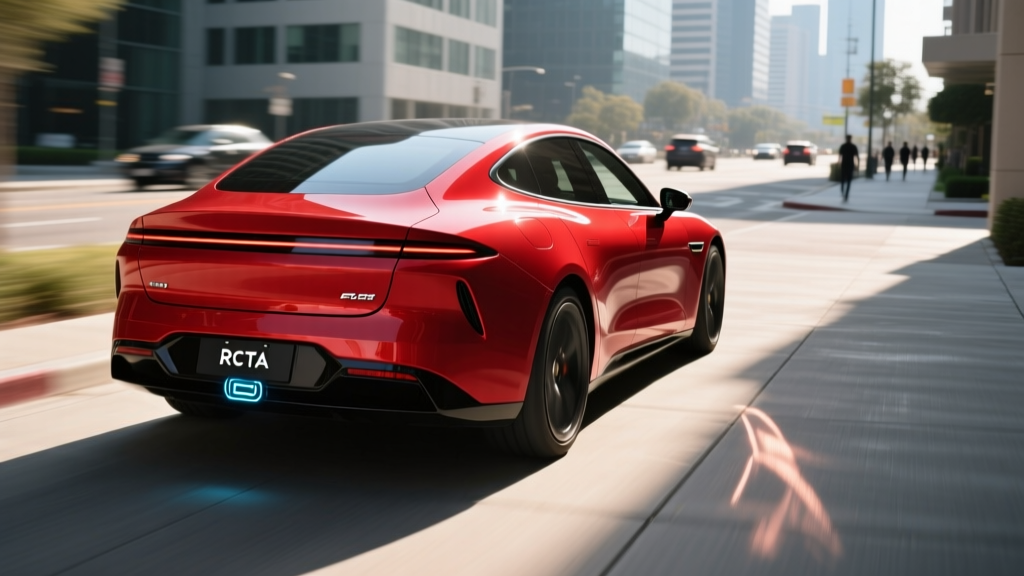
Most EV manufacturers bundle BSM with Rear Cross-Traffic Alert (RCTA), which activates when reversing out of parking spaces. Some premium systems add Blind Spot Collision-Avoidance Assist, which can apply steering torque or selective braking to prevent a lane-change collision.
Blind Spot Monitoring is classified as SAE Level 0 (warning only) or Level 1 (intervention capable, single-axis). It is not an autonomous driving feature. The driver remains fully responsible for lane-change decisions at all times. Even systems with active steering intervention operate only in specific scenarios and require continuous driver supervision.
The Case for Adding a Physical Blind Spot Mirror
Electronic BSM systems are excellent at detecting vehicles in adjacent lanes, but they have known limitations:
- Stationary objects: Most BSM radar filters out stationary targets (guardrails, bollards, parked cars) to reduce false alarms. A cyclist or motorcyclist stopped beside you may not trigger an alert.
- Motorcycles and bicycles: Narrow-profile road users can sometimes pass through radar detection zones without consistent tracking, particularly in heavy rain.
- Sensor obstruction: Heavy road spray, ice buildup on the rear bumper, or mud can attenuate radar signals and reduce detection reliability.
- Detection zone gaps: BSM typically covers a zone offset roughly 3–15 feet behind and beside the vehicle. Objects very close to the rear quarter panel — the so-called "close-coupled" blind zone — may not register until they move laterally.
A properly placed convex blind spot mirror fills these gaps with a direct optical view, requiring no power, no sensors, and no software updates.
Where Do You Put a Blind Spot Mirror on an EV with BSM?
Optimal placement depends on the geometry of your EV's side mirror housing and the location of the BSM indicator LED. Here is the framework:
Step 1: Identify Your BSM Indicator Location
Most EVs place the BSM warning icon in one of three positions:
- On the mirror glass itself — an icon etched or printed into the lower portion of the mirror surface (common on Tesla Model 3/Y, Hyundai Ioniq 5/6)
- On the mirror housing bezel — an LED set into the frame around the mirror (common on Ford Mustang Mach-E, Rivian R1S/R1T)
- On the interior A-pillar or door panel — a separate indicator inside the cabin (common on BMW iX, Mercedes EQS)
Step 2: Place the Convex Mirror Opposite the BSM Indicator
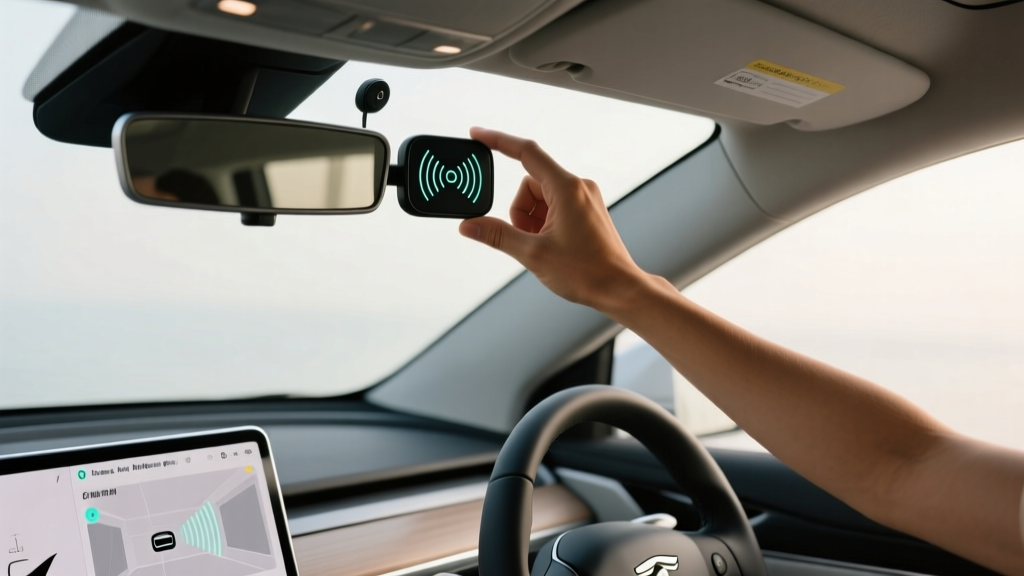
The cardinal rule: never cover the BSM indicator with the aftermarket mirror. If your BSM icon appears in the lower-left corner of the driver's side mirror, place the convex mirror in the upper-outboard corner. If the indicator is in the mirror housing bezel, you have more flexibility — the lower-outboard corner of the glass is typically optimal.
Step 3: Angle for the Close-Coupled Zone
Adjust the convex mirror so it shows the area directly alongside the rear quarter panel and rear door — the zone that your main mirror, even when properly adjusted using the SAE-recommended wide-set method, cannot fully cover. The goal is to see a cyclist or compact car that has pulled up to your rear wheel area at a stoplight.
| System | Covers Adjacent Lane Vehicles | Covers Close-Coupled Zone | Detects Cyclists/Pedestrians | Works in Heavy Rain/Ice | Requires Power |
|---|---|---|---|---|---|
| Factory BSM (Radar) | Yes (moving) | Partial | Inconsistent | Degraded | Yes |
| Stick-On Convex Mirror | Partial | Yes (optical) | Yes (visible) | Yes (if clean) | No |
| Surround-View Camera (360°) | Yes (low speed) | Yes | Yes | Degraded (lens obstruction) | Yes |
How EV Brand BSM Systems Compare
Not all Blind Spot Monitoring systems are equal. Detection range, intervention capability, and naming conventions vary significantly by manufacturer. Here is how major EV brands configure BSM as of the 2025–2026 model years:
| Brand | Feature Name | Active Intervention? | Standard On | Cost |
|---|---|---|---|---|
| Tesla | Blind Spot Camera + Warning | No (visual/audio only) | All models, all trims | Included |
| Hyundai/Kia/Genesis | Blind-Spot Collision-Avoidance Assist (BCA) | Yes (steering + braking) | SEL trim and above | Included in trim |
| Ford | BLIS (Blind Spot Information System) with Cross-Traffic Alert | No (warning only on most); Active on select | XLT (Mach-E), Lariat (F-150 Lightning) | Included in trim or ~$695 package |
| Rivian | Blind Spot Warning | No (warning only) | All Adventure/Ascend trims | Included |
| BMW | Active Blind Spot Detection | Yes (steering torque) | i4 eDrive40, iX xDrive50 and above | Included or part of ~$1,700 Driving Assistance Package |
| Mercedes-Benz | Active Blind Spot Assist | Yes (braking + exit warning) | EQE/EQS mid-to-high trims | Included or part of Driver Assistance Package (~$1,950) |
| Volvo/Polestar | Blind Spot Information System (BLIS) with Steer Assist | Yes (steering) | Plus/Ultimate trims (Volvo); Plus (Polestar) | Included in trim |
Real-World Limitations Every EV Owner Should Know
- It does not steer the car for you during lane changes. Even "active" BSA systems only apply corrective torque if a collision is imminent — they do not execute lane changes autonomously.
- It does not replace mirror checks. NHTSA guidance and every manufacturer owner's manual explicitly state that BSM is a supplement to visual checks, not a replacement.
- It does not detect fast-approaching vehicles reliably in all conditions. A vehicle approaching at 30+ mph over your speed may enter and exit the detection zone before the system processes an alert, especially at highway speeds above 75 mph.
- It does not function identically across all trims. Entry-level trims on several EVs (e.g., base Standard Range Model 3, Mach-E Select) may lack BSM entirely or offer a reduced-functionality version.
- It does not eliminate the close-coupled blind zone. The area immediately beside the rear doors and rear wheels remains partially uncovered by radar, which is exactly where a properly placed convex mirror adds value.
In cold-weather testing, we've observed that ice accumulation on rear bumpers can reduce BSM detection range by an estimated 40–60%, and in some cases cause the system to display a "BSM unavailable" warning on the instrument cluster. This is a scenario where a simple $5 convex mirror provides a reliable fallback.
Cost: Factory BSM vs. Aftermarket Mirror
| Option | One-Time Cost | Subscription Required? | Maintenance |
|---|---|---|---|
| Factory BSM (included in trim) | $0 incremental (bundled in trim price) | No | Sensor calibration after rear-end collision (~$200–$500) |
| Factory BSM (add-on package) | $300–$1,950 depending on brand/package | No | Same as above |
| Aftermarket convex blind spot mirror (pair) | $5–$15 | No | Replace adhesive annually; clean regularly |
| Tesla camera-based blind spot view (in-car display) | $0 (included) | No (standard feature) | Camera lens cleaning |
Notably, no major automaker currently charges a subscription specifically for BSM functionality. Unlike features such as Tesla's Full Self-Driving (Supervised) at $99/month or GM's Super Cruise at $25/month, BSM is treated as a safety feature and included outright. This is consistent with NHTSA's positioning of BSM as a core crash-avoidance technology.
Which Models Include BSM Standard in 2025–2026?
Availability of standard BSM has expanded significantly. As of 2025–2026 model years, the following popular EVs include BSM on all trims (no package upgrade required):
- Tesla Model 3 / Model Y — camera-based blind spot visualization on center display plus mirror indicators, all trims
- Hyundai Ioniq 5 — BCA standard from SEL trim ($45,500 MSRP); base SE ($42,400) includes BSW (warning only, no active intervention)
- Kia EV6 — BCA standard from Wind trim ($48,700); base Light ($42,900) includes warning only
- Chevrolet Equinox EV — standard on all trims starting at $33,600 MSRP
- Volkswagen ID.4 — standard on S trim and above ($40,700+); base Pro ($39,735) includes Side Assist (warning only)
Models where BSM requires an upgraded trim or package include the Ford Mustang Mach-E (standard from Premium trim, ~$48,995) and the BMW i4 (included from eDrive40, ~$57,900, but not on base eDrive35). Always verify the specific trim's equipment list on the manufacturer's build-and-price tool before purchasing.
Frequently Asked Questions
Where exactly do you put a blind spot mirror on a Tesla Model 3 or Model Y?
Tesla's blind spot camera feed appears on the center touchscreen, and the BSM indicator is a visual icon on the mirror glass (lower portion). Place the convex mirror in the upper-outboard corner of the driver's side mirror glass. This keeps the factory icon visible while giving you a wide-angle view of the close-coupled zone near the rear wheel arch.
Is a blind spot mirror necessary if my EV already has BSM?
Not strictly necessary, but beneficial as a supplement. BSM radar excels at detecting moving vehicles in adjacent lanes but can miss stationary objects, narrow-profile cyclists, and vehicles in the close-coupled zone directly beside the rear doors. A convex mirror costs under $10 and provides a reliable optical backup that works in conditions where radar may be degraded (ice, heavy rain, sensor obstruction).
Does adding an aftermarket blind spot mirror interfere with auto-dimming or heated mirror functions?
Generally no, as long as the convex mirror is a surface-mount sticker placed on the outer face of the mirror glass and does not cover the auto-dimming sensor (typically a small photodiode near the mirror's center or edge). Check your mirror housing for a small dark circle or square — that's the ambient light sensor for auto-dimming. Avoid covering it.
What size blind spot mirror should I use on an EV?
A 2-inch (50mm) round or fan-shaped convex mirror is optimal for most EV side mirrors. Larger mirrors (3-inch+) can obstruct too much of the primary mirror's view. Look for mirrors rated at 150°–180° field of view with shatter-resistant glass rather than acrylic, which scratches and hazes over time.
Can I use a blind spot mirror on the passenger side too?
Yes, and it's recommended. The passenger-side blind zone is larger due to the greater distance from the driver's eyes to the passenger mirror. Place the convex mirror in the lower-inboard corner of the passenger mirror to maximize coverage of the right-side close-coupled zone while keeping the main mirror view of traffic behind you unobstructed.
Blind Spot Monitoring is one of the most valuable safety features on modern EVs, and according to IIHS research, BSM reduces lane-change crashes by approximately 14%. But it's a supplement to your eyes, not a replacement for them. A well-placed $8 convex mirror and a proper shoulder check remain the most reliable systems you have — regardless of how many radar sensors your EV carries.