You bought your EV or plug-in hybrid, and after a few months of ownership, you realize something is missing: blind spot monitoring (BSM). Maybe your base trim didn't include it, maybe you're driving an older Model 3 or early Bolt EV, or maybe you simply didn't prioritize driver-assistance features at purchase time. The question every owner eventually asks is straightforward: can you add blind spot monitoring to a car that didn't come with it from the factory?
The short answer is yes — but the method, cost, and reliability vary enormously depending on whether you pursue a factory retrofit, an OEM software unlock, or an aftermarket installation. For EV and PHEV owners, there are additional considerations around high-voltage wiring proximity, over-the-air update compatibility, and integrated sensor suites that gas-car owners don't face.
This guide breaks down every viable path to adding BSM, what the feature actually does at the sensor level, where it falls short, and how much you should expect to spend.
What Blind Spot Monitoring Actually Does (and Doesn't Do)
Blind spot monitoring uses radar sensors — typically 24 GHz or 77 GHz millimeter-wave units — mounted behind the rear bumper fascia or, in some implementations, ultrasonic sensors embedded in the rear quarter panels. These sensors continuously scan the lanes adjacent to your vehicle at speeds generally above 20 mph, detecting vehicles that enter your blind zones (roughly from the B-pillar back and extending 10–15 feet behind the rear bumper).
When a vehicle is detected in your blind spot, the system illuminates a warning indicator — usually an amber icon in or near the side mirror. If you activate your turn signal while a vehicle is present, the warning escalates: the indicator flashes, and some systems add an audible chime or haptic feedback through the steering wheel or seat.
Blind spot monitoring is classified as SAE Level 0 (warning-only) or Level 1 (if paired with active steering intervention like Blind Spot Avoidance Assist). The driver remains fully responsible for all lane-change decisions. BSM does not steer, brake, or accelerate the vehicle autonomously. Even systems marketed as "active" blind spot intervention require the driver to remain engaged and are not a substitute for mirror checks and shoulder looks.
Some advanced implementations go beyond passive warnings:
| Feature Tier | What It Does | SAE Level | Examples |
|---|---|---|---|
| BSM (warning only) | Visual/audible alert when vehicle detected in blind zone | Level 0 | Toyota Safety Sense, Honda Sensing, most base trims |
| BSM with Rear Cross-Traffic Alert (RCTA) | Adds detection of crossing vehicles while reversing | Level 0 | Hyundai SmartSense, Kia Highway Driving Assist packages |
| Active Blind Spot Assist | Applies gentle steering correction or brake intervention to prevent lane change into occupied lane | Level 1 | Mercedes-Benz Active Blind Spot Assist, Genesis Highway Driving Assist |
| Blind Spot View Monitor | Displays live camera feed of blind zone on instrument cluster when turn signal activated | Level 0 | Hyundai/Kia (IONIQ 5, EV6, Telluride), Honda LaneWatch (discontinued) |
OEM Retrofit: Can Your Dealer Add Factory BSM?
The cleanest path to adding blind spot monitoring is through the manufacturer's own parts and service network. Several OEMs offer BSM as a dealer-installed accessory or port-installed option, particularly for models where the wiring harness was pre-routed at the factory even on base trims.
Which EV and PHEV Models Support OEM BSM Retrofit?
Based on current 2025–2026 model-year accessory catalogs and dealer installation bulletins:
- Hyundai IONIQ 5 / IONIQ 6: SEL and above trims include BSM standard. The base SE trim does not include the rear radar sensors, but Hyundai's accessory catalog lists a dealer-installed BSM/RCTA package (part number series 95400) for approximately $600–$850 installed, depending on dealer labor rates. The wiring harness on SE trims is typically pre-routed, making this a plug-and-play addition.
- Kia EV6 / EV9: Similar to Hyundai, the Wind and above trims include BSM. The Light trim (base EV6) can receive a dealer-installed BSM kit. Kia lists the accessory at roughly $550–$750 installed.
- Toyota bZ4X / Prius Prime: Toyota Safety Sense 3.0 includes BSM standard on nearly all 2025–2026 trims. Retrofitting is generally unnecessary, but for 2023 bZ4X XLE models that shipped without the feature due to supply-chain deletions, Toyota authorized dealer reinstallation under service campaign 23TB-01.
- Ford Mustang Mach-E: Select trim includes BLIS (Blind Spot Information System) standard. The base Select RWD omitted it in early model years; Ford's accessory program offered a dealer-installed BLIS package for approximately $700–$900. Availability for 2025–2026 model years varies by VIN — check with your dealer's parts department.
- Chevrolet Equinox EV / Blazer EV: Most trims include BSM standard as part of Chevy Safety Assist. Base 2LT trims in earlier model years could add a Driver Confidence Package at the factory; dealer retrofit is limited and not officially supported in the accessory catalog.
The Tesla Situation: Software-Locked vs. Hardware-Present
Tesla's approach is unique. All current Model 3, Model Y, Model S, and Model X vehicles ship with the camera hardware necessary for blind spot detection. Tesla's blind spot monitoring (displayed on the instrument screen as a visual overlay and accompanied by audible warnings) is included in the base software — it is not locked behind the Full Self-Driving (Supervised) subscription. If your Tesla appears to lack BSM, it is likely disabled in Settings > Autopilot > Blind Spot Camera. Note that Tesla removed ultrasonic sensors (USS) from vehicles built after October 2022, relying entirely on its Tesla Vision camera-based system. This means BSM performance is vision-dependent and can degrade in heavy rain, fog, or when cameras are obstructed by dirt or ice.
Aftermarket Blind Spot Monitoring: What's Available and What to Watch For
If your vehicle's manufacturer doesn't offer an OEM retrofit, the aftermarket provides several options. However, quality varies dramatically, and EV owners face specific integration challenges that gas-car owners typically don't encounter.
Aftermarket BSM System Types
| Type | Sensor Technology | Detection Range | Typical Cost (Installed) | Ease of Integration |
|---|---|---|---|---|
| Radar-based (77 GHz) | Millimeter-wave radar behind bumper | Up to 65 ft rear, 2 adjacent lanes | $400–$900 | Moderate — requires bumper removal, wiring to cabin |
| Ultrasonic-based | Sensors drilled into rear bumper | 10–15 ft, single lane | $150–$350 | Easier — but limited range and visible sensor holes |
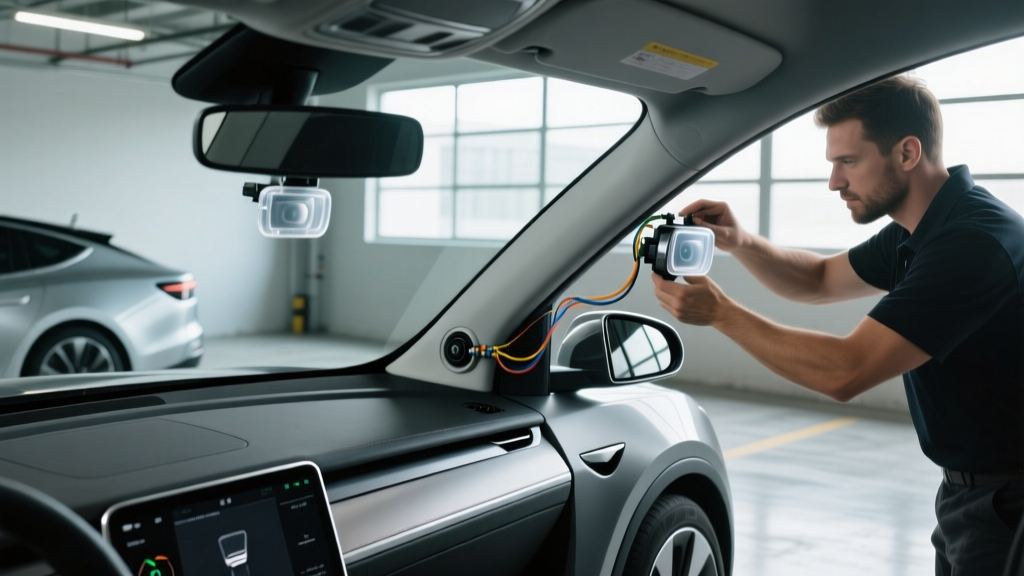
| Camera-based (mirror-integrated) | Wide-angle cameras on mirror housings | Visual only, ~30 ft | $250–$600 | Complex — mirror replacement, A-pillar wiring |
| OBD-II plug-in (warning only) | Uses existing OEM sensors if present | Varies by OEM hardware | $80–$200 (device) | Simple — but only works if hardware is pre-installed |
The radar-based aftermarket systems from brands like Echomaster, Brandmotion, and RoadRover offer the closest approximation of factory BSM performance. These use 77 GHz radar modules mounted behind the rear bumper (no drilling required) and connect to mirror-mounted LED indicators and the vehicle's CAN bus for turn signal integration.
EV-Specific Aftermarket Concerns
When installing aftermarket BSM on an EV or PHEV, several factors require attention:
- High-voltage cable routing: EV rear subframes often carry high-voltage DC cabling to the rear motor (in dual-motor/AWD configurations). Aftermarket installers unfamiliar with EV architecture may inadvertently route sensor wiring near HV lines, creating electromagnetic interference or, worse, a safety hazard. Insist that your installer has documented EV experience.
- 12V battery tap: Aftermarket BSM systems draw power from the 12V auxiliary battery, not the high-voltage traction pack. Ensure the installer uses a fused connection at the 12V distribution block, not a splice into random wiring.
- OTA update conflicts: Tesla, Rivian, Ford (with SYNC 4A OTA), and Hyundai/Kia all push over-the-air updates that can modify CAN bus signaling. An aftermarket BSM system that reads turn signal state from the CAN bus may break after an OTA update changes message IDs. Systems that hardwire into the turn signal circuit at the mirror are more resilient.
- Bumper material: Many EVs use plastic bumper covers that are radar-transparent, allowing behind-the-fascia mounting. However, some models incorporate radar-absorbing paint, metallic trim, or embedded heating elements (for de-icing) that can interfere with aftermarket radar. Check with the kit manufacturer for vehicle-specific compatibility.
- Warranty implications: The Magnuson-Moss Warranty Act protects your right to add aftermarket accessories without voiding your vehicle warranty. However, if an aftermarket BSM installation causes electrical damage (e.g., a short that damages a body control module), the repair for that specific damage may not be covered. Document the installation thoroughly.
- Integrate with factory lane-keeping or active steering systems — it will not steer the car away from a blind-spot vehicle
- Display warnings on the OEM instrument cluster or infotainment screen (warnings are limited to the aftermarket LED indicators)
- Match the detection range, accuracy, or false-positive rejection of factory-calibrated radar systems
- Function reliably at speeds below ~15–20 mph (most systems filter out low-speed detections to avoid false alerts from parked cars and pedestrians)
- Detect motorcycles, bicycles, or pedestrians reliably — most aftermarket radar systems are tuned for passenger-vehicle-sized targets
Cost Breakdown: How Much Does Adding BSM Actually Cost?
The total cost to add blind spot monitoring depends on your chosen path. Here's what to budget for in 2025–2026:
| Method | Parts Cost | Labor / Installation | Total Range | Warranty |
|---|---|---|---|---|
| OEM dealer retrofit (e.g., Hyundai, Kia, Ford) | $350–$600 | $200–$350 | $550–$950 | OEM accessory warranty (12 mo / 12,000 mi typical) |
| Tesla software unlock (if applicable) | $0 (included) | $0 | $0 | N/A — built into base software |
| Aftermarket radar BSM (77 GHz) | $250–$500 | $150–$400 | $400–$900 | Aftermarket kit warranty (1–2 years) |
| Aftermarket ultrasonic BSM | $80–$200 | $75–$150 | $155–$350 | Aftermarket kit warranty (1 year) |
| Camera-based mirror replacement | $150–$400 | $100–$200 | $250–$600 | Aftermarket (1 year) |
For context, factory-installed BSM typically adds $300–$600 to a vehicle's MSRP when bundled in a driver-assistance package. If you're shopping for a new EV, the most cost-effective strategy is to select a trim that includes BSM from the factory rather than retrofitting later. The Hyundai IONIQ 5 SEL ($46,650 MSRP for 2025) includes BSM standard, while the SE ($42,600) does not — a $4,050 trim step that also adds a power liftgate, heated rear seats, and a larger infotainment screen, making the factory path clearly superior to a $600–$850 aftermarket retrofit on the SE.
Real-World Limitations: When BSM Struggles
Blind spot monitoring is one of the most reliable and well-proven ADAS features — the Insurance Institute for Highway Safety (IIHS) has documented that BSM reduces lane-change crashes by approximately 14%. However, every system has operational boundaries that EV owners should understand:
Weather and Environmental Limitations
- Heavy rain and snow: Radar-based BSM can experience reduced detection range in heavy precipitation. Water film on the bumper fascia scatters radar energy. Camera-based systems (Tesla Vision) degrade more severely — Tesla's owner manual explicitly notes reduced performance in rain, fog, and snow.
- Ice and road salt buildup: Winter driving causes salt and slush accumulation on rear bumper surfaces. Radar systems may issue a "sensor blocked" warning and temporarily disable. Keep the rear bumper clean in winter conditions.
- Extreme heat: Radar sensors operate reliably up to approximately 185°F (85°C) ambient. Desert summer conditions do not typically affect BSM, but direct sun on dark bumper surfaces can approach thermal limits in stationary traffic.
Traffic and Road-Geometry Edge Cases
- Curved roads: On tight curves (radius under ~500 feet), BSM may falsely detect guardrails, barriers, or vehicles in non-adjacent lanes. Expect occasional false positives on mountain roads and highway cloverleafs.
- Stopped/slow traffic: Most BSM systems deactivate below 15–20 mph to avoid constant alerts from stationary objects and pedestrians. If you're lane-changing in gridlock, BSM will not help.
- Motorcycles and narrow vehicles: The radar cross-section of a motorcycle is significantly smaller than a passenger car. Both OEM and aftermarket systems have higher miss rates for motorcycles. The National Highway Traffic Safety Administration (NHTSA) notes that drivers should never rely solely on BSM for lane-change decisions.
- Wide loads and trailers: Towing a trailer or carrying a wide load changes the vehicle's detection geometry. Most OEM BSM systems do not compensate for trailer width; some (like Ford's Pro Trailer Backup Assist ecosystem) offer trailer-length compensation, but only when the trailer is configured in the vehicle's settings.
Brand-by-Brand BSM Naming and Availability
Every automarket brands their blind spot system differently. Here's a reference for the major EV and PHEV manufacturers:
| Brand | Feature Name | Standard On (2025–2026 EVs/PHEVs) | Not Available On |
|---|---|---|---|
| Tesla | Blind Spot Monitoring (via Tesla Vision) | All trims (Model 3, Y, S, X) | None — included in base software |
| Hyundai | Blind-Spot Collision-Avoidance Assist (BCA) | IONIQ 5 SEL+, IONIQ 6 SEL+ | IONIQ 5 SE (base) |
| Kia | Blind-Spot Collision-Avoidance Assist | EV6 Wind+, EV9 all trims | EV6 Light (base) |
| Ford | BLIS (Blind Spot Information System) | Mustang Mach-E Premium+, F-150 Lightning Lariat+ | Mach-E Select (some years) |
| Chevrolet | Side Blind Zone Alert | Equinox EV RS, Blazer EV all trims, Silverado EV WT+ | Equinox EV LT (base, some years) |
| Toyota | Blind Spot Monitor (BSM) via TSS 3.0 | bZ4X all trims, Prius Prime all trims | None (standard across lineup) |
| BMW | Active Blind Spot Detection | i4 eDrive40+, iX all trims | i4 eDrive35 (base, if equipped without Driving Assistance Package) |
| Mercedes-Benz | Active Blind Spot Assist | EQE, EQS all trims | None (standard on EV lineup) |
| Rivian | Blind Spot Warning | R1T, R1S all trims (via OTA updates) | None |
Should You Add BSM or Just Upgrade Your Trim?
For most EV shoppers still in the buying phase, selecting a trim that includes blind spot monitoring from the factory is the most sensible approach. You get full integration with the instrument cluster, mirror indicators designed for the vehicle's aesthetics, CAN bus compatibility guaranteed through OTA updates, and OEM warranty coverage.
For current owners of base-trim EVs, the decision depends on your vehicle:
- If your OEM offers a dealer retrofit (Hyundai, Kia, Ford on certain model years): This is the recommended path. The cost ($550–$950) is reasonable, the integration is clean, and the warranty is intact.
- If you drive a Tesla: Check your Autopilot settings — BSM is likely already present and just needs to be enabled. No purchase necessary.
- If no OEM path exists: A quality aftermarket 77 GHz radar system ($400–$900 installed) provides meaningful safety benefit, but choose an EV-experienced installer and verify bumper compatibility before committing.
- If you plan to trade in within 1–2 years: The cost of adding BSM is unlikely to be recouped at resale. Factor this into your decision; you may be better served by simply being more diligent with mirror checks until your next vehicle, which should include BSM as standard equipment.
Frequently Asked Questions
Can blind spot monitoring be added to any car?
Technically, yes — aftermarket BSM kits can be installed on virtually any vehicle with a rear bumper. However, the quality of integration varies. Vehicles with pre-routed wiring harnesses (many Hyundai, Kia, and Ford models) support clean OEM retrofits. Vehicles without pre-existing sensor infrastructure require more invasive aftermarket installations with separate LED indicators and custom wiring.
Does adding aftermarket BSM void my EV warranty?
Under the federal Magnuson-Moss Warranty Act, a dealer cannot void your entire vehicle warranty simply because you added an aftermarket accessory. However, if the aftermarket installation directly causes damage to a vehicle system (e.g., an electrical short that damages a body control module), that specific repair may not be covered under warranty. The burden of proof is on the manufacturer to demonstrate the aftermarket part caused the failure.
Is Tesla's blind spot monitoring as good as radar-based systems?
Tesla's camera-based BSM (Tesla Vision) performs comparably to radar-based systems in clear conditions but has documented limitations in heavy rain, fog, snow, and low-light scenarios where cameras struggle. Radar-based BSM systems from traditional OEMs maintain more consistent performance in adverse weather because millimeter-wave radar penetrates precipitation and does not rely on visible light. Independent testing by Consumer Reports and IIHS has found Tesla Vision BSM to have a slightly higher false-negative rate for motorcycles and a higher false-positive rate in heavy rain compared to radar-based competitors.
How do I know if my car already has blind spot monitoring hardware?
Check your owner's manual or vehicle settings menu first. For EVs with companion apps (Tesla, Rivian, Ford, Hyundai), check the driver-assistance settings in the app or on the vehicle's touchscreen. Physically, radar-based BSM sensors are typically visible as small rectangular modules behind the rear bumper cover (not visible externally) or as small circular indentations in the bumper. Camera-based systems have visible camera lenses on the side mirror housings or rear quarter panels. Your dealer's parts department can also look up your VIN to confirm factory-installed equipment.
What's the difference between blind spot monitoring and rear cross-traffic alert?
Blind spot monitoring operates while driving forward, scanning adjacent lanes for vehicles in your blind zones. Rear cross-traffic alert (RCTA) activates when the vehicle is in reverse, scanning laterally behind the car for crossing vehicles, cyclists, or pedestrians — useful when backing out of a parking space. Many OEM packages bundle both features together because they share the same rear radar sensors, but they serve different driving scenarios. If you're retrofitting, confirm whether the kit includes RCTA functionality or BSM only.